Nesta página
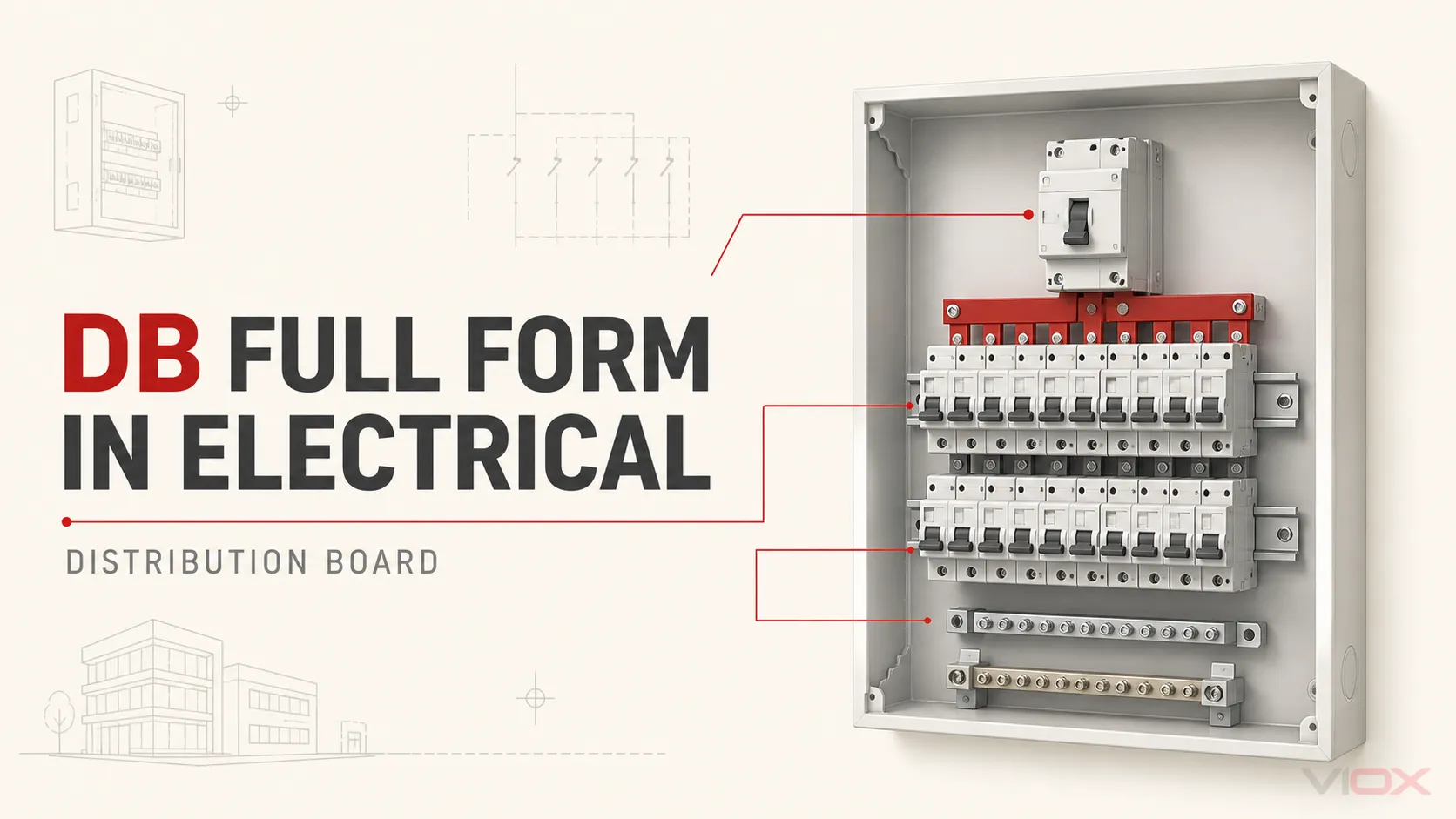
O A forma completa de DB em eletricidade é Quadro de Distribuição. Um quadro de distribuição recebe energia elétrica através de um ou mais circuitos de entrada e distribui-a para múltiplos circuitos de saída através de dispositivos de comutação e proteção alojados num conjunto comum.
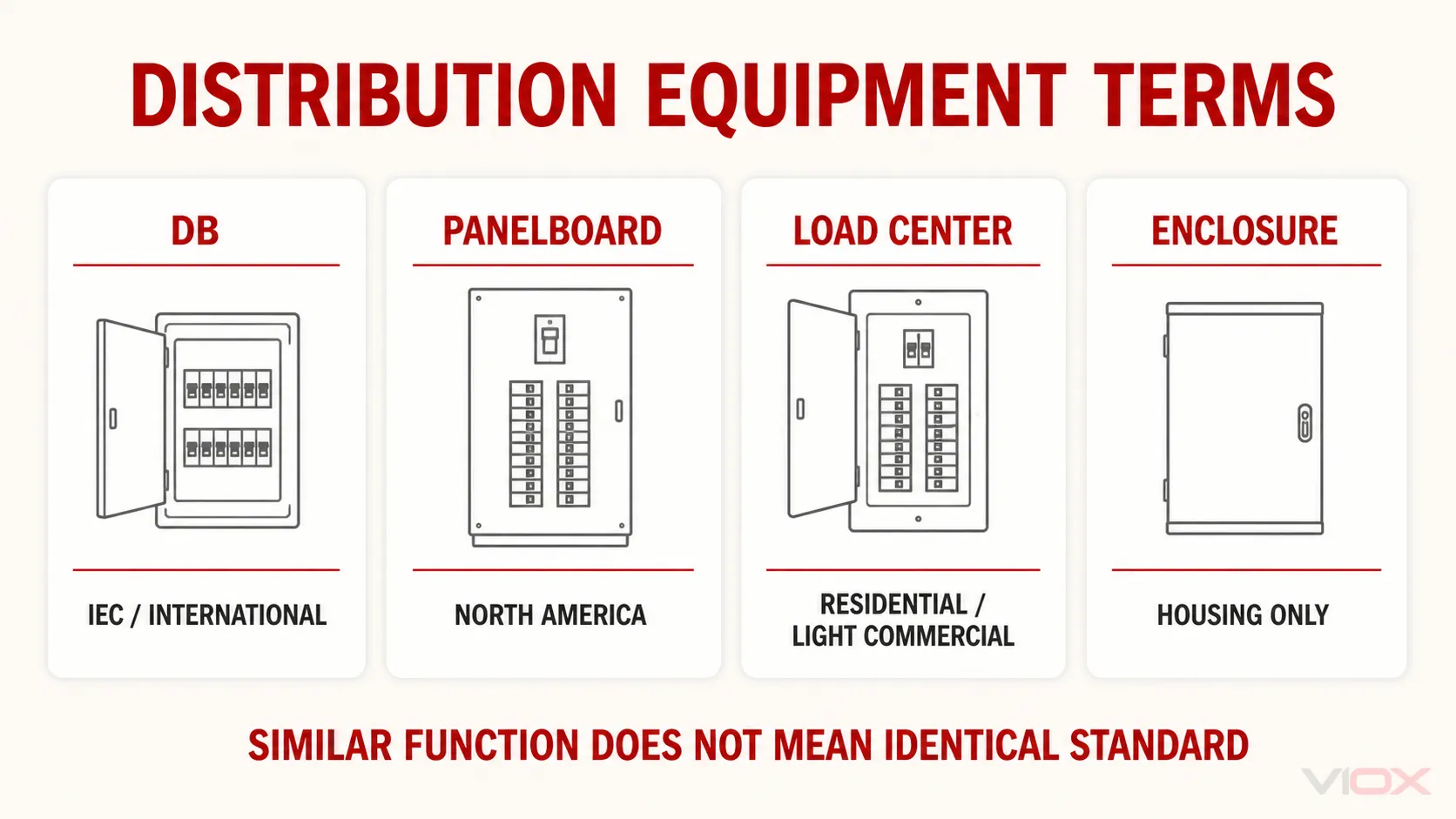
Dependendo do país e da aplicação, equipamentos semelhantes podem ser chamados de painel de distribuição, painel de disjuntores, quadro de luz, unidade consumidora, centro de carga ou caixa de distribuição. Estes termos sobrepõem-se, mas nem sempre são tecnicamente intercambiáveis, uma vez que as normas de produto, classificações, construção e quem pode operar o equipamento podem diferir.
| Errada | Resposta direta |
|---|---|
| Forma completa de DB | Quadro de distribuição |
| Propósito principal | Dividir uma alimentação de entrada em circuitos de saída protegidos |
| Dispositivos de proteção típicos | MCBs, MCCBs, RCCBs, RCBOs, fusíveis ou dispositivos específicos para a aplicação |
| Caminho principal da corrente | Dispositivo de entrada para barramento/conjunto de painel para dispositivos de saída |
| Conexões de neutro e terra | Barramento de neutro e barramento de proteção (terra) conforme exigido pelo projeto do sistema |
| Norma reguladora | Depende do mercado e do tipo de montagem; a IEC 61439 é central nos mercados IEC |
O que é um Quadro de Distribuição?
A Electropedia da IEC define um quadro de distribuição como um conjunto contendo manobra e comando associados a um ou mais circuitos de saída alimentados por um ou mais circuitos de entrada, juntamente com terminais para condutores de fase, neutro, ponto médio e proteção, conforme aplicável.
Em termos práticos, um quadro de distribuição cria um limite organizado entre a alimentação de entrada e os circuitos derivados. Ele fornece:
- uma conexão de entrada controlada;
- proteção contra sobrecorrente e corrente residual quando exigido;
- distribuição por barramento para dispositivos de derivação;
- terminação de condutores e identificação de circuitos;
- um invólucro que limita o acesso a partes vivas;
- um ponto de serviço para testes, seccionamento e manutenção.
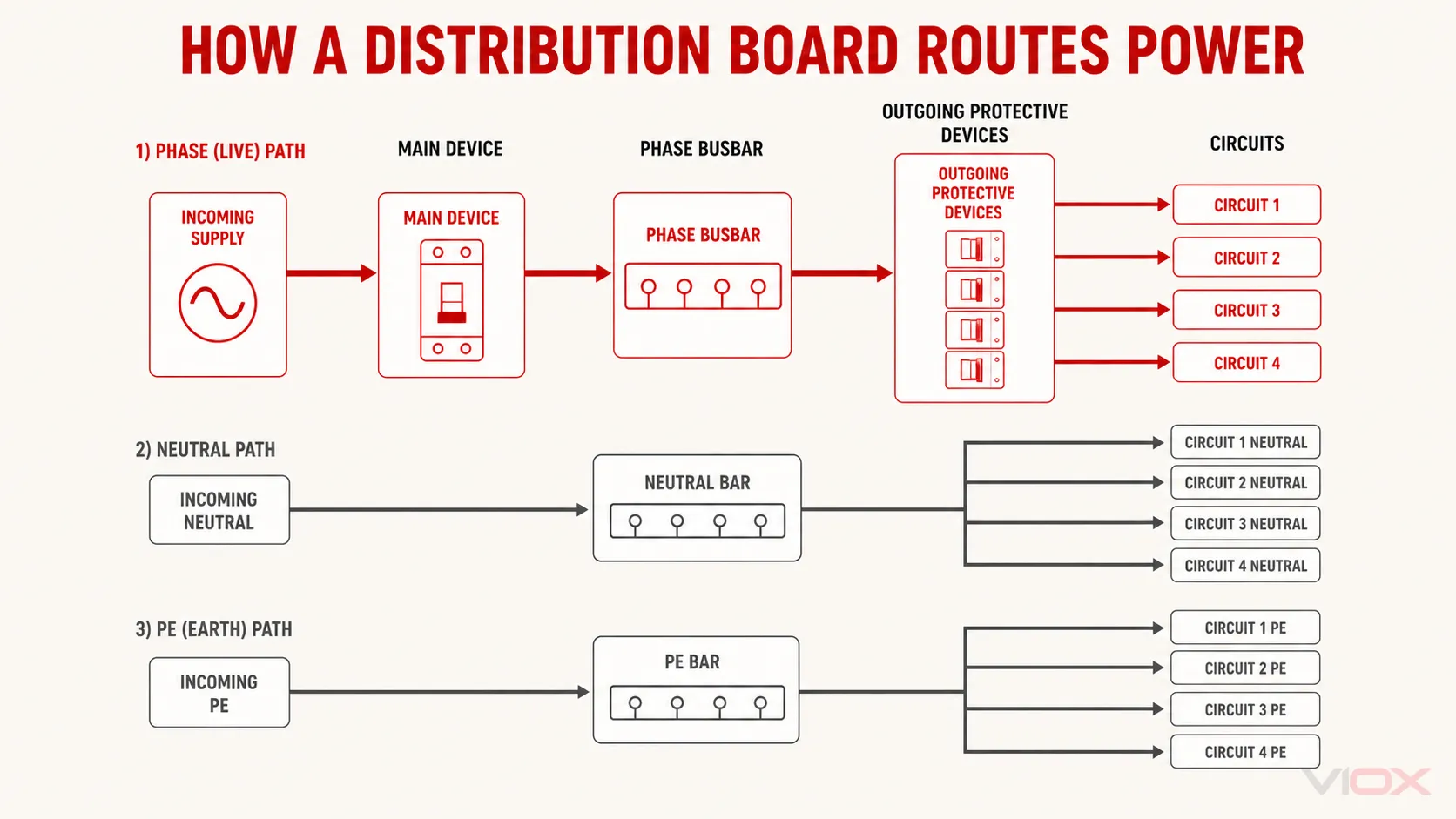
Componentes Principais Dentro de um Quadro de Distribuição
| Componente | Função | Verificação importante |
|---|---|---|
| Invólucro | Aloja e protege o conjunto | Material, grau de proteção IP, impacto, calor, acesso, ambiente de instalação |
| Interruptor principal, seccionador ou disjuntor | Controla a alimentação de entrada | Corrente, polos, função de comutação/seccionamento, capacidade de curto-circuito |
| Barramento ou conjunto de distribuição | Distribui energia para os dispositivos de derivação | Corrente nominal, compatibilidade de dispositivos, elevação de temperatura, resistência a curto-circuito |
| Dispositivos de proteção de saída | Proteção de circuitos derivados e cargas | Norma do dispositivo, corrente, curva, capacidade de interrupção, tipo de corrente residual quando aplicável |
| Barra neutra | Terminação de condutores neutros | Disposição do sistema de aterramento, agrupamento de circuitos, capacidade de corrente |
| Barramento de PE/aterramento | Termina condutores de proteção | Equipotencialização, capacidade do condutor, separação do neutro quando exigido |
| Trilho DIN ou sistema de montagem | Suporte para dispositivos modulares | Compatibilidade, espaçamento, retenção mecânica |
| Etiquetas e cronograma de circuitos | Identifica circuitos e capacidades nominais | Durabilidade, precisão, atualização após modificação |
Para uma análise mais detalhada do layout interno, utilize o VIOX Caixa de distribuição e guia de seleção.
Tipos de Quadros de Distribuição
Quadro Geral de Baixa Tensão (QGBT)
O QGBT recebe uma alimentação principal de baixa tensão e alimenta quadros de subdistribuição ou grandes cargas de saída. Normalmente, possui requisitos de corrente e capacidade de curto-circuito superiores aos quadros a jusante.
Quadro de Subdistribuição (SDB)
Um SDB recebe um alimentador de um quadro a montante e distribui energia dentro de um andar, zona, área de processo ou seção de um edifício.
Quadro de Distribuição Final
Um quadro de distribuição final alimenta circuitos terminais, tais como iluminação, tomadas, equipamentos de AVAC ou pequenas máquinas.
Quadro de Distribuição TP&N (Trifásico e Neutro)
Um quadro trifásico com neutro suporta distribuição de entrada trifásica e circuitos de saída monofásicos ou trifásicos, de acordo com o seu projeto. A VIOX explica este formato em O que é um Quadro de Distribuição Metálico TP&N?.
Quadros de Distribuição de CA e CC
Quadros de CA e CC requerem dispositivos de proteção e manobra diferentes. Em sistemas fotovoltaicos, ACDB e DCDB são termos comuns de projeto. O comportamento da tensão, polaridade, interrupção de arco e as especificações dos componentes não devem ser misturados.
DB vs Quadro de Distribuição vs Painel Elétrico vs Quadro de Consumidor
| Prazo | Uso típico | Limite a ser lembrado |
|---|---|---|
| Quadro de distribuição (DB) | Termo amplo da IEC e internacional | O escopo da montagem varia de circuitos finais a distribuições maiores |
| Caixa de distribuição | Frequentemente equipamentos de distribuição fechados de menor porte | Pode ser usado de forma genérica no marketing; verifique as especificações da montagem |
| Quadro de distribuição | Termo comum norte-americano | A estrutura do produto e da instalação difere da terminologia de quadros de distribuição (DB) da IEC |
| Centro de carga | Produto comum para aplicações residenciais/comerciais leves na América do Norte | Não é um sinônimo universal para todos os quadros de distribuição |
| Quadro de distribuição residencial | Termo britânico para um tipo específico de quadro de distribuição doméstico | Construção e requisitos específicos de mercado |
| Invólucro elétrico | Invólucro vazio ou equipado | Um invólucro por si só não é um quadro de distribuição |
Veja Invólucro Elétrico vs Caixa de Distribuição vs Quadro de Distribuição para uma comparação terminológica focada, e Centro de Carga vs. Quadro de Distribuição para a fronteira NEMA/IEC.
Qual norma se aplica a um quadro de distribuição?
A norma correta depende do mercado, dos usuários, da tensão, da corrente e da categoria do conjunto.
Nos mercados IEC, IEC 61439-1 fornece regras gerais para conjuntos de manobra e comando de baixa tensão e é utilizada em conjunto com a parte aplicável do conjunto. IEC 61439-3:2024 define requisitos específicos para quadros de distribuição destinados a serem operados por pessoas comuns (DBO) dentro do seu escopo declarado. Conjuntos de manobra e comando de baixa tensão industriais podem, em vez disso, enquadrar-se em IEC 61439-2.
Portanto, dizer “em conformidade com a IEC 61439” sem nomear a parte aplicável, a responsabilidade pelo conjunto, a evidência de verificação e a configuração do produto é incompleto.
Equipamentos norte-americanos podem usar terminologia UL e NEC, como "panelboard" e "load center". Não transfira uma descrição de produto IEC diretamente para uma especificação norte-americana sem verificar as regras de produto e instalação aplicáveis.
Como selecionar um quadro de distribuição
1. Definir a alimentação
Registre CA ou CC, tensão nominal, frequência, fase, disposição do neutro, sistema de aterramento e dispositivo de entrada.
2. Calcular a carga e a diversidade
Determine a corrente de projeto, a carga simultânea, os circuitos futuros e o equilíbrio de fases. A corrente nominal do quadro não substitui os cálculos de condutores e circuitos.
3. Determinar a capacidade de interrupção de curto-circuito
Estabelecer a corrente de curto-circuito presumida no quadro. Verificar o conjunto e os dispositivos instalados utilizando as características nominais de curto-circuito aplicáveis e o método de coordenação.
4. Definir a arquitetura de proteção
Selecionar a proteção contra sobrecorrente e corrente residual de acordo com o tipo de circuito, cabo, carga, requisitos de seccionamento e normas aplicáveis. Evitar a adição de dispositivos apenas por hábito.
5. Escolher o invólucro
Considerar a localização interior/exterior, poeira, água, corrosão, impacto, temperatura, condensação e acessibilidade.
6. Verificar o espaço e o calor
Prever a curvatura dos condutores, terminais, circuitos de reserva, agrupamento de dispositivos, dissipação de potência, ventilação e acesso para manutenção. Um quadro fisicamente maior pode ser mais seguro e fácil de manter do que um quadro densamente ocupado.
Verificar a montagem completa
Confirmar a compatibilidade do fabricante, corrente nominal, verificação de elevação de temperatura, propriedades dielétricas, resistência a curto-circuito, continuidade do circuito de proteção, distâncias de isolamento, distâncias de escoamento e marcações, conforme aplicável.
Erros comuns em quadros de distribuição
Selecionar apenas pelo número de vias
Um quadro de 12 vias não é definido apenas pela contagem de circuitos. A corrente, o nível de falha, o formato do dispositivo, as fases, o invólucro e as normas são importantes.
Misturar famílias de dispositivos sem aprovação
O encaixe mecânico em um trilho DIN não comprova a compatibilidade do barramento, o alinhamento dos terminais, o desempenho térmico ou a verificação da montagem.
Conectar o neutro e o terra no local incorreto
A ligação entre o neutro e a terra depende do esquema de alimentação e de aterramento. Uma ligação incorreta a jusante pode causar caminhos de corrente perigosos e o disparo de dispositivos de corrente residual (DR).
Ignorar o equilíbrio de fases
As cargas monofásicas devem ser distribuídas pelas fases de acordo com o projeto. Um desequilíbrio acentuado pode aumentar a corrente no neutro e o desequilíbrio de tensão.
Considerar a etiqueta da porta como a classificação nominal
A classificação do quadro refere-se a uma configuração de montagem definida. Substituições posteriores de dispositivos ou alterações na cablagem podem invalidar os pressupostos iniciais.
FAQ
Qual é o significado completo de DB em eletricidade?
DB significa Distribution Board (Quadro de Distribuição).
Qual é a função de um quadro de distribuição?
Recebe um ou mais circuitos elétricos de entrada e distribui energia para circuitos de saída protegidos.
Um quadro de distribuição (DB) é o mesmo que uma caixa de fusíveis?
Uma caixa de fusíveis é uma forma mais antiga ou baseada em fusíveis de equipamento de distribuição. Os quadros de distribuição modernos utilizam frequentemente disjuntores e dispositivos de corrente residual, mas a terminologia varia.
Qual é a diferença entre MDB e DB?
MDB significa Quadro de Distribuição Principal (Main Distribution Board) e identifica um quadro de nível superior que alimenta outros quadros ou cargas principais. DB é o termo mais abrangente.
Um quadro de distribuição é o mesmo que um painel elétrico (panelboard)?
Eles desempenham funções de distribuição semelhantes, mas "panelboard" é principalmente uma terminologia norte-americana com um quadro de normas diferente.
Qual norma IEC cobre quadros de distribuição?
A norma IEC 61439-1 é utilizada em conjunto com a parte específica aplicável ao conjunto. A norma IEC 61439-3:2024 aplica-se a quadros de distribuição destinados a serem operados por pessoas comuns dentro do seu âmbito.