Joe

Oi, eu sou o zé, um profissional dedicado, com 12 anos de experiência na indústria elétrica. Em VIOX Elétrico, o meu foco é no fornecimento de alta qualidade elétrica de soluções sob medida para atender as necessidades de nossos clientes. Minha experiência abrange automação industrial, fiação residencial, comercial e sistemas elétricos.Contacte-me [email protected] se vc tiver alguma dúvida.

Switchgear Retrofit vs. Refurbish vs. Replace: A Cost-Benefit Analysis Guide

Modernização, Remodelação ou Substituição de Quadros Elétricos: Um Guia de Análise Custo-Benefício

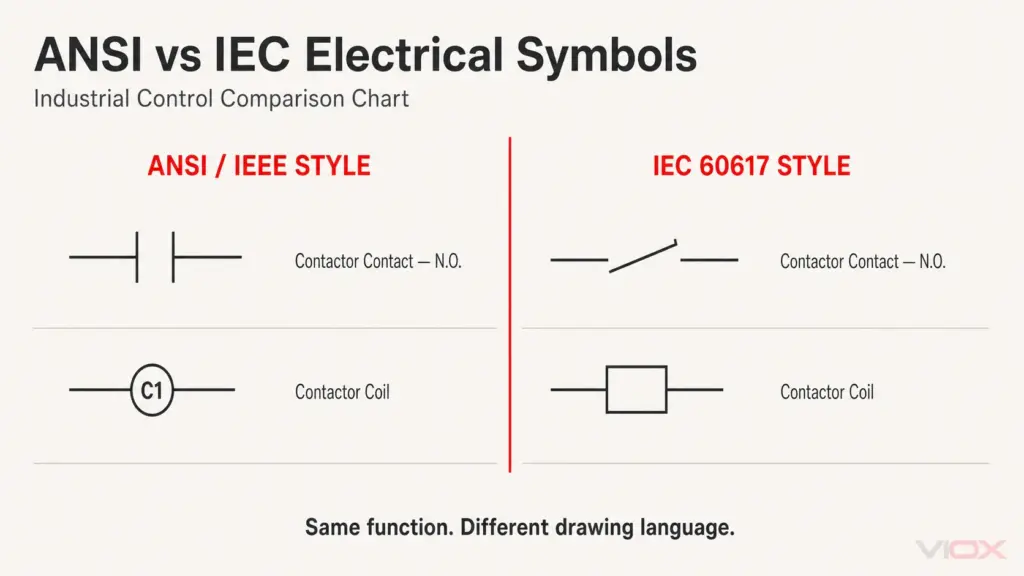
Modern medium-voltage switchgear installation showing VIOX Electric equipment in industrial facility Direct Answer When facing aging switchgear, facility managers have three primary options: retrofit (upgrading internal components like circuit breakers while keeping the existing structure), refurbish (comprehensive maintenance and repair of existing equipment), or complete replacement (removing old equipment and installing new systems). The optimal […]
Modernização, Remodelação ou Substituição de Quadros Elétricos: Um Guia de Análise Custo-Benefício Read More »

How to Build Your Electrical Maintenance Program

Como Construir o Seu Programa de Manutenção Elétrica

Figure 1: Professional electrician conducting thermographic inspection on industrial electrical panel with VIOX equipment to identify thermal anomalies. Direct Answer Building an electrical maintenance program requires five essential steps: (1) conducting a comprehensive equipment inventory and condition assessment, (2) establishing maintenance schedules based on NFPA 70B standards and manufacturer guidelines, (3) assigning qualified personnel and

Como Construir o Seu Programa de Manutenção Elétrica Read More »

4 Critical MCCB Specification Mistakes That Risk System Failure

4 Erros Críticos na Especificação de MCCBs que Arriscam a Falha do Sistema

Direct Answer The four critical MCCB specification mistakes that cause system failures are: (1) Ignoring temperature derating in high-heat environments (45-70°C), leading to nuisance tripping or failure to protect, (2) Inadequate IP rating and corrosion protection in coastal/humid locations, causing insulation breakdown and terminal oxidation, (3) Insufficient dust protection in industrial facilities, resulting in trip

4 Erros Críticos na Especificação de MCCBs que Arriscam a Falha do Sistema Read More »

Thermal Overload Relay vs. MPCB: What Is the Difference?

Relé de Sobrecarga Térmica vs. MPCB: Qual é a Diferença?

Direct Answer A thermal overload relay provides only overload protection for motors and must be paired with a separate circuit breaker for short-circuit protection, while a Motor Protection Circuit Breaker (MPCB) is an integrated device that combines overload protection, short-circuit protection, and often phase failure detection in a single compact unit. The key difference lies

Relé de Sobrecarga Térmica vs. MPCB: Qual é a Diferença? Read More »

Different Types of Motor Starters: A Complete Guide for Industrial Applications

Diferentes Tipos de Arranque de Motor: Um Guia Completo para Aplicações Industriais

Direct Answer: Motor starters are electrical devices that safely start, stop, and protect electric motors from damage. The five main types are Direct-On-Line (DOL) starters, Star-Delta starters, Soft Starters, Variable Frequency Drives (VFDs), and Auto-Transformer starters. Each type serves specific applications based on motor size, starting current requirements, and operational needs. DOL starters suit motors

Diferentes Tipos de Arranque de Motor: Um Guia Completo para Aplicações Industriais Read More »

Crimping vs. Soldering: Why Solderless Connections Ensure Maximum Reliability

Crimpagem vs. Soldadura: Por que as Conexões Sem Solda Garantem Máxima Fiabilidade

Direct Answer Crimping delivers superior reliability over soldering in high-vibration, thermal cycling, and harsh-environment applications. While soldering creates a metallurgical bond through heat fusion, crimping establishes a gas-tight cold weld through mechanical compression—eliminating heat-affected zones, preventing solder embrittlement, and maintaining wire flexibility at stress points. Industry standards including SAE/USCAR-21, IEC 60352-2, and IPC/WHMA-A-620 mandate crimped

Crimpagem vs. Soldadura: Por que as Conexões Sem Solda Garantem Máxima Fiabilidade Read More »

MCCB Instantaneous Trip (Ii) Guide: 10In vs 12In for Motor & Distribution Protection

Guia de Disparo Instantâneo MCCB (Ii): 10In vs 12In para Proteção de Motor e Distribuição

Direct Answer For MCCB instantaneous trip settings, use 10In for distribution loads (lighting, receptacles, mixed circuits) and 12In for motor loads with direct-on-line starting. The instantaneous trip multiplier determines the current threshold at which your breaker trips immediately without delay. Setting it too low causes nuisance tripping during motor startup; setting it too high compromises

Guia de Disparo Instantâneo MCCB (Ii): 10In vs 12In para Proteção de Motor e Distribuição Read More »

Magnetic Blowout vs. Vacuum vs. SF6: The Physics of Arc Extinction Explained

Sopro Magnético vs. Vácuo vs. SF6: A Física da Extinção de Arco Explicada

Direct Answer Magnetic blowout, vacuum, and SF6 represent three fundamentally different approaches to arc extinction in circuit breakers. Magnetic blowout uses electromagnetic force to physically stretch and cool arcs in air (common in MCCBs and ACBs up to 6.3kA), vacuum technology eliminates the ionization medium entirely for rapid extinction in 3-8ms (ideal for 3-40.5kV systems),

Sopro Magnético vs. Vácuo vs. SF6: A Física da Extinção de Arco Explicada Read More »

Voltage vs. Current: Calculating Line Loss and Voltage Drop in Electrical Systems

Tensão vs. Corrente: Cálculo da Perda de Linha e Queda de Tensão em Sistemas Elétricos

Direct Answer When you halve the distribution voltage while maintaining the same power output, the current doubles, and line losses increase by a factor of four. This occurs because power loss in conductors follows the I²R formula, where losses are proportional to the square of the current. For example, reducing voltage from 400V to 200V

Tensão vs. Corrente: Cálculo da Perda de Linha e Queda de Tensão em Sistemas Elétricos Read More »

The Science of Passivation: Understanding How Chromium and Nickel Protect Stainless Steel Enclosures

A Ciência da Passivação: Entendendo como o Cromo e o Níquel Protegem as Caixas de Aço Inoxidável

Figure 1: A VIOX stainless steel enclosure demonstrating durability in a coastal industrial environment. Direct Answer: Why Stainless Steel Doesn’t Rust Stainless steel enclosures resist corrosion not because they are “noble” metals like gold or platinum, but through a dynamic protective mechanism called passivation. When stainless steel containing at least 12% chromium is exposed to

A Ciência da Passivação: Entendendo como o Cromo e o Níquel Protegem as Caixas de Aço Inoxidável Read More »

Pedir orçamento agora