The NEC 125% rule for continuous loads means that when a branch circuit or feeder supplies a obciążenie ciągłe, the overcurrent device and related circuit design have to account for that load at 125% of the continuous portion, unless a specific 100%-rated assembly exception applies.
In practical terms, if a load is expected to run at its maximum current for 3 godziny lub dłużej, the circuit usually is nie sized at exactly 100% of that current. The continuous portion is carried into the design with the 125% adjustment in mind.
This comes up constantly in breaker sizing, conductor sizing, EV charging, lighting, heating, and other long-duration loads because it changes what looks “big enough” on paper.
Kluczowe wnioski
- A obciążenie ciągłe under the NEC is generally a load expected to run at maximum current for 3 godziny lub dłużej.
- The common rule of thumb is: continuous load × 125%.
- This rule affects how branch circuits and feeders are sized.
- It matters for both breaker rating decisions oraz overall circuit design.
- One of the most common mistakes is applying the 125% rule to the wrong load portion or assuming it means the breaker is “oversized.”
- NEC readers usually need four section anchors to understand the topic properly: Article 100, 210.19(A)(1), 210.20(A)oraz 110.14(C).
Why Users Search the NEC 125% Rule
Most people searching this topic are usually trying to answer one of these practical questions:
- Why can’t I size the breaker exactly equal to the load?
- When does the NEC consider a load “continuous”?
- Does the 125% rule apply to breakers, conductors, or both?
- Why does a 48A EV charger often end up on a 60A breaker?
This is not really a “what does the code say?” query. It is a “what does the code mean for my breaker, conductor, or charger circuit?” query.
What the NEC Means by a Continuous Load
Under NEC terminology, Article 100 defines a continuous load as a load where the maximum current is expected to continue for 3 godziny lub dłużej.
That definition matters because a circuit that carries high current for a short period is not treated the same way as a circuit expected to stay loaded for extended operating time.
Typical continuous-load examples can include:
- commercial lighting circuits
- heating loads with long operating duration
- EV charging loads
- certain process loads
- equipment expected to run at rated current for long intervals
Not every load is continuous. The expected operating profile matters, and this is where field judgment starts to matter. In real projects, misclassification often happens when designers assume that a load is “continuous” just because it is important, or “noncontinuous” just because it cycles. The question is not importance. The question is expected maximum-current duration.
What the NEC 125% Rule Says in Practice
The practical rule electricians and designers use is:
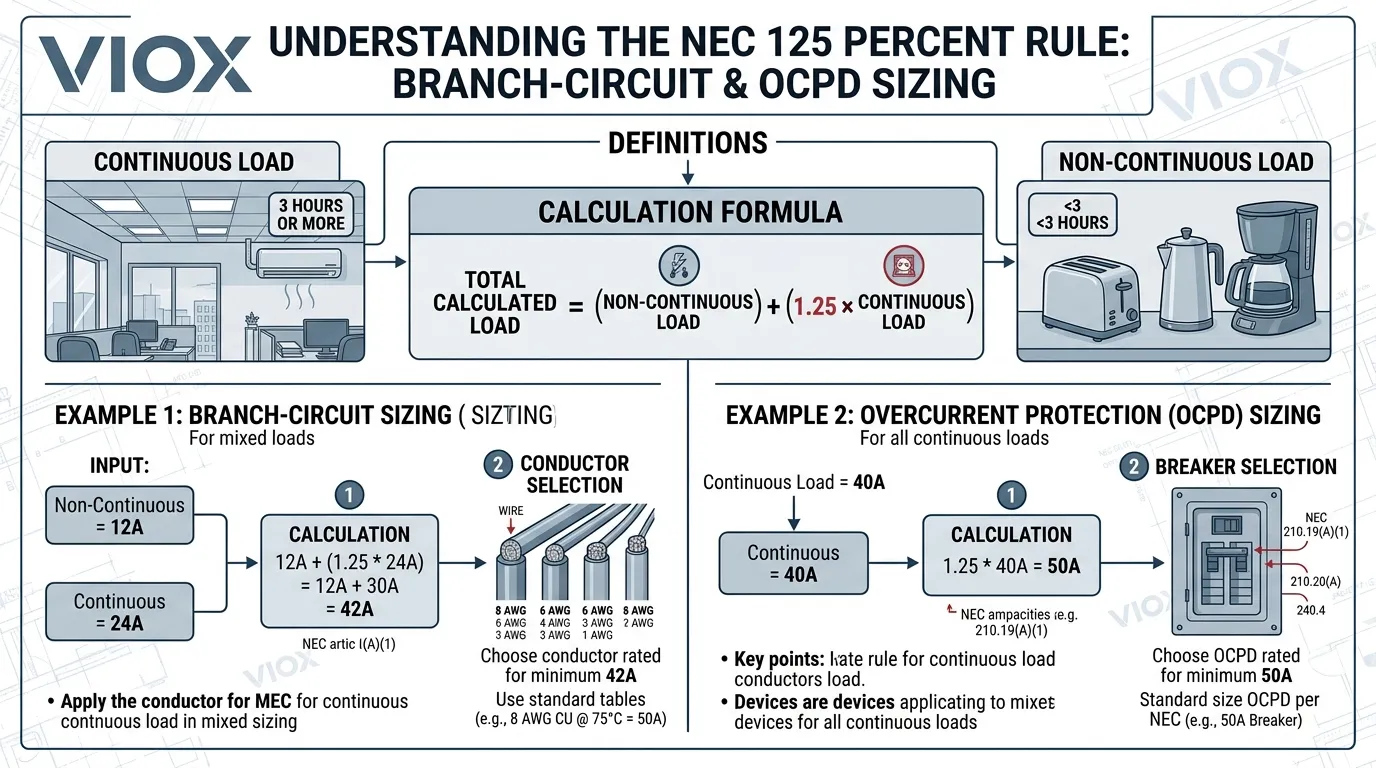
Overcurrent device rating must not be less than the noncontinuous load plus 125% of the continuous load.
For branch circuits, that logic is reflected in NEC 210.20(A). On the conductor side, the same continuous-load logic is tied to NEC 210.19(A)(1) for branch-circuit conductors and NEC 215.2(A)(1) / 215.3 for feeder design context.
In plain English:
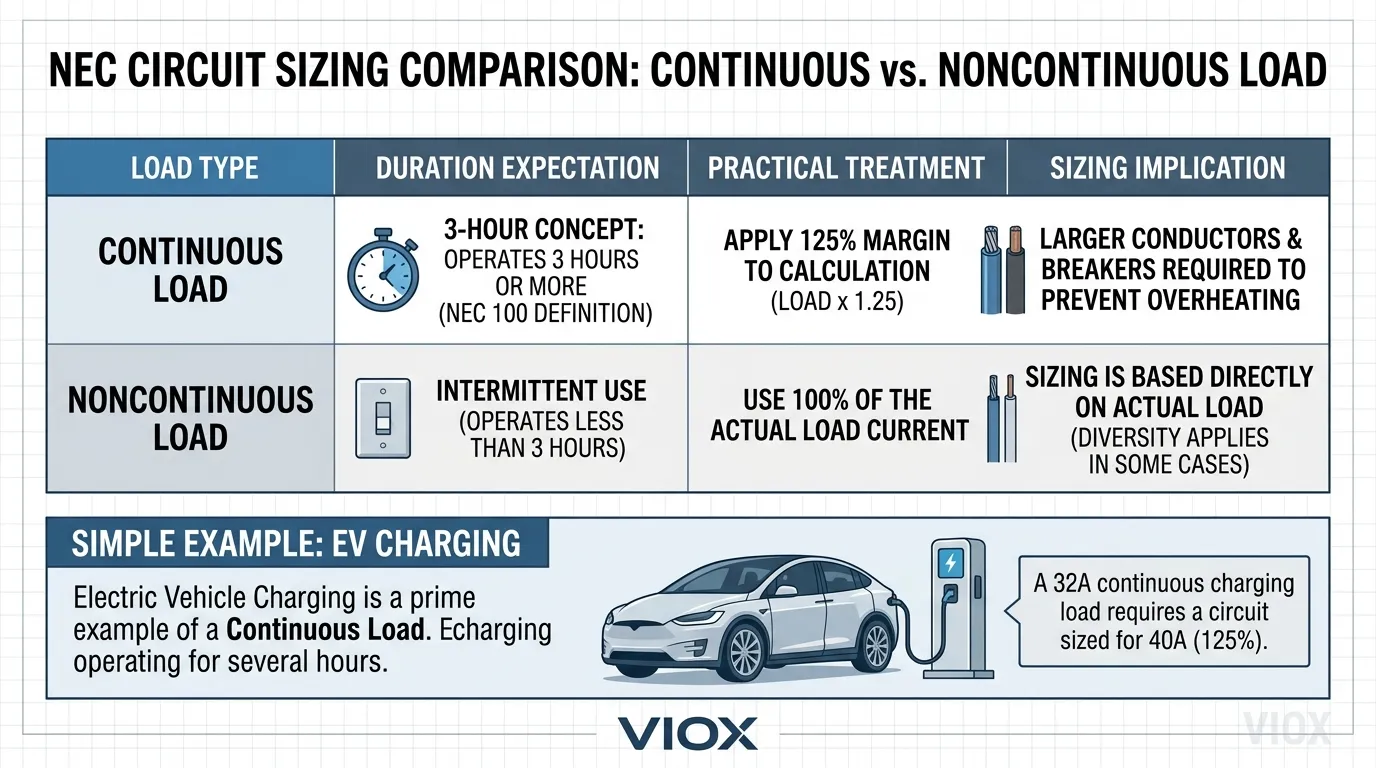
- if a load is noncontinuous, it is generally counted at 100%
- if a load is continuous, it is generally counted at 125%
That is why the rule is so often discussed in connection with breaker sizing, even though the real design conversation is broader than the breaker alone.
The Core Formula
For mixed loads:
Required circuit basis = noncontinuous load + (continuous load × 125%)
For a purely continuous load:
Required circuit basis = continuous load × 125%
Example 1: A Simple Continuous Load
If a load is 40A continuous, then:
40A × 125% = 50A
That means the circuit design cannot usually be based on a 40A breaker if the load is truly continuous at 40A. The design basis becomes 50A.
Example 2: Mixed Load
If a circuit supplies:
- 16A noncontinuous
- 24A continuous
Następnie:
16A + (24A × 125%) = 16A + 30A = 46A
That means the circuit basis becomes 46A, not 40A.
Example 3: Why EV Charging Often Comes Up
EV charging is one of the most common modern examples because EV loads are often treated as continuous.
If a charger has a continuous output current of 48A, the sizing basis commonly becomes:
48A × 125% = 60A
That is why 48A charging equipment is often associated with a 60A branch-circuit rating in NEC-based discussions. In practice, this is one of the most common places where electricians first meet the 125% rule in a memorable way.
For adjacent application context, see EV Charger Circuit Breaker Sizing Guide.
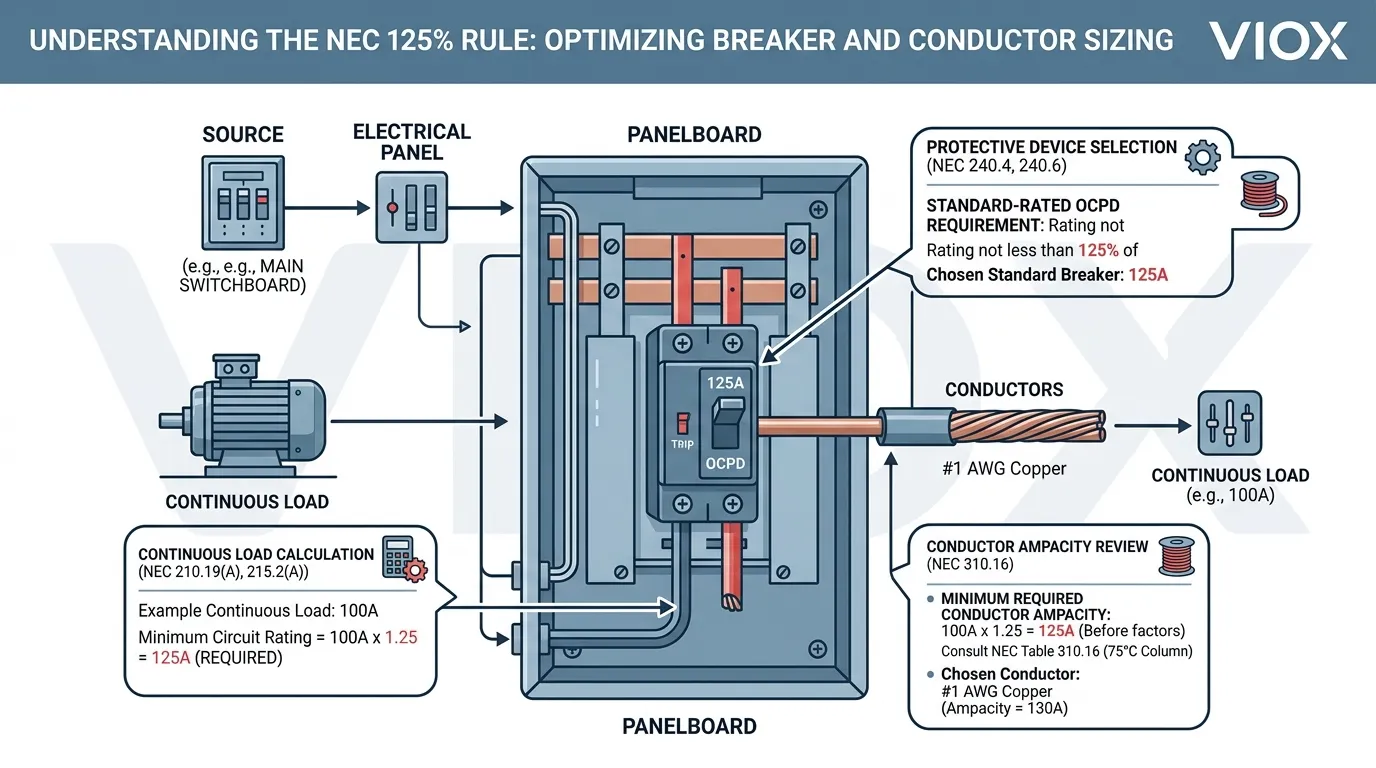
Breaker Sizing vs Conductor Sizing
This is where many articles become too vague.
Users often ask “Does the 125% rule apply to the breaker or the wire?” The practical answer is: it affects the circuit design logic, and both breaker and conductor decisions need to be checked in the correct NEC context.
Breaker side
For branch circuits supplying continuous loads, the overcurrent device is commonly selected so it is not less than the required load basis. This is the part most directly associated with NEC 210.20(A).
Conductor side
Conductors also have to be evaluated so the ampacity supports the real design requirement under the applicable NEC rules and installation conditions. This is where NEC 210.19(A)(1) becomes important for branch circuits.
Dlaczego to ma znaczenie
A design can fail even if the breaker “looks right” on paper, if:
- the conductor ampacity is not adequate
- temperature correction changes the result
- bundled conductors affect ampacity
- the load profile was classified incorrectly
One detail that gets missed surprisingly often is terminal temperature rating. Under NEC 110.14(C), the allowable conductor ampacity at the termination can be limited by the temperature rating of the equipment terminals. In other words, even if the conductor insulation seems to support a higher ampacity elsewhere, the final usable ampacity at the breaker or terminal may still be governed by the termination rating. That is where real-world sizing gets less theoretical and more practical.
This is why the NEC 125% rule should never be treated as a one-line shortcut without checking the full circuit context.
The Terminal Temperature Rating Trap
On real jobs, one of the easiest mistakes is to stop at the breaker size and forget the termination.
When electricians talk through a continuous-load problem in the field, the conversation often goes like this:
- the load math points toward one conductor size
- the ambient correction pushes the calculation
- the bundling adjustment changes the ampacity
- and then the terminal temperature limitation becomes the final constraint
That last point is where NEC 110.14(C) quietly matters. If the breaker or equipment terminals are effectively governed by 60°C or 75°C termination limits, the usable conductor ampacity has to be evaluated on that basis. In practical design, this is one reason “the wire looked large enough” is not always the end of the discussion.
Where the Rule Shows Up Most Often
The NEC 125% rule becomes especially important in these situations:
- panel schedule and branch-circuit design
- feeder sizing
- commercial lighting systems
- HVAC-related continuous operation
- EV charging circuits
- industrial equipment with long-duty current draw
In design work, this is one of the most common reasons a selected breaker size ends up larger than a reader first expects.
Why the Rule Exists
The practical reason is simple: sustained current creates sustained heating.
Electrical equipment that carries current for long durations should not be treated the same way as equipment seeing short intermittent load peaks. The NEC 125% rule reflects the need to size the protective and distribution system appropriately for long-duration loading conditions.
It is not “extra margin for no reason.” It is part of how continuous operating duty is treated in NEC-based design.
The 100%-Rated Equipment Exception
This is where more advanced readers usually want precision.
There is an exception in NEC language for assemblies listed for 100% operation of their rating. In those cases, the standard 125% approach may not apply in the same way.
That exception is important, but it should not be treated casually. It depends on the assembly being specifically listed and applied correctly. For most everyday design discussions, the standard 125% rule remains the practical starting point.
Common Mistakes
Treating every load as continuous
Not every load qualifies as continuous under NEC. The expected operating profile matters.
Forgetting the 3-hour condition
The definition of continuous load is tied to expected operation at maximum current for 3 hours or more.
Applying 125% to the whole load when only part is continuous
If a circuit has both continuous and noncontinuous load, the continuous portion is treated differently from the noncontinuous portion.
Thinking the rule means the breaker is oversized
In NEC terms, the breaker is being selected to suit the continuous-duty condition. This is a design requirement, not casual oversizing.
Ignoring conductor and installation conditions
Breaker rating alone does not finish the sizing conversation.
Forgetting the terminal temperature limit
Even when the load math is done correctly, the final conductor decision can still be limited by the temperature rating of the termination under NEC 110.14(C).
Tabela szybkiego odniesienia
| Sytuacja | Practical NEC Treatment |
|---|---|
| Noncontinuous load only | Usually treated at 100% |
| Continuous load only | Usually treated at 125% |
| Mixed load | Noncontinuous load + 125% of continuous load |
| 100%-rated listed assembly | May follow exception conditions if properly listed and applied |
Practical Design Note for Breaker Selection
The NEC 125% rule often comes up when choosing between breaker families or deciding whether a branch circuit should move into a different device class.
For product context, VIOX already has supporting pages on MCB, MCCB, and the broader terminology differences in MCB, MCCB, RCB, RCD, RCCB, and RCBO.
Those pages do not replace NEC design review, but they help clarify device roles when the 125% rule pushes the design toward a different protection class.
Wnioski
The NEC 125% rule for continuous loads means that a continuous load is not usually sized at exactly 100% of its nominal current when selecting branch-circuit and feeder protection. Instead, the continuous portion is commonly treated at 125%, unless a specific 100%-rated equipment exception applies.
For most readers, the practical formula is:
noncontinuous load + (continuous load × 125%)
That is the key logic behind many breaker and conductor sizing decisions in NEC-based work. The short formula is easy to remember. The real skill is knowing when to connect it back to Article 100, 210.19(A)(1), 210.20(A), and 110.14(C) instead of treating it like an isolated rule.
FAQ
What is the NEC definition of a continuous load?
A continuous load is generally a load where the maximum current is expected to continue for 3 hours or more, as defined in NEC Article 100.
What is the NEC 125% rule in simple terms?
In simple terms, the continuous portion of the load is generally counted at 125% when sizing the circuit, unless a specific 100%-rated exception applies.
Does the 125% rule apply to breakers?
Yes. For branch circuits, that discussion is closely tied to NEC 210.20(A).
Does the 125% rule apply to conductors too?
It affects overall circuit design, which is why conductor sizing must also be reviewed under NEC 210.19(A)(1) and related feeder provisions, together with terminal temperature limits under NEC 110.14(C).
Why is a 48A EV charger often put on a 60A breaker?
Because EV charging is commonly treated as a continuous load in NEC-based design, and 48A × 125% = 60A.
Does every load get multiplied by 125%?
No. The 125% factor is tied to the continuous-load portion, not automatically to every load on every circuit.