
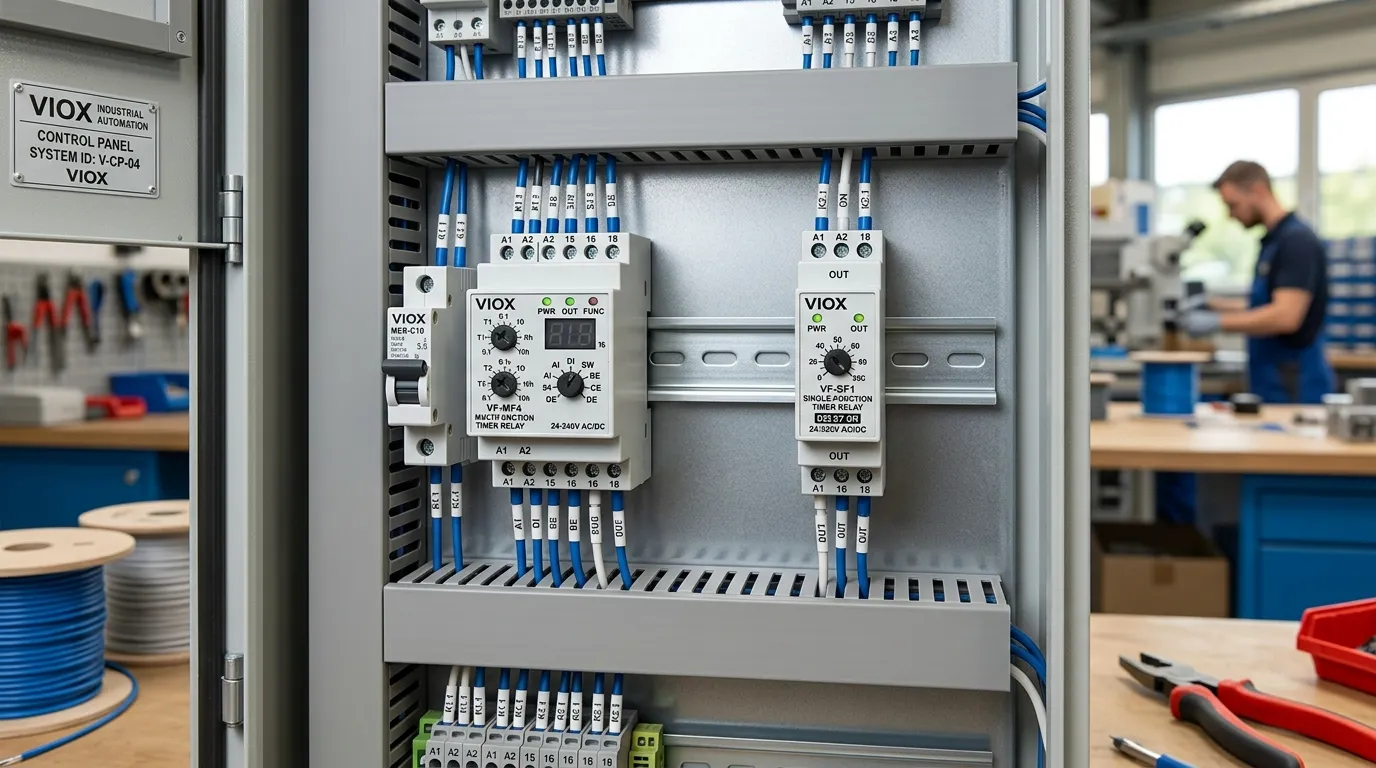
Direkte Antwort
Wählen Sie einen multifunction timer relay when one product needs to cover several timing modes, panel standardization matters, or you want flexibility during commissioning and future changes.
Wählen Sie einen single-function timer relay when the timing task is fixed, operator error must be minimized, troubleshooting needs to stay simple, or the project values one-purpose reliability over configurability.
This is not a question of which type is “better” in the abstract. It is a question of whether your application benefits more from flexibility oder simplicity. The right answer depends on the panel, the maintenance environment, and the project lifecycle — not on the relay’s feature count alone.
If you need broader background first, start with What Is a Time Relay? oder der Timer Relay product page. This timer relay comparison focuses specifically on the selection decision between multifunction and single-function types.
Quick Comparison Table: Multifunction vs Single-Function Timer Relay
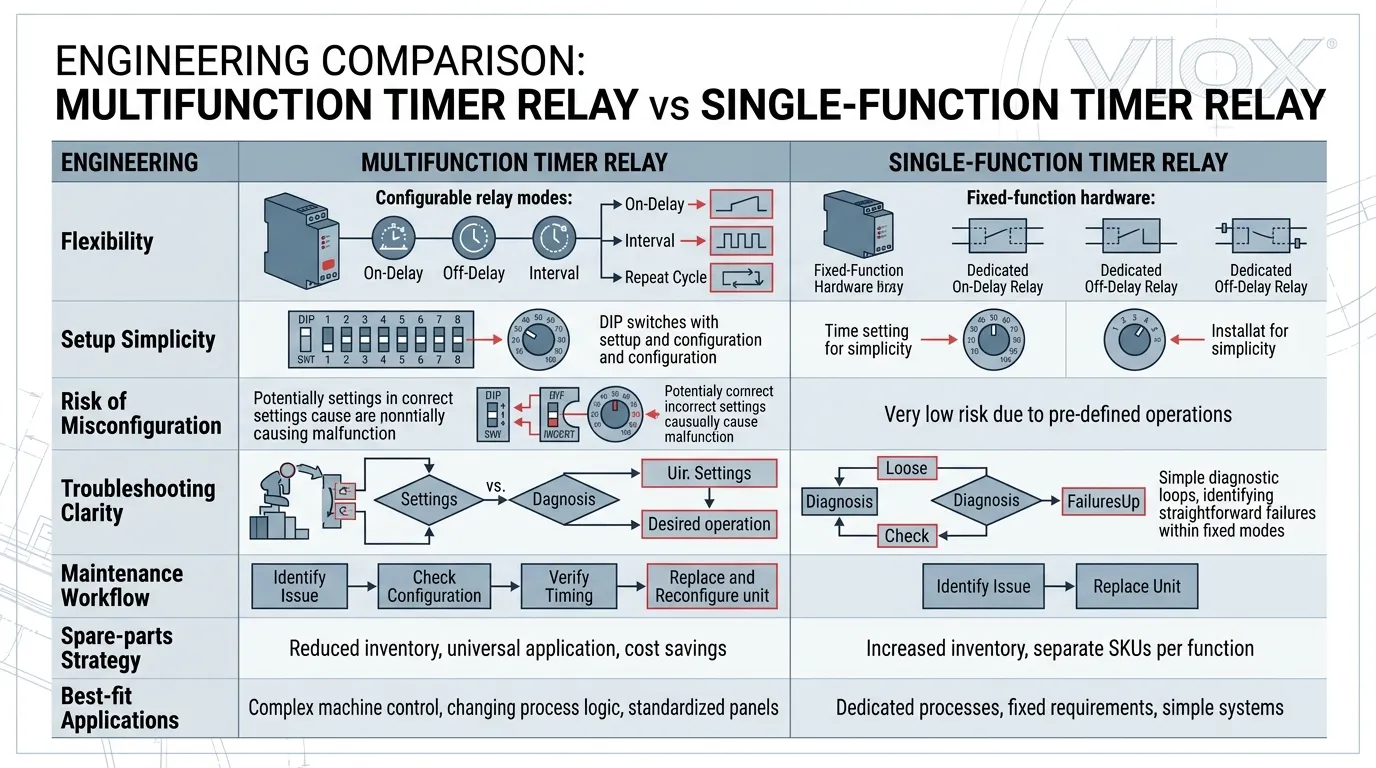
| Faktor | Multifunktions-Zeitrelais | Single-Function Timer Relay |
|---|---|---|
| Core concept | One relay supports multiple selectable timing modes | One relay is designed and locked to one timing mode |
| Flexibilität | High — mode, time range, and sometimes trigger logic are user-configurable | Low — operating mode is fixed by hardware |
| Setup simplicity | Lower — requires correct function selection before use | Higher — no mode selection needed |
| Risk of misconfiguration | Higher — wrong mode or range can be selected accidentally | Lower — function is enforced by design |
| Panel standardization | Strong advantage — one SKU covers many applications | Limited — each timing mode may require a different part number |
| Troubleshooting clarity | Slower — technician must verify mode settings as well as wiring | Faster — intended function is obvious from the device itself |
| Spare-parts strategy | Fewer SKUs needed across a mixed panel fleet | More SKUs, but each is application-specific |
| Typical configuration interface | Front-panel DIP switches, rotary selectors, or digital menu | Fixed function; only time-range adjustment (potentiometer or dial) |
| Am besten geeignet für | OEM panels, inventory reduction, applications that may change | Repetitive machines, fixed sequences, maintenance-sensitive sites |
What Is the Real Difference Between Multifunction and Single-Function Timer Relays?
The real difference is not simply the number of functions listed on the label. It is the operating philosophy behind the panel design.
Ein multifunction timer relay is chosen because the designer wants one hardware family that can be configured for different timing modes at the point of use. Depending on the product, selectable modes typically include:
- On-delay (delay on energization)
- Off-delay (delay on de-energization)
- Interval timing (output energized for a set period after trigger)
- One-shot or single-pulse timing
- Cyclic or repeat-cycle timing (asymmetric or symmetric)
- Star-delta motor starting
- Flashing (equal or adjustable on/off periods)
Configuration is usually done through front-panel DIP switches, a small rotary selector, or — on more advanced units — a digital interface. The same physical relay can behave as an on-delay timer on one machine and an interval timer on another, depending entirely on how it is set.
Ein single-function timer relay is chosen because the designer wants the device itself to enforce the application boundary. If the machine needs an on-delay and only an on-delay, the hardware is built for that one purpose. There is no mode selector to set incorrectly, no DIP switch combination to decode during troubleshooting. The relay does one thing, and the panel reflects that directly.
That philosophical difference has real consequences for:
- Commissioning speed — multifunction units require an extra verification step (is the correct mode selected?) that single-function units skip entirely.
- Spare-parts strategy — multifunction units reduce the number of unique part numbers in inventory; single-function units increase SKU count but make each replacement self-evident.
- Field troubleshooting — with a multifunction relay, a fault can be caused by wrong wiring oder by wrong mode selection; with a single-function relay, the mode variable is eliminated.
- Operator error risk — every configurable parameter is a potential error source; single-function designs remove that surface area.
- Long-term maintenance discipline — multifunction relays depend on documentation and labeling discipline to remain correctly configured across years of service; single-function relays are inherently self-documenting.
Understanding this distinction is the foundation of any timer relay selection guide. The sections below apply it to specific scenarios.
When a Multifunction Timer Relay Makes More Sense
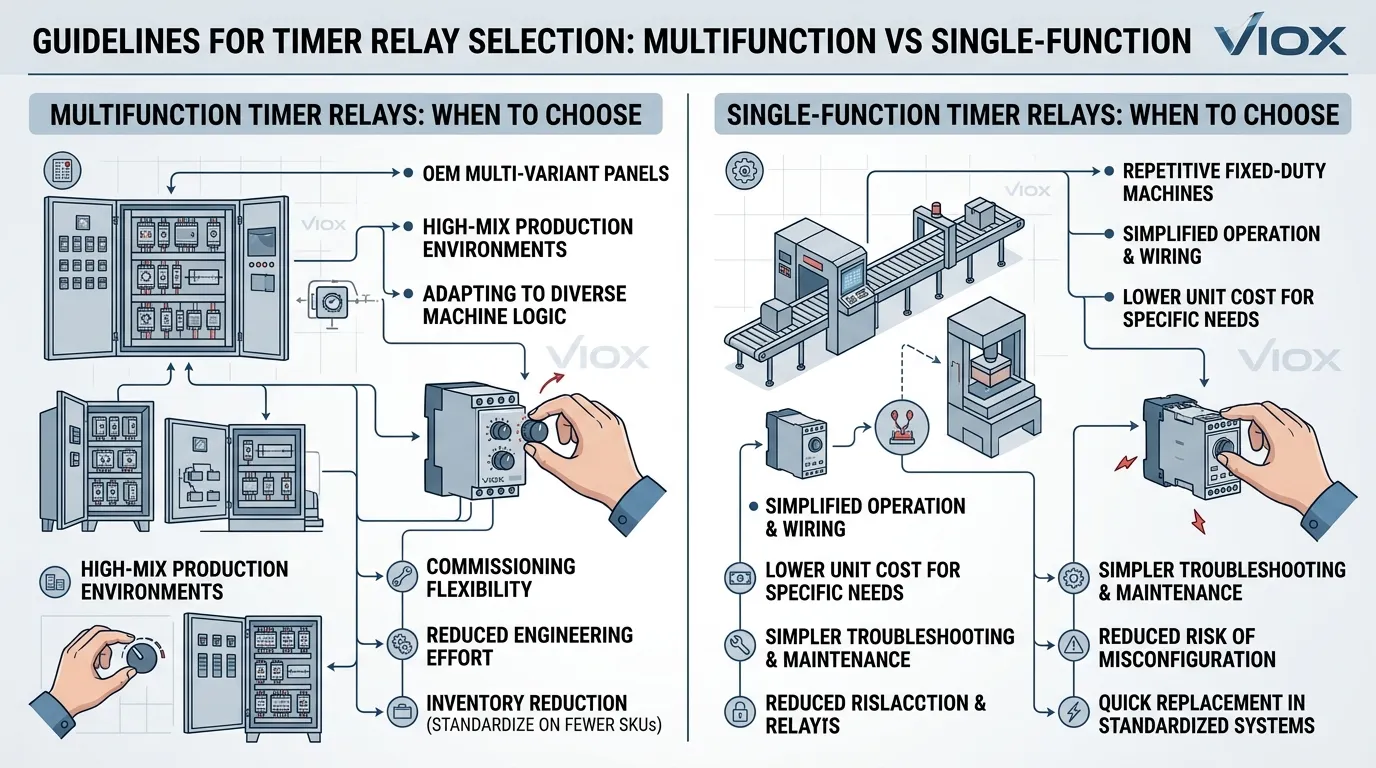
1. You want to standardize one relay across multiple panels
This is one of the strongest reasons to choose a multifunction timer relay, and it is the reason most OEMs and panel builders gravitate toward them.
Instead of stocking separate relays for on-delay, off-delay, interval, pulse, and cyclic functions — each with its own part number, datasheet, and wiring diagram — the team stocks one configurable family. The timing mode is selected during assembly or commissioning. That approach cuts the bill of materials, simplifies purchasing, and means the warehouse holds one spare instead of five.
This advantage is especially pronounced when panel variants are similar but not identical. An OEM building ten versions of a pump-control cabinet, where three need on-delay, four need off-delay, and three need interval timing, can use the same multifunction relay across all ten. The wiring footprint is identical; only the front-panel setting changes.
2. The final timing function may change during commissioning
Not every project is fully defined on paper before hardware ships. The machine sequence may need refinement after initial startup, or different end users may request slightly different timer behavior for the same panel design.
A multifunction timer relay gives the commissioning engineer room to adjust without pulling a relay out of the DIN rail and replacing it with a different part number. That saves time, avoids unplanned procurement, and keeps the project moving.
This situation is common in:
- Custom automation projects where control logic is finalized during site commissioning
- Export machines that serve multiple regional markets with different operational preferences
- Pilot or prototype equipment where the timing sequence is still being validated
3. The project values inventory reduction
For distributors, OEM stockrooms, and maintenance departments managing many panel types, inventory reduction is a measurable financial benefit.
One multifunction timer relay can replace multiple single-purpose stock items. That simplifies:
- Purchasing — fewer part numbers to requisition and track
- Warehouse management — less shelf space, simpler bin organization
- Spare stocking — one universal spare can cover several machines
- Replacement planning — reduced risk of ordering the wrong single-function variant
A practical example: a maintenance team supporting a plant with 200 control panels might otherwise need to stock five different single-function relays. With a multifunction approach, one or two SKUs cover the entire fleet. The carrying cost difference, multiplied across a large facility, is substantial.
4. The panel builder serves multiple application types
If one workshop builds motor starter panels, pump control panels, HVAC cabinets, lighting controllers, and general automation enclosures, the variety of timing functions required across those projects is wide. Multifunction timer relays make sense here because the same product line can serve all of those applications without forcing the builder to maintain a large catalog of dedicated relays.
This is also valuable for contract panel builders who do not control the end specification. When a new project calls for a timing mode the shop has not used before, a multifunction relay already on the shelf can often fill the requirement immediately.
If you are working through the broader selection process, Wie man das richtige Zeitrelais auswählt covers the full set of decision factors beyond the multifunction-versus-single-function question.
When a Single-Function Timer Relay Makes More Sense
1. The timing duty is fixed and will not change
If the application requires one timing mode and that requirement is not going to evolve, a single-function timer relay is typically the cleaner engineering choice. Extra functions do not add value in a fixed application — they add opportunities for incorrect setup.
Typical fixed-duty examples include:
- A compressor anti-short-cycle delay (on-delay, fixed at 180 seconds, never changes)
- A standard star-delta motor start sequence with a defined switchover time
- A fan run-on delay that runs for a set period after the main system shuts down
- A conveyor dwell timer that holds a workpiece in position for a fixed interval
In every one of these cases, the timing mode was decided during design and will remain the same for the life of the machine. Choosing a multifunction relay adds no operational benefit, but it does add a configuration surface that someone can accidentally change.
2. The site prioritizes fast, clear troubleshooting
Single-function timer relays are almost always easier for maintenance teams to diagnose, because the relay’s intended function is self-evident from the hardware. The technician does not need to open a manual, decode DIP switch positions, or wonder whether the relay has been inadvertently switched to the wrong operating mode.
That advantage matters most in environments where:
- Maintenance staff turnover is high — new technicians may not know the panel history or the correct relay settings
- Documentation discipline is weak — if settings are not recorded on the panel drawing or the relay label, a multifunction relay becomes a puzzle during a fault
- Downtime cost is severe — every minute spent verifying relay configuration instead of diagnosing the actual fault extends the outage
A real-world scenario: a night-shift technician responds to a conveyor stoppage. The timer relay LED is cycling in a pattern that does not match the expected on-delay behavior. With a single-function on-delay relay, the technician knows immediately that the relay is either faulty or miswired — the function cannot be wrong. With a multifunction relay, the technician must first confirm that the DIP switches are set to on-delay mode, then check the time range, then inspect the wiring. That extra diagnostic step can add 10–20 minutes to a repair under pressure.
3. You want to minimize misconfiguration risk
Every selectable parameter on a multifunction timer relay is a potential error source. The mode selector can be bumped during installation. A DIP switch can be flipped accidentally during adjacent work. A replacement relay can be installed with default settings instead of the application-specific ones.
If the machine builder or plant engineer wants to reduce configuration risk to the lowest practical level, a single-function timer relay accomplishes that by design. The function is not selected — it is inherent. There is nothing to set wrong.
This consideration carries extra weight in safety-adjacent applications where an incorrect timing mode could cause equipment damage or process upset, even if the relay itself is not a safety-rated device.
4. The application is highly repetitive
Where the same timing function is used dozens or hundreds of times across identical machines or panels, single-function relays typically make more sense than configurable ones.
This pattern is common in:
- Standardized production machine lines where every station uses the same delay
- High-volume HVAC control panels built to a fixed specification
- Motor control centers with repeating starter sections
- Packaging lines with identical timing at each station
In repetitive applications, the inventory argument for multifunction relays weakens (because only one type of single-function relay is needed anyway), while the configuration-risk argument against them strengthens (because every unit installed is another unit that could be set incorrectly).
Cost Analysis: Look Beyond Unit Price
The unit price comparison between a multifunction timer relay and a single-function timer relay is only one layer of the total cost picture. Both types carry indirect costs that can outweigh the purchase price difference.
Multifunction timer relay cost logic
A multifunction timer relay often has a higher per-unit price — typically 15–40% more than a comparable single-function model, depending on manufacturer and feature set. However, it can deliver lower total system cost wenn:
- One device replaces three, four, or five dedicated part numbers in inventory
- The workshop avoids minimum order quantities on low-volume single-function variants
- The same relay platform spans an entire product family, enabling volume pricing on a single SKU
- Reduced spare-parts variety cuts warehouse carrying costs and simplifies procurement
Single-function timer relay cost logic
A single-function timer relay may have a lower unit price and can reduce indirect operational cost by:
- Shortening troubleshooting time (fewer things to verify during a fault)
- Reducing wrong-setting incidents that cause rework, downtime, or warranty claims
- Simplifying technician training (no mode-selection knowledge required)
- Making field replacement faster and more error-proof
The right cost question
The real cost question in any timer relay comparison is not:
Which timer relay is cheaper per unit?
It is:
Which timer relay creates less total complexity — and therefore less total cost — across the full lifecycle of this project?
For a one-off panel with a fixed timing function, the answer is almost always the single-function relay. For a panel family with multiple variants and a shared maintenance ecosystem, the answer often shifts toward the multifunction relay.
Commissioning and Maintenance: Where the Tradeoff Becomes Visible
This is the section many buyers and specifiers overlook during selection but feel acutely during the life of the equipment.
Multifunction timer relay in practice
Stronger when:
- The commissioning engineer needs the ability to adjust timing logic without swapping hardware
- The machine sequence is being tuned during startup and the final mode is not yet confirmed
- One standard relay platform is deployed across many panel variants, and the commissioning team is trained on that platform
Weaker when:
- The wrong function is selected on the DIP switches or rotary dial — a mistake that produces symptoms (unexpected output behavior) that mimic wiring faults
- Time-range and function settings are not documented clearly on the panel drawing or relay label
- Field technicians unfamiliar with the specific relay model assume a wiring fault when the issue is actually a settings fault — leading to unnecessary rewiring, component replacement, or extended downtime
A common maintenance failure pattern with multifunction relays: a relay is replaced under warranty. The replacement unit arrives with factory-default settings. The installer fits it without re-entering the application-specific mode and time-range settings. The machine behaves incorrectly. The resulting troubleshooting effort can consume hours before someone realizes the relay settings were never restored.
Single-function timer relay in practice
Stronger when:
- Maintenance teams want a relay they can diagnose and replace quickly without consulting documentation
- The control sequence is established and locked — there is no benefit to field-adjustable function selection
- Replacement needs to be simple: remove old relay, install new relay of the same part number, done
Weaker when:
- A small logic change (e.g., switching from on-delay to off-delay) requires a hardware swap rather than a settings change
- The builder wants one relay family across many panel variants and is willing to accept the configuration overhead
Practical Examples
Example 1: OEM water-treatment control panel family
An OEM manufactures six versions of a water-treatment control cabinet. Across those variants, some panels require on-delay for pump sequencing, some require off-delay for drain valve timing, and some require interval timing for filter backwash purge cycles. The physical panel layout, wiring harness, and DIN-rail arrangement are otherwise identical.
Recommended choice: multifunction timer relay.
One SKU covers all six panel versions. The timing mode is set during final assembly using front-panel DIP switches. The OEM stocks a single relay in bulk, achieves volume pricing, and avoids the risk of installing the wrong single-function relay in the wrong panel variant. When a customer requests a new timing mode for a seventh variant, no new part number is needed.
Example 2: Fixed HVAC compressor protection panel
A mechanical contractor builds the same compressor restart-delay panel repeatedly for commercial rooftop units. Every panel uses an identical on-delay function set to 300 seconds. The sequence has not changed in four years and will not change. The maintenance teams servicing these panels are HVAC technicians, not control-systems specialists.
Recommended choice: single-function on-delay timer relay.
The function is fixed, the application is repetitive, and the service technicians benefit from a relay that does one thing obviously. There is no risk of mode misconfiguration, no DIP switches to decode, and no chance that a replacement relay arrives with wrong default settings. If the relay fails, the technician swaps it with an identical unit and the panel is back in service immediately.
Example 3: Packaging line with mixed timing requirements
A packaging-machine builder integrates twelve timer relays into each machine. Eight perform on-delay functions (product dwell, label application, glue cure), two perform interval timing (reject gate activation), and two perform cyclic timing (pneumatic actuator oscillation). The machine is built in batches of 20 units per month.
Recommended choice: multifunction timer relay for inventory efficiency, with strict configuration documentation.
Using a single multifunction relay across all twelve positions reduces the BOM to one timer-relay SKU. However, the builder must implement clear labeling on each relay position (function mode + time setting) and include a configuration verification step in the quality-control checklist. Without that discipline, the misconfiguration risk across twelve relays per machine becomes significant.
Example 4: Municipal pump station with long service life
A systems integrator designs a pump-station control panel that will operate for 15–25 years. The maintenance will be performed by municipal utility workers with varying levels of control-systems experience. The panel uses three on-delay timers for pump sequencing and one off-delay timer for a run-on function.
Recommended choice: single-function timer relays.
Over a 15–25 year service life, the panel will see many maintenance technicians, several relay replacements, and possibly incomplete documentation transfers. Single-function relays eliminate the risk that a future technician installs a replacement relay with wrong mode settings. The function is self-documenting: an on-delay relay is an on-delay relay, regardless of who is servicing the panel or how current the drawings are.
Timer Relay Selection Guide by Application Type
| Anwendung Typ | Recommended Timer Relay Type | Primäre Grund |
|---|---|---|
| OEM multi-variant control panels | Mehrfachfunktion | Reduces SKU count and supports flexible configuration across variants |
| Fixed repetitive machine circuits | Single-function | Eliminates setup confusion and minimizes service errors |
| Maintenance-sensitive industrial sites | Single-function | Faster troubleshooting with fewer variables to check |
| General-purpose panel workshops | Mehrfachfunktion | One product line serves diverse panel types |
| Projects likely to change after startup | Mehrfachfunktion | Allows timing-mode changes without hardware replacement |
| High-volume identical equipment | Single-function | No configuration overhead; each relay is immediately correct |
| Long-lifecycle infrastructure panels | Single-function | Self-documenting function survives technician turnover and documentation gaps |
| Export machines with regional variations | Mehrfachfunktion | Same hardware adapts to different market requirements |
Häufige Auswahlfehler
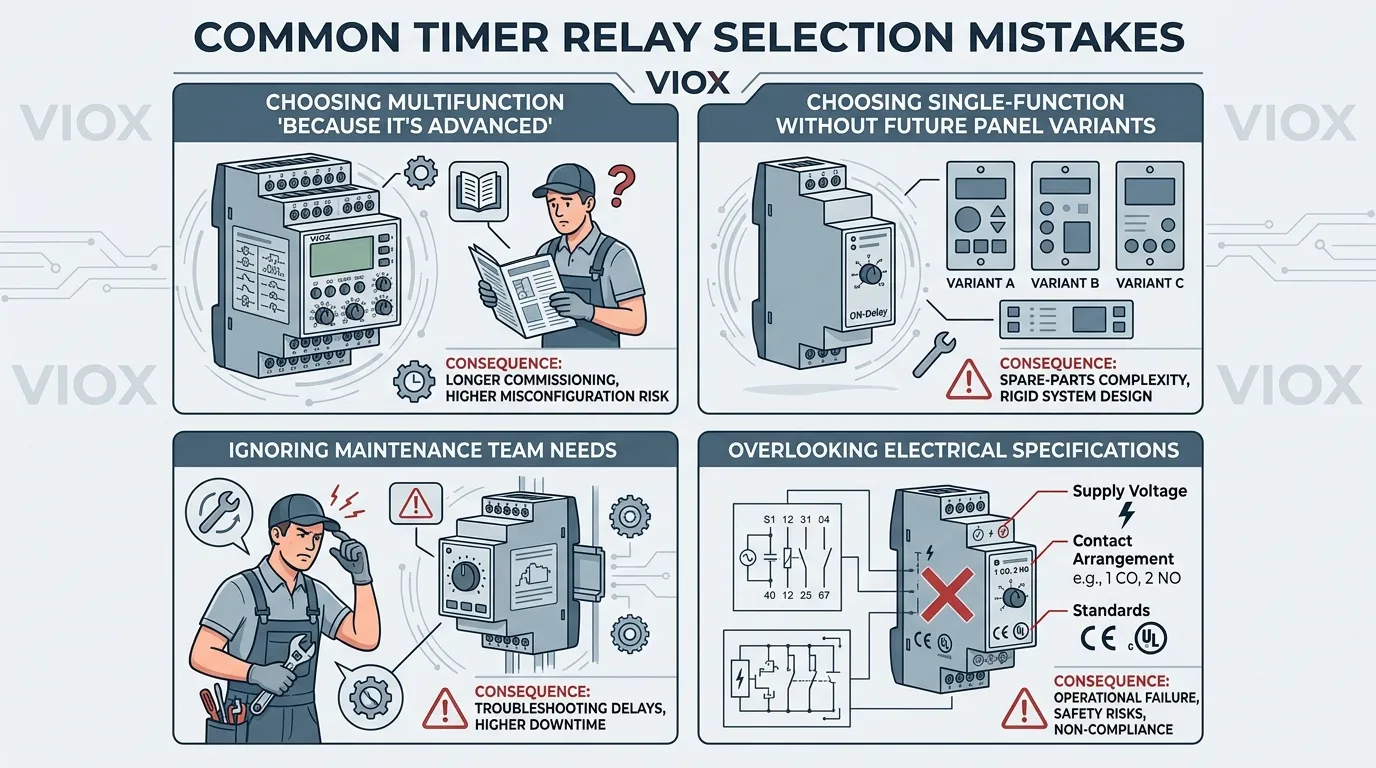
1. Choosing multifunction because it sounds more advanced
More functions do not automatically mean better engineering. A multifunction timer relay is a tool for flexibility, not a badge of sophistication. Specifying it when the application does not need configurability makes the panel harder to commission and easier to misconfigure.
Konsequenz: increased commissioning time, higher misconfiguration risk, and more complex troubleshooting — with no offsetting benefit.
2. Choosing single-function without considering future panel variants
A single-function relay looks clean and economical when only one timing mode is needed today. But if the same panel family later grows to include variants requiring different timing modes, each new mode means a new part number, a new datasheet to maintain, and a new item in inventory.
Konsequenz: the spare-parts list and BOM expand over time, and the benefits of standardization are lost retroactively.
3. Ignoring the maintenance team’s perspective
The panel designer may appreciate the elegance of a configurable platform. The maintenance technician working a night shift with a flashlight and a basic multimeter may not. If the people who service the panel were not consulted during specification, the relay choice may create ongoing friction between design intent and field reality.
Konsequenz: service time increases because technicians must decode and verify relay settings before they can begin diagnosing the actual circuit fault.
4. Treating all timer relays as interchangeable apart from function count
Function count is only one selection dimension. Supply voltage compatibility, contact configuration (SPDT, DPDT, etc.), mounting format (DIN rail, panel mount, plug-in socket), timing range, timing accuracy, repeat accuracy, and compliance with applicable standards (IEC 61812, UL 508, CE marking) all remain critical.
A relay that matches the desired timing logic but cannot operate on the available supply voltage, or does not fit the panel’s DIN-rail layout, or lacks the required safety certification, is not a valid selection regardless of whether it is multifunction or single-function.
Konsequenz: the selected relay fits the timing logic but fails on electrical, mechanical, or compliance requirements.
If interpreting relay datasheets is the challenge, How to Read Time Delay Relay Datasheets & Specifications walks through every key parameter.
5. Overlooking documentation requirements for multifunction relays
Choosing a multifunction timer relay commits the organization to documenting the configured mode and time range for every installed unit. If that documentation discipline does not exist — or is unlikely to be maintained over years of service — the long-term troubleshooting burden can exceed the short-term flexibility benefit.
Konsequenz: after several years of operation and multiple relay replacements, no one can confidently confirm what mode each relay is supposed to be set to without testing the circuit behavior directly.
How to Decide Quickly
If you need a fast decision framework for choosing between a multifunction timer relay and a single-function timer relay:
- Wählen multifunction when one relay family must cover several different timing jobs, when panel variants share a common layout, or when the timing mode may need to change without hardware replacement.
- Wählen single-function when the timing job is fixed, when the maintenance team benefits from simplicity, or when the panel will be in service for many years with limited documentation oversight.
If you are still unsure after considering those points, ask one question:
Is this panel more likely to suffer from a lack of flexibility, or from too much configurability?
If the risk is inflexibility — choose multifunction. If the risk is misconfiguration — choose single-function. That single question resolves the majority of timer relay selection decisions in practice.
FAQ
Is a multifunction timer relay always better than a single-function timer relay?
No. A multifunction timer relay is the better choice only when the project benefits from flexibility, reduced SKU count, or the ability to adjust timing modes during commissioning or over the panel’s service life. When the timing function is fixed, a single-function relay is typically simpler, safer, and easier to maintain.
Why would anyone still choose a single-function timer relay?
Because fixed-function hardware is easier to commission, easier to troubleshoot, and inherently resistant to misconfiguration. In applications where the timing mode will not change, a single-function timer relay removes an entire category of potential error without sacrificing any needed capability.
Are multifunction timer relays harder to troubleshoot?
In most cases, yes. With a multifunction timer relay, the troubleshooting technician must verify both the wiring and the selected operating mode before diagnosing the fault. That additional step takes time and introduces the possibility of a settings-related misdiagnosis. With a single-function relay, the intended timing logic is apparent from the device itself, and troubleshooting can focus directly on the circuit.
Which type is better for OEM machine builders?
Multifunction timer relays are generally the stronger choice for OEMs who build multiple related panel variants, because they enable stocking a single relay SKU across the product family and allow mode selection during assembly. However, OEMs who build high volumes of identical machines with fixed timing may still prefer single-function relays for their lower configuration overhead.
Which type is better for repetitive fixed-duty applications?
Single-function timer relays are usually the better fit for repetitive, fixed-duty applications where the timing logic is established, validated, and unlikely to change. The elimination of mode-selection risk outweighs any standardization benefit in these contexts.
Can I use a multifunction timer relay as a drop-in replacement for a single-function one?
In many cases, yes — provided the multifunction relay matches the original relay’s supply voltage, contact configuration, timing range, and mounting format, and the correct operating mode is selected and documented. However, the replacement introduces a configuration step that did not exist before, so clear labeling and documentation are essential to prevent future issues.
What standards apply to timer relay selection?
Timer relays are typically designed and tested according to IEC 61812 (time relays for industrial use), with additional certifications such as UL 508 (industrial control equipment) for North American markets and CE marking for European markets. The choice between multifunction and single-function does not change the applicable standards, but the selected relay must comply regardless of type.