
You walk into your facility on a Monday morning to find the production floor dark. Again. The circuit breaker tripped overnight—but here’s the real problem: this is the third time this month, and you’re starting to suspect you don’t have a power problem. You have a breaker selection problem.
Or worse: picture this. A worker in your commercial kitchen reaches for a mixer near the sink. Water on the counter, wet hands, standard outlet. Then the unthinkable happens—a shock that could have been fatal. The investigation reveals the painful truth: someone installed a basic MCB where code required a GFCI. The breaker worked perfectly, protecting the wire from overheating. But it was never designed to protect a person from electrocution.
The brutal reality? Most electrical failures aren’t caused by bad equipment—they’re caused by using the wrong equipment in the right place.

Why Circuit Breaker Selection Goes Wrong
Here’s what happens in the field: an engineer or facility manager knows they need “a 20-amp breaker” for a circuit. They grab what’s in stock—usually a standard Miniature Circuit Breaker (MCB)—and move on. The breaker works. The lights come on. Job done, right?
Not quite. That MCB can detect thermal overloads and short circuits brilliantly. But it’s completely blind to ground faults (the leading cause of electrocution), arc faults (a major cause of electrical fires), and it can’t handle the sustained high-current demands of industrial equipment. You wouldn’t use a smoke detector to sense carbon monoxide. Don’t use an MCB to do a GFCI’s job.
The issue isn’t the quality of the breaker—it’s the mismatch between the breaker’s protective function and the actual hazard you’re facing. And with the National Electrical Code (NEC) continuously updating requirements for GFCI and AFCI protection, that gap is getting more expensive and more dangerous.
The Solution: Match the Breaker Type to the Hazard Type
Think of circuit breakers as specialized defenders, each with a unique “superpower”:
- MCB are your thermal and magnetic guardians—they stop overloads and short circuits
- GFCIs are your shock sentinels—they detect even tiny ground faults before they can kill
- AFCIs are your fire fighters—they sense dangerous arcing conditions invisible to other breakers
- MCCBs are your industrial workhorses—they handle high currents with adjustable trip settings
The key insight? You’re not just protecting circuits—you’re protecting against specific failure modes. Let’s break down exactly when and where to deploy each type.
Step 1: Start With the Environment and Code Requirements
Before you even think about amperage ratings, ask yourself: “What could go wrong here?”
Wet or Damp Locations → GFCI Required
Pro-Tip: If water and electricity could ever meet in that location, code mandates GFCI protection—no exceptions.
The National Electrical Code (NEC) requires GFCIs in:
- Bathrooms, kitchens, and laundry rooms
- Outdoor receptacles
- Garages and unfinished basements
- Anywhere within 6 feet of a sink
- Construction sites and temporary power
Why? A GFCI monitors the current flowing out (hot wire) versus the current returning (neutral wire). If there’s even a 4-6 milliamp difference—the amount that could be flowing through a person to ground—it trips in 1/40th of a second. That’s faster than a heartbeat can be disrupted.
Real-world scenario: In commercial kitchens, food processing plants, or any wet manufacturing environment, every receptacle must be GFCI-protected. Installing a standard MCB here isn’t just a code violation—it’s a liability waiting to happen.
Living Spaces and Bedrooms → AFCI Protection
Key Takeaway: Arc faults cause over 28,000 home fires annually. An MCB can’t see them—an AFCI can.
Arc Fault Circuit Interrupters detect the unique electrical signature of dangerous arcing—like when insulation on a wire deteriorates, or a loose connection starts sparking behind a wall. Unlike the high-current fault an MCB responds to, arc faults can occur at very low currents but with extreme heat.
Code now requires AFCIs in:
- Bedrooms (since 2002)
- Living rooms, hallways, closets, and most habitable spaces (expanded in recent code cycles)
- Some commercial applications
The catch? Many facilities still have old MCB-only panels in these areas. If you’re renovating or replacing breakers, this is your chance to upgrade to dual-function AFCI/GFCI breakers where needed.
Industrial and High-Current Applications → MCCB Territory
Once you’re above 100-125 amps, or you need adjustable trip settings for motor starting currents, you’ve moved beyond MCB territory into Molded Case Circuit Breakers.
Think of MCCBs as “the professional-grade MCB.” They offer:
- Higher amperage ratings (250A to 2,500A+)
- Adjustable thermal and magnetic trip points
- Higher interrupting capacity for industrial fault currents
- Better coordination with downstream protective devices
Use MCCBs for:
- Main distribution panels in commercial and industrial facilities
- Large HVAC systems and chillers
- Industrial machinery and motor control centers
- Distribuce energie v datovém centru
Step 2: Match the Amperage to the Wire, Not Just the Load
Here’s a mistake that gets expensive fast: someone calculates the load at 18 amps, so they install a 20-amp breaker. Seems logical, right? But if that 20-amp breaker is protecting 14 AWG wire (rated for only 15 amps), you’ve just created a fire hazard. The breaker will let 20 amps flow before it trips—but the wire will start cooking at 15.
The golden rule: Your breaker must protect the smallest wire in the circuit, not just handle the load.
Quick Reference for Common Applications
| Typ jističe | Typické hodnocení | Common Application | Wire Size (Copper) |
|---|---|---|---|
| MCB | 15A | General lighting, standard outlets | 14 AWG |
| MCB | 20A | Kitchen, bathroom, laundry circuits | 12 AWG |
| GFCI | 15A or 20A | Wet locations, outdoor receptacles | 14 or 12 AWG |
| AFCI | 15A or 20A | Ložnice, obývací prostory | 14 or 12 AWG |
| MCCB | 100A-250A | Subpanels, large equipment | 3 AWG – 250 kcmil |
Step 3: Installation Best Practices—Where Good Breakers Go Wrong
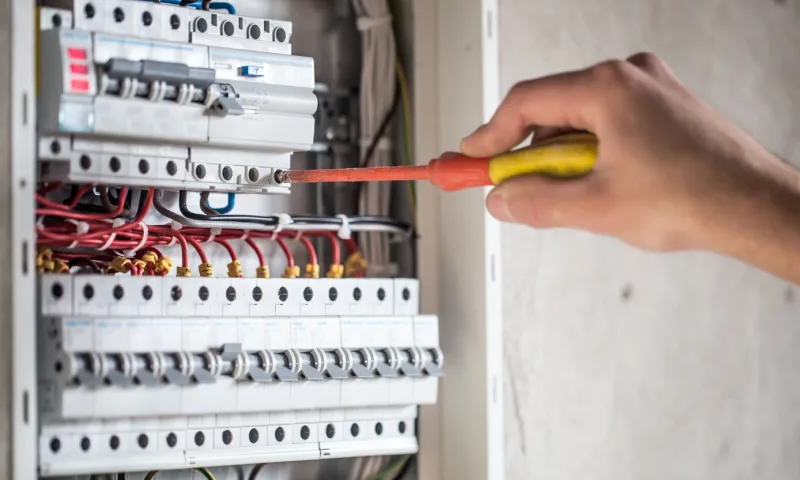
You’ve selected the right breaker type and rating. Now comes the moment of truth: installation. This is where even experienced electricians can make critical mistakes.
Terminal Torque: The Silent Killer
Pro-Tip: More fires start from loose connections than from overloaded circuits. Always use a calibrated torque screwdriver.
Every breaker has a specified terminal torque value (usually 20-50 lb-in for MCBs, higher for MCCBs). Too loose, and you get arcing and heat buildup. Too tight, and you can crack the bus bar or damage the terminal. Use a torque screwdriver and follow the manufacturer’s specs—every single time.
Správná příprava drátů
Strip wire to the exact length shown on the breaker’s strip gauge (usually stamped right on the terminal block). Too much bare wire = shock hazard. Too little = poor contact and heat buildup. And never double-tap terminals unless the breaker is explicitly rated for it.
Test After Installation
For GFCIs: Press the “TEST” button monthly to verify the trip mechanism works. A GFCI that doesn’t trip when tested is worse than no GFCI at all—it gives false confidence.
For AFCIs: These should be tested during installation and whenever you suspect a problem, but they don’t have the same monthly test requirement as GFCIs.
The Bottom Line: The Right Breaker Is a System, Not a Component
Let’s bring it all together:
- MCBs are your default for standard circuits—thermal and magnetic protection for overloads and short circuits
- GFCIs are legally required and life-critical in wet locations—they stop ground faults that could kill
- AFCIs are fire prevention devices—mandatory in living spaces to detect dangerous arcing
- MCCBs are for industrial and high-current applications—adjustable protection for complex loads
Remember this: The most dangerous circuit breaker isn’t the one that trips too often—it’s the one that never trips when it should because it was never designed to see that type of fault in the first place.
When you’re spec’ing your next panel or replacing an aging breaker, don’t just ask “What amperage do I need?” Ask “What am I protecting against?” Answer that question correctly, and you’ve just made your facility safer, more code-compliant, and more reliable.
Need help identifying the right circuit breaker for your application? Don’t guess. Contact our technical team for a free consultation and application review. We’ll help you match the breaker type, rating, and installation requirements to your specific environment—because getting it right the first time is always cheaper than retrofitting after an incident.

