

Di halaman ini
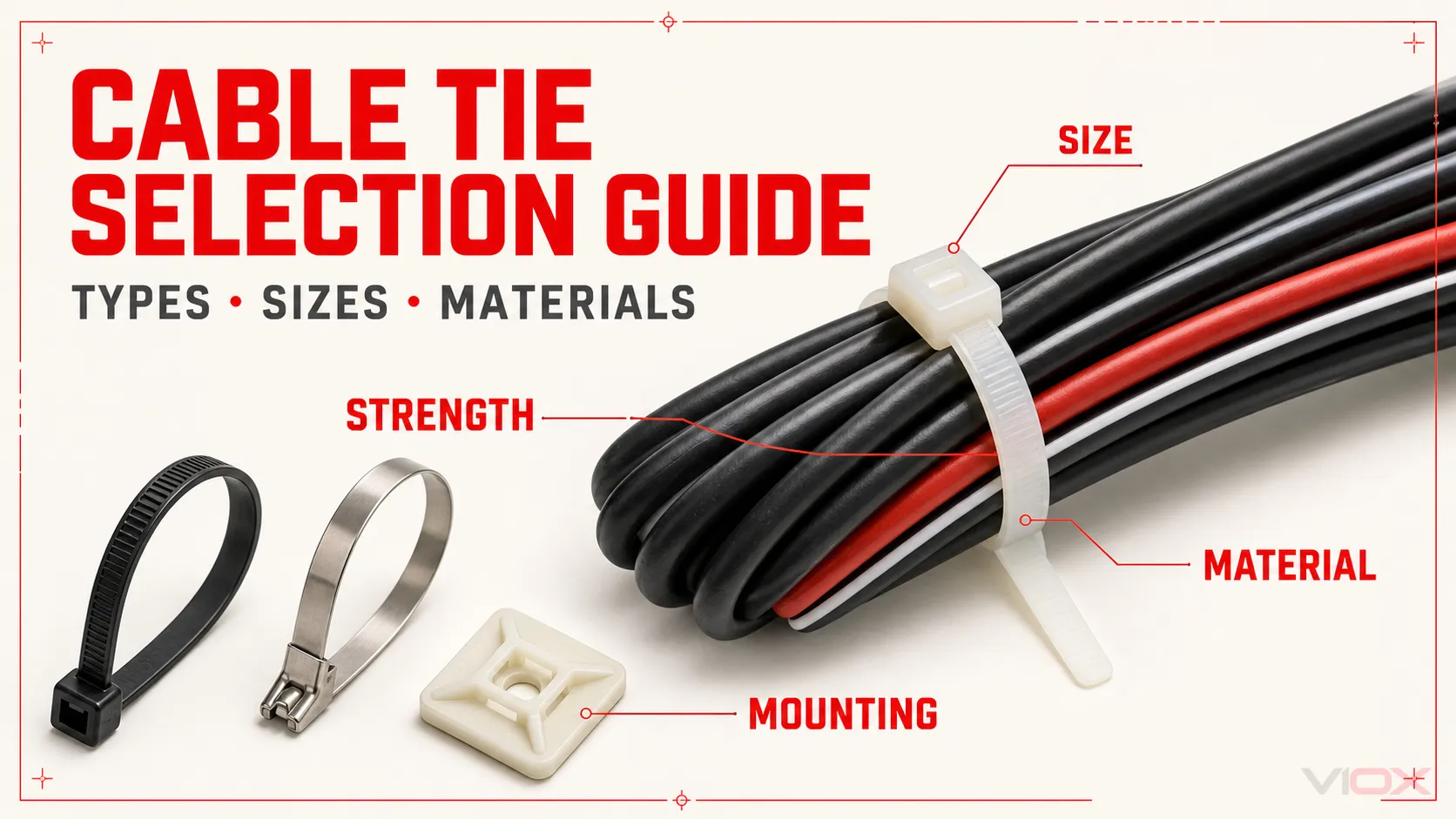
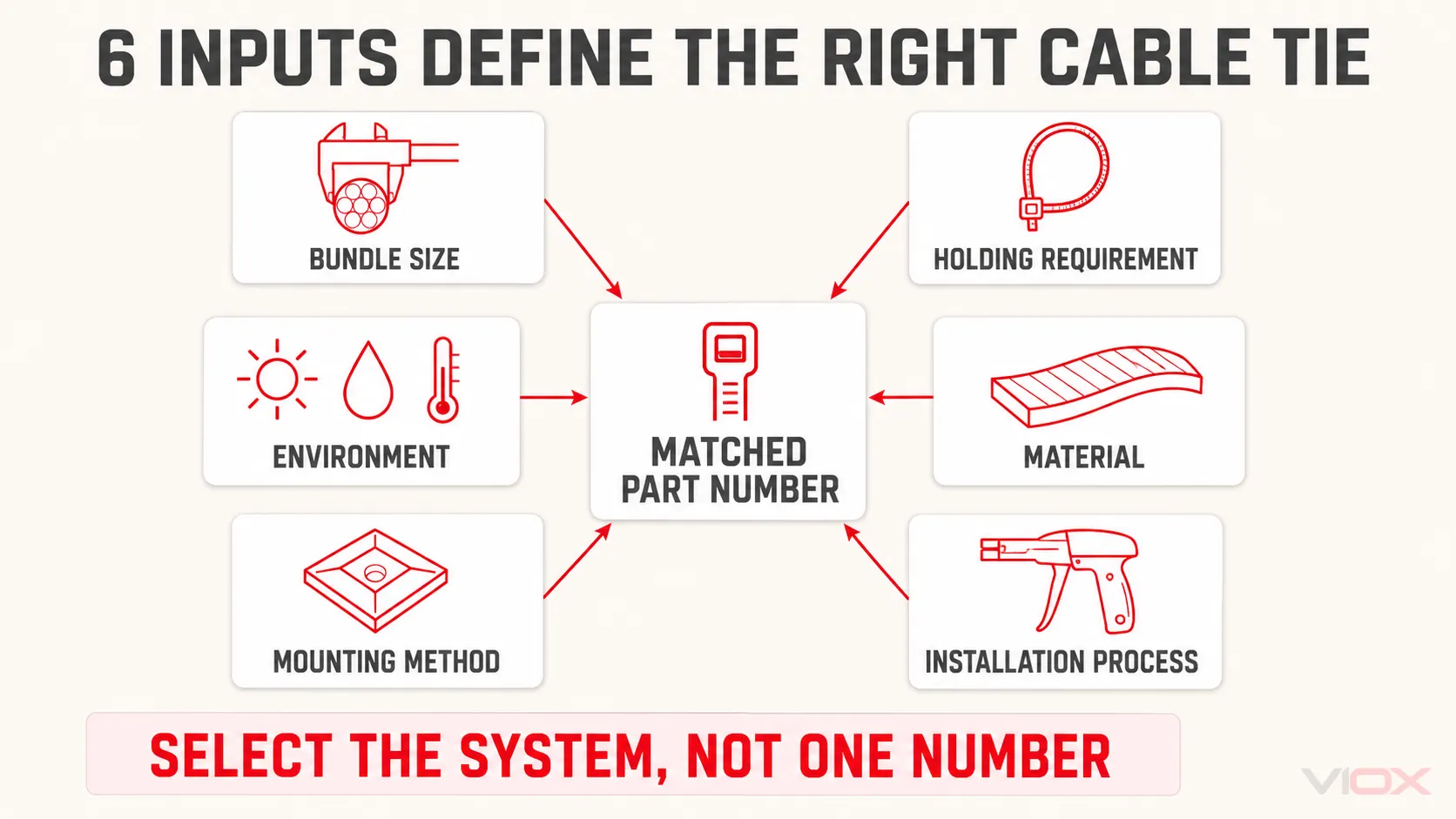
Pilih pengikat kabel dengan mencocokkan enam input: ukuran bundel, performa penahanan yang diperlukan, lingkungan operasional, material, metode pemasangan, dan proses instalasi. Panjang saja tidak cukup. Pengikat mungkin muat di sekeliling bundel namun tetap tidak sesuai karena terlalu lemah, terbuat dari material yang salah, dipasang pada dudukan yang tidak kompatibel, atau diaplikasikan dengan tegangan yang tidak terkontrol.
Cable tie dan zip tie sering digunakan secara bergantian. Apa pun istilah yang muncul pada gambar atau permintaan pembelian, pemilihan harus didasarkan pada nomor komponen yang terverifikasi dan persyaratan aplikasi—bukan nama produk generik.
Panduan ini membantu pembeli komponen listrik, perakit panel, instalatur, dan produsen peralatan asli (OEM) dalam menentukan jalur pemilihan yang tepat. Panduan ini memberikan gambaran umum mengenai keputusan yang perlu diambil dan tautan ke panduan VIOX terperinci untuk ukuran, material, mekanisme penguncian, sistem pemasangan, alat instalasi, dan evaluasi pemasok.
Sekilas tentang Pemilihan Pengikat Kabel
| Kondisi aplikasi | Mulai dengan | Verifikasi sebelum pemilihan | Panduan terperinci |
|---|---|---|---|
| Pengikatan kabel dalam ruangan secara umum | Pengikat kabel nilon standar | Diameter bundel, lebar, kekuatan tarik yang dinyatakan, suhu, dan persetujuan produk | Tabel ukuran pengikat kabel (cable tie) |
| Penggunaan luar ruangan atau paparan sinar matahari | Pengikat kabel tahan sinar UV | Ketahanan UV yang dinyatakan, suhu pemasangan, suhu pengoperasian, kelembapan, dan lingkungan layanan | Pengikat kabel tahan sinar UV |
| Peralatan suhu tinggi | Polimer penstabil panas, polimer khusus, atau pengikat logam yang sesuai | Material yang tepat, rentang suhu yang dinyatakan, sumber panas di sekitar, dan batas isolasi kabel | Pengikat kabel suhu tinggi |
| Lingkungan industri yang korosif atau berat | Pengikat baja tahan karat atau baja tahan karat berlapis | Tingkat baja, pelapisan, paparan korosi, perlindungan tepi, desain penguncian, dan peralatan pemasangan | Panduan pengikat kabel baja tahan karat |
| Pengikatan sementara atau penyesuaian berulang | Pengikat kabel yang dapat dilepas atau digunakan kembali | Metode pelepasan, retensi setelah penggunaan kembali, sensitivitas ikatan, dan batas penggunaan kembali khusus produk | Pengikat kabel mengunci sendiri vs dapat digunakan kembali |
| Perutean tetap pada permukaan | Pengikat kabel ditambah perangkat pemasangan yang kompatibel | Material permukaan, metode pemasangan, dimensi lubang atau slot, arah beban, suhu, dan lingkungan | Panduan pemasangan pengikat kabel |
| Bundel beban tinggi atau yang terpapar getaran | Pengikat polimer tugas berat atau logam yang sesuai | Kinerja tarik yang dinyatakan, beban dinamis, kekuatan dudukan, tegangan pemasangan, dan kriteria inspeksi | Panduan beban pengikat kabel (zip-tie) tugas berat |
Aturan verifikasi: Anggap setiap pernyataan mengenai suhu, kekuatan tarik, ultraviolet (UV), ketahanan kimia, kinerja api, dan sertifikasi sebagai hal yang spesifik untuk nomor komponen. Warna, panjang, lebar, atau nama material yang serupa tidak menjamin kinerja yang setara.
Enam Input yang Menentukan Pengikat Kabel yang Tepat
| Input pemilihan | Pertanyaan untuk dijawab | Bukti untuk verifikasi |
|---|---|---|
| Ukuran bundel | Berapakah dimensi luar minimum dan maksimum dari bundel yang sudah jadi? | Diameter bundel minimum dan maksimum dari produsen |
| Persyaratan penahanan | Beban, pergerakan, getaran, atau tuntutan retensi apa yang harus mampu ditahan oleh pengikat (tie)? | Klasifikasi tarik yang dipublikasikan atau data mekanis spesifik produk |
| Lingkungan | Apakah pengikat akan terpapar UV, panas, dingin, kelembapan, bahan kimia, korosi, persyaratan kinerja api, atau kondisi khusus dalam ruangan? | Data material, peringkat lingkungan, dan informasi persetujuan yang berlaku |
| Bahan | Polimer, logam, atau konstruksi komposit mana yang sesuai dengan lingkungan tersebut? | Penunjukan material yang tepat dan dokumentasi produsen |
| Pemasangan | Apakah pengikat hanya untuk menyatukan kabel, atau harus juga mengamankan bundel tersebut ke permukaan? | Jenis perangkat pengencang, kompatibilitas permukaan, dan persyaratan pemasangan |
| Instalasi | Apakah akan dipasang dengan tangan atau dengan alat penegang dan pemotong terkontrol? | Keluarga alat yang disetujui, metode penegangan, metode pemotongan, dan kriteria inspeksi |
Kerangka kerja enam input ini mencegah kesalahan pengadaan yang umum: memilih pengikat terlebih dahulu dan mencoba membenarkan aplikasinya setelahnya.
Ukur Bundel Sebelum Memilih Panjang Pengikat
Ukur diameter luar aktual atau selubung dari bundel kabel yang telah selesai pada lokasi pengikatan yang dituju. Jangan hanya memperkirakannya dari jumlah konduktor. Ketebalan isolasi kabel, bentuk jaket, geometri saluran atau selang, titik percabangan, dan penambahan di masa mendatang semuanya dapat mengubah ukuran lilitan yang diperlukan.
Nilai produk yang paling berguna adalah rentang diameter bundel yang dinyatakan oleh produsen. Panjang pengikat keseluruhan mendukung rentang tersebut, tetapi bukan pengganti yang dapat dipertukarkan. Kepala pengunci, panjang pengikatan yang diperlukan, dan sisa ujung yang dapat digunakan memengaruhi seberapa banyak panjang nominal yang dapat melilit bundel.
Periksa juga diameter bundel minimum. Pengikat yang terlalu panjang atau berat pada bundel kecil yang fleksibel dapat menyulitkan penegangan secara konsisten dan dapat menghasilkan pemasangan yang terlalu tebal.
Gunakan Bagan ukuran pengikat kabel VIOX untuk perbandingan yang lebih mendalam mengenai panjang, lebar, kekuatan tarik, dan diameter bundel.
Tentukan Persyaratan Penahan Tanpa Menganggap Kekuatan Tarik sebagai Beban Kerja Aman
Lembar data pengikat kabel mungkin menyatakan kekuatan tarik loop atau klasifikasi mekanis lainnya, namun nilai tersebut tidak boleh secara otomatis dianggap sebagai berat gantung yang diizinkan dari sistem kabel yang terpasang. Pemasangan nyata dapat menambah getaran, guncangan, siklus termal, pergerakan, distribusi beban yang tidak merata, deformasi dudukan, dan tekanan yang diberikan oleh pemasang.
Mulailah dengan memisahkan tiga pertanyaan berikut:
- Apakah pengikat hanya berfungsi untuk mengelompokkan konduktor, atau diharapkan untuk mengamankan bundel kabel ke struktur?
- Apakah bebannya sebagian besar statis, atau apakah instalasi akan mengalami getaran, pergerakan, atau perubahan termal berulang?
- Apakah persyaratan instalasi atau peralatan yang berlaku mengizinkan pengikat dan perangkat pengencang yang dipilih untuk menjalankan fungsi tersebut?
IEC 62275:2022 mencakup pengikat kabel logam, non-logam, dan komposit serta perangkat pengencang terkait yang digunakan untuk mengatur atau mengamankan sistem pengkabelan dalam instalasi listrik. Persyaratan tambahan dapat berlaku jika perangkat tersebut digunakan sebagai penyangga. UL Solutions juga membedakan fungsi pengamanan umum dengan produk yang dievaluasi untuk aplikasi penyangga tertentu. Nilai tarik yang tinggi saja tidak menetapkan bahwa suatu pengikat disetujui sebagai penyangga kabel utama.
Untuk beban yang sangat tinggi atau kondisi layanan yang berat, bandingkan data produk dengan panduan beban pengikat kabel (zip-tie) tugas berat dan yang tersedia alternatif yang lebih kuat daripada pengikat kabel (zip-tie).
Sesuaikan Material Pengikat Kabel (Cable Tie) dengan Lingkungan
“Pengikat kabel nilon” bukanlah spesifikasi material yang lengkap. Pengikat kabel dapat menggunakan berbagai tingkatan polimer, penstabil, aditif, logam, pelapis, dan konstruksi komposit yang berbeda. Perbedaan ini memengaruhi perilaku suhu, ketahanan terhadap sinar UV, kompatibilitas kimia, respons terhadap kelembapan, fleksibilitas, kinerja terhadap api, ketahanan terhadap korosi, dan daya tahan jangka panjang.
| Arah material | Alasan pemilihan umum | Batasan penting |
|---|---|---|
| Pengikat kabel poliamida standar | Pengorganisasian kabel dalam ruangan secara umum | Jangan berasumsi bahwa produk ini cocok untuk penggunaan di luar ruangan, suhu tinggi, lingkungan kimia, atau kinerja terhadap api |
| Poliamida tahan cuaca atau tahan sinar UV | Pemasangan jalur kabel di luar ruangan atau paparan sinar matahari yang berulang | Warna hitam saja tidak membuktikan peringkat UV atau masa pakai tertentu |
| Polimer yang distabilkan terhadap panas atau polimer khusus | Peralatan bersuhu tinggi atau kondisi industri khusus | Sesuaikan polimer yang tepat dengan rentang pemasangan dan pengoperasian yang dinyatakan |
| Polimer dengan daya serap kelembapan rendah atau tahan bahan kimia | Aplikasi di mana kelembapan atau paparan bahan kimia mengubah pemilihan material | Kompatibilitas bergantung pada bahan kimia yang disebutkan, konsentrasi, suhu, dan metode paparan |
| Baja tahan karat | Panas tinggi, paparan korosi, layanan tugas berat, atau jalur industri yang menuntut | Periksa paduan, konstruksi penguncian, kondisi tepi, risiko kontak galvanik, dan alat pemasangan |
| Baja tahan karat berlapis | Performa pengikat logam dengan tambahan pemisah atau pelindung tepi | Bahan pelapis dan cakupan bersifat spesifik pada produk dan dapat mengubah batas suhu atau kimia |
| Pengikat polimer atau elastomer yang dapat digunakan kembali | Pekerjaan sementara, akses layanan, atau bundel sensitif | Periksa metode pelepasan yang diizinkan, batas penggunaan kembali, dan performa penahanan yang tersisa |
Untuk pemilihan berdasarkan material, gunakan Panduan material pengikat kabel VIOX. Halaman pendukung mengenai Pengikat kabel tahan sinar UV, pengikat kabel suhu tinggi, pengikat kabel baja tahan karatdan pengikat kabel karet vs plastik membahas keputusan lingkungan dan konstruksi yang lebih spesifik.
4. Pilih Konstruksi Penguncian dan Format Penggunaan Kembali
Desain penguncian memengaruhi gaya penyisipan, retensi, kontak bundel, perilaku pelepasan, perkakas, dan kesesuaian aplikasi. Arah umum meliputi:
- Pengikat self-locking dengan gerigi di bagian dalam: digunakan secara luas untuk pengikatan umum; gerigi menghadap ke arah bundel dan mengunci pada elemen pengunci di bagian kepala.
- Pengikat dengan gerigi di bagian luar: menempatkan permukaan tali yang lebih halus pada bundel, yang berguna jika lekukan pada isolasi, pipa, atau selang yang sensitif menjadi perhatian.
- Pengikat yang dapat dilepas: menyertakan mekanisme yang memungkinkan elemen pengunci dilepaskan; pastikan apakah produk tersebut ditujukan untuk penggunaan berulang atau hanya pelepasan terkontrol selama pemasangan.
- Pengikat stainless steel ball-lock atau self-locking: menggunakan sistem pengunci logam dan biasanya memerlukan praktik pemasangan yang sesuai dengan produk.
- Konstruksi kepala ganda atau loop ganda: menciptakan fungsi perutean atau pengikatan terpisah dan harus dipilih berdasarkan geometri yang dituju, bukan diperlakukan sebagai pengganti loop tunggal biasa.
- Pengikat dengan pemasangan terintegrasi: menggabungkan tali dengan dudukan dorong, fitur lubang sekrup, klip tepi, atau geometri pemasangan lainnya.
Untuk mekanisme penguncian dan konstruksi pengikat utama, baca cara kerja pengikat kabel. Gunakan perbandingan terfokus dari pengikat kabel loop ganda dan kepala ganda ketika geometri dua bundel atau perutean terpisah diperlukan.
5. Pilih Metode Pemasangan sebagai Bagian dari Sistem
Pengikat kabel dapat mengatur bundel tanpa menempelkannya ke permukaan. Ketika perutean tetap diperlukan, pengikat, perangkat pemasangan, pengencang, dan permukaan pemasangan membentuk satu sistem mekanis.
| Arah pemasangan | Paling cocok untuk | Apa yang harus diverifikasi |
|---|---|---|
| Dudukan perekat | Pemasangan bersih tanpa pengeboran di mana permukaan dan lingkungan memungkinkan pemasangan perekat | Persiapan permukaan, jenis perekat, suhu, penuaan, arah beban, dan kontaminasi |
| Dudukan sekrup | Pemasangan yang didefinisikan secara mekanis pada struktur yang sesuai | Ukuran pengencang, substrat, geometri lubang, metode pengencangan, kompatibilitas korosi, dan akses |
| Dudukan tekan (push mount) | Pemasangan cepat ke dalam lubang panel yang kompatibel | Ketebalan panel, diameter lubang, geometri retensi, persyaratan pelepasan, dan getaran |
| Klip tepi (edge clip) | Pengaturan jalur di sepanjang tepi logam lembaran atau panel tanpa lubang pemasangan yang dibor | Ketebalan tepi, retensi klip, perlindungan lapisan akhir, orientasi, dan jarak bebas kabel |
| Dudukan magnetik | Pemasangan yang dapat diposisikan ulang pada permukaan feromagnetik yang kompatibel | Gaya tahan pada arah aktual, getaran, suhu, penyelesaian permukaan, dan kompatibilitas magnetik |
| Lubang pengikat terintegrasi | Pengikatan dan pemasangan satu bagian | Kompatibilitas lubang atau pengencang, orientasi yang diizinkan, ukuran pengikat, dan metode penggantian |
Untuk gambaran lengkap, gunakan panduan pengikat kabel pemasangan. Keputusan yang lebih spesifik dibahas dalam panduan pemilihan dudukan pengikat kabel perekat dan panduan untuk dudukan pengikat kabel magnetik.
Jangan berasumsi bahwa peringkat mekanis pengikat juga menetapkan peringkat perangkat pemasangan. Bagian terlemah dari sistem yang terpasang mungkin adalah perekat, pengencang, permukaan, klip, pengikat, atau metode pemasangannya.
6. Kontrol Penegangan, Pemotongan, dan Inspeksi
Kualitas pemasangan dapat mengubah hasil akhir meskipun pengikat yang tepat telah dipilih. Penegangan yang berlebihan dapat membuat lekukan atau merusak isolasi kabel, mengubah bentuk selang lunak, membuat pengikat terlalu tegang, atau menyulitkan pemeliharaan di kemudian hari. Penegangan yang tidak memadai dapat menyebabkan pergerakan, abrasi, kebisingan, atau hilangnya kontrol jalur kabel.
Untuk pekerjaan umum bervolume rendah, pemasangan dengan tangan mungkin tepat jika produk mengizinkannya. Pekerjaan bervolume lebih tinggi atau yang sensitif terhadap konsistensi dapat memperoleh manfaat dari alat penegang dan pemotong yang kompatibel yang mengontrol aplikasi dan menghasilkan potongan yang lebih rapi. Pengikat baja tahan karat dan pengikat khusus sering kali memerlukan jenis alat yang berbeda dari pengikat polimer standar.
Proses instalasi yang terkontrol harus menetapkan:
- produsen dan nomor komponen pengikat kabel (cable tie);
- rentang bundel serta sensitivitas kabel atau selang;
- alat tangan atau alat bertenaga yang disetujui, jika ditentukan;
- pengaturan tegangan atau metode aplikasi dari produsen;
- metode pemotongan sisa ujung pengikat;
- posisi kepala pengikat dan kondisi bundel yang dapat diterima;
- kriteria inspeksi untuk ujung yang tajam, isolasi yang rusak, penguncian yang tidak sempurna, dan jalur kabel yang longgar; dan
- aturan penggantian setelah pemeliharaan atau perubahan bundel.
Lihat cara menggunakan pengikat kabel logam untuk pemasangan pengikat logam dan panduan pemotong pengikat kabel untuk pertimbangan penegangan, pemotongan, dan pemilihan alat.
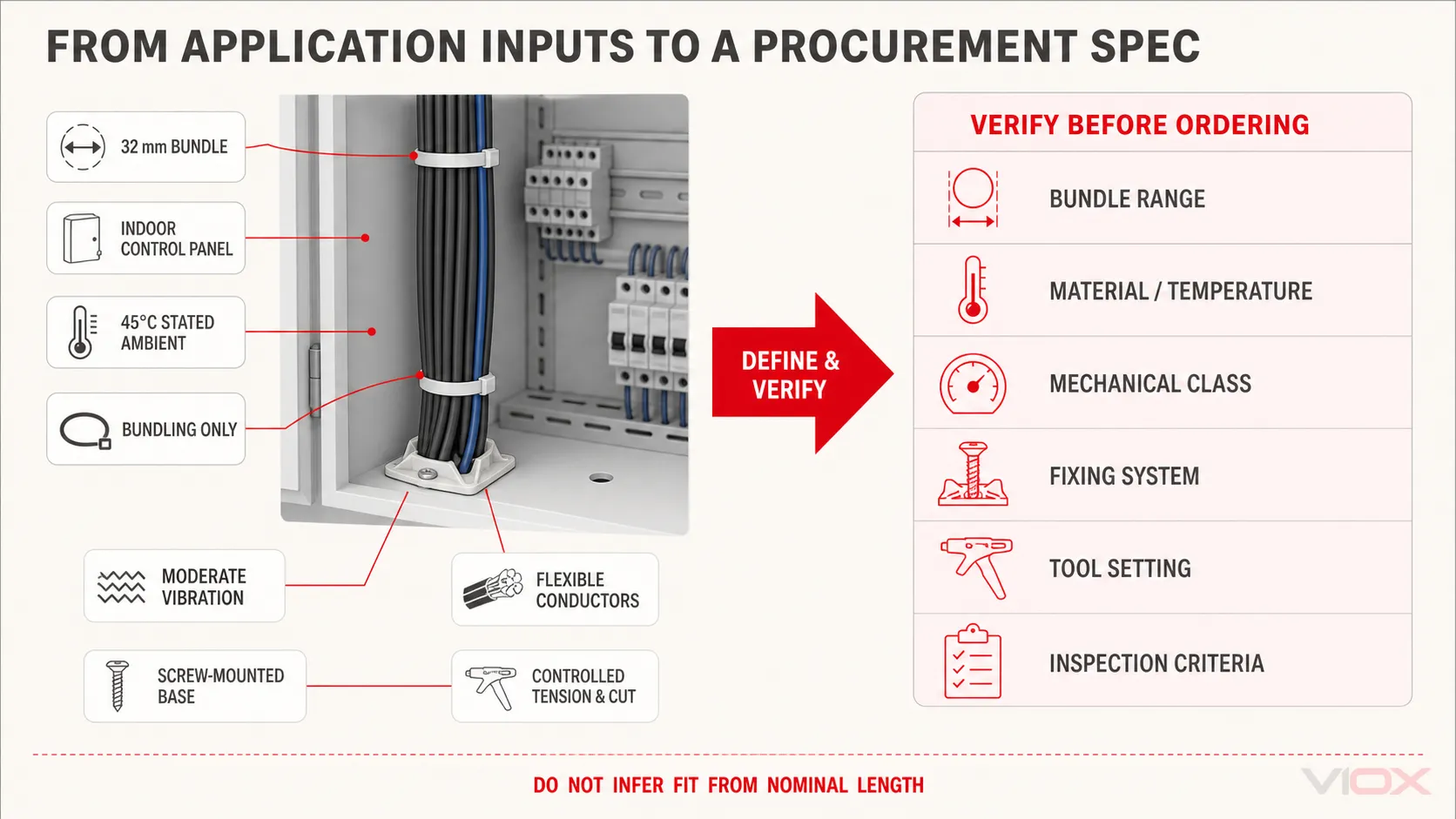
Contoh Pengerjaan: Mengubah Input Aplikasi menjadi Spesifikasi Pengikat Kabel
Pertimbangkan aplikasi panel kontrol dalam ruangan dengan input tetap berikut. Contoh ini menunjukkan proses pengambilan keputusan tanpa membuat nomor komponen VIOX atau memperlakukan label material generik sebagai spesifikasi akhir.
| Masukan (Input) | Persyaratan aplikasi | Konsekuensi pemilihan |
|---|---|---|
| Diameter bundel | 32 mm pada titik pemasangan | Pilih komponen yang rentang bundelnya mencakup 32 mm; jangan menyimpulkan kecocokan hanya dari panjang nominal |
| Fungsi | Hanya untuk pengikatan, bukan sebagai penyangga utama | Tentukan persyaratan pengamanan; sebuah S klasifikasi penyangga tidak diperlukan hanya untuk fungsi ini, meskipun persyaratan peralatan dan pasar tetap berlaku |
| Lingkungan | Panel dalam ruangan, suhu lingkungan maksimum yang dinyatakan 45°C | Rentang operasi terukur produk harus mencakup suhu di lokasi pengikatan, termasuk sumber panas lokal dan panas konduktor—bukan hanya suhu lingkungan ruangan |
| Kondisi mekanis | Getaran sedang | Bandingkan klasifikasi mekanis yang dipublikasikan, desain penguncian, retensi dudukan, dan konsistensi pemasangan daripada mengonversi kekuatan tarik menjadi beban kerja |
| Sensitivitas kabel | Konduktor kontrol fleksibel | Pilih konstruksi yang membatasi lekukan isolasi, seperti desain bergerigi luar yang sesuai atau desain dengan lekukan rendah lainnya |
| Pemasangan | Basis pemasangan dengan sekrup | Sesuaikan pengikat, slot basis pemasangan, sekrup, material panel, orientasi, dan persyaratan permukaan pemasangan sebagai satu sistem |
| Instalasi | Alat penegang dan pemotong terkontrol | Sesuaikan alat dengan jenis pengikat yang dipilih serta tentukan tegangan yang dapat diterima, pemotongan rata, dan kriteria inspeksi |
Output ini adalah spesifikasi pengadaan, bukan nomor produk:
- pengikat kabel untuk bundel 32 mm, dengan rentang penggunaan dan jarak bebas kepala yang memadai;
- material dalam ruangan dengan rentang operasi di atas suhu lokasi pengikat yang telah diverifikasi;
- klasifikasi mekanis yang sesuai untuk pengikatan di bawah getaran sedang;
- geometri kontak bundel yang cocok untuk isolasi konduktor fleksibel;
- perangkat pemasangan sekrup, pengencang, dan permukaan panel yang kompatibel;
- alat penegang dan pemotong yang sesuai dengan aplikasi dan kriteria inspeksi yang ditentukan; dan
- bukti sertifikasi dan penandaan yang diperlukan untuk pasar tujuan dan kategori peralatan.
Hanya setelah persyaratan ini ditetapkan, pembeli baru boleh membandingkan nomor komponen yang sebenarnya. Jika produk pilihan tidak memiliki perangkat pengencang, alat, deklarasi suhu, atau catatan persetujuan yang kompatibel, mengubah panjang pengikat saja tidak akan menyelesaikan ketidaksesuaian tersebut.
Standar dan Batasan Persetujuan
IEC 62275:2022 menetapkan persyaratan untuk pengikat kabel logam, non-logam, dan komposit serta perangkat pengencang terkait yang digunakan untuk mengatur atau mengamankan sistem kabel dalam instalasi listrik. Persyaratan tambahan dapat berlaku jika perangkat ini mendukung sistem kabel atau menjalankan fungsi lain di luar cakupan yang dinyatakan dalam standar.
Untuk aplikasi di Amerika Utara, UL 62275 dan CSA C22.2 No. 62275 didasarkan pada IEC 62275 tetapi mencakup perbedaan nasional. Penunjukan Tipe UL memberikan cara praktis bagi pembeli untuk membedakan metode kekuatan yang diuji dan jalur sertifikasi.
Sekilas tentang Penunjukan Tipe UL 62275
| Tipe UL 62275 | Evaluasi kekuatan | Jalur sertifikasi UL | Implikasi pemilihan |
|---|---|---|---|
| Tipe 1 / 11 | Klasifikasi pemutusan setelah pengondisian lingkungan | Diakui | Cocok untuk pengamanan dalam lingkup yang diteliti; klasifikasi tersebut tidak menetapkan kesesuaian sebagai penyangga utama |
| Tipe 2 / 21 | Ketahanan satu menit pada kekuatan yang dinyatakan setelah pengondisian lingkungan | Terdaftar | Cocok untuk pengamanan dalam lingkup yang diteliti; tidak ada S akhiran berarti kesesuaian sebagai penyangga utama tidak dapat disimpulkan |
| Tipe 2S / 21S | Ketahanan selama lima menit pada kekuatan yang dinyatakan setelah pengondisian lingkungan | Terdaftar | Diperiksa untuk aplikasi penyangga tertentu, bergantung pada penandaan produk, perangkat pengencang dan perangkat keras yang sesuai, permukaan pemasangan, dan kode kelistrikan yang berlaku |
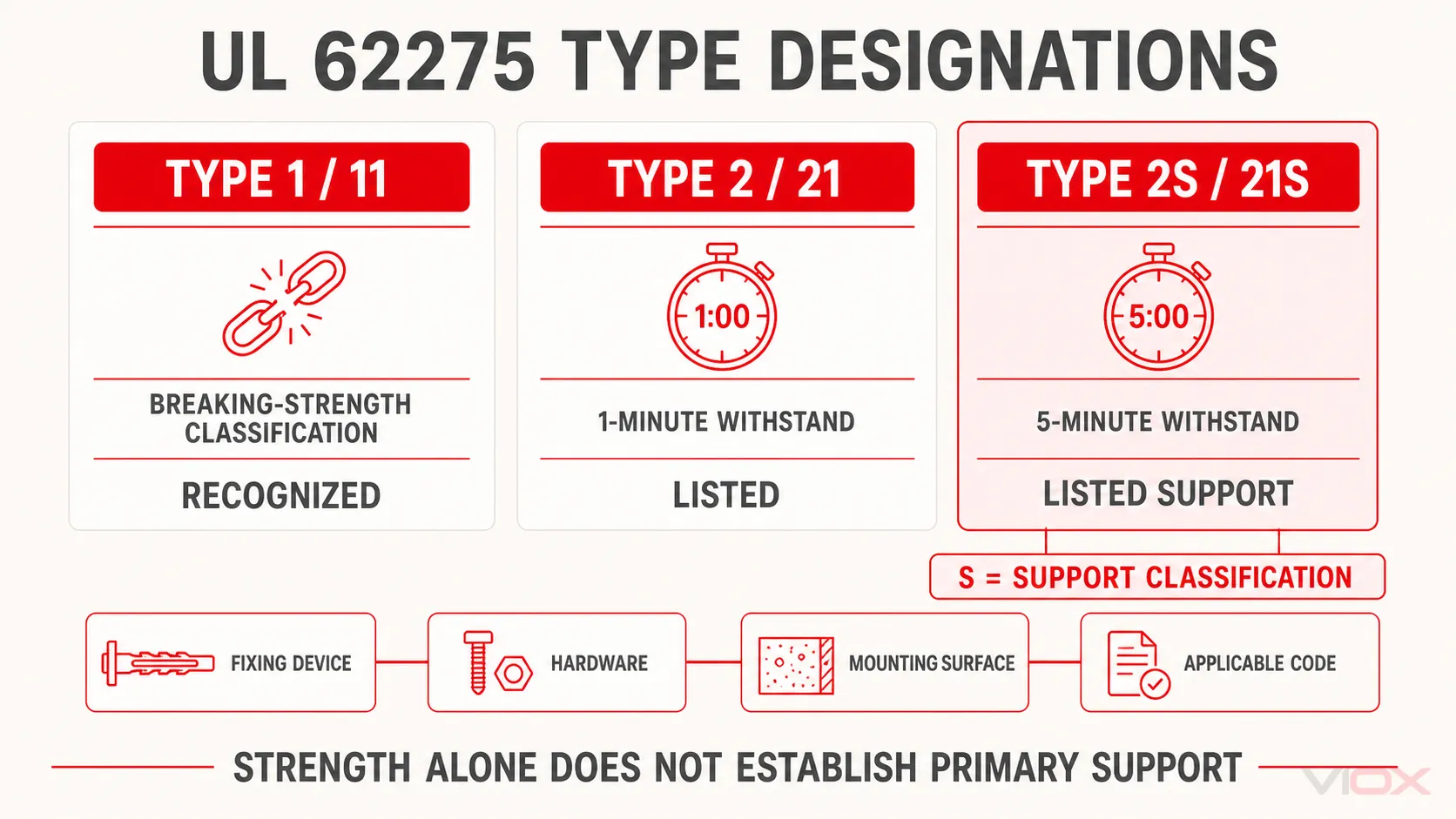
The S akhiran hanya berlaku untuk Tipe 2S dan Tipe 21S. UL menyatakan bahwa produk yang diperiksa untuk penyangga utama membawa akhiran ini; klasifikasi penyangga berlaku untuk konduit fleksibel, pipa fleksibel, atau kabel jika diizinkan oleh kode kelistrikan yang relevan. Konduit kaku tidak tercakup dalam klasifikasi ini. UL juga menyatakan bahwa produk penyangga menyatakan setidaknya 222 N (50 lb-f) kekuatan tarik loop dan/atau kekuatan mekanis perangkat pengencang, namun ambang batas tersebut tidak menggantikan evaluasi penggunaan akhir.
Tambahan 1 pada Tipe 11, 21, atau 21S berkaitan dengan penyelidikan lebih lanjut mengenai karakteristik material polimer, termasuk ketahanan termal jangka panjang. Hal ini tidak boleh diartikan sebagai tingkat kekuatan mekanis yang lebih tinggi daripada Tipe 1, 2, atau 2S yang bersesuaian. Perangkat yang seluruhnya berbahan logam diklasifikasikan sebagai Tipe 2 atau Tipe 2S, bukan tipe dengan akhiran 1.
Gunakan Panduan aplikasi pengikat kabel UL dan catatan sertifikasi untuk produk yang dipilih guna mengonfirmasi Tipe, status Terdaftar (Listed) atau Diakui (Recognized), penandaan, dan pemasangan yang diizinkan secara tepat. Nilai tarik yang tinggi tanpa Tipe, pengaturan pemasangan, dan konteks kode yang benar bukanlah bukti kesesuaian untuk penyangga utama.
Aplikasi Khusus yang Memerlukan Klasifikasi Tambahan
| Aplikasi khusus | Apa yang harus dicari | Batas |
|---|---|---|
| Pengikat kabel yang dapat dideteksi logam | Produk yang dirancang dan didokumentasikan untuk proses deteksi dan pengendalian kontaminasi fasilitas | Kemampuan deteksi bergantung pada produk dan sistem deteksi yang sebenarnya; pengikat berwarna tidak secara otomatis dapat dideteksi |
| Klasifikasi penanganan udara AH-1 | Produk logam bertanda UL untuk saluran penanganan udara dan ruang udara lingkungan yang ditentukan | Ini adalah klasifikasi Amerika Utara dan harus tercantum dalam penandaan atau dokumentasi produk |
| Klasifikasi penanganan udara AH-2 | Produk non-logam, komposit, atau berlapis non-logam bertanda UL yang telah diuji untuk pelepasan asap dan panas rendah | AH-2 berlaku untuk ruang udara lingkungan tertentu dan tidak mengizinkan pemasangan di dalam saluran fabrikasi |
Standar dan klasifikasi ini tidak menetapkan bahwa setiap pengikat kabel (cable tie) tersertifikasi atau dapat diterima di setiap instalasi. Berkas pengadaan harus mengidentifikasi pasar tujuan, jenis produk, jalur sertifikasi, perangkat pengencang, permukaan pemasangan, penandaan kemasan, persyaratan peralatan, dan kode yang berlaku.
Kesalahan Umum dalam Pemilihan Pengikat Kabel
- Memilih hanya berdasarkan panjang saja. Pengikat dapat melilit bundel tetapi tetap memiliki lebar, kinerja tarik, material, atau rentang bundel yang dapat digunakan yang salah.
- Memperlakukan kekuatan tarik sebagai peringkat beban kerja universal. Kesesuaian penyangga yang dipasang bergantung pada klasifikasi produk dan aplikasi secara menyeluruh.
- Mengasumsikan setiap pengikat hitam memiliki peringkat UV. Warna bukanlah pengganti untuk spesifikasi material dan ketahanan UV yang dinyatakan.
- Mengasumsikan setiap pengikat baja tahan karat adalah setara. Paduan, pelapisan, desain penguncian, kondisi tepi, kinerja tarik, dan peralatan dapat berbeda.
- Mengabaikan perangkat pengencang. Pemasangan dengan perekat, sekrup, tekan, tepi, dan magnet memiliki batasan kompatibilitas dan beban yang berbeda.
- Mengencangkan kabel atau selang sensitif secara berlebihan. Tegangan yang berlebihan dapat merusak isolasi, menyempitkan selang lunak, atau membuat pengikat menjadi terlalu tegang.
- Menyisakan ujung pengikat yang tajam atau terpotong dengan tidak rapi. Pemotong yang tidak sesuai dapat menimbulkan bahaya saat pemeliharaan dan penanganan.
- Menyalin peringkat dari produk yang terlihat serupa. Peringkat dan persetujuan hanya berlaku untuk nomor komponen dan dokumentasi produk yang telah diverifikasi.
- Menggunakan pengikat kabel sebagai penyangga utama tanpa verifikasi. Beberapa aplikasi pendukung memerlukan produk dan pengaturan pemasangan yang dievaluasi secara khusus.
- Membeli berdasarkan harga sebelum menentukan spesifikasi. Biaya satuan yang rendah tidak memperbaiki ketidaksesuaian dalam ukuran, lingkungan, pemasangan, atau persyaratan persetujuan.
Daftar Periksa Spesifikasi Pengikat Kabel (Cable Tie)
Gunakan daftar periksa ini saat membandingkan produk atau meminta penawaran harga.
| Bidang spesifikasi | Informasi yang harus disediakan |
|---|---|
| Aplikasi | Pengabelan panel, mesin, perutean luar ruangan, kendaraan, telekomunikasi, tenaga surya, kelautan, pengikatan sementara, atau penggunaan lain yang disebutkan |
| Dimensi bundel | Diameter atau selubung bundel minimum dan maksimum |
| Dimensi pengikat (tie) | Panjang, lebar, dan ruang yang diperlukan di sekitar kepala pengunci |
| Persyaratan mekanis | Kelas tarik yang dinyatakan atau persyaratan retensi khusus aplikasi |
| Bahan | Polimer, tingkat baja tahan karat, pelapis, atau konstruksi komposit yang tepat jika diperlukan |
| Lingkungan | Paparan dalam/luar ruangan, UV, suhu, kelembapan, bahan kimia, garam, getaran, atau korosi |
| Sensitivitas kabel | Apakah isolasi, selang, serat, atau pipa memerlukan kontak dengan indentasi rendah |
| Format penguncian | Mengunci sendiri (self-locking), dapat dilepas, bergerigi luar, pengunci bola (ball-lock), kepala ganda, atau tipe lain yang ditentukan |
| Metode pemasangan | Bundel bebas, perekat, sekrup, dorong, klip tepi, magnetik, atau pemasangan integral |
| Metode instalasi | Pemasangan manual atau alat penegang dan pemotong yang ditentukan |
| Warna dan identifikasi | Warna, penandaan, kemampuan deteksi, atau fungsi identifikasi yang diperlukan |
| Standards and approvals | Target pasar dan sertifikasi atau dokumentasi yang diperlukan |
| Pengemasan | Kuantitas per kantong, pelabelan, ketertelusuran, dan persyaratan label pribadi |
| Persyaratan komersial | Kuantitas pesanan, persyaratan sampel, jadwal pengiriman, serta kebutuhan OEM atau ODM |
Untuk perbandingan tingkat pemasok, gunakan panduan VIOX untuk produsen dan pemasok pengikat kabel (cable tie). Panduan ini memisahkan pengenalan merek produk dari kemampuan pabrik, dokumentasi, perkakas, kontrol kualitas, dan pengadaan yang penting dalam pengadaan industri yang berulang.
Pertanyaan yang Sering Diajukan
Bagaimana cara memilih ukuran pengikat kabel (cable tie) atau zip tie yang tepat?
Ukur bundel yang sudah jadi dan pilih pengikat kabel atau zip tie yang rentang diameter bundelnya mencakup ukuran tersebut. Kemudian periksa lebar, kinerja tarik, material, jarak kepala pengunci, lingkungan, dan metode pemasangan. Jangan memilih hanya berdasarkan panjang keseluruhan.
Material pengikat kabel (cable tie) apa yang terbaik untuk penggunaan di luar ruangan?
Tidak ada material universal untuk luar ruangan. Pemilihan bergantung pada paparan sinar UV, suhu, kelembapan, bahan kimia, kondisi layanan yang diharapkan, dan persetujuan yang diperlukan. Gunakan produk yang secara eksplisit ditandai atau didokumentasikan untuk kebutuhan luar ruangan atau paparan sinar UV.
Apakah pengikat kabel yang lebih lebar selalu lebih kuat?
Pengikat yang lebih lebar sering kali termasuk dalam keluarga produk dengan kekuatan lebih tinggi, namun lebar saja tidak menentukan performa tarik. Geometri penguncian, ketebalan, material, kualitas manufaktur, dan klasifikasi pengujian juga berpengaruh. Bandingkan data produk yang dinyatakan.
Kapan saya harus menggunakan pengikat kabel baja tahan karat (stainless steel)?
Pertimbangkan baja tahan karat jika aplikasi memerlukan kemampuan suhu yang lebih tinggi, ketahanan terhadap korosi, performa mekanis yang menuntut, atau daya tahan di luar jangkauan yang terverifikasi dari pengikat polimer. Pastikan paduan, pelapisan, perlindungan tepi, desain penguncian, dan peralatan yang digunakan sesuai untuk lingkungan sebenarnya.
Apakah kabel ties dapat digunakan kembali?
Hanya jika konstruksi produk dan instruksi produsen mendukung pelepasan atau penggunaan kembali. Pengikat pengunci mandiri standar sekali pakai biasanya harus diganti setelah dipotong atau dilepas paksa. Produk yang dapat digunakan kembali tetap perlu diperiksa kerusakannya dan performa penguncian yang tersisa.
Bisakah pengikat kabel menopang kabel listrik sendirian?
Tidak secara otomatis. Pengikat kabel (cable ties) umum biasanya digunakan untuk membundel dan memosisikan. Dalam sistem UL 62275, produk yang diteliti untuk aplikasi pendukung utama tertentu membawa penunjukan Tipe 2S atau 21S dan tetap memerlukan perangkat pengencang, perangkat keras, permukaan pemasangan, penandaan, dan penggunaan yang diizinkan oleh kode yang sesuai.
Apa arti UL 62275 Tipe 2S dan Tipe 21S?
Tipe 2S dan Tipe 21S adalah klasifikasi Terdaftar (Listed) yang dievaluasi dengan uji ketahanan lima menit dan diteliti untuk aplikasi pendukung tertentu. S mengidentifikasi klasifikasi pendukung; tambahan 1 pada Tipe 21S berkaitan dengan investigasi material polimer lebih lanjut, bukan tingkat kekuatan mekanis yang lebih tinggi. Penandaan produk dan batasan kode pemasangan tetap mengendalikan aplikasinya.
Informasi apa yang harus saya kirimkan ke pemasok pengikat kabel?
Sediakan rentang bundel, kinerja mekanis yang diperlukan, lingkungan, preferensi material, metode pemasangan, proses instalasi, target pasar, persyaratan sertifikasi, kuantitas, pengemasan, dan kebutuhan OEM. Rekomendasi nomor komponen tanpa input ini tidaklah lengkap.
Aturan Pemilihan Akhir
Pengikat kabel yang benar bukan sekadar pengikat terpanjang yang muat. Pengikat yang benar adalah nomor komponen yang rentang bundel, kinerja mekanis, material, batasan lingkungan, konstruksi penguncian, metode pengencangan, proses instalasi, dan bukti persetujuannya sesuai dengan aplikasi secara menyeluruh.
Untuk membandingkan konstruksi yang tersedia, tinjau Rangkaian pengikat kabel VIOX. Untuk penyesuaian aplikasi, kirimkan dimensi bundel, daya tahan yang diperlukan, lingkungan, metode pemasangan, target pasar, dan jumlah pesanan, alih-alih hanya meminta pengikat berdasarkan panjang atau warna saja.
Sumber
- IEC 62275:2022 — Sistem manajemen kabel: Pengikat kabel untuk instalasi listrik
- UL Solutions — Pengikat Kabel untuk Manajemen Kabel
- UL Solutions — Perangkat Pemosisian: Pengikat Kabel untuk Manajemen Kabel pada Instalasi Listrik
- HellermannTyton — Panduan Pemilihan Material untuk Pengikat Kabel
- Panduit — Data Produk dan Tabel Pemilihan Pengikat Kabel