Blog

A blog kategóriád

How to Choose the Right RCCB Sensitivity

Hogyan válasszuk ki a megfelelő RCCB érzékenységet

Understanding RCCB Sensitivity: The Foundation of Electrical Safety Selecting the right Residual Current Circuit Breaker (RCCB) sensitivity is one of the most critical decisions in electrical system design. The sensitivity rating—measured in milliamperes (mA)—determines how quickly an RCCB responds to earth leakage currents, directly impacting both personal safety and equipment protection. An improperly selected sensitivity […]

Hogyan válasszuk ki a megfelelő RCCB érzékenységet Tovább "

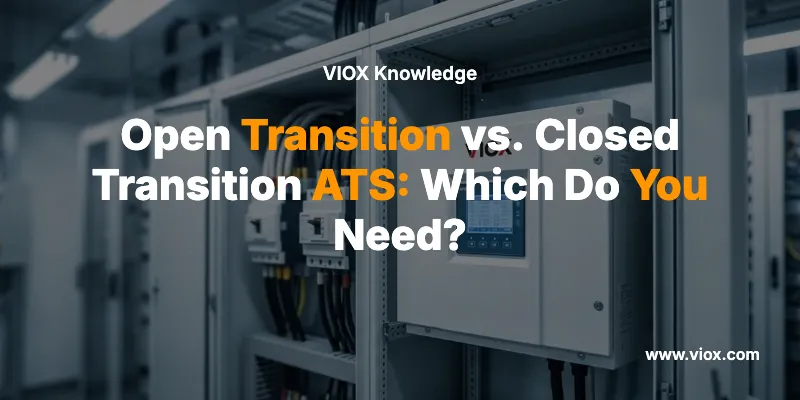
Open Transition vs. Closed Transition ATS: Which Do You Need?

Nyitott vagy zárt átmenetű ATS: Melyikre van szüksége?

Figure 1: A VIOX automatic transfer switch installed in an industrial electrical control panel. In the world of backup power, most specifiers obsess over amperage ratings or enclosure types. However, the most critical factor determining whether your facility experiences a seamless handover or a disruptive reboot lies in the switching logic: Open Transition vs. Closed

Nyitott vagy zárt átmenetű ATS: Melyikre van szüksége? Tovább "

Top 10 Time Relay Brands & Manufacturers

A világ 10 legjobb időrelé márkája és gyártója (2026-os frissítés)

In the world of industrial automation, the time relay is a small component with a massive responsibility. Whether it is controlling the star-delta startup of a 100kW motor or managing the pump cycles in a water treatment plant, the precision of a timer determines the stability of the entire system. For panel builders and procurement

A világ 10 legjobb időrelé márkája és gyártója (2026-os frissítés) Tovább "

Breather Plug vs. Breathable Cable Gland: Which is Best for Condensation?

Szellőződugó kontra szellőző kábeltömítés: Melyik a legjobb a kondenzáció ellen?

Condensation is the silent killer of outdoor electrical infrastructure. You can spec an IP68 enclosure, seal every gasket perfectly, and still find water pooling inside your panel after a cold night. Why? Because standard sealing keeps water out, but it also traps moisture in. As internal temperatures fluctuate, pressure differentials create a vacuum effect, sucking

Szellőződugó kontra szellőző kábeltömítés: Melyik a legjobb a kondenzáció ellen? Tovább "

1P vs 1P+N vs 2P: Single Pole vs. Double Pole Breaker Guide

Egypólusú vagy kétpólusú megszakító: Mikor használjunk 1P, 1P+N vagy 2P megszakítót?

Selecting the right circuit breaker pole configuration is one of the most critical—and frequently misunderstood—decisions in electrical system design. The difference between a single-pole (1P), single-pole with neutral (1P+N), and double-pole (2P) breaker determines not just whether your system works, but whether it protects equipment and personnel safely. Using the wrong configuration can leave a

Egypólusú vagy kétpólusú megszakító: Mikor használjunk 1P, 1P+N vagy 2P megszakítót? Tovább "

Fuse Holder vs. Fuse Switch Disconnector

Biztosítéktartó kontra biztosíték-szakaszoló kapcsoló: Működtetheti őket terhelés alatt?

You’re specifying equipment for a solar combiner box, a motor control panel, or a manufacturing facility—and your supplier asks a critical question: “Do you need a fuse holder or a fuse switch disconnector?” Your first instinct is probably cost-driven. A standard fuse holder costs $50–$100. A fused disconnect switch runs $200–$400. The difference feels significant

Biztosítéktartó kontra biztosíték-szakaszoló kapcsoló: Működtetheti őket terhelés alatt? Tovább "

Sizing Fuses for Bifacial Solar Panels: Handling the Extra Current Gain

Biztosítékok méretezése bifaciális napelemekhez: A többletáram kezelése

The rise of bifacial photovoltaic (PV) technology has revolutionized the solar industry, offering energy yield increases of up to 30% by capturing reflected light on the rear side of the module. However, this “bonus” energy comes with a critical engineering challenge: current gain. For electrical engineers and system designers, the variable nature of rear-side irradiance

Biztosítékok méretezése bifaciális napelemekhez: A többletáram kezelése Tovább "

Why Time Relay Contacts Fail on Inductive Loads: Understanding AC-1 vs. AC-15 Ratings

Miért hibásodnak meg az időrelé érintkezői induktív terheléseken: Az AC-1 és AC-15 besorolások megértése

Figure 1: Visual comparison showing the severe pitting and carbonization on a relay contact caused by inductive load arcing versus a pristine VIOX contact. It starts with a common scenario in industrial automation: a packaging line stops mid-shift. The maintenance technician traces the fault to a 24VDC solenoid valve that failed to close. Upon inspecting

Miért hibásodnak meg az időrelé érintkezői induktív terheléseken: Az AC-1 és AC-15 besorolások megértése Tovább "

RCBO Overload Class: 5kA vs 10kA vs 16kA Breaking Capacity Selection

RCBO Túlterhelési osztály: 5kA vs 10kA vs 16kA megszakítóképesség kiválasztása

Selecting the correct RCBO (Residual Current Breaker with Overcurrent protection) breaking capacity is not merely a box-ticking exercise in compliance; it is a fundamental engineering decision that dictates whether a fault is safely cleared or results in catastrophic equipment failure. In B2B electrical procurement and panel design, the breaking capacity (Icn) specification—typically 6kA, 10kA, or

RCBO Túlterhelési osztály: 5kA vs 10kA vs 16kA megszakítóképesség kiválasztása Tovább "

Kérjen árajánlatot most