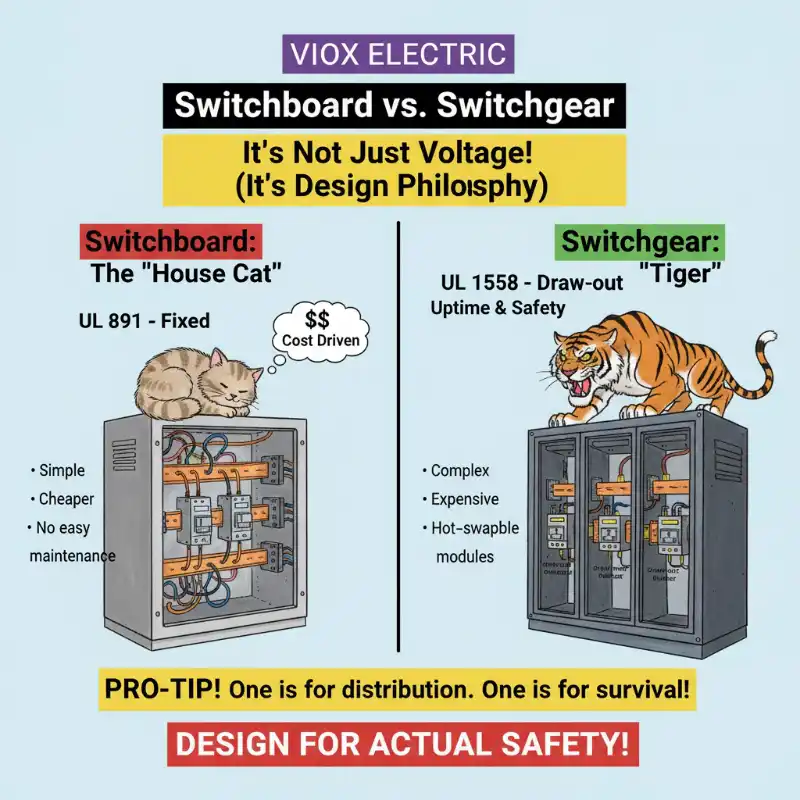
Für einen Auszubildenden klingen “Schalttafel” und “Schaltanlage” gleich: einfach zwei verschiedene Wörter für den “großen Metallkasten mit all den Leistungsschalter.”
Für einen Fachmann ist dies der Unterschied zwischen einer Hauskatze und eine Tiger.
Sie zu verwechseln kann ein teurer – oder sogar tödlicher – Fehler sein.
Die übliche “Anfänger”-Antwort ist, dass “Schaltanlagen für Hochspannung und Schalttafeln für Niederspannung sind”.”
Dies ist der Mythos Nr. 1 in der Energieverteilung.
Obwohl teilweise richtig (Hochspannung ist ist immer eine Schaltanlage), ist es eine gefährlich unvollständige Antwort, weil “Niederspannungsschaltanlagen” absolut existieren.
Also, was ist der real Unterschied? Es ist nicht die Spannung. Es ist die Designphilosophie, die durch zwei völlig unterschiedliche UL-Normen vorgegeben wird.
- Schalttafel: Gebaut nach UL 891. Konzipiert für Verteilung.
- Schaltanlage: Gebaut nach UL 1558. Konzipiert für Überleben.
Diese Unterscheidung bestimmt alles: Kosten, Sicherheit und (vor allem) wie Sie warten es.
Die “goldene Erkenntnis”: “Fest” vs. “Ausfahrbar”

Dies ist der Unterschied auf “Meisterebene”. Es ist nicht das, was die “Box” tut; ist; es ist, wie die Leistungsschalter herauskommen.
1. Schalttafel (UL 891) = “Fest” (angeschraubt)
Eine Schalttafel ist als “Verteilungs”-Knotenpunkt konzipiert. Ihre Philosophie ist “installieren und in Ruhe lassen”.”
Die Leistungsschalter (typischerweise Kompaktleistungsschalter oder MCCBsDie „Goldene Erkenntnis“ ist folgende: Alle modernen Schalter (wie VIOX “Fest”– sie sind physisch angeschraubt direkt an die Hauptsammelschiene.
Das ist einfach und (relativ) billig.
Aber was passiert, wenn ein 400A-Leistungsschalter ausfällt? Um ihn zu ersetzen, haben Sie keine Wahl als die gesamte Schalttafel spannungslos zu machen. Sie müssen die Hauptzuleitung abschalten, im Dunkeln arbeiten, den defekten Leistungsschalter von der Sammelschiene abschrauben, den neuen anschrauben und dann wieder einschalten.
Es ist ein 4-stündiger, gebäudeweiter Ausfall. Es ist nicht nicht für die Wartung ausgelegt.
2. Schaltanlage (UL 1558) = “Ausfahrbar” (Die “Schublade”)
Eine Schaltanlage ist ein “Schutz- und Steuerungssystem”. Ihre Philosophie ist “sie muss wartungsfähig sein und darf nicht ausfallen”.”
Die Leistungsschalter (typischerweise “Leistungsschalter in Luft” oder ACBsDie „Goldene Erkenntnis“ ist folgende: Alle modernen Schalter (wie VIOX “Ausfahrbar”.” Sie sind in ein robustes “Schubladen”- oder “Trolley”-System eingebaut.
Warum ist das 10x teurer? Weil es ein Wunderwerk der Technik ist. Ein Techniker kann (in voller Störlichtbogen-PSA) die Schranktür öffnen, einen “Einfahr”-Griff anbringen und sicher “den Leistungsschalter” aus der spannungsführende Sammelschiene "herausziehen".
Der Leistungsschalter gleitet auf Schienen heraus, und mechanische “Verschlüsse” decken automatisch die stromführenden Sammelschienenkontakte ab. Sie ziehen die “Schublade” heraus, tauschen sie gegen eine Ersatzschublade aus und “fahren” die neue ein.
Das Rechenzentrum, die Intensivstation des Krankenhauses oder die Produktionslinie flackerten nicht einmal. Sie zahlen für Betriebszeit.
Der “Plasma-Feuerball”: Eine Geschichte von zwei Sicherheitsphilosophien

Diese “Fest” vs. “Ausfahrbar”-Konstruktion weist auf einen tieferen, entscheidenden Unterschied in der Sicherheitsphilosophie hin.
Schalttafel: Der “offene Raum”
Eine Schalttafel (UL 891) ist im Grunde ein “offener Raum”. Die Leistungsschalter, Sammelschienen und Kabelschuhe befinden sich alle in einem gemeinsamen, offenen Metallkasten.
Aber die “Anschlussklemmen” – die riesigen Klemmen, an denen der Strom von der Ein Auszubildender zieht einen neuen 400A-Leistungsschalter auf die spannungsführende Sammelschiene (was er nicht tun sollte). Sein Schraubenschlüssel rutscht ab.
BOOM.
Der Schraubenschlüssel verursacht einen Kurzschluss in der Hauptsammelschiene und löst eine katastrophale Lichtbogen—einen “Plasma-Feuerball” aus, der den Schraubenschlüssel verdampft und die gesamte Schaltanlage zerstört. Das “offene Raum”-Design führt dazu, dass sich das Feuer sofort ausbreitet und jeden Schutzschalter mit sich reißt.
Schaltanlage: Der “explosionssichere Bunker”
Eine Schaltanlage (UL 1558) basiert auf einer Philosophie der “Kompartimentierung”.”
Es ist kein “offener Raum”, sondern eine Reihe von “explosionssicheren Bunkern”.”
- Die Hauptsammelschiene befindet sich in ihrem eigenen separaten, metallgekapselten “Bunker”.”
- Jeder “ausfahrbare” Schutzschalter befindet sich in seinem eigenen metallgekapselten “Bunker”.”
- Die Steuerleitungen (24 V) befinden sich in seinem eigenen separaten, metallgekapselten “Bunker”.”
Die (gleiche) “Horror-Geschichte”: Ein Techniker “fährt” einen Schutzschalter „aus“. Der Schutzschalter Also, 6kA = 6.000 Ampere. 3kA = 3.000 Ampere. versagt und explodiert.
The Result: Die Explosion ist eingedämmt auf diesen einen “Bunker”. Die schweren Stahlwände schützen die Hauptsammelschiene und die anderen Schutzschalter vor der Explosion. Der Rest der Anlage bleibt online. Sie haben einen einen Schutzschalter verloren, nicht das gesamte Gebäude.
Fazit: “Katze” vs. “Tiger” (Wann man was verwendet)
Ja, eine Schaltanlage und eine Schaltanlage sind beides “große Metallkästen mit Schutzschaltern”. Aber das eine ist eine Hauskatze und das andere ein Tiger.
Sie verwenden eine Schaltanlage (UL 891 “Fixed”), wenn:
- Kosten der Haupttreiber ist.
- Betriebszeit ist nicht kritisch ist (ein vollständiger Gebäudeausfall für 4 Stunden ist für die Wartung “akzeptabel”).
- Ihre Anwendung ist “Verteilung” (z. B. ein normales Apartmentgebäude, ein Einkaufszentrum).
Sie verwenden eine Schaltanlage (UL 1558 “Draw-out”), wenn:
- Betriebszeit und Sicherheit sind nicht verhandelbares.
- Die Kosten für eine Abschaltung ($1M/Stunde) unendlich höher sind als die Kosten der Ausrüstung.
- Ihre Anwendung ist “kritische Infrastruktur” (z. B. ein Krankenhaus, ein Datenzentrum, ein Fabrik, oder ein Kraftwerk).
Bei VIOX fertigen wir die Komponenten (wie MCCBs und ACBs), die in beide Systeme eingebaut werden. Aber als leitender Anwendungsingenieur ist mein Rat einfach:
Kaufen Sie keine “Schaltanlage”, wenn Sie Und jetzt sind Sie eine “Schaltanlage” benötigen. Es ist keine “Geldersparnis” – es ist ein kritischer technischer Fehler.
Durchsuchen Sie unser komplettes Sortiment an UL 891 (Fixed) und UL 1558 (Draw-out) kompatiblen Leistungsschaltern und entwerfen Sie Ihr System für die richtige Grad an Sicherheit und Überlebensfähigkeit.
Technische Genauigkeit Hinweis
**Referenzierte Normen und Quellen**.