Monday morning, 7:15 AM. The health inspector walks into your food processing plant, points at the motor control enclosure in the packaging area, and says four words that stop production cold: “This fails the inspection.”
The enclosure is NEMA 3R—weather-resistant, rated for outdoor use, perfect for rain and sleet. Except this isn’t a gentle outdoor environment. Twice per shift, your crew hits every surface in that room with high-pressure hoses and caustic cleaning solution, and NEMA 3R enclosures are tested for falling rain, not 1,000 PSI spray from three feet away. Water found its way past the gaskets during the 6 AM washdown. By the time the inspector arrived, moisture was visible inside the enclosure, condensation was forming on the contactor coils, and your entire production line—scheduled to run 2,400 cases that day—sat idle.
The fix: Pull the NEMA 3R, order a NEMA 4X stainless steel enclosure (\$1,850 vs. the \$680 you paid for the 3R), wait four days for delivery, rewire everything, and resubmit for inspection. Total cost: \$47,000 in lost production, labor, and premium shipping. The root cause? Falling into The Washdown Trap—assuming any outdoor-rated enclosure works in wet environments.
So how do you match NEMA enclosure ratings to your actual environment without under-protecting (failed inspections, equipment damage) or over-engineering (30-60% cost premiums for features you don’t need)?
Quick Answer: NEMA Ratings at a Glance
Most engineers miss this: The Higher-Number Lie. NEMA 12 isn’t “better” than NEMA 4. They’re designed for completely different environments—NEMA 12 for indoor dust and drips, NEMA 4 for outdoor hose-down. The numbers don’t represent a progressive scale of protection; they represent distinct environmental test profiles.
NEMA ratings, defined by ANSI/NEMA 250-2020, classify enclosures based on the environmental tests they pass. Indoor types (1, 2, 5, 12, 12K, 13) protect against dust, drips, and non-corrosive liquids. Outdoor types (3, 3R, 3S, 4, 4X, 6, 6P) add protection against rain, snow, windblown dust, and in some cases, hose-directed water or submersion. The “X” suffix (3X, 4X) indicates added corrosion resistance—typically stainless steel or fiberglass construction.
Here’s how the most common NEMA types compare:
| NEMA-Typ | Standort | Protection Against | Typischer Kostenbereich | Beste Anwendungsfälle |
| 1 | Innenbereich | Falling dirt, accidental contact | \$50-\$200 | Clean indoor panels, office environments |
| 3R | Im Freien | Rain, sleet, snow, falling dirt | \$150-\$400 | Outdoor utility, metering, general service |
| 4 | Im Freien | Rain, hose-down, windblown dust | \$300-\$800 | Washdown areas (non-corrosive), outdoor industrial |
| 4X | Im Freien | All Type 4 + corrosion resistance | \$600-\$1,850 | Coastal, marine, chemical, food processing |
| 12 | Innenbereich | Dust, lint, drips, non-corrosive liquids | \$120-\$350 | Manufacturing, factories, non-washdown industrial |
| 13 | Innenbereich | Type 12 + oil/coolant seepage | \$180-\$450 | Machine tool environments, CNC enclosures |
Notice the functional divide: outdoor types withstand weather and hose-down, while indoor types handle dust and splashes. When you fall into The Washdown Trap—choosing 3R for a hose-down environment because “it’s outdoor-rated”—you’re selecting a rain-tested enclosure for a pressure-spray application. That’s the \$47K mistake from the opening.
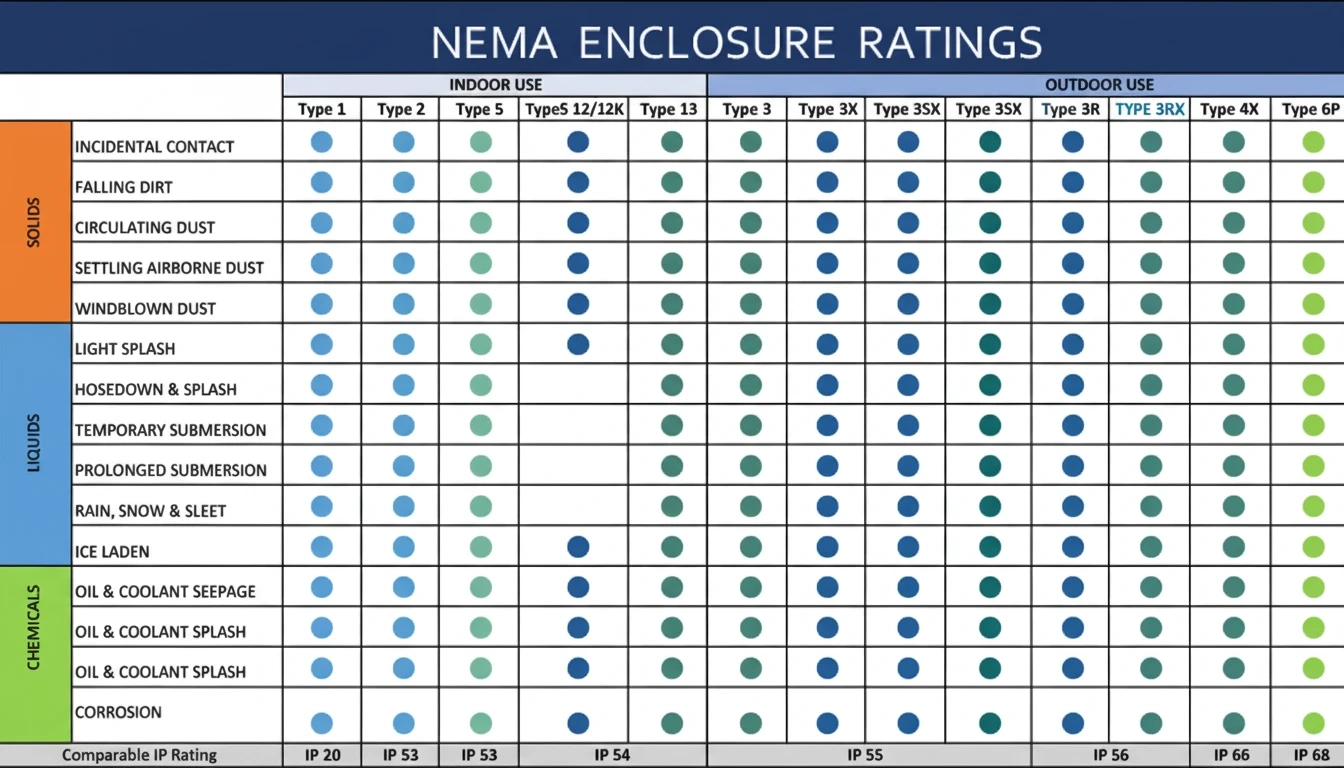
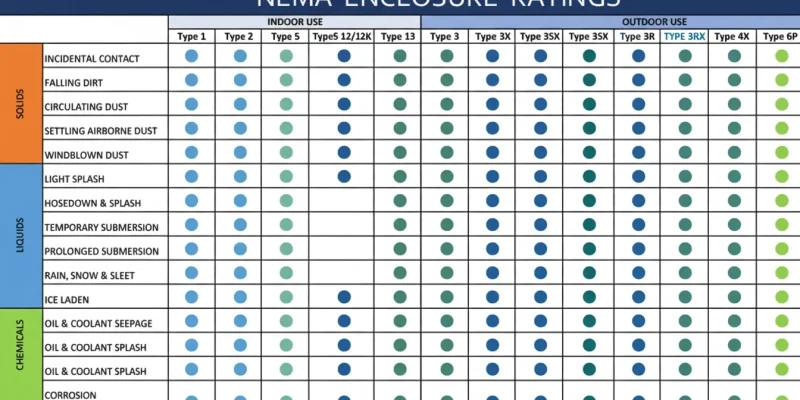
Figure 1: NEMA rating comparison matrix showing protection features for Types 1 through 6P. This chart provides a quick reference for matching enclosure types to environmental hazards—dust protection, water exposure levels, and corrosion resistance.
The Standards Foundation: ANSI/NEMA 250-2020
NEMA doesn’t just assign numbers to boxes and call it a day. The rating system is backed by ANSI/NEMA 250-2020, Enclosures for Electrical Equipment (1,000 Volts Maximum), approved December 8, 2020. This standard defines the construction requirements, environmental test methods, and marking specifications for every NEMA type.
What ANSI/NEMA 250 actually tests:
Each NEMA type must pass specific design tests defined in Section 5 of the standard. These aren’t abstract ratings—they’re measurable environmental simulations:
- Rain test (Section 5.4): Enclosure exposed to falling water at 5 inches per hour for 30 minutes. Water must not enter and affect operation. Types 3, 3R, 3S, 4, 4X, 6, 6P pass this test.
- Hose-down test (Section 5.7): Enclosure sprayed with 65 GPM water stream from a 1-inch nozzle at 65 PSI from all angles. No water ingress allowed. Only Types 4 and 4X pass this test—not Type 3R.
- Dust tests (Section 5.5): Windblown dust, circulating dust, and settling dust tests. Type 3/4 resist windblown dust. Type 12 resists circulating dust and lint. Type 5 is dust-tight (complete exclusion).
- Corrosion tests (Section 5.10): Salt spray (600 hours for outdoor X-variants) and CO2/SO2/air exposure. Types 3X, 3RX, 3SX, 4X, and 6P require added corrosion protection and must pass these extended tests.
- Submersion tests (Sections 5.11-5.12): Type 6 withstands temporary submersion (occasional, limited depth). Type 6P handles prolonged submersion.
NEMA doesn’t certify enclosures. Manufacturers self-declare NEMA compliance, and third-party testing labs (NRTLs like UL) list products to UL 50 (construction) and UL 50E (environmental) standards, which align with NEMA 250. When you spec an enclosure, look for the UL listing mark—that’s your verification it passed the tests.
Pro-Tipp #1: NEMA types define environmental protection, but they don’t address thermal management. A sealed NEMA 4X enclosure can’t use a simple fan that draws outside air—that would compromise the seal. You’ll need closed-loop cooling (air conditioners, heat exchangers) which adds \$800-\$3,500 to your system cost. If your application doesn’t need hose-down protection, choosing NEMA 12 with filtered ventilation saves significant cooling costs.
Indoor NEMA Types: When Clean Environments Need Protection
Indoor NEMA types (1, 2, 5, 12, 12K, 13) are designed for controlled environments where rain and outdoor weather aren’t concerns. But “indoor” doesn’t mean “no protection needed”—these ratings address dust, drips, splashes, and in industrial settings, oil and coolant exposure.
NEMA Type 1: General Purpose Indoor
Schutz: Basic protection against accidental contact with live parts and limited falling dirt. Not dust-tight. Minimal protection against water (drip/light splash only).
Anwendungen: Clean office environments, residential panels, equipment rooms with controlled conditions. Think panelboards in commercial buildings, PLC cabinets in climate-controlled server rooms, and indoor switch enclosures where dust and moisture aren’t concerns.
Kosten: \$50-\$200 for typical sizes (12×12×6 to 24×24×10 inches).
When it fails: Put a Type 1 enclosure in a dusty factory, and circulating dust will enter through ventilation openings and settle on components. Put it where condensation forms (near HVAC equipment, laundry facilities), and moisture ingress can cause corrosion or Kurzschlüsse.
NEMA Type 2: Indoor with Drip Protection
Schutz: Similar to Type 1 with enhanced protection against dripping and light splashing water. Still not dust-tight.
Anwendungen: Laundry facilities, cooling equipment rooms, areas with condensation but not heavy splashing. Less common than Types 1 or 12 in industrial settings.
Kosten: \$80-\$250 for typical sizes.
NEMA Type 5: Dust-Tight Indoor
Schutz: Completely dust-tight (no dust ingress), plus protection against dripping and light splashing water. This is the highest dust protection rating for indoor enclosures.
Anwendungen: Steel mills, cement plants, powder handling facilities—anywhere airborne dust is a major concern. Also suitable for environments with lint or fibers (textile mills).
Kosten: \$200-\$500 for typical sizes. Gasket construction and sealing add cost compared to Type 1.
Montagmorgen, 7:15 Uhr. Der Gesundheitsinspektor betritt Ihre Lebensmittelverarbeitungsanlage, zeigt auf das Motorsteuerungsgehäuse im Verpackungsbereich und sagt vier Worte, die die Produktion abrupt stoppen: „Das ist nicht bestanden.“ Das Gehäuse ist NEMA 3R – wetterfest, für den Außenbereich geeignet, perfekt für Regen und Schneeregen. Nur ist dies keine sanfte Außenumgebung. Zweimal pro Schicht bearbeitet Ihre Crew jede Oberfläche in diesem Raum mit Hochdruckschläuchen und ätzender Reinigungslösung, und NEMA 3R-Gehäuse werden auf fallenden Regen getestet, nicht auf 1.000 PSI-Sprays aus einem Meter Entfernung. Wasser fand während der 6-Uhr-Wäsche seinen Weg an den Dichtungen vorbei. Als der Inspektor eintraf, war Feuchtigkeit im Inneren des Gehäuses sichtbar, Kondenswasser bildete sich auf den Schützspulen, und Ihre gesamte Produktionslinie – die an diesem Tag 2.400 Kisten produzieren sollte – stand still.
Die Lösung: Ziehen Sie die NEMA 3R ab, bestellen Sie ein NEMA 4X-Edelstahlgehäuse (\$1.850 gegenüber den \$680, die Sie für die 3R bezahlt haben), warten Sie vier Tage auf die Lieferung, verkabeln Sie alles neu und reichen Sie es erneut zur Inspektion ein. Gesamtkosten: \$47.000 an Produktionsausfall, Arbeitskosten und Premium-Versand. Die Ursache? Reinfallen in
Schutz: Die Washdown-Falle.
Anwendungen: – davon ausgehen, dass jedes für den Außenbereich geeignete Gehäuse in feuchten Umgebungen funktioniert.
Kosten: Wie ordnen Sie also.
When it works: Gehäuseschutzarten an Ihre tatsächliche Umgebung an, ohne zu wenig Schutz zu bieten (fehlgeschlagene Inspektionen, Geräteschäden) oder zu viel zu konstruieren (30-60%-Kostenaufschläge für Funktionen, die Sie nicht benötigen)?.
When it fails: Kurze Antwort: NEMA-Schutzarten auf einen Blick.
Die meisten Ingenieure übersehen Folgendes:
Schutz: Die Lüge der höheren Zahl.
Anwendungen: . NEMA 12 ist nicht „besser“ als NEMA 4. Sie sind für völlig unterschiedliche Umgebungen konzipiert – NEMA 12 für Staub und Tropfen in Innenräumen, NEMA 4 für Schlauchreinigung im Freien. Die Zahlen stellen keine progressive Schutzskala dar; sie stellen unterschiedliche Umweltprüfprofile dar.
Kosten: NEMA-Schutzarten, definiert durch ANSI/NEMA 250-2020, klassifizieren Gehäuse basierend auf den bestandenen Umweltprüfungen. Innentypen (1, 2, 5, 12, 12K, 13) schützen vor Staub, Tropfen und nicht korrosiven Flüssigkeiten. Außentypen (3, 3R, 3S, 4, 4X, 6, 6P) bieten zusätzlichen Schutz vor Regen, Schnee, windgepeitschtem Staub und in einigen Fällen vor schlauchgerichtetem Wasser oder Untertauchen. Das Suffix „X“ (3X, 4X) weist auf eine erhöhte Korrosionsbeständigkeit hin – typischerweise Edelstahl- oder Glasfaserkonstruktion.
Pro-Tipp #2: So schneiden die gängigsten NEMA-Typen im Vergleich ab:.

Figure 2: Construction differences between NEMA 12 (indoor gasketed), NEMA 4 (outdoor hose-down sealed), and NEMA 4X (corrosion-resistant stainless steel). Notice the gasket sealing, material specifications, and intended application environments for each type.
Outdoor NEMA Types: Rain, Hose-Down, and The Washdown Trap
Schutz gegen The Washdown Trap catches engineers: assuming all outdoor ratings handle high-pressure water.
NEMA Type 3 and 3R: Weatherproof Outdoor
Type 3 Protection: Herabfallender Schmutz, versehentlicher Kontakt.
Saubere Innenraumplatten, Büroumgebungen 3R.
Anwendungen:
- Typ 3: Construction sites, ship docks, outdoor industrial equipment in dusty environments.
- Regen, Schneeregen, Schnee, herabfallender Schmutz Versorgungsunternehmen im Freien, Messung, allgemeiner Service.
Kosten: Type 3R runs \$150-\$400 for typical sizes. Type 3 adds 20-30% for enhanced gasket sealing.
Regen, Schlauchreinigung, windgepeitschter Staub Waschbereiche (nicht korrosiv), industrielle Außenbereiche do not 4X The Washdown Trap.
NEMA Type 3S: Ice-Operable Outdoor
Schutz: Alle Typ 4 + Korrosionsbeständigkeit.
Anwendungen: Küsten-, Meeres-, Chemie-, Lebensmittelverarbeitung.
Kosten: \$250-\$600 for typical sizes. Ice-resistant mechanisms and heated options add cost.
Staub, Fusseln, Tropfen, nicht korrosive Flüssigkeiten
Typ 4 Schutz: Alle Schutzarten von Typ 3 plus Schlauchwasser (Abschnitt 5.7 Test: 246 l/min bei 4,5 bar aus allen Winkeln). Dies ist der entscheidende Unterschied – Typ 4 Dichtungen müssen direktem Sprühstrahl standhalten, nicht nur fallendem Regen.
Typ 4X Schutz: Alle Schutzarten von Typ 4 plus Korrosionsbeständigkeit (600-Stunden-Salzsprühnebeltest, CO2/SO2-Exposition). Erfordert Edelstahl, Fiberglas oder korrosionsbeständige Materialien.
Anwendungen:
- Typ 4: Waschbereiche mit Baustahl akzeptabel – Lebensmittelverarbeitung (nicht korrosive Zonen), Getränkeanlagen, pharmazeutische Reinräume, industrielle Außengeräte mit periodischer Schlauchreinigung.
- Typ 4X: Korrosive Umgebungen – Küsten-/Marineinstallationen, chemische Verarbeitung, Abwasserbehandlung, Öl- und Gasplattformen, jede Außen- oder Waschumgebung mit Salz, Chemikalien oder korrosiven Atmosphären.
Kosten:
- Typ 4 (Baustahl): \$300-\$800 für typische Größen
- Typ 4X (Edelstahl 304): \$600-\$1.850 für typische Größen – oft doppelt so teuer wie Typ 4
Dies ist der Scheideweg 3R vs. 4X: Die häufigste Entscheidung für Außengehäuse. Fragen Sie sich: “Wird dieses Gehäuse jemals mit einem Schlauch gereinigt, oder ist es nur Regen ausgesetzt?” Wenn eine Schlauchreinigung möglich ist (Wartungsreinigung, nahegelegene Waschvorgänge), benötigen Sie Typ 4 oder 4X. Wenn es sich wirklich nur um Regen handelt, spart Typ 3R 50-60% gegenüber 4X.
Pro-Tipp #3: Die Installationsausrichtung ist für die Entwässerung wichtig. NEMA 3R- und 4-Gehäuse haben Ablauflöcher oder Entwässerungsvorrichtungen an der Unterseite. Montieren Sie das Gehäuse waagerecht und gemäß den Anweisungen des Herstellers – Neigen oder Umdrehen kann Wasser im Inneren einschließen. Überprüfen Sie die Montageanleitung; einige Gehäuse sind nur für die vertikale Wandmontage zugelassen, nicht für die horizontale Oberflächenmontage.
NEMA Typ 6 und 6P: Tauchfähige Gehäuse
Typ 6 Schutz: Alle Schutzarten von Typ 4 plus vorübergehendes Eintauchen in Wasser (gelegentliches Eintauchen in begrenzter Tiefe für begrenzte Zeit, gemäß den Herstellerspezifikationen – typischerweise 1,8 Meter für 30 Minuten).
Typ 6P Schutz: Längeres Eintauchen in größerer Tiefe (gemäß Herstellerangabe). Nicht für den kontinuierlichen Unterwasserbetrieb vorgesehen, kann aber längere Überschwemmungen oder vorübergehende Unterwasserinstallationen bewältigen.
Anwendungen:
- Typ 6: Schächte, Versorgungsschächte, Tunnel, Pumpstationen – überall dort, wo vorübergehende Überschwemmungen möglich sind.
- Typ 6P: Abwasserhebeanlagen, Sumpfpumpensteuerungen, Installationen in Überschwemmungsgebieten.
Kosten: \$800-\$2.500 für typische Größen. Tauchfähige Dichtungen, Kabelverschraubungen und Abdichtungen verursachen erhebliche Kosten.
Selten in den meisten industriellen Anwendungen: Sofern Sie nicht in der Wasser-/Abwasserwirtschaft oder in überschwemmungsgefährdeten Gebieten tätig sind, benötigen Sie keinen Typ 6/6P. Typ 4X bewältigt die meisten rauen Außenumgebungen ohne den Aufpreis für das Eintauchen.
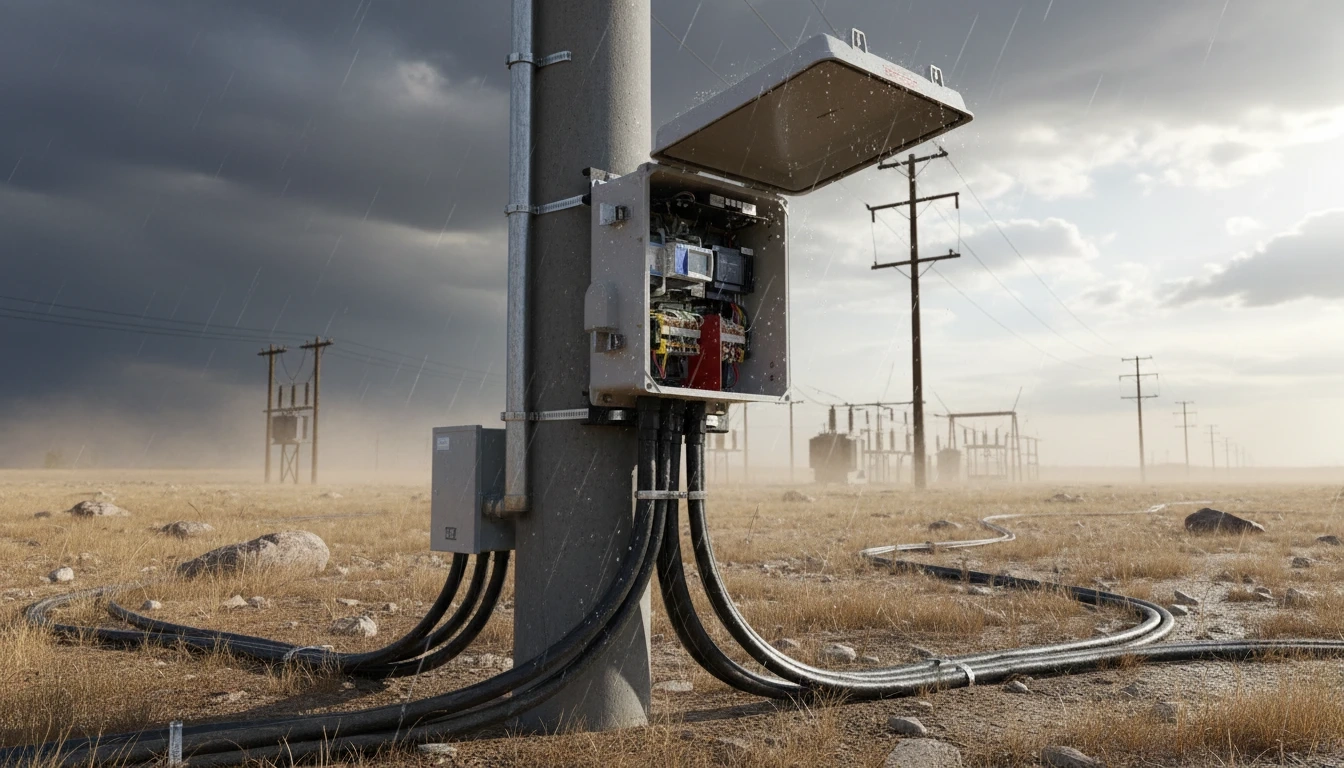
Abbildung 3: Reale NEMA-Gehäuseinstallation im Freien an einem Strommast. Diese Art der Installation erfordert typischerweise NEMA 3R (nur Regen) oder NEMA 4X (wenn Schlauchwartung oder Küstenkorrosion ein Problem darstellt). Die korrekte Montageausrichtung gewährleistet die Entwässerung gemäß den Herstellerspezifikationen.
Die Korrosions-“X”-Varianten: Wann sich Edelstahl lohnt
Das Suffix “X” in den NEMA-Bewertungen (3X, 3RX, 3SX, 4X, 6P) signalisiert Korrosionsbeständigkeit. Dies ist kein geringfügiges Upgrade – es ist eine grundlegende Materialänderung, die erweiterte Korrosionstests und typischerweise einen Preisaufschlag von 40-150% auslöst. Willkommen zu Der Korrosionssteuer.
Was “X” tatsächlich erfordert (ANSI/NEMA 250-2020 Abschnitt 5.10):
- 600-Stunden-Salzsprühnebeltest (X-Varianten für den Außenbereich): Das Gehäuse wird 600 Stunden lang kontinuierlich einem 5% NaCl-Salznebel ausgesetzt. Es sind keine Korrosion oder Funktionsbeeinträchtigungen zulässig.
- CO2/SO2/Luft-Korrosionstest: 1.200-stündige Exposition gegenüber einem korrosiven Gasgemisch, das industrielle Atmosphären simuliert.
- Materialanforderungen (Abschnitt 3.5.7): Edelstahl (304 oder 316), glasfaserverstärktes Polyester, Polycarbonat oder andere korrosionsbeständige Materialien mit geeignetem Oberflächenschutz.
Kostenaufschlüsselung für Typ 4 vs. 4X (18×16×8-Zoll-Wandgehäuse):
- Typ 4 (Baustahl, pulverbeschichtet): \$450-\$650
- Typ 4X (Edelstahl 304): \$850-\$1.200 (+89-85% Aufpreis)
- Typ 4X (Edelstahl 316): \$1.200-\$1.850 (+167-185% Aufpreis)
- Typ 4X (Fiberglas): \$700-\$1.100 (+56-69% Aufpreis)
Wann sich die Korrosionssteuer lohnt:
- Küsten- und Meeresumgebungen: Innerhalb von 1,6 km von Salzwasser beschleunigt Salzsprühnebel die Korrosion dramatisch. Baustahl Typ 4 kann in 6-18 Monaten Rost aufweisen. Edelstahl 4X hält 15-25+ Jahre.
- Chemische Verarbeitung: Exposition gegenüber Säuren, Basen, Lösungsmitteln oder korrosiven Dämpfen. Selbst eine leichte Exposition über 5-10 Jahre beeinträchtigt Beschichtungen und verursacht Durchrostung.
- Lebensmittel und Getränke (korrosive Reinigung): Ätzende Reinigungschemikalien (Natriumhydroxid, Phosphorsäure) greifen Baustahl an. 4X Edelstahl ist Standard in FDA-regulierten Umgebungen.
- Abwasser- und Wasseraufbereitung: Schwefelwasserstoff (H2S)-Ausgasung, Chlor und hohe Luftfeuchtigkeit beschleunigen die Korrosion. 4X oder Fiberglas ist Standard.
- Tropische Klimazonen im Freien: Hohe Hitze + hohe Luftfeuchtigkeit + salzhaltige Luft (auch im Landesinneren) schaffen aggressive Korrosionsbedingungen.
Wann Sie die X-Variante überspringen und 40-150% sparen können:
- Trockene Klimazonen im Freien (Wüste, trockene Regionen) ohne Salz- oder Chemikalienexposition – Typ 3R oder 4 Baustahl funktioniert mit guter Pulverbeschichtung 10-20 Jahre lang einwandfrei.
- Gemäßigte Außenbereiche ohne Küsten- und Industriegebiete – Installationen von Versorgungsunternehmen in Vororten, Gebäudeaußenbereiche von Gewerbebauten ohne Chemikalienexposition.
- Innenräume, auch mit Waschen, wenn Chemikalien nicht korrosiv sind (nur Wasser und milde Reinigungsmittel) – Typ 4 Baustahl kann ausreichen.
Materialauswahl innerhalb von 4X:
- Edelstahl 304: Universelle Korrosionsbeständigkeit. Gut für Küsten (nicht direkter Spritzwasserbereich), Lebensmittelverarbeitung, allgemeine Chemikalienexposition.
- Edelstahl 316: Erhöhte Korrosionsbeständigkeit, insbesondere gegenüber Chloriden und Meeresumgebungen. Geben Sie 316 für direkte Meerwasserexposition, Offshore-Plattformen, Chemieanlagen mit chlorierten Verbindungen an.
- Fiberglas: Nicht leitend, ausgezeichnete chemische Beständigkeit, UV-beständig, 30-50% leichter als Stahl. Ideal für stark korrosive chemische Umgebungen oder wenn elektrische Isolierung erforderlich ist. Nachteil: geringere Schlagfestigkeit als Stahl.
Pro-Tipp #4: Überprüfen Sie das UL-Listenschild und die NEMA-Kennzeichnung im Inneren des Gehäuses. Das Etikett sollte den/die NEMA-Typ(en) angeben und die UL-Aktennummer auflisten. Wenn Sie die Korrosionssteuer für 4X zahlen, überprüfen Sie die Listung – nicht gelistete “4X-äquivalente” Gehäuse erfüllen möglicherweise nicht den 600-Stunden-Salzsprühtest. Bei Inspektionen achten die AHJs (Authorities Having Jurisdiction) auf dieses UL-Zeichen.
Gefährliche Standorttypen: Klasse I und Klasse II Umgebungen
Wenn sich Ihre Installation an einem gefährlichen (klassifizierten) Standort gemäß NEC Artikel 500 befindet, sind Standard-NEMA-Typen nicht ausreichend. Sie benötigen Gehäuse, die die Entzündung von brennbaren Gasen, Dämpfen oder brennbaren Stäuben verhindern.
NEMA Typ 7: Klasse I, Division 1 Explosionsgeschützt
Schutz: Erfüllt die Anforderungen für explosionsgefährdete Bereiche der Klasse I, Division 1 (brennbare Gase oder Dämpfe sind unter normalen Betriebsbedingungen vorhanden). Das Gehäuse ist so konzipiert, dass es eine interne Explosion eindämmt und die Entzündung der umgebenden Atmosphäre verhindert. Getestet gemäß UL 1203 (Explosionsgeschützte und staubzündgeschützte elektrische Geräte).
Anwendungen: Petrochemische Raffinerien, Chemiewerke, Farbspritzkabinen, Kraftstoffabgabebereiche – überall dort, wo brennbare Dämpfe (Benzin, Lösungsmittel, Wasserstoff) vorhanden sind.
Kosten: 1.500 bis über 8.000 US-Dollar, abhängig von Größe und Klasse/Division/Gruppe. Die explosionsgeschützte Bauweise (dickwandiger Guss, Flammensperrfugen) ist teuer.
Einbau: Erfordert Gewinderohrverbindungen mit spezifizierter Eingrifftiefe, Dichtungsverschraubungen innerhalb von 45 cm (18 Zoll) vom Gehäuseeintritt und strikte Einhaltung der NEC 501-Anforderungen.
NEMA Typ 9: Klasse II, Division 1 Staubzündgeschützt
Schutz: Erfüllt die Anforderungen für Standorte der Klasse II, Division 1 (brennbarer Staub ist unter normalen Bedingungen vorhanden – Metallstaub, Kohlestaub, Getreidestaub). Das Gehäuse verhindert das Eindringen von Staub und verhindert, dass interne Funken oder Hitze externe Staubschichten entzünden.
Anwendungen: Getreidesilos, Getreidemühlen, Kohleumschlag, Metallpulververarbeitung, Sägewerke.
Kosten: 1.200 bis über 6.000 US-Dollar, abhängig von Größe und Staubgruppenbewertung.
NEMA Typ 10: Bergwerksicherheit (MSHA)
Schutz: Erfüllt die Anforderungen der Mine Safety and Health Administration (MSHA) für den Einsatz in Kohlebergwerken mit Methangefahr.
Anwendungen: Nur Untertagebau.
Wird selten außerhalb des Bergbaus spezifiziert: Wenn Sie nicht für Untertagebau planen, werden Sie Typ 10 nicht begegnen.
Kernpunkt: Gehäuse für explosionsgefährdete Bereiche erfordern die Einhaltung von NEC Artikel 500-506 und typischerweise die UL 1203- oder UL 698-Listung. Ersetzen Sie niemals eine Standard-NEMA 4X oder 12 in einem klassifizierten Bereich – Zündgefahr birgt Gefahren für die Lebenssicherheit und massive Verstöße gegen die Vorschriften. Arbeiten Sie mit einem zertifizierten Konstrukteur oder Ingenieur für explosionsgefährdete Bereiche zusammen, wenn Ihr Projekt Bereiche der Klasse I oder Klasse II umfasst.
NEMA vs. IP-Schutzarten: Warum eine direkte Umrechnung fehlschlägt
Globale Projekte erfordern oft Geräte mit sowohl NEMA- (Nordamerika) als auch IP-Schutzarten (International Electrotechnical Commission IEC 60529). Ingenieure fragen häufig: “Was ist das IP-Äquivalent von NEMA 4X?” Die Antwort: Es gibt kein perfektes.
Der grundlegende Unterschied:
- NEMA-Schutzarten (ANSI/NEMA 250): Ganzheitliche Umweltschutzkategorien, die Konstruktionsanforderungen, mehrere Gefahren (Staub, Wasser, Korrosion, Öl) und Testmethoden umfassen, die spezifisch für nordamerikanische Standards sind.
- IP-Schutzarten (IEC 60529): Zweistelliger Schutzartcode, der sich ausschließlich auf das Eindringen von festen Partikeln (erste Ziffer, 0-6) und Flüssigkeiten (zweite Ziffer, 0-9) konzentriert. Keine expliziten Anforderungen an Korrosions-, Ölbeständigkeit oder Konstruktion.
IP-Code-Struktur: IPXY
- Erste Ziffer (Feststoffe): 0 = kein Schutz, 1 = >50mm Objekte, 2 = >12,5mm, 3 = >2,5mm, 4 = >1mm, 5 = staubgeschützt, 6 = staubdicht.
- Zweite Ziffer (Flüssigkeiten): 0 = kein Schutz, 1 = tropfendes Wasser (vertikal), 2 = tropfendes Wasser (15° Neigung), 3 = Sprühwasser (60° von vertikal), 4 = Spritzwasser, 5 = Wasserstrahlen, 6 = starke Wasserstrahlen, 7 = zeitweiliges Eintauchen, 8 = dauerhaftes Eintauchen, 9 = Hochdruck-/Hochtemperaturstrahlen.
Ungefähre Zuordnung (ANSI/NEMA 250-2020 Anhang A und NEMA BI 50014-2024):
| NEMA-Typ | Ungefähres IP-Äquivalent | Einschränkungen |
| 1 | IP10 | NEMA 1 beinhaltet begrenzten Tropfschutz; IP10 ist minimal |
| 3, 3R | IP24 (sometimes IP54) | NEMA 3R lacks windblown dust (IP5X); rain test ≠ IP water jet test |
| 4, 4X | IP65 or IP66 | NEMA hose-down ≈ IP65/66 jets, but test methods differ |
| 12, 13 | IP54 or IP52 | NEMA 12/13 focus on indoor dust/drip; IP54 is broader |
| 6, 6P | IP67 or IP68 | NEMA temporary vs prolonged submersion ≈ IP67 vs IP68 |
Why you can’t rely on direct conversion:
- Test methods differ: NEMA hose-down uses 65 GPM at 65 PSI. IP66 uses 100 liters/min at 100 kPa from 3 meters. Similar but not identical.
- NEMA includes additional requirements: Corrosion resistance (X-suffix) isn’t part of IP rating. Oil exclusion (NEMA 13) has no IP equivalent.
- IP doesn’t address construction: NEMA specifies gasket materials, mounting, marking. IP only tests ingress.
- Regulatory acceptance: NEC and UL require NEMA ratings in North America. CE marking in Europe requires IP ratings per IEC 60529.
Practical guidance for global projects:
- Dual-rated enclosures: Specify equipment listed to both NEMA and IP standards (e.g., “NEMA 4X / IP66”). Many manufacturers offer dual-rated products.
- Verify test reports: If a vendor claims “NEMA 4X equivalent to IP65,” ask for test reports showing compliance with both ANSI/NEMA 250 and IEC 60529.
- Don’t assume equivalence: A European enclosure rated IP54 may not meet NEMA 12 requirements if gasket materials, construction, or marking don’t align.
For detailed comparison, check NEMA BI 50014-2024, Degrees of Protection Provided by Enclosures (IP Code): A Brief Comparison, published by NEMA to clarify these distinctions.
5-Question Decision Framework: Matching Environment to NEMA Type
You’ve seen the types, the test methods, and the cost implications. Now here’s the practical framework: answer these five questions, and you’ll know which NEMA rating your application needs.
Question 1: Indoor or Outdoor Installation?
Innenbereich (controlled environment, no rain or weather exposure):
→ Start with NEMA 1, 2, 5, 12, or 13. Go to Question 2.
Im Freien (exposed to weather):
→ Start with NEMA 3, 3R, 3S, 4, 4X, 6, or 6P. Go to Question 3.
Question 2 (Indoor): What Are Your Environmental Hazards?
Dust/lint/fibers present?
- Minimal dust, clean environment → NEMA 1
- Moderate dust, industrial environment → NEMA 12
- Heavy dust, need complete exclusion → NEMA 5
Oil, coolant, or cutting fluids present?
- No oil exposure → NEMA 1 oder 12
- Oil mist, coolant spray → NEMA 13
Dripping water or condensation?
- Dry environment → NEMA 1
- Drips or light splashing → NEMA 2 or 12
Thermal management needs?
- If you need ventilation for cooling, NEMA 1 or 12 with louvers/fans is feasible. If you need sealed environment for dust, NEMA 5 or 12 requires closed-loop cooling (Pro-Tip #1).
→ Go to Question 5 (cost/material considerations).
Question 3 (Outdoor): Rain-Only or Hose-Down Exposure?
Dies ist The Washdown Trap decision point.
Rain, sleet, snow only (no pressure washing):
- Windblown dust is concern → NEMA 3
- Windblown dust not a concern → NEMA 3R (most economical outdoor option)
- Must operate when ice-covered → NEMA 3S
Hose-down, pressure washing, or water jets:
→ NEMA 4 or 4X required. Type 3R will fail. Go to Question 4 for corrosion assessment.
Temporary flooding or submersion possible:
→ NEMA 6 or 6P (rare; most outdoor applications are satisfied with 4/4X).
Question 4 (Outdoor): Corrosion Exposure Assessment
Dies ist Der Korrosionssteuer decision.
High corrosion risk (requires X-suffix):
- Coastal location (within 1 mile of ocean) → 3X, 3RX, or 4X
- Marine environment (direct seawater exposure) → 4X with 316 stainless
- Chemical plant or corrosive atmosphere → 4X (stainless or fiberglass)
- Food processing with caustic cleaning → 4X stainless
- Wastewater/water treatment → 4X or fiberglass
Low corrosion risk (mild steel acceptable):
- Dry or temperate climate, no salt/chemicals → 3, 3R, or 4 mild steel
- Significant cost savings (40-150% lower than X-variants)
Material selection for X-variants:
- General corrosion → 304 stainless
- Marine/chloride exposure → 316 stainless
- Highly corrosive chemicals + weight concern → GFK
Question 5: Hazardous Location Classification?
Is this a classified (hazardous) area per NEC Article 500?
Yes, Class I, Division 1 (flammable gases/vapors):
→ NEMA Type 7 (explosion-proof, UL 1203 listed)
Yes, Class II, Division 1 (combustible dust):
→ NEMA Type 9 (dust-ignition-proof)
Yes, underground coal mine:
→ NEMA Type 10 (MSHA approved)
No, non-classified:
→ Use your answer from Questions 1-4.
Critical: Never substitute standard NEMA 4 or 12 in a classified area. Explosion/ignition risk is life-safety critical.
Decision Tree Summary
START HERE:
- Hazardous location?
- Yes, Class I → Type 7
- Yes, Class II → Type 9
- No → Go to #2
- Indoor or Outdoor?
- Indoor → Go to #3
- Outdoor → Go to #4
- Indoor hazards?
- Clean, minimal dust → Typ 1
- Dust/lint present → Typ 12
- Heavy dust, need dust-tight → Typ 5
- Oil/coolant spray → Typ 13
- Outdoor water exposure?
- Rain only (no hose-down) → Typ 3R oder 3 (if dust)
- Hose-down/pressure wash → Go to #5
- Submersion possible → Type 6/6P
- Corrosion exposure?
- High (coastal, marine, chemical, caustic) → Typ 4X
- Low (temperate, dry, no salt/chemicals) → Typ 4
This is how you avoid The Washdown Trap (3R in hose-down environment), The Higher-Number Lie (thinking 12 > 4), and Der Korrosionssteuer (paying for 4X when 3R or 4 works).

Figure 4: Decision flowchart for NEMA enclosure type selection. Follow this 5-step framework to match environmental hazards (indoor/outdoor, water exposure, corrosion, hazardous location classification) to the appropriate NEMA rating, avoiding common specification mistakes like The Washdown Trap and The Corrosion Tax.
Cost Implications and Common Specification Mistakes
NEMA type selection directly impacts project budgets—sometimes by 40-150%. Here’s how to avoid the costly mistakes.
Cost Benchmarks (18×16×8-inch wall-mount enclosure)
| NEMA-Typ | Material | Typische Kosten | Premium vs NEMA 1 |
| 1 | Mild steel, powder coat | \$120-\$180 | Baseline |
| 3R | Mild steel, gasketed | \$250-\$380 | +108-111% |
| 4 | Mild steel, sealed | \$450-\$650 | +275-261% |
| 4X | 304 stainless | \$850-\$1,200 | +608-567% |
| 4X | 316 stainless | \$1,200-\$1,850 | +900-928% |
| 12 | Mild steel, gasketed | \$220-\$320 | +83-78% |
Notice Der Korrosionssteuer: Upgrading from 4 to 4X (304 stainless) adds 89-85%. Upgrading to 316 stainless adds 167-185%. Over a 50-enclosure project, that’s \$20,000-\$60,000 in material costs alone.
Common Specification Mistakes
Mistake #1: Specifying 4X for all outdoor applications
Why it happens: Engineers default to “best protection” or clients demand stainless for perceived quality.
The cost: A suburban utility installation with 20 enclosures in temperate climate (no salt, no chemicals) specified 4X stainless. Cost: \$32,000. If they’d specified 3R mild steel (adequate for rain-only), cost would have been \$7,600—\$24,400 saved.
The fix: Ask: “Is corrosion exposure high?” If no, 3R or 4 mild steel works. Save Der Korrosionssteuer for environments that actually need it.
Mistake #2: Using 3R in washdown environments (The Washdown Trap)
Why it happens: “Outdoor-rated” seems sufficient for “wet environment.”
The cost: The \$47K mistake from the opening—failed inspection, production loss, enclosure replacement, rewiring labor.
The fix: Ask: “Will this enclosure be hose-washed?” If yes, Type 4/4X required. Rain test ≠ hose-down test.
Mistake #3: Selecting 12 instead of 4 (The Higher-Number Lie)
Why it happens: Assuming higher NEMA number = better protection.
The cost: An outdoor motor control installation specified NEMA 12 because “12 is higher than 4.” After one rainstorm, water entered the non-weather-sealed enclosure. Replacement cost: \$8,500 in labor + materials.
The fix: Understand that NEMA types are environmental categories, not progressive scale. 12 is for indoor dust. 4 is for outdoor hose-down. Different hazards, different types.
Mistake #4: Over-ventilating sealed enclosures
Why it happens: Thermal management needs conflict with environmental sealing.
The cost: A NEMA 4X enclosure with VFD and PLC required cooling. Engineer added filtered fan intake/exhaust. This compromised the 4X seal (fans draw in dust and moisture). Six months later, humidity caused VFD failures. Enclosure had to be retrofitted with closed-loop air conditioner (\$2,800) instead of \$300 fan.
The fix: Denken Sie daran Pro-Tip #1—sealed enclosures (4X, 12) can’t use fans that exchange outside air. Budget for closed-loop cooling from the start if heat dissipation is significant.
Mistake #5: Ignoring installation orientation
Why it happens: Mounting convenience overrides drainage requirements.
The cost: A NEMA 4 enclosure installed horizontally (door facing up) instead of vertically. Rainwater pooled on door surface and eventually found entry. Water damage to components: \$3,200.
The fix: Folgen Pro-Tip #3—NEMA 3R, 4, and 6 enclosures have drainage provisions that require proper orientation. Check manufacturer installation instructions and mounting requirements.
Überlegungen zu den Lebenszykluskosten
Initial cost isn’t the only factor. Consider 15-20 year lifecycle:
- Corrosion replacement: Mild steel Type 4 in moderate coastal environment may need replacement in 8-12 years (\$650 enclosure + \$1,500 labor to rewire). Type 4X stainless lasts 20-25+ years. Over 20 years, 4X may be cheaper despite 85% higher initial cost.
- Maintenance access: Sealed enclosures (4, 4X, 12) reduce component exposure to contaminants, lowering maintenance frequency. Open-ventilated Type 1 may require more frequent cleaning.
- Wärmemanagement: Closed-loop cooling for sealed enclosures adds \$800-\$3,500 initial cost plus \$200-\$600/year in energy and maintenance. Factor this into Type 4X vs Type 1 decisions.
The Right Rating for the Right Environment
Remember that \$47,000 washdown mistake from the opening? It happened because someone fell into The Washdown Trap—choosing NEMA 3R for an environment that needed 4X. The rating seemed close enough. The test methods told a different story.
Here’s what actually matters:
The Higher-Number Lie is real. NEMA 12 isn’t better than NEMA 4—they protect against entirely different hazards. NEMA types are environmental categories, not a progressive scale. Match the rating to your specific hazards: indoor dust (12), outdoor rain (3R), outdoor hose-down (4), corrosive exposure (4X).
The Washdown Trap catches engineers who assume “outdoor-rated” handles all water exposure. It doesn’t. NEMA 3R passes a rain test (5 inches/hour falling water). NEMA 4 passes a hose-down test (65 GPM at 65 PSI from all angles). If your environment includes pressure washing, 3R will fail. Spend the extra \$200-\$400 upfront and avoid the \$47K mistake.
Der Korrosionssteuer is steep—40-150% cost premium for X-suffix ratings—but it’s worth paying when corrosion risk is high. Coastal installations, chemical plants, marine environments, and food processing with caustic cleaning all justify stainless steel 4X. Temperate climates with no salt or chemical exposure? Mild steel 3R or 4 saves thousands per enclosure.
The 3R vs 4X Crossroads is your most common decision point for outdoor enclosures. Ask two questions: (1) “Will this be hose-washed?” If yes, you need 4 or 4X. (2) “Is corrosion exposure high?” If yes, you need 4X. If both answers are no, 3R saves 60-70% vs 4X.
Use the 5-Question Decision Framework: hazardous location classification, indoor vs outdoor, water exposure level (rain vs hose-down), corrosion risk, and thermal management needs. Answer those five questions with your actual environmental conditions, and the right NEMA type becomes clear.
Pro-Tipp #5: When in doubt, reference the standards. ANSI/NEMA 250-2020 defines the test methods. UL 50 and UL 50E certify compliance. If a vendor claims a NEMA rating, verify the UL listing mark inside the enclosure. Your AHJ will check during inspection—make sure it’s there.
Choose based on your environment, not assumptions. Test methods, not marketing. Lifecycle cost, not just initial price. Get it right the first time, and you’ll never pay for that \$47K washdown mistake.
Häufig Gestellte Fragen
What is a NEMA rating for enclosures?
A NEMA rating is a standardized classification defined by ANSI/NEMA 250-2020 that indicates the level of environmental protection an electrical enclosure provides. Ratings specify which environmental hazards the enclosure can withstand—such as dust, rain, hose-directed water, corrosion, or submersion—based on passing specific design tests. NEMA types range from Type 1 (basic indoor protection) to Type 4X (outdoor hose-down with corrosion resistance) to Type 7/9 (explosion-proof/dust-ignition-proof for hazardous locations).
What is the difference between NEMA 4 and NEMA 4X?
NEMA 4 provides protection against windblown dust, rain, sleet, snow, and hose-directed water (65 GPM at 65 PSI). Enclosures are typically mild steel with powder coating.
NEMA 4X provides all NEMA 4 protections plus corrosion resistance. It requires materials like stainless steel (304 or 316 grade) or fiberglass and must pass a 600-hour salt spray test and CO2/SO2 corrosion exposure test. The cost premium is typically 40-150% vs NEMA 4.
When to choose 4X over 4: Coastal/marine environments, chemical plants, wastewater facilities, food processing with caustic cleaning, or any outdoor installation with salt, corrosive chemicals, or aggressive atmospheres.
Is NEMA 3R suitable for outdoor use?
Yes, NEMA 3R is designed for outdoor use and provides protection against rain, sleet, snow, and falling dirt. It’s the most economical outdoor NEMA rating and is widely used for outdoor utility enclosures, metering, disconnect switches, and general outdoor electrical equipment.
However, NEMA 3R does not protect against:
- Windblown dust (use NEMA 3 or 4 if dust is a concern)
- Hose-directed water or pressure washing (use NEMA 4 or 4X)
- Corrosive environments (use NEMA 3RX or 4X)
If your outdoor environment includes hose-down cleaning or corrosive exposure, NEMA 3R will fail—this is The Washdown Trap.
What does NEMA 12 protect against?
NEMA 12 protects against:
- Falling dirt
- Circulating dust, lint, and fibers
- Dripping water and light splashing of non-corrosive liquids
It does nicht protect against:
- Oil or coolant seepage (use NEMA 13)
- Outdoor rain or hose-down (use NEMA 3R or 4)
- Korrosive Umgebungen
Best applications: General-purpose indoor industrial environments—manufacturing floors, warehouses, assembly lines, non-washdown factories.
Can you use a NEMA 4 enclosure indoors?
Yes, NEMA 4 can be used indoors and provides protection that exceeds most indoor requirements (dust-tight, drip-tight, splash-resistant). However, it’s often over-specified for typical indoor environments:
- NEMA 4 is sealed: No ventilation openings, which limits cooling options. You’ll need closed-loop cooling (air conditioner, heat exchanger) if heat dissipation is significant—adding \$800-\$3,500 to system cost.
- NEMA 12 is usually sufficient for indoor industrial use (dust, drips, light splashing) and costs 30-50% less than NEMA 4.
- Use NEMA 4 indoors when: You need hose-down cleaning capability (food processing, pharmaceutical, washdown rooms) or dust-tight sealing beyond NEMA 12.
What is the difference between NEMA and IP ratings?
NEMA ratings (ANSI/NEMA 250) are North American standards that classify enclosures based on holistic environmental protection—including construction requirements, materials, corrosion resistance, and multiple hazards (dust, water, oil).
IP ratings (IEC 60529) are international standards that use a two-digit code (IPXY) to indicate ingress protection: first digit = solid particle protection (0-6), second digit = liquid protection (0-9). IP ratings focus solely on ingress; they don’t address corrosion, oil resistance, or construction standards.
Approximate equivalents (per NEMA BI 50014-2024):
- NEMA 1 ≈ IP10
- NEMA 3R ≈ IP24 (sometimes IP54)
- NEMA 4/4X ≈ IP65 or IP66
- NEMA 12 ≈ IP54
- NEMA 6/6P ≈ IP67 or IP68
Key point: These are approximate mappings. Test methods differ, and NEMA includes requirements (corrosion resistance, oil exclusion) that IP doesn’t address. For global projects, specify dual-rated enclosures (e.g., “NEMA 4X / IP66”) and verify compliance with both standards.
What NEMA rating do I need for a food processing plant?
Food processing plants typically require NEMA 4X stainless steel for several reasons:
- Washdown requirements: USDA and FDA regulations mandate regular high-pressure washdown with hot water and caustic cleaning chemicals (sodium hydroxide, phosphoric acid). NEMA 4X passes the hose-down test; 3R does not.
- Korrosionsbeständigkeit: Caustic cleaners attack mild steel. Stainless steel (304 or 316 grade) is required for long-term durability.
- Sanitary design: Smooth stainless surfaces are easier to clean and sanitize than painted mild steel.
Material choice: 304 stainless is standard. Use 316 stainless if cleaning chemicals include chlorinated compounds or if the plant is coastal.
Kosten: NEMA 4X stainless runs \$600-\$1,850 for typical sizes (vs \$150-\$400 for NEMA 3R mild steel). The premium is justified by regulatory compliance, longer lifespan, and avoiding failed inspections.
Are NEMA ratings required by code?
NEMA ratings themselves are not code requirements—the National Electrical Code (NEC) doesn’t mandate specific NEMA types. However:
- NEC 110.3(B) requires equipment to be installed per manufacturer instructions and listing, which includes environmental suitability.
- NEC Article 500-506 requires explosion-proof or dust-ignition-proof enclosures (NEMA 7, 9) in hazardous (classified) locations.
- Local codes and AHJs (Authorities Having Jurisdiction) often require enclosures suitable for the installation environment. If an inspector determines the enclosure isn’t adequately protected for the environment (e.g., NEMA 3R in a hose-down area), they can fail the installation.
Best practice: Specify NEMA ratings that match the environmental hazards, and ensure enclosures carry UL 50/50E listing marks. Inspectors look for UL marks as verification of compliance.
How long do NEMA enclosures last?
Lifespan depends on NEMA type, material, environment, and maintenance:
- NEMA 1 indoor (mild steel, dry environment): 15-25+ years with minimal maintenance.
- NEMA 3R outdoor (mild steel, temperate climate): 10-15 years; may show rust/degradation in 5-10 years in humid or coastal areas.
- NEMA 4 outdoor (mild steel, moderate exposure): 8-12 years before coating degradation and rust in humid/coastal climates.
- NEMA 4X stainless (304 or 316): 20-30+ years in most environments. Coastal 316 stainless can last 30+ years with minimal corrosion.
- NEMA 4X fiberglass: 20-25+ years in chemically aggressive environments; UV and chemical resistant.
Lifecycle cost consideration: A NEMA 4X stainless enclosure costs 85% more initially than NEMA 4 mild steel but lasts 2-3× longer in corrosive environments. Over 20 years, 4X can be more economical when replacement labor is factored in.
Technical Standards Referenced
- ANSI/NEMA 250-2020 – Enclosures for Electrical Equipment (1,000 Volts Maximum)
- UL 50 – Enclosures for Electrical Equipment, Non-Environmental Considerations (construction)
- UL 50E – Enclosures for Electrical Equipment, Environmental Considerations
- IEC 60529 – Degrees of protection provided by enclosures (IP Code)
- NEMA BI 50014-2024 – Degrees of Protection Provided by Enclosures (IP Code): A Brief Comparison
- UL 1203 – Explosion-Proof and Dust-Ignition-Proof Electrical Equipment for Use in Hazardous (Classified) Locations
- NEC Article 500-506 – Hazardous (Classified) Locations
- NEC 110.3(B) – Installation and Use (manufacturer instructions and listing compliance)
As of November 2025, all standards and specifications in this guide reflect the latest published editions and industry practices.