If you work with low-voltage circuit breakers in the United States, the hardest part is often not the breaker itself. It is figuring out who does what in the standards system.
People see names like:
- ANSI
- IEEE
- NEMA
- UL
- NFPA
- UL 489
- UL 1066
- NEMA AB
- IEEE C37
- NEC
and assume they all do the same job. They do not. Some are standards coordinators, some are standards developers, some are testing and certification organizations, and one of them is the installation code rather than a product standard.
The simplest way to understand them is this:
- ANSI is the coordination and approval layer for American National Standards, not the organization that writes every technical breaker rule itself.
- IEEE a NEMA are standard-development paths.
- UL Standards & Engagement develops standards, while UL Solutions is associated with testing, evaluation, and certification activity.
- NFPA publishes the NEC, a NEC is the installation code, not a product listing standard.
- UL 489 a NEMA AB 1 sit in the molded-case breaker world.
- UL 1066 and the low-voltage IEEE / ANSI-NEMA C37 family sit in the low-voltage power circuit breaker world.
That is the core framework. The rest of this article explains what each one means in practice and how they fit together when selecting or specifying breakers in the US market.
Klíčové poznatky
- ANSI approves American National Standards processes; it is not the same thing as IEEE, NEMA, UL, or NEC.
- UL 489 a UL 1066 are not competing labels for the same breaker family.
- UL 489 / NEMA AB point toward the molded-case circuit breaker world.
- UL 1066 / IEEE C37 point toward the low-voltage power circuit breaker world.
- NFPA 70 (NEC) governs installation and application, while UL, NEMA, and IEEE documents govern product categories, construction expectations, testing frameworks, or related guidance.
- OSHA NRTL is a regulatory recognition framework for testing laboratories, not a breaker standard.
Tabulka rychlé orientace
| Jméno | What It Is | Typical Role in the Breaker Ecosystem | Praktický význam |
|---|---|---|---|
| ANSI | Standards coordination and approval body | Oversees ANSI-approved consensus process | Confirms process and consensus, not every technical clause |
| IEEE | Standards development organization | Technical standards path, especially in power switchgear families like C37 | Core technical source for many power breaker standards |
| NEMA | Industry association and standards development organization | Publishes molded-case breaker and switchgear-related standards and guides | Key source for AB and some ANSI/NEMA C37 documents |
| UL Standards & Engagement / UL Solutions | Standards development plus testing/certification ecosystem | Product standards and product evaluation framework | Central to product listing and certification discussions |
| NFPA / NEC | Code publisher and installation code | Field design, installation, and inspection rules | Governs how listed breakers may be applied |
| OSHA NRTL | Government recognition program | Recognizes private-sector testing labs for certain product certifications | Regulatory recognition layer, not a product standard |
The Fast Mental Model
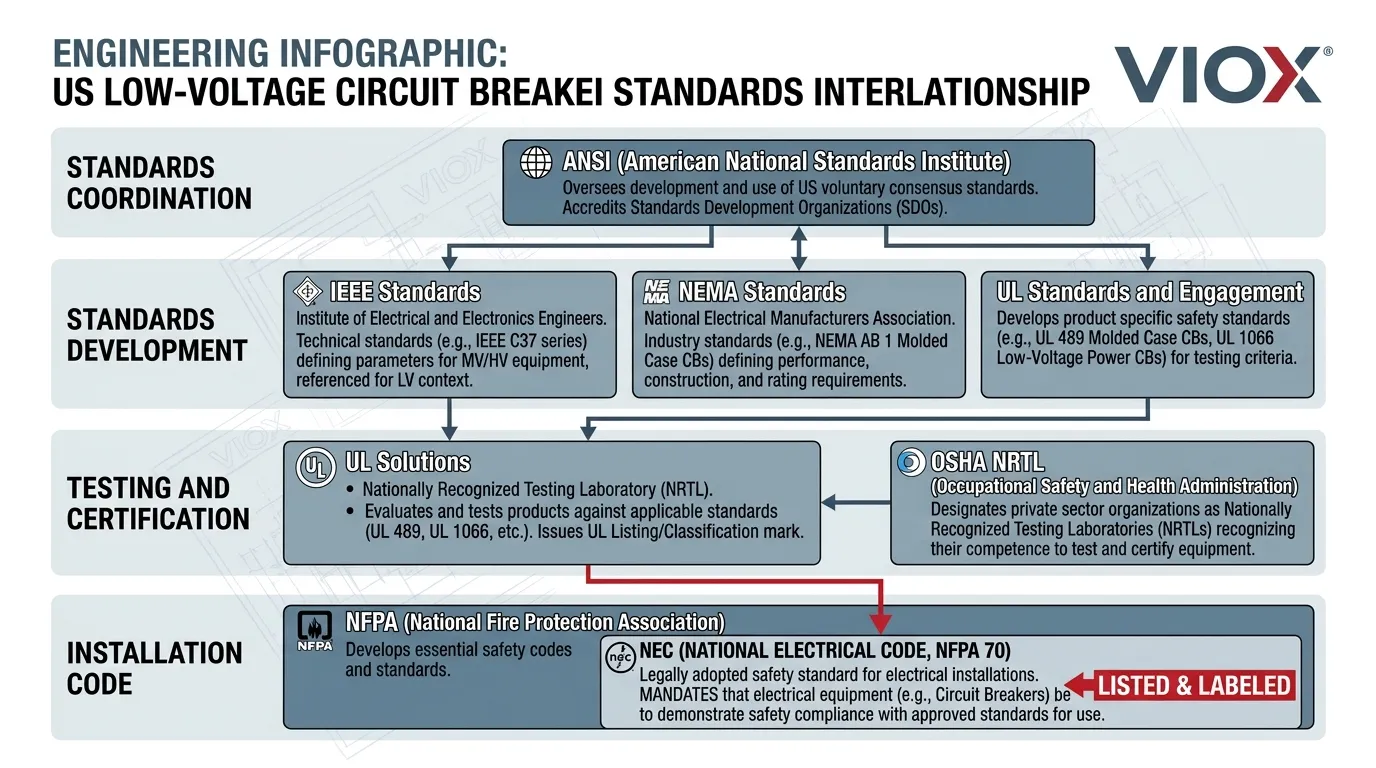
When US breaker standards feel chaotic, this simplified hierarchy usually helps:
- ANSI approves the consensus process
- IEEE, NEMA, UL Standards & Engagementa NFPA develop standards or codes in their own lanes
- UL Solutions and other recognized bodies evaluate products to applicable standards
- OSHA NRTL recognizes laboratories for defined certification scopes
- NEC (NFPA 70) tells you how equipment must be installed and applied
Once that structure is clear, the breaker-family mapping becomes easier:
- UL 489 / NEMA AB point toward molded-case breaker practice
- UL 1066 / IEEE C37 point toward low-voltage power circuit breaker and switchgear practice
Who Does What in the US Standards Structure
Before comparing specific breaker documents, it helps to separate the institutions.
ANSI
ANSI stands for the American National Standards Institute. Its role is coordination and approval. ANSI does not personally write every breaker standard engineers use. Instead, it approves standards processes and recognizes standards developers that can bring documents forward as American National Standards.
In practical terms, ANSI is the process and consensus layer.
IEEE
IEEE (příliš mnoho zařízení) nebo Institute of Electrical and Electronics Engineers. In the breaker world, IEEE is a major technical standards path, especially through the C37 family used in power switchgear and power circuit breaker contexts.
In practical terms, IEEE is a technical standards-writing organization.
NEMA
NEMA (příliš mnoho zařízení) nebo National Electrical Manufacturers Association (Národní asociace výrobců elektrických zařízení). It is both an industry association and an ANSI-accredited standards developer. In low-voltage breaker work, it matters because it publishes the NEMA AB family for molded-case circuit breakers and is also involved in parts of the C37 switchgear standards landscape.
In practical terms, NEMA is both an industry body and an active standards publisher.
UL
The name UL often causes the most confusion because people use it to mean both standard writing and product certification.
At a high level:
- UL Standards & Engagement is associated with standards development
- UL Solutions is associated with testing, evaluation, and certification activity
So when engineers say “this is a UL breaker,” they often really mean the breaker has been evaluated to a UL product standard such as UL 489 nebo UL 1066 by a recognized certification body.
NFPA and NEC
NFPA (příliš mnoho zařízení) nebo National Fire Protection Association. It publishes NFPA 70, better known as the NEC, or National Electrical Code.
The important thing to remember is:
- NFPA is the publisher
- NEC is the code document
OSHA NRTL
Na stránkách OSHA NRTL Program is not one laboratory and not one breaker standard. It is a government recognition framework for private-sector laboratories that certify products within specific recognized scopes.
That matters in compliance discussions because the market often talks as if “UL” were the only certification path. In reality, the regulatory logic is broader: OSHA recognizes testing laboratories for defined product-standard scopes.
Why These Standards Get Confused
The confusion usually happens for one of three reasons:
1. Engineers use “breaker standard” to mean different things
Sometimes they mean:
- product listing standard
- equipment construction standard
- installation code
- maintenance guideline
Those are not the same category.
2. UL 489 and UL 1066 both apply to low-voltage breakers
That makes them sound similar, but they are aimed at different breaker families.
3. NEMA AB and IEEE C37 are both series, not single documents
People say “NEMA AB” or “IEEE C37” as if each were one standard. In reality, both names refer to standard families.
4. NEC gets confused with certification
It is not. NEC is installation code, not product listing.
What UL 489 Means
UL 489 is the core US safety standard most people think of when they talk about ordinary molded-case circuit breakers in branch and feeder applications.
According to UL Solutions, UL 489 covers:
- molded-case circuit breakers
- molded-case switches
- circuit-breaker enclosures
In practical design terms, this is the standard family most often associated with:
- panelboard breakers
- many miniature and molded-case branch devices
- feeder breakers in typical low-voltage distribution
- breaker assemblies expected to serve as standard overcurrent protective devices in common commercial and industrial systems
This is why UL 489 sits close to the product families most buyers would describe as MCB a MCCB in market language, even though the exact category mapping depends on the product design and listing path.
If you want the device-family side of that topic, Úplný průvodce jističi s tvarovaným pouzdrem (MCCB) is the right companion page.
What UL 1066 Means
UL 1066 applies to low-voltage AC and DC power circuit breakers used in enclosures.
This is a different breaker family from the molded-case breakers usually associated with UL 489. In practical system design, UL 1066 is tied much more closely to:
- rozváděče
- low-voltage power circuit breakers
- larger main and tie breaker applications
- drawout or enclosure-based power breaker assemblies
UL Solutions also notes an important functional distinction: these power circuit breakers are not intended to provide the branch-circuit overcurrent protection required by the NEC in the same way that UL 489 molded-case breakers commonly do.
That is one of the most important reasons you should not casually substitute “UL 1066 breaker” for “UL 489 breaker” in specifications.
For the product-family context, this topic overlaps more naturally with ACB and the broader Kompletní průvodce vzduchovými jističi (ACB), because that is where many low-voltage power breaker discussions land in practice.
UL 489 vs UL 1066: The Real Difference
The most useful distinction is not “which one is better,” but what kind of breaker you are actually specifying.
| Rozměr | UL 489 | UL 1066 |
|---|---|---|
| Primary breaker family | Molded-case breaker family | Low-voltage power circuit breaker family |
| Typical installation context | Panelboards, branch and feeder circuits, standard distribution systems | Switchgear, mains, ties, larger power distribution assemblies |
| Role ochrany | Commonly used as standard branch / feeder overcurrent protective device | Used as power circuit breaker in enclosure and switchgear context |
| Typical market association | MCB / MCCB side of the market | LV power breaker / ACB side of the market |
This is also why engineers should be careful when comparing a molded-case breaker directly with a low-voltage power circuit breaker. The certification path, physical construction, maintenance expectations, and intended application are not the same.
What “NEMA AB” Actually Means
One of the most useful clarifications in this topic is that NEMA AB is not one single competing standard against UL.
It is a document family connected to the molded-case circuit breaker product group.
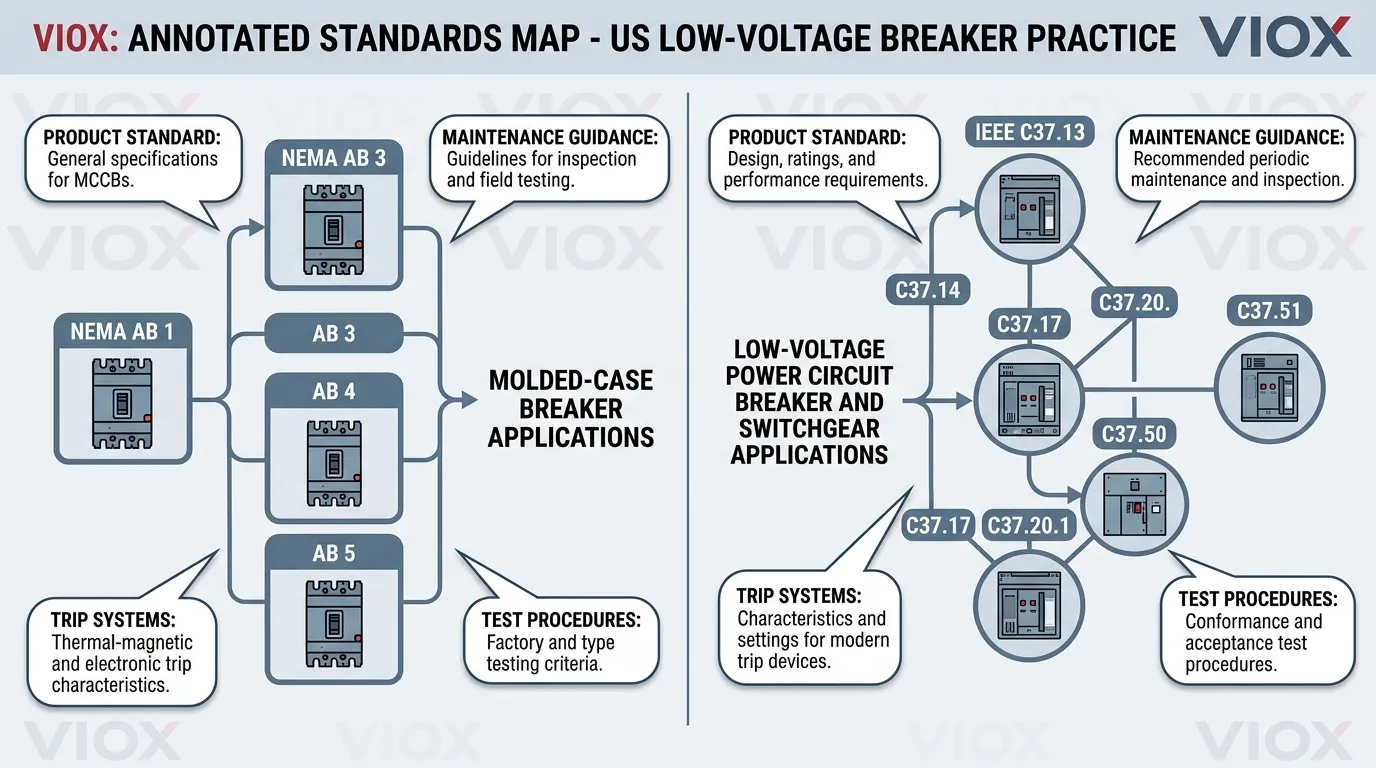
NEMA AB 1
Historically, NEMA AB 1 is the molded-case breaker product document most closely associated with the same product family as UL 489. Many engineers still mention it because older literature, product documents, and guidance papers use AB 1 language alongside UL 489.
In current North American practice, however, the more important point is that the molded-case breaker product standard framework is now commonly understood through the tri-national UL 489 / CSA C22.2 No. 5 / NMX-J-266-ANCE alignment. So if you see AB 1 mentioned in older material, treat it as part of the molded-case breaker standards history and product-family lineage, not as the only current shorthand you need to rely on.
NEMA AB 4
NEMA AB 4 is a maintenance-oriented document. It provides guidance for inspection and preventive maintenance of molded-case circuit breakers used in commercial and industrial applications.
That makes AB 4 useful for:
- maintenance programs
- facility engineering
- commercial and industrial breaker inspection planning
Other NEMA AB documents
There are also other AB-series documents, including:
- AB 3 for molded-case circuit breaker application guidance
- AB 4 for inspection and preventive maintenance
- AB 5 for selective coordination guidance in low-voltage breaker systems
The key point is that “NEMA AB” should be read as a family of molded-case breaker documents, not as a single label that replaces UL, the NEC, or the tri-national product-standard framework now used in current North American practice.
Where IEEE C37 Fits
If NEMA AB is the molded-case breaker family side of the US ecosystem, IEEE C37 is the major low-voltage and medium-voltage power switchgear family side.
For low-voltage power circuit breaker discussions, the most relevant C37 documents usually include:
- IEEE C37.13 for low-voltage AC power circuit breakers used in enclosures
- IEEE C37.14 for low-voltage DC power circuit breakers used in enclosures
- IEEE C37.16 for preferred ratings and application recommendations for low-voltage power circuit breakers
- IEEE C37.17 for trip systems for low-voltage power circuit breakers
- IEEE C37.20.1 for metal-enclosed low-voltage power circuit breaker switchgear
- ANSI/NEMA C37.50 for low-voltage AC power circuit breaker test procedures
- ANSI/NEMA C37.51 for conformance test procedures for metal-enclosed low-voltage power circuit breaker switchgear assemblies
This is why serious low-voltage power breaker work in the US market often pulls you beyond UL 1066 alone and into the broader C37 family.
Why Some C37 Standards Are Called IEEE and Others ANSI/NEMA
This confuses many readers the first time they see it.
The short answer is that C37 is a family, but the publishing path is not always labeled the same way on every document.
In practice:
- documents such as C37.13, C37.14, C37.17a C37.20.1 are commonly encountered under the IEEE trasu
- documents such as C37.50 a C37.51 are often encountered as ANSI/NEMA documents
The takeaway is not that they belong to different technical universes. The takeaway is that they are related documents within the broader C37 switchgear framework, but the publication and approval path shown on the cover may differ.
What the NEC Does and Does Not Do
Na stránkách Národní elektrotechnický předpis (NEC) is the installation code. It tells designers, installers, and inspectors how electrical equipment must be applied in real systems.
What the NEC does:
- sets application rules
- establishes installation requirements
- tells you when listed and labeled equipment must be used according to its instructions
- defines overcurrent protection rules in the field
What the NEC does not do:
- certify a breaker product
- serve as a product test standard
- replace UL product listing requirements
That is why NEC questions usually sit on top of the UL question rather than instead of it.
In practical US design work, the logic often becomes:
- What breaker family is this?
- What product standard or listing path applies?
- How does the NEC require it to be installed and applied?
Why SCCR and AIC Matter in US Breaker Work
If you stop at the names of the standards, you still miss one of the most practical engineering questions in US breaker selection: what fault current can the device or assembly safely interrupt or withstand in its intended application?
Two ideas matter here:
- AIC is commonly used in breaker practice to describe interrupting capacity at a stated voltage and condition
- SCCR is the short-circuit current rating of the assembly or equipment as applied in the field
This is where standards stop being abstract and start affecting specification risk.
In UL 489 molded-case breaker work
Interrupting ratings are central to the product selection itself. A breaker may be perfectly acceptable in one panel and completely inappropriate in another if the available fault current is higher than the breaker’s interrupting capability.
In UL 1066 / power breaker and switchgear work
The conversation becomes broader because breaker selection is tied not only to the breaker itself, but also to switchgear construction, test procedures, trip systems, and the related C37 family context.
In custom equipment and industrial control panels
Even if each component is individually acceptable, the assembly still has to achieve an appropriate SCCR. That is why US engineers cannot stop at “this breaker is UL listed.” They also have to ask:
- what is the available fault current?
- what interrupting rating applies?
- what SCCR must the assembly carry on the nameplate?
- how do upstream and downstream devices interact under fault conditions?
That is also why US breaker standard discussions connect naturally to application pages like Circuit Breaker Ratings: Icu, Ics, Icw, and Icm, even though the naming conventions are not identical across IEC and UL practice.
Where NEC Matters Most in This Topic
When engineers compare UL 489, UL 1066, NEMA AB, and NEC, the NEC usually matters most in these areas:
- overcurrent protection rules
- equipment application limits
- způsob instalace
- listing and labeling compliance
- coordination with panelboards, switchgear, or motor systems
For example, NEC application rules help explain why a breaker that is valid in one equipment context cannot automatically be assumed to be valid in another.
If your focus is on breaker application ratings and coordination language, Circuit Breaker Ratings: Icu, Ics, Icw, and Icm is a useful adjacent read.
A Practical Way to Use These Standards in Specification Work
When writing or reviewing a breaker specification in the US market, a practical engineering workflow is:
Step 1. Identify the breaker family
Are you specifying:
- a molded-case breaker for panel or feeder use
- or a low-voltage power circuit breaker for switchgear
That one decision often points you toward UL 489 or UL 1066 immediately.
Step 2. Check the assembly context
Is the breaker going into:
- panel
- switchboard
- rozváděče
- custom industrial equipment
The equipment context matters just as much as the breaker itself.
Step 3. Check NEC application requirements
Even a correctly listed breaker can still be misapplied if the installation design does not align with NEC requirements.
Step 4. Use NEMA AB documents as support, not as a substitute for code
NEMA AB documents are valuable for molded-case breaker understanding, maintenance, and application detail, but they do not replace NEC installation obligations.
Step 5. Confirm fault current and rating expectations
In the US market, this means checking whether the breaker and the assembly can support the available fault-current condition, interrupting requirement, and SCCR expectation at the installation point.
Step 6. Ask whether the project is US-only or also IEC-facing
If the project also serves international markets, engineers often need to understand where IEC 60947-1 a IEC 60947-2 sit relative to the US framework. They are not direct copies of UL 489 or UL 1066, but they are the key IEC-side reference points for low-voltage switchgear and circuit breakers.
Common Mistakes Engineers and Buyers Make
Treating UL 489 and UL 1066 as if they describe the same device category
They do not. They cover different low-voltage breaker families.
Treating NEMA AB as one standalone answer
Usually the real question is which AB document you mean and whether you are talking about product equivalence, maintenance guidance, or a specific application issue.
Assuming NEC is a product certification
It is not. NEC is the installation code, not the product safety listing.
Ignoring available fault current, interrupting rating, or SCCR
This is one of the fastest ways to turn a “compliant” specification into a field problem.
Expert Field Note: In breaker retrofit reviews, one of the most common specification mistakes is matching only ampere rating and frame size while ignoring the fault-current context of the assembly. On paper the replacement can look equivalent. In the field, the problem appears when the switchboard or panel SCCR no longer lines up cleanly with the available fault current or with the intended breaker family.
Selecting by current rating alone
In US practice, breaker family, assembly context, listing path, and code application are all part of the decision, not just amperes.
Assuming every “UL breaker” question stops at UL
In many real projects, the full answer also involves NEC application rules, NEMA guidance, IEEE C37 context, and sometimes the OSHA NRTL recognition framework behind certification acceptance.
Často Kladené Otázky
Is UL 489 the same as UL 1066?
No. UL 489 applies to the molded-case breaker family, while UL 1066 applies to low-voltage power circuit breakers used in enclosures.
Is NEMA AB 1 different from UL 489?
Historically, they were closely aligned in the molded-case breaker context. In current North American practice, however, engineers usually understand the molded-case breaker product framework through the tri-national alignment of UL 489 / CSA C22.2 No. 5 / NMX-J-266-ANCE, while AB 1 is more useful as part of the standards history and document-family lineage.
Does the NEC replace UL standards for circuit breakers?
No. The NEC governs installation and application. UL standards govern product safety and certification categories.
Which standard is more relevant for MCCBs?
In US low-voltage practice, molded-case circuit breakers are primarily associated with the UL 489 / NEMA AB 1 side of the framework.
Which standard is more relevant for low-voltage power breakers in switchgear?
That is where UL 1066 becomes the more relevant product standard framework.
What is the relationship between ANSI, IEEE, NEMA, UL, and NEC?
ANSI is the coordination and approval layer for American National Standards. IEEE and NEMA are standards-development paths. UL is associated with product standards and product certification activity. NFPA publishes the NEC, and the NEC governs installation and application rather than product listing.
Závěrečné doporučení
If you remember only one thing from this article, make it this:
- UL 489 = molded-case breaker world
- UL 1066 = low-voltage power breaker world
- NEMA AB = molded-case breaker document family
- IEEE C37 = power switchgear and power breaker standards family
- NEC = installation and application code
Once those roles are separated clearly, US breaker selection becomes much easier to interpret.
Pro související témata pokračujte do: