A licensed electrician installed it in your main panel, right there next to the breakers. Six months later, lightning strikes a utility transformer 200 meters down the road—not even close to your facility. By the next morning, you’re staring at $40,000 in damaged PLCs, VFDs, and control systems.
The panel-mount surge protector? Still sitting there in the panel, looking perfectly fine.
Like expensive panel jewelry.
How Panel-Mount Surge Protectors Actually Work (And Why Most Don’t)
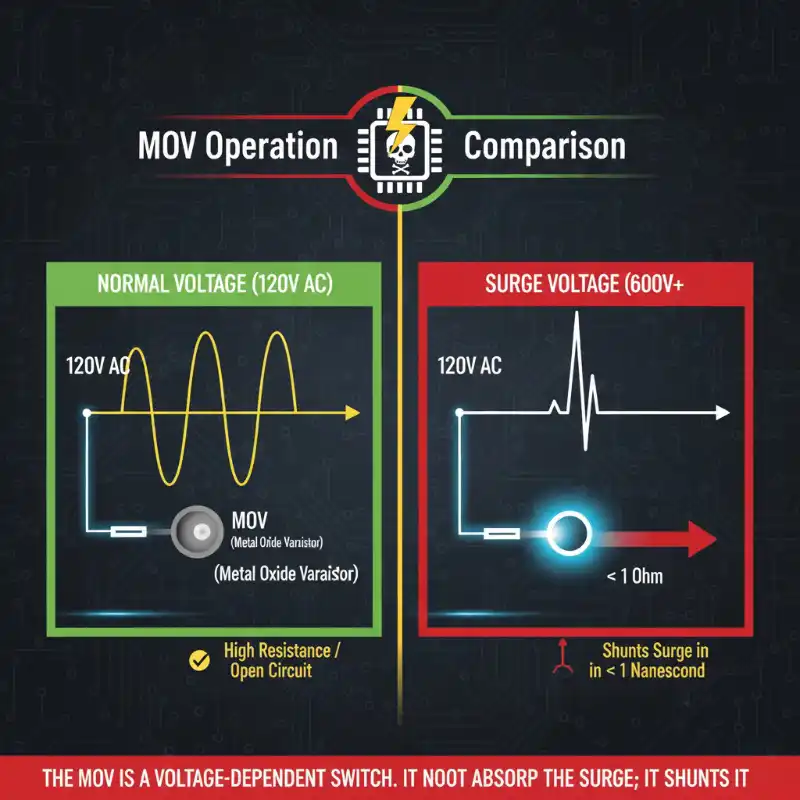
Here’s what actually happens inside that panel-mount surge protective device (SPD). The core technology is a metal oxide varistor—MOV for short. Think of it as a voltage-sensitive switch that lives in an interesting quantum state.
At normal operating voltage (120V or 240V), the MOV has extremely high resistance—essentially an open circuit. Your power flows through your breakers to your equipment like nothing’s there. But when voltage spikes above a specific threshold—typically around 400-600V for residential systems—the MOV undergoes dielectric breakdown. Its resistance drops from millions of ohms to nearly zero in about one nanosecond.
That’s faster than you can blink. Faster than you can say “lightning.” The MOV just became a 10,000-amp switch, and it just closed.
Now here’s the question nobody asks until it’s too late: where does that surge energy go?
The MOV creates a path. But a path to where? This is The Earth Ground Question—and it’s the difference between actual protection and expensive panel jewelry.
Most panel-mount SPDs connect to three points: hot-to-neutral, hot-to-ground, and neutral-to-ground. When the MOV triggers, it’s trying to shunt that surge energy somewhere. If “somewhere” is just your equipment ground bar—the same bar bonding your outlet grounds and equipment frames—you’ve created a problem, not solved one.
That surge energy needs to dissipate into the earth. Not into your grounding system’s equipment safety ground. Not into your water pipes. Into the actual earth—what Benjamin Franklin was talking about when he flew that kite 250 years ago.
A lightning strike can carry 300,000 joules of energy. Your panel-mount SPD with its “20,000 joule rating”? That’s not absorption capacity—that’s marketing theater. The MOV doesn’t absorb the surge. It shunts it. And if there’s nowhere for 300,000 joules to go except through your facility’s wiring, your PLC racks, and your variable frequency drives? Well, that explains the $40,000 repair bill.
专业提示: Joule ratings tell you when the MOV will fail, not how much protection you have. A 50,000-amp current rating matters far more than a 20,000-joule energy rating. The SPD must shunt the surge to earth, not try to absorb it.
Why “Ground” Without “Earth” Is Just Expensive Panel Jewelry
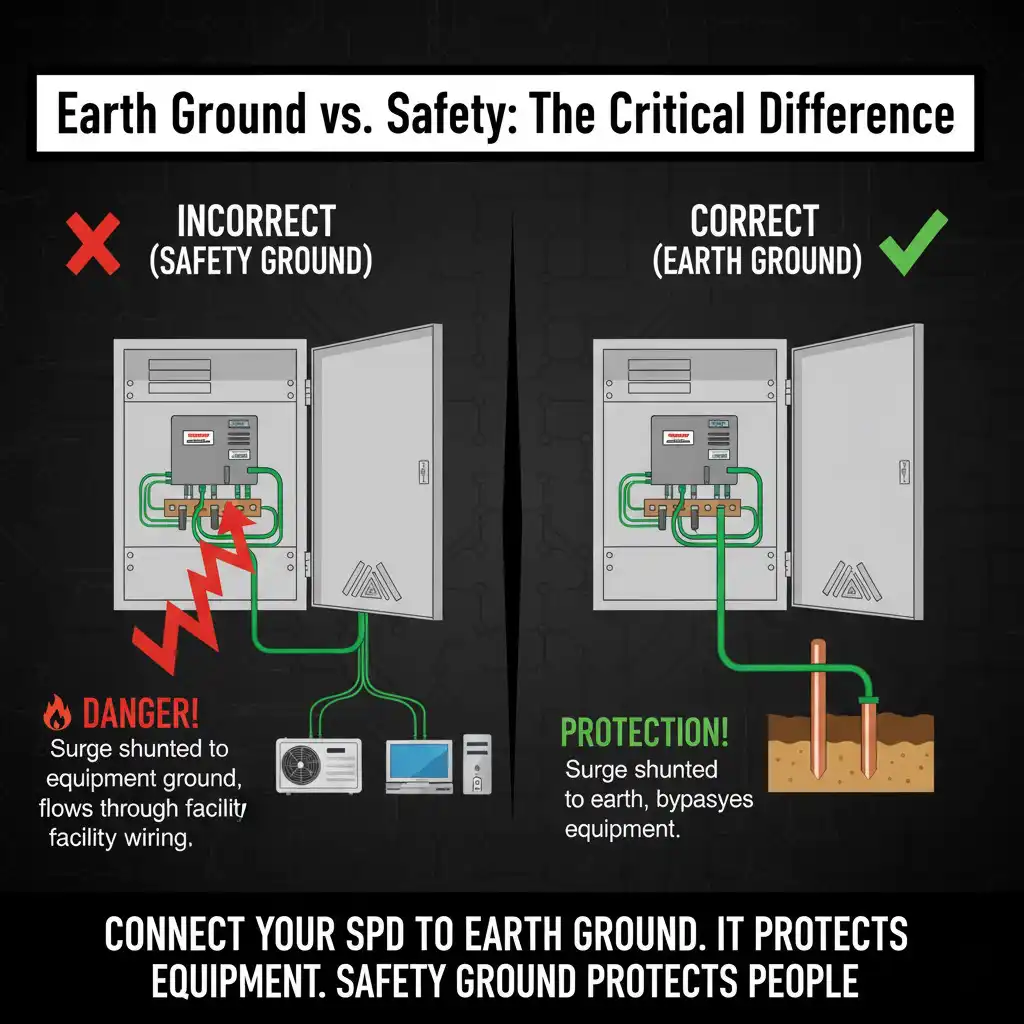
Electricians and engineers throw around the word “ground” like everyone knows what it means. They don’t. And this linguistic sloppiness costs facilities tens of thousands of dollars in damaged equipment every year.
There are two completely different grounds in your electrical system:
Safety Ground (Equipment Ground): This is the ground bar in your panel where all your equipment grounding conductors terminate. Its job is to provide a fault current path back to the source during a short circuit, tripping the breaker before someone gets electrocuted. It bonds equipment frames, outlet grounds, and metal enclosures together. Essential for electrical safety. Completely wrong for surge protection.
Earth Ground: This is a connection to the actual earth—ground rods, Ufer grounds, grounding electrodes driven into the soil. Its job is to provide an infinite sink for surge energy, dissipating hundreds of thousands of joules harmlessly into the planet’s mass. This is what Franklin was demonstrating. This is what actually stops lightning damage.
When your panel-mount SPD connects to the equipment ground bar instead of a dedicated earth ground path, you’ve just given that surge a highway directly through your electrical system. The MOV triggers. The surge diverts from the hot conductor. And then it travels through every single conductor bonded to that equipment ground bar, searching for a path to earth—through your computer’s chassis, through your VFD’s input stage, through your PLC’s power supply.
If that power strip protector is found in your luggage, cruise ships will confiscate it. They take fire threats seriously. Why? Because undersized MOVs trying to handle surge energy they can’t shunt create heat. Enough heat to ignite the plastic housing. A $25 power strip with $0.50 worth of MOV parts inside doesn’t have thermal mass to handle even modest surge energy.
Now scale that up. A panel-mount SPD improperly grounded, trying to shunt a nearby lightning strike through your facility’s wiring instead of to earth? That’s not surge protection. That’s a distributed fire hazard.
专业提示: Ask your electrician one simple question: “Where does this SPD’s ground wire go—to the equipment ground bar, or directly to earth ground electrodes?” If they say “the ground bar,” you have expensive panel jewelry, not surge protection.
Type 1, Type 2, Type 3: Why Location and Earth Connection Trump Joule Ratings
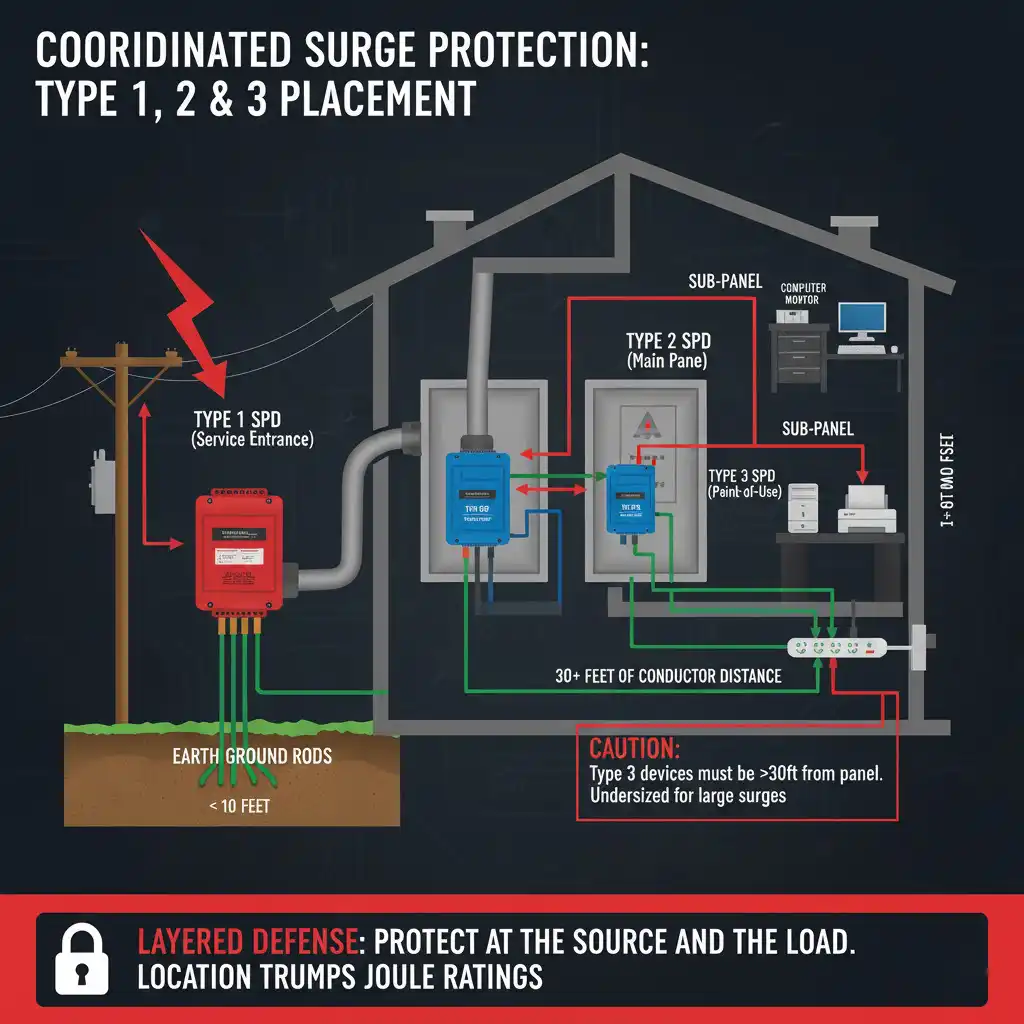
The industry classifies surge protective devices by where they’re installed, not how many joules they claim to handle. Understanding this classification explains why most facilities get surge protection wrong.
টাইপ ১ এসপিডি install at the service entrance—where utility power enters your facility, before the main disconnect. They must connect to earth ground electrodes with less than 10 feet of conductor (we’ll get to why that number matters shortly). These are the heavy hitters: typically rated 50,000 to 200,000 amps. Their job is to clamp the massive surge from external sources—lightning strikes, utility switching, transformer failures—before it reaches your facility’s wiring.
টাইপ ২ এসপিডি install at your main distribution panel or sub-panels. They provide a second layer of protection for surges that make it past the Type 1, and they also address surges generated within your facility (motor switching, VFD harmonics, capacitor bank switching). Most panel-mount SPDs are Type 2 devices.
টাইপ ৩ এসপিডি are point-of-use protectors—your power strips, individual equipment surge protectors, inline coax protectors. Here’s the critical requirement almost nobody knows: Type 3 devices must install more than 30 feet of conductor length from the main panel.
Wait, more than 30 feet? That seems backward. Shouldn’t protection be as close as possible?
No. And here’s why:
Type 3 SPDs are intentionally undersized. They’re designed to handle small, local surges—the static discharge, the minor switching transient. They use small MOVs with limited thermal mass. If you install a Type 3 SPD close to the panel—say, 5 feet away—and a major surge comes in from the utility, that Type 3 device sees the full hit before the conductor’s impedance can limit the current.
Those small MOVs vaporize. Sometimes violently. Fire investigators call this “thermal runaway.” Facility managers call it “that burning smell from the wall.” Either way, you’re not protecting equipment—you’re creating a fire hazard.
The 30-foot minimum provides electrical impedance that naturally limits how much surge current reaches the Type 3 device. It’s a safety margin. The Type 1 or Type 2 SPD at the service entrance or panel handles the big hits. The Type 3 device handles local noise.
But here’s what gets people: a $3 power strip with five cents worth of MOV parts sells for $25 to $80. The marketing screams “20,000 joules!” or “4,000 joules!” These are numbers designed to make you feel protected. What they don’t tell you: those joules measure the point where the MOV fails, not what it can actually handle safely.
A proper Type 1 SPD costs $150 to $300 and protects your entire facility—your dishwasher, HVAC, PLCs, computers, door bells, everything. That’s about $1 per protected appliance for a typical facility. The $80 power strip protects nothing if it’s installed wrong, catches fire if overloaded, and makes someone a very healthy profit margin.
This is The Joule Trap—focusing on a spec that doesn’t matter while ignoring the installation requirements that do.
专业提示: A Type 1 or Type 2 SPD rated 50,000 amps will outlast dozens of lightning strikes and remain functional for decades. A Type 3 “20,000 joule” power strip might not survive its first real surge. Amp rating beats joule rating every time.
The 10-Foot Rule: Why Your Grounding Wire Length Matters More Than Wire Gauge
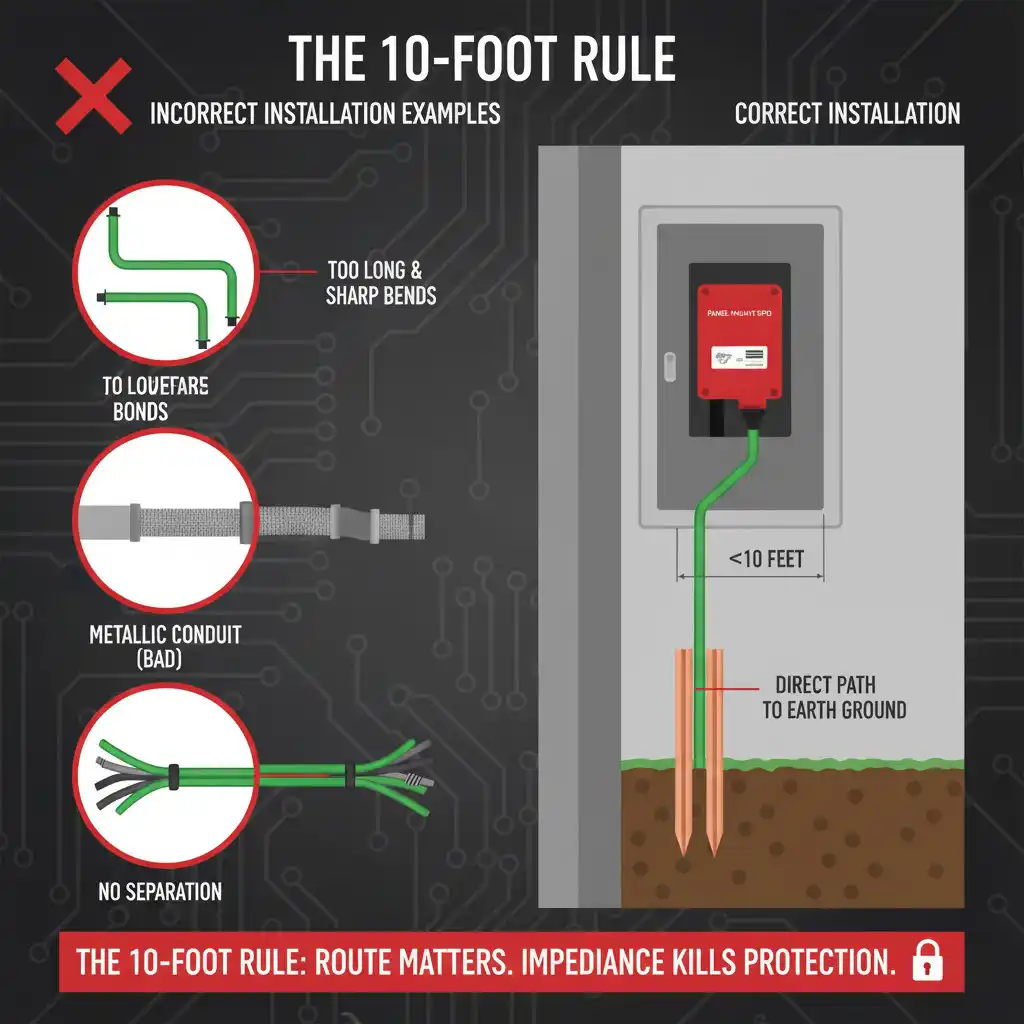
You’ve probably seen the installation instructions: “Connect SPD to grounding system.” Simple, right? Run a #6 AWG copper wire from the SPD to the nearest ground bar. Check the box, move on.
Wrong. That installation just turned your $200 SPD into panel jewelry.
The issue is impedance. Not resistance—impedance. They’re related, but they’re not the same thing, and the difference matters enormously when you’re trying to divert a lightning strike’s leading edge that rises in microseconds.
Resistance is what you measure with a multimeter: the opposition to DC current flow. A #6 AWG copper wire has about 0.4 ohms per thousand feet. From the SPD to ground bar? Maybe 8 feet? That’s 0.003 ohms. Negligible, right?
Impedance is frequency-dependent. It’s resistance plus reactance—the opposition to changing current. A surge from lightning isn’t DC. It’s a fast-rising pulse with frequency content extending into the megahertz range. At those frequencies, even a straight wire acts as an inductor. The longer the wire, the more inductance. The more inductance, the more impedance.
Every foot of conductor adds roughly 300 to 400 nanohenries of inductance. During a fast-rising surge, that inductance creates a voltage drop. Formula: V = L × (di/dt). When current is changing at 10,000 amps per microsecond—not unusual for nearby lightning—every nanohenry of inductance creates voltage.
Here’s the math:
8 feet of #6 AWG ≈ 3,000 nH of inductance
Surge rise: 10 kA/μs = 10,000,000,000 A/s
Voltage across wire: V = 3,000 × 10-9 H × 1010 A/s = 30,000 volts
Your SPD clamped the surge at 600V. But now there’s 30,000 volts across the grounding conductor because of its impedance. Where does that voltage appear? Across your equipment connected to the other end.
This is The 10-Foot Rule: your SPD’s connection to earth ground must be less than 10 feet, and every detail of that route matters.
What kills the 10-Foot Rule:
Sharp bends. Every 90-degree bend in the grounding conductor adds inductance. The magnetic field can’t follow the bend, creates opposing voltage. Route your ground wire in gentle curves if you must bend it. Better yet: run it straight.
Metallic conduit. ধাতব কন্ডুইট বা EMT-এর ভিতরে গ্রাউন্ডিং কন্ডাক্টর চালালে কন্ডুইটের ইন্ডাকট্যান্স সিরিজে যোগ হয়। এটা অনেকটা আপনার গ্রাউন্ড তারকে ইন্ডাকটিভ কয়েলে মোড়ানোর মতো। SPD গ্রাউন্ডিং কন্ডাক্টর কখনোই ধাতব কন্ডুইটে চালাবেন না—সুরক্ষার প্রয়োজন হলে প্লাস্টিক ব্যবহার করুন অথবা কোড অনুযায়ী খোলা রাখুন।.
অন্যান্য কন্ডাকটরের সাথে রুটিং।. আপনার SPD গ্রাউন্ড তার পাওয়ার কন্ডাকটরের মতো একই পথে চলা উচিত নয়। পারস্পরিক ইন্ডাকট্যান্স মানে একটি কন্ডাকটরের সার্জ কাছাকাছি কন্ডাকটরে ভোল্টেজ তৈরি করবে। SPD গ্রাউন্ডকে অন্যান্য তার থেকে কমপক্ষে ১২ ইঞ্চি দূরে রাখুন।.
ভুল গ্রাউন্ড সংযোগ।. ফাউন্ডেশন ওয়ালের উপর দিয়ে গিয়ে তারপর গ্রাউন্ড রডের দিকে নিচে নামছেন? আপনি conductor এর ৮ ফুট এবং দুটি তীক্ষ্ণ বাঁক যোগ করলেন। সম্ভব হলে ফাউন্ডেশনের মধ্যে দিয়ে যান অথবা সরাসরি ফ্লোরের মধ্যে দিয়ে আসুন।.
আপনি আর্থ গ্রাউন্ড electrodes-এর জন্য সর্বনিম্ন প্রতিবন্ধকতার পথ চান। সরঞ্জাম গ্রাউন্ড বারের জন্য নয়। জলের পাইপের জন্য নয় (যেকোনো আধুনিক ইনস্টলেশনে এটি একটি কোড লঙ্ঘন)। নিকটতম সুবিধাজনক বন্ডিং পয়েন্টের জন্য নয়। আসল আর্থ গ্রাউন্ড রড বা Ufer গ্রাউন্ডের জন্য, বিশেষভাবে আপনার সার্ভিস এন্ট্রান্সের সাথে যুক্ত একই গ্রাউন্ডিং electrode সিস্টেমের জন্য।.
专业提示: ১০ ফুটের বেশি প্রতিটি গ্রাউন্ডিং কন্ডাক্টর, প্রতিটি তীক্ষ্ণ ৯০° বাঁক, ধাতব কন্ডুইটের ভিতরে প্রতিটি ফুট—প্রত্যেকটি প্রতিবন্ধকতা যোগ করে যা আনুমানিক ১০-১৫% সুরক্ষা কার্যকারিতা হ্রাস করে। তিনটি তীক্ষ্ণ বাঁক এবং ১০ ফুট কন্ডুইট সহ একটি ২০ ফুটের গ্রাউন্ড তার? আপনি আপনার SPD-এর অর্ধেকের বেশি কার্যকারিতা হারিয়েছেন।.
আরও একটি গুরুত্বপূর্ণ বিষয় আছে: সিঙ্গেল-পয়েন্ট আর্থ গ্রাউন্ড। আপনার সমস্ত SPD—পাওয়ার, কোয়াক্স, ফোন, ডেটা লাইনে—একই আর্থ গ্রাউন্ড সিস্টেমের সাথে সংযোগ করতে হবে। যদি আপনার পাওয়ার SPD গ্রাউন্ড রড A-তে একটি সার্জ ফেলে এবং আপনার কোয়াক্স SPD ৩০ ফুট দূরের গ্রাউন্ড রড B-কে রেফারেন্স করে, তাহলে আপনি সরাসরি আপনার সরঞ্জামের সাথে সংযুক্ত একটি ৩০ ফুটের অ্যান্টেনা তৈরি করেছেন। সার্জের সময়, এই দুটি গ্রাউন্ডের মধ্যে কয়েক হাজার ভোল্টের পার্থক্য হতে পারে।.
সবকিছুকে একটি সিঙ্গেল-পয়েন্ট আর্থ গ্রাউন্ডের সাথে বন্ড করুন। ফ্রাঙ্কলিন সেটাই প্রদর্শন করেছিলেন। সেটাই এখনও কাজ করে।.
আপনার সুবিধাটি কীভাবে রক্ষা করবেন: ৪-ধাপের পদ্ধতি
ক্ষতির পরে আপনি সুরক্ষা পুনরুদ্ধার করতে পারবেন না। এখানে এমন একটি পদ্ধতি দেওয়া হল যা প্রকৃতপক্ষে কাজ করে, যা ১০০ বছরের বেশি সময় ধরে বজ্র সুরক্ষা প্রকৌশলে নথিভুক্ত করা হয়েছে।.
ধাপ ১: সার্ভিস এন্ট্রান্সে টাইপ ১ বা টাইপ ২ SPD ইনস্টল করুন
আপনার সুরক্ষার প্রথম লাইনটি সেখানে ইনস্টল করুন যেখানে ইউটিলিটি পাওয়ার প্রবেশ করে—প্রধান ব্রেকারের আগে অথবা প্রধান ডিস্ট্রিবিউশন প্যানেলে। আপনার মূল্যবান সরঞ্জাম থাকলে এটি আলোচনার ঊর্ধ্বে।.
সর্বনিম্ন রেটিং: ৫০,০০০ অ্যাম্পিয়ার। বজ্রপাতে যখন “মাত্র” ২০,০০০ অ্যাম্পিয়ার হতে পারে, তখন ৫০kA কেন? তিনটি কারণ। প্রথমত, ২০ kA সংখ্যাটি একটি সাধারণ আঘাত—সবচেয়ে খারাপ পরিস্থিতি নয়। দ্বিতীয়ত, আপনি হেডরুম চান; একটি SPD তার রেটিং সীমাতে কাজ করলে দ্রুত খারাপ হয়ে যাবে। তৃতীয়ত, একটি ৫০ kA ডিভাইসে সাধারণত বড় MOV থাকে যা ভালো তাপীয় ভর যুক্ত, যার মানে এটি প্রতিস্থাপনের প্রয়োজন হওয়ার আগে আরও বেশি সার্জ ইভেন্ট টিকে থাকতে পারে।.
খরচের বাস্তবতা: একটি ভালো মানের ৫০ kA টাইপ ১ বা টাইপ ২ SPD-এর দাম ১৫০ থেকে ৩০০ ডলার। ২০০টি রিসেপ্ট্যাকল, ৩০টি মোটর, বিভিন্ন কন্ট্রোল সিস্টেম, HVAC, আলো এবং ইলেকট্রনিক্স সহ একটি সুবিধার জন্য? এটি সুরক্ষিত প্রতিটি সরঞ্জামের জন্য প্রায় ১ ডলারের সুরক্ষা। একটি PLC প্রতিস্থাপনের খরচ SPD-এর চেয়ে বেশি।.
আপনার সুবিধার যেকোনো একটি ডিভাইসের যদি সার্জ সুরক্ষার প্রয়োজন হয়—এবং যদি আপনার কম্পিউটার, কন্ট্রোলার, VFD বা মাইক্রোপ্রসেসর যুক্ত কিছু থাকে, তবে এটির প্রয়োজন—তাহলে সবকিছুর সুরক্ষার প্রয়োজন। সার্জ কোন সার্কিট পথ দিয়ে যাবে তা বিবেচনা করে না। এটি যা পাওয়া যায় তার মাধ্যমে আর্থ গ্রাউন্ড খুঁজে নেয়। নিশ্চিত করুন যে “যা পাওয়া যায়” তা হল SPD-এর ডেডিকেটেড আর্থ সংযোগ, আপনার সরঞ্জাম নয়।.
ধাপ ২: ডেডিকেটেড আর্থ গ্রাউন্ড পাথ তৈরি করুন (<১০ ফুট)
এখানেই ৯০% ইনস্টলেশন ব্যর্থ হয়। SPD একটি গ্রাউন্ড লগের সাথে আসে। ইনস্টলার এটিকে সরঞ্জামের গ্রাউন্ড বারের সাথে সংযুক্ত করে। কাজ শেষ, তাই না?
না। আপনি কেবল দামি প্যানেল জুয়েলারি ইনস্টল করেছেন যা প্রয়োজনের সময় ব্যর্থ হবে।.
SPD-এর গ্রাউন্ড কন্ডাক্টর অবশ্যই ১০ ফুটের কম কন্ডাক্টর দিয়ে সরাসরি আর্থ গ্রাউন্ড electrodes-এর দিকে যেতে হবে। ১৫ ফুট নয়। ১২ ফুট নয়। ১০ ফুটের কম। এবং এই ফুটগুলো গুরুত্বপূর্ণ:
তীক্ষ্ণ বাঁক ছাড়াই কন্ডাক্টর চালান—কেবল হালকা বাঁক অথবা সম্ভব হলে সরাসরি। প্রতিটি ৯০-ডিগ্রি সমকোণ ইন্ডাকট্যান্স যোগ করে যা আপনি বজ্রপাতের সার্জের লিডিং এজের ন্যানোসেকেন্ড-স্কেলে বহন করতে পারবেন না।.
কোনো ধাতব কন্ডুইট নয়—কন্ডুইটের ইন্ডাকট্যান্স উদ্দেশ্যকে ব্যর্থ করে। যান্ত্রিক সুরক্ষার প্রয়োজন হলে প্লাস্টিক কন্ডুইট ব্যবহার করুন অথবা কোড অনুমতি দিলে কন্ডাক্টর খোলা চালান।.
অন্যান্য তার থেকে আলাদা করুন—পাওয়ার কন্ডাক্টর থেকে কমপক্ষে ১২ ইঞ্চি দূরত্ব বজায় রাখুন। আপনি পারস্পরিক ইন্ডাকট্যান্স কমাতে চেষ্টা করছেন যা আপনার সিস্টেমে সার্জ শক্তি ফিরিয়ে আনে।.
সিঙ্গেল-পয়েন্ট আর্থ গ্রাউন্ড—সমস্ত SPD (পাওয়ার, কোয়াক্স, ফোন, ডেটা) অবশ্যই একই গ্রাউন্ডিং electrode সিস্টেমকে রেফারেন্স করতে হবে। দূরত্ব দ্বারা পৃথক করা একাধিক আর্থ গ্রাউন্ড পয়েন্ট তৈরি করলে আপনার সুবিধাটি একটি বজ্রপাতের অ্যান্টেনা হয়ে যাবে।.
সঠিক রুটের জন্য ফাউন্ডেশন ওয়ালের মধ্যে দিয়ে ড্রিলিং, ফ্লোরের মধ্যে দিয়ে ইনস্টল করা অথবা বেসমেন্টের ফ্লোরের নিচে দিয়ে রুটিং করার প্রয়োজন হতে পারে। এটা সুবিধাজনক নয়। এটা প্রয়োজনীয়। “সুবিধাজনক” এবং “কার্যকর”-এর মধ্যে পার্থক্য সরঞ্জামের ক্ষতির হাজার হাজার ডলারে পরিমাপ করা যায়।.
ধাপ ৩: অন্যান্য ইনকামিং সার্ভিস রক্ষা করুন
সার্জ শক্তির জন্য পাওয়ারই একমাত্র পথ নয়। বাইরে থেকে আপনার সুবিধায় প্রবেশ করা প্রতিটি কন্ডাক্টর একটি সম্ভাব্য সার্জ প্রবেশের পয়েন্ট।.
কোয়াক্সিয়াল ক্যাবলের (ইন্টারনেট, স্যাটেলাইট, কেবল টিভি) কোয়াক্সের জন্য রেট করা একটি SPD প্রয়োজন। সার্জ শিল্ডের মাধ্যমে প্রবেশ করতে পারে, আপনার সরঞ্জামকে বাইপাস করতে পারে এবং পাওয়ার গ্রাউন্ডের মাধ্যমে বের হতে পারে—যা সাধারণ-মোড ভোল্টেজ তৈরি করে যা ইলেকট্রনিক্স ধ্বংস করে।.
ফোন লাইনের টেলিকম-রেট করা SPD প্রয়োজন। যদিও “ল্যান্ডলাইন মৃত,” অনেক সুবিধা এখনও অ্যানালগ ফোন পরিষেবা, ফায়ার অ্যালার্ম ডায়ালার অথবা কপার পেয়ারে চলমান এলিভেটর জরুরি লাইন ব্যবহার করে। বজ্রপাত সেই পেয়ারগুলোতে ভোল্টেজ তৈরি করতে পারে।.
নেটওয়ার্ক ডেটা লাইন—যদি আপনার বহিরাঙ্গন ইথারনেট, বিল্ডিংয়ের বাইরের দিকে সুরক্ষা ক্যামেরা অথবা বিল্ডিংয়ের মধ্যে চলমান কোনো নেটওয়ার্ক ক্যাবল থাকে—ডেটা-রেট করা SPD প্রয়োজন। একটি বহিরাঙ্গন ক্যাবলের কাছাকাছি মাটিতে আঘাত করলে টুইস্টেড পেয়ারগুলোতে ভোল্টেজ তৈরি হয়।.
এখানে আলোচনার ঊর্ধ্বে থাকা প্রয়োজনটি হল: প্রতিটি ইনকামিং সার্ভিসের প্রতিটি SPD অবশ্যই একই আর্থ গ্রাউন্ড পয়েন্টের সাথে বন্ড করতে হবে।. এটি হল ধাপ ২ থেকে সিঙ্গেল-পয়েন্ট গ্রাউন্ড। যদি আপনার পাওয়ার SPD আর্থ গ্রাউন্ড A-তে একটি সার্জ ফেলে এবং আপনার কোয়াক্স SPD ৪০ ফুট দূরের আর্থ গ্রাউন্ড B-কে রেফারেন্স করে, তাহলে আপনি আপনার কম্পিউটারের পাওয়ার সাপ্লাই এবং এর নেটওয়ার্ক ইন্টারফেসের মধ্যে সরাসরি সংযুক্ত ৪০ ফুটের ভোল্টেজ ডিফারেনশিয়াল তৈরি করেছেন।.
সার্জ সমতা পথ খুঁজে নেয়। সাধারণত আপনার সরঞ্জামের অভ্যন্তরীণ অংশের মাধ্যমে। সরঞ্জাম প্রতিস্থাপন করা সস্তা যা এটি নিয়ন্ত্রণ বা সঞ্চয় করছিল তার চেয়ে।.
ধাপ ৪: টাইপ ৩ পয়েন্ট-অফ-ইউজ প্রোটেক্টর ৩০ ফুটের বেশি দূরে রাখুন
আপনি যদি পৃথক সরঞ্জাম সার্জ প্রোটেক্টর ব্যবহার করেন—পাওয়ার স্ট্রিপ, ইনলাইন কোয়াক্স প্রোটেক্টর, UPS ইউনিট—এগুলো টাইপ ৩ ডিভাইস। এগুলো ব্যবহারের পয়েন্টে ইনস্টল করা হয় এবং এগুলো প্রধান প্যানেল থেকে ৩০ ফুটের বেশি কন্ডাক্টর দূরত্বে থাকতে হবে।.
কেন? কারণ টাইপ ৩ SPD স্থানীয় ক্ষণস্থায়ীর জন্য ছোট MOV ব্যবহার করে, ইউটিলিটি-স্কেল সার্জের জন্য নয়। বজ্রপাতের সময় যদি একটি পাওয়ার স্ট্রিপ প্যানেল থেকে ৫ ফুট দূরে থাকে, তবে কন্ডাক্টর প্রতিবন্ধকতা সীমিত করার আগে এটি পুরো সার্জ কারেন্ট দেখতে পায়। MOV বাষ্পীভূত হয়ে যায়। সবচেয়ে ভালো ক্ষেত্রে: স্ট্রিপ কাজ করা বন্ধ করে দেয়। সবচেয়ে খারাপ ক্ষেত্রে: তাপীয় রানওয়ে আগুন তৈরি করে।.
৩০ ফুটের নিয়মটি ইচ্ছাকৃত নয়। এটি বৈদ্যুতিক প্রতিবন্ধকতা যা কারেন্ট লিমিটার হিসেবে কাজ করে। প্রতি ফুটে ৩০০-৪০০ ন্যানো-হেন্ড্রি হিসাবে, ৩০ ফুট প্রায় ১০ মাইক্রো-হেন্ড্রি সরবরাহ করে—পয়েন্ট-অফ-ইউজ ডিভাইসে পৌঁছানোর সময় যথেষ্ট সিরিজ ইন্ডাকট্যান্স সার্জ কারেন্ট বৃদ্ধির হারকে উল্লেখযোগ্যভাবে সীমিত করতে।.
এটি এমন কিছু ব্যাখ্যা করে যা ইনস্টলাররা স্বজ্ঞাতভাবে খুঁজে পান: আপনার সার্ভিস এন্ট্রান্সে টাইপ ১ বা টাইপ ২ SPD কেবল আপনার সুবিধাকে বাহ্যিক সার্জ থেকে রক্ষা করে না। এটি আপনার সুবিধার অভ্যন্তরের টাইপ ৩ ডিভাইসগুলোকেও রক্ষা করে। সেই ছোট আকারের পয়েন্ট-অফ-ইউজ প্রোটেক্টরগুলো ভুলভাবে স্থাপন করা হলে সম্ভাব্য আগুনের ঝুঁকি। সার্ভিস এন্ট্রান্স SPD সার্জকে আটকে দেয় যাতে এটি তাদের কাছে পৌঁছাতে এবং ধ্বংস করতে না পারে।.
আপনি যখন উভয়ই ইনস্টল করেন তখন আপনি অতিরিক্ত সুরক্ষা তৈরি করছেন না। আপনি একটি সমন্বিত সুরক্ষা সিস্টেম তৈরি করছেন যেখানে প্রতিটি উপাদান তার উপযুক্ত স্থানে তার কাজ করে।.
专业提示: আর্থের সাথে সঠিকভাবে গ্রাউন্ডেড একটি টাইপ ১ বা টাইপ ২ SPD ইনস্টল করার পরে, আপনার সুবিধার টাইপ ৩ প্লাগ স্ট্রিপ এবং সরঞ্জাম প্রোটেক্টরগুলো আসলে সঠিকভাবে কাজ করে—এগুলো স্থানীয় ক্ষণস্থায়ী পরিচালনা করে যখন সার্ভিস এন্ট্রান্স SPD বড় সার্জগুলো পরিচালনা করে। সঠিকভাবে গ্রাউন্ডেড টাইপ ১/২ ছাড়া, আপনার টাইপ ৩ ডিভাইসগুলো কেবল দামি আগুনের ঝুঁকি যা ভুল সার্জের জন্য অপেক্ষা করছে।.
মূল কথা: আর্থ গ্রাউন্ড ঐচ্ছিক নয়
প্যানেল-মাউন্ট সার্জ প্রোটেক্টর কাজ করে—যখন এগুলো সঠিকভাবে সংযুক্ত থাকে। MOV প্রযুক্তি ভালো। প্রকৌশল প্রমাণিত। যা ব্যর্থ হয় তা হল ইনস্টলেশন।.
আপনি এখন প্যানেল জুয়েলারি এবং আসল সুরক্ষার মধ্যে পার্থক্য জানেন: The Earth Ground Question গুরুত্বপূর্ণ। সুরক্ষা গ্রাউন্ড ত্রুটির সময় মানুষকে রক্ষা করে। আর্থ গ্রাউন্ড সার্জের সময় সরঞ্জাম রক্ষা করে। আপনার SPD-কে ভুলটির সাথে সংযুক্ত করুন এবং আপনি ভুল সমস্যা সমাধান করেছেন।.
আপনি জানেন কেন অবস্থান কার্যকারিতা নির্ধারণ করে: টাইপ ১ এবং টাইপ ২ SPD সরাসরি আর্থ গ্রাউন্ড সংযোগ সহ সার্ভিস এন্ট্রান্স বা প্রধান প্যানেলে ইনস্টল করা হয়। টাইপ ৩ ডিভাইসগুলো ব্যবহারের পয়েন্টে ৩০ ফুটের বেশি দূরে ইনস্টল করা হয়। এই স্থান নির্ধারণের নিয়মগুলো লঙ্ঘন করুন এবং আপনি সুরক্ষার পরিবর্তে আগুনের ঝুঁকি তৈরি করেন।.
আপনি জানেন কেন কন্ডাক্টর রুটিং বেশিরভাগ ইনস্টলেশনকে ব্যর্থ করে: The 10-Foot Rule একটি পরামর্শ নয়। ১০ ফুটের বেশি প্রতিটি ফুট, প্রতিটি তীক্ষ্ণ বাঁক, ধাতব কন্ডুইটের প্রতিটি ইঞ্চি প্রতিবন্ধকতা যোগ করে যা সার্জ ভোল্টেজকে আপনার সরঞ্জামের পরিবর্তে মাটিতে পাঠায়।.
অন্য প্যানেল-মাউন্ট SPD ইনস্টল করার আগে—অথবা আপনার যদি ইতিমধ্যে একটি ইনস্টল করা থাকে—এই প্রশ্নগুলো জিজ্ঞাসা করুন:
SPD-এর গ্রাউন্ড কন্ডাক্টর কোথায় শেষ হয়? যদি উত্তর হয় “সরঞ্জামের গ্রাউন্ড বার,” তাহলে আপনার কাছে প্যানেল জুয়েলারি আছে।.
আসল আর্থ গ্রাউন্ড electrodes-এর গ্রাউন্ড কন্ডাক্টর পথের দৈর্ঘ্য কত? যদি উত্তর ১০ ফুটের বেশি হয়, তবে প্রতিটি অতিরিক্ত ফুটের সাথে আপনার SPD-এর কার্যকারিতা কমে যায়।.
সমস্ত ইনকামিং সার্ভিস (পাওয়ার, কোয়াক্স, ফোন, ডেটা) কি একই সিঙ্গেল-পয়েন্ট আর্থ গ্রাউন্ডের সাথে বন্ড করা SPD দিয়ে সুরক্ষিত? যদি না হয়, তবে আপনি আপনার সরঞ্জামের মাধ্যমে ভোল্টেজ ডিফারেনশিয়াল পথ তৈরি করেছেন।.
বেঞ্জামিন ফ্রাঙ্কলিন ২৫০ বছর আগে একটি ঘুড়ি, একটি চাবি এবং একটি লেইডেন জার দিয়ে আর্থ গ্রাউন্ডিং আবিষ্কার করেছিলেন। আমাদের কাছে মেটাল অক্সাইড ভ্যারিস্টর, অসিলোস্কোপ এবং কয়েক দশকের IEEE স্ট্যান্ডার্ড রয়েছে।.
আমাদের এটি ভুল করার কোনো অজুহাত নেই। আর্থ গ্রাউন্ড সমস্যা সমাধান করুন এবং আপনার প্যানেল-মাউন্ট SPD দামি জুয়েলারি হওয়া বন্ধ করে আসল সুরক্ষা হতে শুরু করবে।.


প্রযুক্তিগত নির্ভুলতার নোট
স্ট্যান্ডার্ড এবং উৎস উল্লেখ করা হয়েছে:
- IEEE C62.41 (নিম্ন-ভোল্টেজ এসি পাওয়ার সার্কিটে সার্জ ভোল্টেজের উপর IEEE প্রস্তাবিত অনুশীলন)
- আমিEEE C62.11 (এসি পাওয়ার সার্কিটের জন্য মেটাল-অক্সাইড সার্জ অ্যারেস্টারের জন্য IEEE স্ট্যান্ডার্ড)
- NEC আর্টিকেল ২৮৫ (সার্জ প্রোটেক্টিভ ডিভাইস, ১০০০ ভোল্ট বা তার কম)
- IEC 61643-11 (নিম্ন-ভোল্টেজ সার্জ প্রোটেক্টিভ ডিভাইস)
- IEEE C62.45 (সরঞ্জামের জন্য সার্জ টেস্টিংয়ের উপর IEEE প্রস্তাবিত অনুশীলন)
সময়োপযোগী বিবৃতি: সমস্ত প্রযুক্তিগত স্পেসিফিকেশন, ইনস্টলেশন প্রয়োজনীয়তা এবং স্ট্যান্ডার্ড রেফারেন্স নভেম্বর ২০২৫ পর্যন্ত সঠিক। MOV প্রযুক্তি, টাইপ ১/২/৩ শ্রেণীবিভাগ এবং আর্থ গ্রাউন্ডিং প্রয়োজনীয়তা হল IEEE এবং NEC স্ট্যান্ডার্ডে নথিভুক্ত প্রতিষ্ঠিত প্রকৌশল অনুশীলন।.