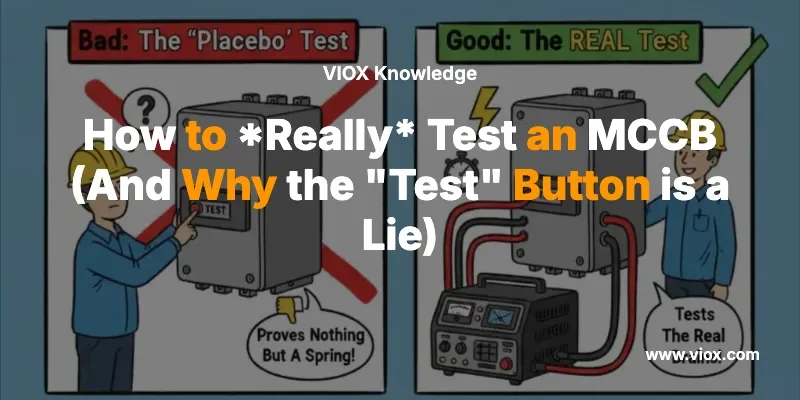
Ti trovi sul posto, di fronte a un gigantesco MCCB (Moulded Case Circuit Breaker) da 400A che funge da “porta principale” per una linea di produzione critica.
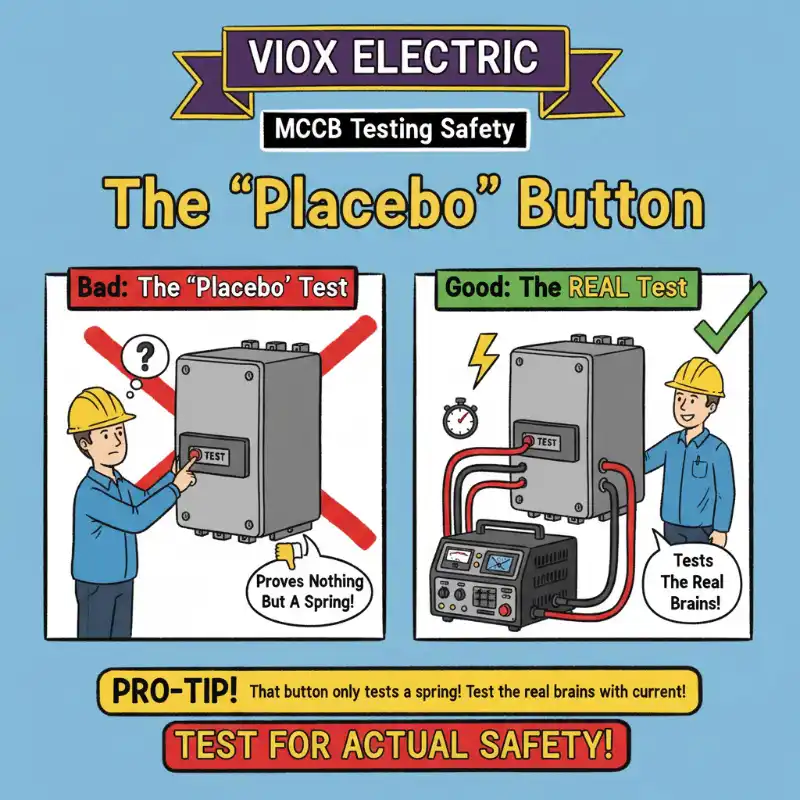
Devi “testarlo”. Vedi il piccolo pulsante “Push-to-Trip” (PTT). Lo premi.
CLUNK.
L'interruttore scatta.
Il tuo lavoro è finito, giusto? Hai “testato” l'interruttore?
No. Hai fatto niente se non testare una molla. Sei appena caduto nella trappola del “Pulsante ‘Placebo’”.” Ecco la verità su quel “test” e su come realmente capire se il tuo interruttore è un “guardiano” o solo una “bomba”.”
L'analogia con il “Rilevatore di Fumo”: Cosa Fa Quel Pulsante Effettivamente Fa

Il più grande momento di “Aha!” nella sicurezza elettrica è questo: premere quel pulsante “Test” è esattamente come premere il pulsante “Test” sul rilevatore di fumo di casa tua.
Pensaci.
- Cosa prova: La sirena suona. La batteria ha energia. La sirena interna funziona.
- Cosa NON prova: Che il “sensore di fumo” (il reale cervello) possa effettivamente rilevare il fumo.
Quel pulsante “Test” dell'MCCB è lo stesso. È un test meccanico , non uno elettrico elettronico.
Il pulsante PTT è solo una piccola asta di plastica che bypassa il vero “cervello” e “spinge” meccanicamente il fermo di sgancio finale. Hai confermato che il “percussore” funziona, non che il “grilletto” possa effettivamente essere tirato dai sensori.
I “Due Cervelli” Che il Pulsante “Placebo” Ignora
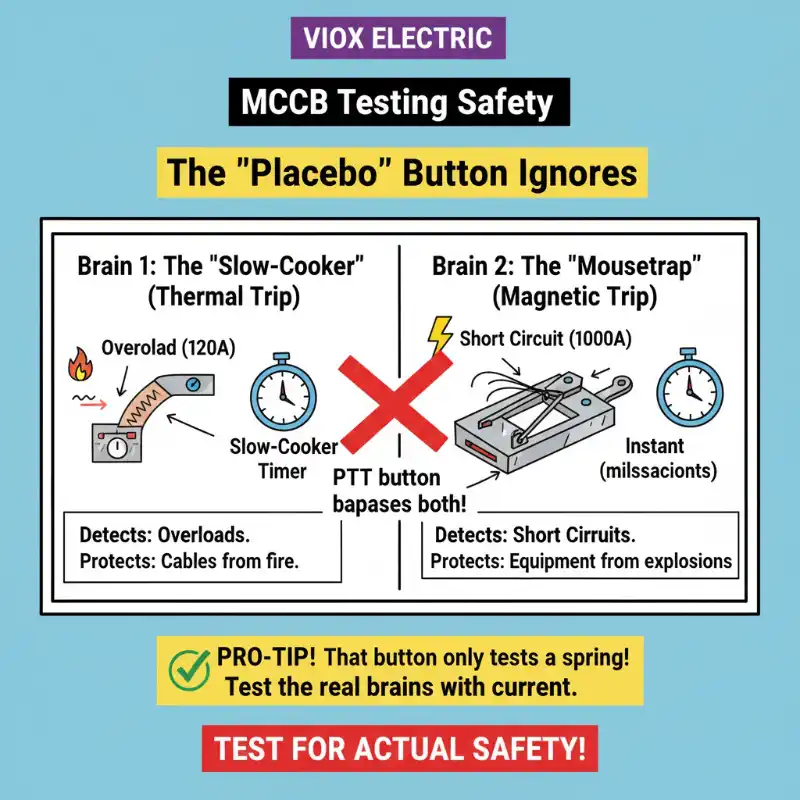
Un interruttore ha due reale “cervelli” (unità di sgancio) progettati per salvare le tue apparecchiature e la tua vita. Quel pulsante “placebo” non testa nessuno dei due.
Cervello 1: La “Cottura Lenta” (Sgancio Termico)
- Il Suo Lavoro: Rilevare sovraccarichi (ad esempio, un interruttore da 100A che funziona a 120A per 10 minuti).
- Come Funziona: Una striscia bimetallica (due metalli) si riscalda lentamente con la corrente in eccesso. Mentre si riscalda, si piega e alla fine, come un timer di “cottura lenta”, si piega abbastanza da “spingere” il fermo di sgancio.
- Perché è Importante: Questo salva i tuoi cavi dal surriscaldamento nella parete, dalla fusione e dall'innesco di un incendio.
Cervello 2: La “Trappola per Topi” (Sgancio Magnetico)
- Il Suo Lavoro: Rilevare cortocircuiti (ad esempio, un guasto da 1000A da un cortocircuito).
- Come Funziona: Un elettromagnete immediatamente (in millisecondi) genera un potente campo magnetico dall'enorme picco di corrente. Questo campo scatta una leva, come una “trappola per topi”, per “spingere” il fermo di sgancio.
- Perché è Importante: Questo ti salva da un'esplosione di arco elettrico , guasti che distruggono le apparecchiature e una giornata molto brutta.
Il pulsante PTT bypassa completamente entrambi questi “cervelli” salvavita.”
Il “Guasto da 800A”: Quando un “Interruttore” Diventa un “Interruttore Sezionatore”
“E allora?” dici. “Se la molla funziona, i cervelli probabilmente stanno bene.”
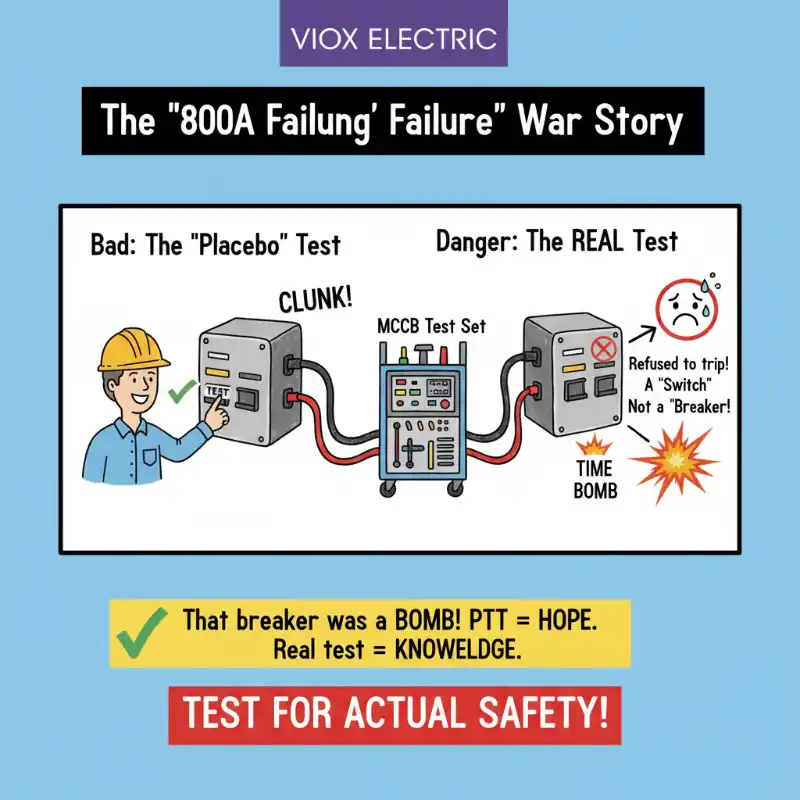
Questo è esattamente il modo di pensare che porta alla catastrofe. Questo è “Il guasto dell'interruttore da 800A.”
Una “storia di guerra” di un ingegnere senior di sistemi di alimentazione:
“Siamo stati assunti per eseguire la manutenzione preventiva annuale (PM) in una fabbrica. Avevano un MCCB da 400A su un alimentatore principale. Aveva 20 anni.
La prima cosa che abbiamo fatto? Abbiamo premuto il pulsante di test. CLUNK. È scattato perfettamente. Il direttore dello stabilimento ha sorriso.
Poi, abbiamo tirato fuori “La Bestia.”
Abbiamo collegato il nostro set di test ‘Iniezione di corrente primaria’. Questa macchina non preme il pulsante; “alimenta” l'interruttore reale con corrente.
Abbiamo iniziato ad ‘alimentarlo’. 500 Ampere... 600 Ampere... 800 Ampere...
Niente.
L'interruttore si rifiutava di scattare. Lo abbiamo spinto fino a 1200A prima che finalmente, a malincuore, si aprisse.
Quel 400A “Interruttore” era morto anni fa. Era solo un 400A “Interruttore.”
Per 20 anni, l'intera linea di fabbrica non aveva zero protezione da sovraccarico. Il grasso all'interno dell'interruttore si era seccato. Le molle erano deboli. Il “cervello” (l'unità termica) era morto.
Era una “bomba a orologeria” che superava il suo “test placebo” ogni singolo anno.
Il Reale Test: “Alimentare la Bestia” (Iniezione di corrente primaria)

Quindi, come si fa a realmente testare un MCCB? Come si testa il “sensore di fumo”, non solo il “clacson”?
Voi “Alimenta la Bestia.”
Questo non è un lavoro per un elettricista standard; è un lavoro per un ingegnere specializzato di sistemi di alimentazione NETA (International Electrical Testing Association).
- Lo Strumento: Un “Set di test MCCB” specializzato ad alta corrente. Questa macchina ha spesso le dimensioni di una grande valigia, pesa 50 kg e può costare 20.000 € o più.
- Il Processo: L'ingegnere isola l'interruttore e collega questa “Bestia” ad esso. La macchina quindi in realtà inietta 500A, 1000A o 3000A di corrente reale e tracciabile attraverso il “cervello” dell'interruttore.”
- Il Risultato: Usano un cronometro (o un timer integrato) per “far correre” l'interruttore contro la sua nota curva di intervento (la TCC, o Curva Tempo-Corrente).
- “È scattato a 800A nei 5-10 secondi specificati?” (Cervello Termico: PASSATO)
- “È scattato a 3000A in 0,04 secondi?” (Cervello Magnetico: PASSATO)
CONSIGLIO DA PROFESSIONISTI: Un Elettricista installa l'interruttore ed esegue il test PTT (meccanico). Un ingegnere di test NETA certifica l'interruttore con un test di iniezione di corrente primaria (elettrico). Conosci il tuo ruolo. Non approvare mai un test PTT come “test di sicurezza funzionale”. Stai approvando la “speranza”, non la “conoscenza”.”
Conclusione: “Tranquillità” vs. “Sicurezza Reale”
Quel piccolo pulsante “Test” non è un test. È un “reset meccanico”. È “Pulsante ‘Placebo’”.”
È progettato per dare al gestore dell'edificio o a un non professionista “Tranquillità”.”
Il reale test, “Iniezione di corrente primaria”, è ciò che fornisce “Sicurezza Reale.”
Quando costruisci un sistema critico, lo costruisci sulla certezza. Gli MCCB VIOX sono progettati secondo gli standard più elevati, con curve di intervento chiare, pronti per essere certificati da un set di test professionale. Non solo sperare che il tuo “cervello” funzioni—sapere che lo fa.
Sfoglia il nostro VIOX MCCB Allineare e costruire con certezza.
La Precisione Tecnica Nota
**Norme e fonti di riferimento** Norma IEC 60947-2 e NEMA AB 1.