Seorang pekerja konstruksi menyentuh bor listrik yang rusak. Arus mulai mengalir melalui tubuhnya ke tanah—28 miliampere, kemudian 35. Cukup untuk menghentikan jantungnya.
Namun sebelum fibrilasi ventrikel dimulai, rangkaian mati. RCD di panel sementara mendeteksi ketidakseimbangan 30 mA dan memutus daya dalam 28 milidetik. Pekerja itu menjatuhkan bor, terguncang namun selamat. MCB di sebelah RCD itu? Ia mencatat arus gangguan tetapi tidak berbuat apa-apa—karena ini bukan tugasnya. Arus yang mengalir melalui tubuh pekerja itu sangat kecil dibandingkan dengan pemicu MCB, namun lebih dari cukup untuk membunuh.
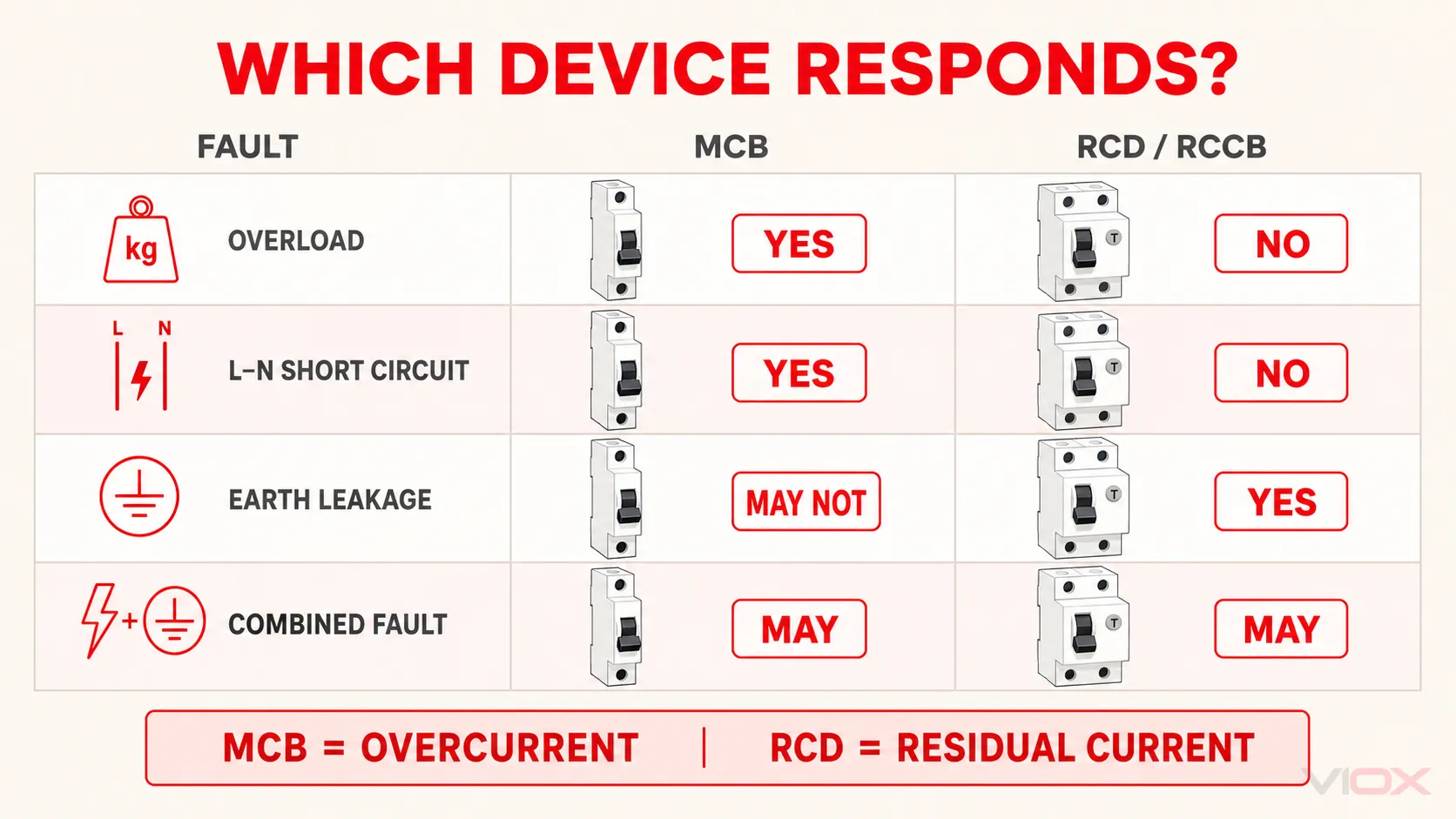
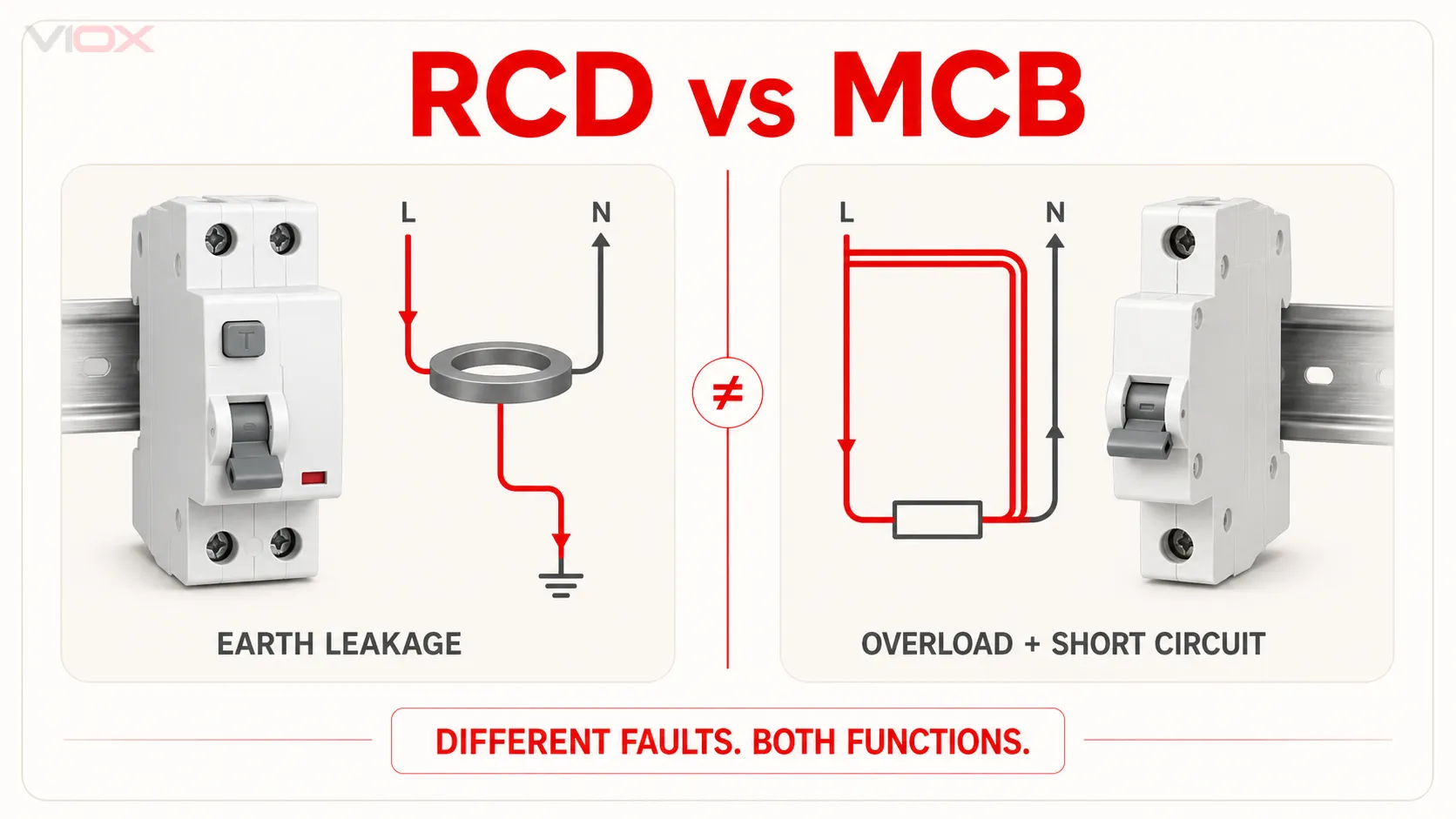
Inilah perbedaan mendasar antara proteksi RCD dan MCB. RCD mendeteksi kebocoran arus kecil yang dapat menyetrum manusia. MCB mendeteksi arus lebih besar yang dapat melelehkan kabel dan memicu kebakaran. Panel yang sama, ancaman berbeda, mekanisme proteksi yang sama sekali berbeda.
Mengacaukan kedua perangkat ini—atau lebih buruk, mengira satu dapat menggantikan yang lain—menciptakan celah dalam proteksi listrik Anda yang dapat berakibat fatal. Panduan ini menjelaskan secara tepat cara kerja RCD dan MCB, kapan menggunakan masing-masing, dan mengapa keamanan optimal seringkali memerlukan keduanya bekerja bersama.
RCD vs MCB: Perbandingan Singkat
Sebelum menyelami detail teknis, berikut hal-hal yang membedakan dua perangkat proteksi penting ini:
| Faktor | RCD (Perangkat Arus Sisa) | MCB (Pemutus Sirkuit Mini) |
|---|---|---|
| Perlindungan Utama | Sengatan listrik (melindungi orang) | Arus lebih & hubung singkat (melindungi rangkaian) |
| Mendeteksi | Ketidakseimbangan arus antara fasa dan netral (kebocoran ke tanah) | Total arus yang mengalir melalui rangkaian |
| Sensitivitas | 10 mA hingga 300 mA (biasanya 30 mA untuk proteksi personel) | 0,5A hingga 125A (tergantung rating rangkaian) |
| Waktu Respons | 25-40 milidetik pada arus sisa terukur | Termal: beberapa detik hingga menit; Magnetik: 5-10 milidetik |
| Tombol Tes | Ya (harus diuji triwulanan) | Tidak ada tombol tes |
| Standar | IEC 61008-1:2024 (RCCB), IEC 61009-1:2024 (RCBO) | IEC 60898-1:2015+A1:2019 |
| Jenis | AC, A, F, B (berdasarkan bentuk gelombang), S (tunda waktu) | B, C, D (berdasarkan ambang batas tripping magnetik) |
| TIDAK akan melindungi dari | Beban lebih atau hubung singkat | Sengatan listrik dari kebocoran ke tanah |
| Aplikasi Khas | Area basah, soket colokan, lokasi konstruksi, pentanahan TT | Proteksi rangkaian umum, pencahayaan, distribusi daya |
Intinya: RCD tanpa MCB membuat rangkaian Anda rentan terhadap beban lebih dan kebakaran. MCB tanpa RCD membuat orang rentan terhadap sengatan listrik. Anda hampir selalu membutuhkan keduanya.
Apa Itu RCD (Residual Current Device)?
A Residual Current Device (RCD)—juga disebut Residual Current Circuit Breaker (RCCB) atau Ground Fault Circuit Interrupter (GFCI) di Amerika Utara—adalah perangkat keselamatan listrik yang dirancang untuk mencegah sengatan listrik dengan mendeteksi aliran arus abnormal ke tanah. Diatur oleh IEC 61008-1:2024 untuk RCCB mandiri dan IEC 61009-1:2024 untuk RCBO (kombinasi RCD+MCB), RCD wajib di banyak yurisdiksi untuk rangkaian di mana orang mungkin menyentuh bagian konduktif terbuka atau mengoperasikan peralatan dalam kondisi basah.
“Arus sisa” yang dipantau perangkat ini adalah perbedaan antara arus yang mengalir keluar melalui konduktor fasa dan arus yang kembali melalui konduktor netral. Dalam kondisi normal, kedua arus ini sama—setiap elektron yang keluar harus kembali melalui jalur netral. Tetapi ketika terjadi masalah—seseorang menyentuh kabel berarus, casing perkakas menjadi bertegangan, isolasi rusak di dalam peralatan—sebagian arus menemukan jalur alternatif ke tanah. Ketidakseimbangan itulah arus sisa, dan itulah yang dideteksi RCD.
Inilah alasan RCD menyelamatkan nyawa: Kontrol otot manusia hilang pada sekitar 10-15 mA arus melalui tubuh. Fibrilasi ventrikel (henti jantung) dimulai sekitar 50-100 mA yang bertahan selama satu detik. RCD khas untuk proteksi personel berrating 30 mA dengan waktu tripping 25-40 milidetik. Ia memutus rangkaian sebelum arus yang cukup mengalir dalam waktu yang cukup lama untuk menghentikan jantung Anda.
RCD tidak melindungi dari arus lebih atau hubung singkat. Jika Anda membebani rangkaian yang hanya dilindungi RCD—misalnya, mencolokkan pemanas 3.000W ke rangkaian soket 13A—RCD akan diam saja sementara kabel kepanasan. Itu tugas MCB. RCD memiliki satu misi: mendeteksi arus bocor ke tanah dan trip sebelum membunuh seseorang.
Pro-Tip #1: Jika RCD trip dan tidak dapat direset, jangan terus memaksanya. Ada sesuatu yang menyebabkan arus bocor—peralatan rusak, kelembapan di kotak sambungan, atau isolasi kabel yang memburuk. Temukan dan perbaiki gangguan terlebih dahulu. Melewati atau mengganti RCD tanpa menangani akar penyebabnya adalah mempertaruhkan nyawa seseorang.
Cara Kerja RCD: Sistem Deteksi Penyelamat Nyawa
Di dalam setiap RCD terdapat perangkat yang sangat elegan: sebuah transformator arus toroidal (juga disebut transformator diferensial). Transformator ini terus-menerus membandingkan arus di konduktor fasa dengan arus di konduktor netral. Begini cara kerjanya:
Keadaan Normal (Tidak Trip)
Both the live and neutral conductors pass through the center of a toroidal ferrite core. Under normal operation, 5A flows out through the live wire, and exactly 5A returns through the neutral wire. These two currents create magnetic fields in the toroidal core that are equal in magnitude but opposite in direction—they cancel each other out. No net magnetic flux exists in the core, so no voltage is induced in the sensing coil wrapped around the core. The RCD remains closed.
The Fault State (Trip)
Now a fault occurs: a person touches an exposed live part, or cable insulation breaks down, allowing 35 mA of current to leak to earth. Now 5.035A flows out through the live wire, but only 5.000A returns through the neutral wire. The missing 35 mA creates an imbalance—the magnetic fields no longer cancel. This imbalance induces a voltage in the sensing coil, which triggers the trip mechanism (usually a relay or solenoid), mechanically opening the contacts and disconnecting the circuit.
All of this happens in 25 to 40 milliseconds at rated residual current (IEC 61008-1 requires tripping within 300 ms at rated IΔn, and much faster at higher residual currents). For a 30 mA RCD, the device must trip when residual current reaches 30 mA, but typically trips somewhere between 15 mA (50% of rating) and 30 mA (100% of rating). At 150 mA (5× rating), the trip time drops to under 40 milliseconds.
The Test Button
Every RCD includes a test button that you should press quarterly. Pressing the test button creates an artificial imbalance by routing a small amount of current around the toroidal transformer, simulating a ground fault. If the RCD doesn’t trip when you press the test button, the device is faulty and must be replaced immediately. Testing is not optional—it’s the only way to verify the RCD will work when someone’s life depends on it.
What RCDs Cannot Detect
RCDs have blind spots. They cannot detect:
- Phase-to-phase faults: If someone touches both live and neutral simultaneously (or two phases in a three-phase system), current enters through one conductor and leaves through another—no imbalance, no trip.
- Overcurrent or short circuits: A dead short between live and neutral creates massive current flow, but if it’s balanced (same current out and back), the RCD sees nothing.
- Faults downstream of the RCD: If the fault occurs on the load side of the RCD but doesn’t involve earth, the RCD won’t help.
This is why you need MCBs. RCDs are specialists—they do one thing brilliantly, but they’re not a complete protection solution.
Pro-Tip #2: If you have multiple RCDs in a system and one keeps tripping, the fault is on a circuit protected by that specific RCD. Don’t swap RCDs around hoping the problem will disappear—trace the fault by isolating circuits one at a time until you find the offending load or cable.

RCD Types: Matching Device to Load
Not all RCDs are created equal. Modern electrical loads—especially those with power electronics—can produce residual currents that older RCD designs won’t detect reliably. IEC 60755 and the updated IEC 61008-1:2024 / IEC 61009-1:2024 standards define several RCD types based on the waveform they can detect:
Type AC: Sinusoidal AC Only
Type AC RCDs detect residual sinusoidal alternating current only—the traditional 50/60 Hz waveform. These were the original RCD design and work perfectly for resistive loads, simple appliances, and traditional AC motors.
Limitation: Type AC RCDs may fail to trip—or trip unreliably—when residual current contains DC components or high-frequency distortion. Many modern appliances (variable-frequency drives, EV chargers, induction cooktops, solar inverters, LED drivers) produce rectified or pulsating DC residual currents that Type AC devices cannot reliably detect.
Where it’s still acceptable: Lighting circuits with incandescent or basic fluorescent fixtures, simple resistive heating, circuits feeding only traditional AC appliances. But even here, Type A is becoming the safer default.
Type A: AC + Pulsating DC
Type A RCDs detect both sinusoidal AC residual current and pulsating DC residual current (half-wave or full-wave rectified). This makes them suitable for most modern residential and commercial loads, including single-phase variable-speed appliances, washing machines with electronic controls, and modern consumer electronics.
Why it matters: A clothes dryer with a VFD motor, a modern refrigerator with inverter compressor, or an induction cooktop can all produce pulsating DC residual currents under fault conditions. A Type AC RCD may not trip reliably. Type A RCDs are the minimum standard in many European jurisdictions as of 2020+.
Pro-Tip #3: If you’re specifying protection for any circuit with variable-speed drives, inverter appliances, or modern HVAC equipment, default to Type A as a minimum. Type AC is increasingly obsolete for anything beyond basic resistive loads.
Type F: Higher Frequency Protection
Type F RCDs (also called Type A+ or Type A with enhanced frequency response) detect everything Type A detects, plus higher-frequency residual currents and composite waveforms. They’re designed for loads with frequency converters and are specified in some European standards for circuits supplying equipment with power electronic front-ends.
Type B: Full DC and AC Spectrum
Type B RCDs detect sinusoidal AC, pulsating DC, and smooth DC residual currents up to 1 kHz. Smooth DC is the big differentiator—it’s produced by three-phase rectifiers, DC fast chargers, solar inverters, and some industrial drives.
Why Type B is critical for EVs: Electric vehicle chargers (especially DC fast chargers and AC chargers with Mode 3 control) can produce smooth DC fault currents that flow to ground through the protective earth. A Type A RCD will not detect these faults reliably. IEC 62955 defines Residual DC current Detecting Devices (RDC-DD) specifically for EV charging equipment, and many jurisdictions require Type B or RCD-DD protection for EV charging points.
When you must use Type B:
- EV charging equipment (unless an RCD-DD is installed at the EVSE)
- Solar photovoltaic installations with grid-tied inverters
- Industrial variable-frequency drives (three-phase rectifiers)
- Medical equipment with significant DC leakage potential
Type S (Selective / Time-Delayed)
Type S RCDs have an intentional time delay (typically 40-100 ms longer than standard RCDs) to provide selectivity in systems with multiple cascaded RCDs. Install a Type S RCD upstream (e.g., on the main incomer) and standard RCDs downstream on individual circuits. If a fault occurs on a branch circuit, the downstream RCD trips first, leaving other circuits energized.
RCD Type Selection Flowchart Summary
- Resistive loads only (rare) → Type AC acceptable, but Type A is safer
- Modern residential/commercial (appliances, electronics) → Type A minimum
- EV charging, solar PV, three-phase VFDs → Type B or RCD-DD
- Cascade protection (main incomer) → Type S
What Is an MCB (Miniature Circuit Breaker)?
A Pemutus Sirkuit Miniatur (MCB) is an automatically operated electrical switch designed to protect electrical circuits from damage caused by overcurrent—either from prolonged overload or sudden short circuit. Governed by IEC 60898-1:2015+Amendment 1:2019 for household and similar installations, MCBs have largely replaced fuses in modern distribution boards worldwide because they’re resettable, faster, and more reliable.
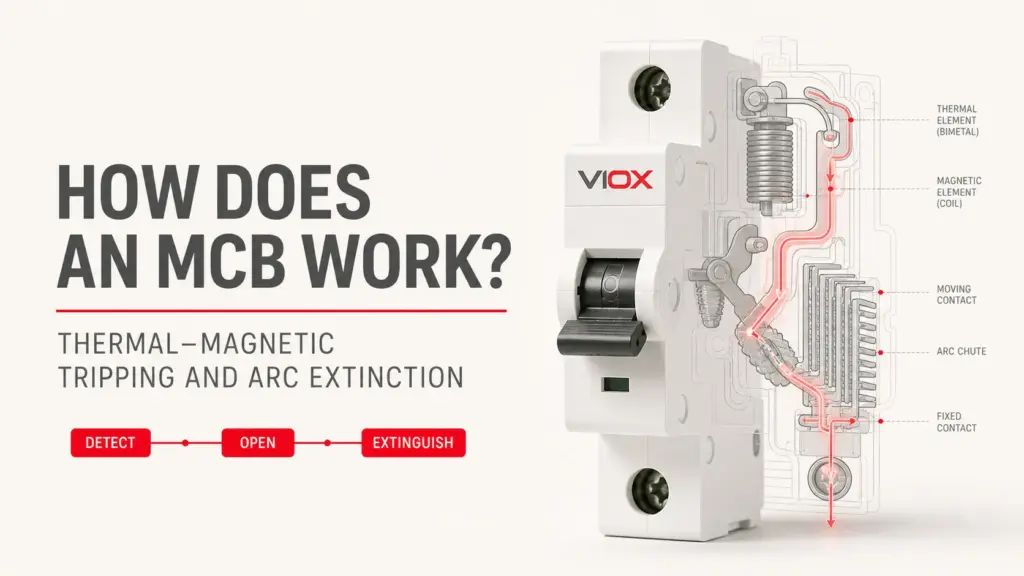
What makes an MCB different from a simple on/off switch is its dual-protection mechanism: thermal protection for sustained overloads (120-200% of rated current over minutes) and magnetic protection for short circuits and severe faults (hundreds to thousands of percent over rated current, tripping in milliseconds).
Here’s what MCBs protect against:
- Kelebihan beban: A circuit rated for 16A continuously carrying 20A. The cable insulation slowly heats beyond its rating, eventually failing and potentially starting a fire. The MCB’s thermal element detects this prolonged overcurrent and trips before insulation damage occurs.
- Sirkuit pendek: A fault creates a bolted connection between live and neutral (or live and earth), allowing fault current limited only by source impedance—potentially thousands of amps. The MCB’s magnetic element trips in 5-10 milliseconds, extinguishing the arc and preventing cable vaporization.
What MCBs do NOT protect against: Electric shock from earth leakage. A 30 mA current through a person’s body is more than enough to kill, but it’s nowhere near the threshold needed to trip even the most sensitive MCB.
Pro-Tip #4: Check your MCB ratings against your cable current-carrying capacity (CCC). The MCB should be rated at or below the cable’s CCC to ensure the MCB trips before the cable overheats.
How MCBs Work: The Dual-Guardian System
Inside every MCB sit two independent protection mechanisms, each optimized for a different threat: The Thermal Guardian (bimetallic strip) for sustained overloads, and The Magnetic Sniper (solenoid coil) for instantaneous short-circuit faults.
The Thermal Guardian: Bimetallic Strip Protection
Imagine two different metals—typically brass and steel—bonded into a single strip. When current flows through this bimetallic element, resistive heating occurs. But here’s the clever part: the two metals expand at different rates. Brass expands faster than steel. As the strip heats, the differential expansion causes it to bend predictably in one direction.
When your circuit is carrying rated current (say, 16A on a C16 MCB), the bimetallic strip heats to equilibrium but doesn’t bend far enough to trip. Push the circuit to 130% of rated current (20.8A), and the strip begins bending noticeably. At 145% (23.2A), the strip bends enough to release a mechanical latch, opening the contacts and breaking the circuit.
The Magnetic Sniper: Instantaneous Electromagnetic Trip
For short circuits and severe faults, waiting even a few seconds is too slow. Fault current can vaporize copper and ignite nearby materials in under 100 milliseconds. Enter the magnetic trip—the MCB’s instantaneous protection.
Wrapped around a section of the MCB’s current path is a solenoid coil. Under normal current flow, the magnetic field generated by this coil isn’t strong enough to actuate anything. But when fault current hits—say, 160A on that same C16 MCB (10× rated current)—the magnetic field becomes powerful enough to yank a ferromagnetic plunger or armature, mechanically tripping the latch and opening the contacts.
This happens in 5-10 milliseconds. No heating required. No time delay. Just pure electromagnetic force proportional to current.

MCB Trip Curves: Understanding B, C, and D
Every electrical load has a steady-state operating current and an inrush current—the brief surge when the load first energizes. If you protect a motor circuit with the wrong MCB, the motor’s inrush will trigger the magnetic trip every time you start the motor. This is why IEC 60898-1 defines three trip curves:
Type B: Low Inrush (3-5× In)
Typical applications: Pure resistive loads (electric heaters, incandescent lighting), long cable runs where fault current is naturally limited by impedance.
When to avoid Type B: Any circuit with motors, transformers, or switch-mode power supplies.
Type C: General Purpose (5-10× In)
Typical applications: General lighting (including LED), heating and cooling equipment, residential and commercial power circuits, office equipment.
Default choice: If you’re unsure which type to specify and the application isn’t explicitly high-inrush, default to Type C. It handles 90% of applications.
Type D: High Inrush (10-20× In)
Typical applications: Direct-on-line motor starters, transformers, welding equipment.
When Type D is mandatory: Motors with high starting torque requirements or frequent start-stop duty cycles.
Pro-Tip #5: Wrong MCB curve selection is the #1 cause of nuisance tripping complaints. Match the curve to the load.
RCD vs MCB: The Core Differences
| Fitur | RCD | MCB |
|---|---|---|
| Melindungi | People (Shock) | Circuits & Equipment (Fire/Damage) |
| Metode | Detects current imbalance (Leakage) | Detects current magnitude (Heat/Magnetic) |
| Sensitivitas | High (mA) | Low (Amps) |
| Blind Spot | Beban Lebih/Hubung Pendek | Kebocoran Bumi |
When to Use RCD vs MCB: Application Guide
The question isn’t “RCD or MCB?”—it’s “where do I need RCD in addition to MCB?”
Scenarios Requiring RCD Protection (in addition to MCB)
- Lokasi Basah dan Lembab: Bathrooms, kitchens, laundry areas, outdoor outlets (NEC 210.8, BS 7671 Section 701).
- Socket Outlets: Outlets likely to supply portable equipment.
- TT Earthing Systems: Where earth fault loop impedance is too high for MCB alone.
- Specific Equipment: EV charging, Solar PV, Medical locations.
Scenarios Where MCB Alone Is Sufficient
- Fixed equipment in dry locations (inaccessible to ordinary persons).
- Lighting circuits in dry locations (depending on local code).
- Dedicated circuits for fixed loads like water heaters (non-wet areas).
Pro-Tip #6: When in doubt, add the RCD. The incremental cost is trivial compared to the cost of an electric shock injury.

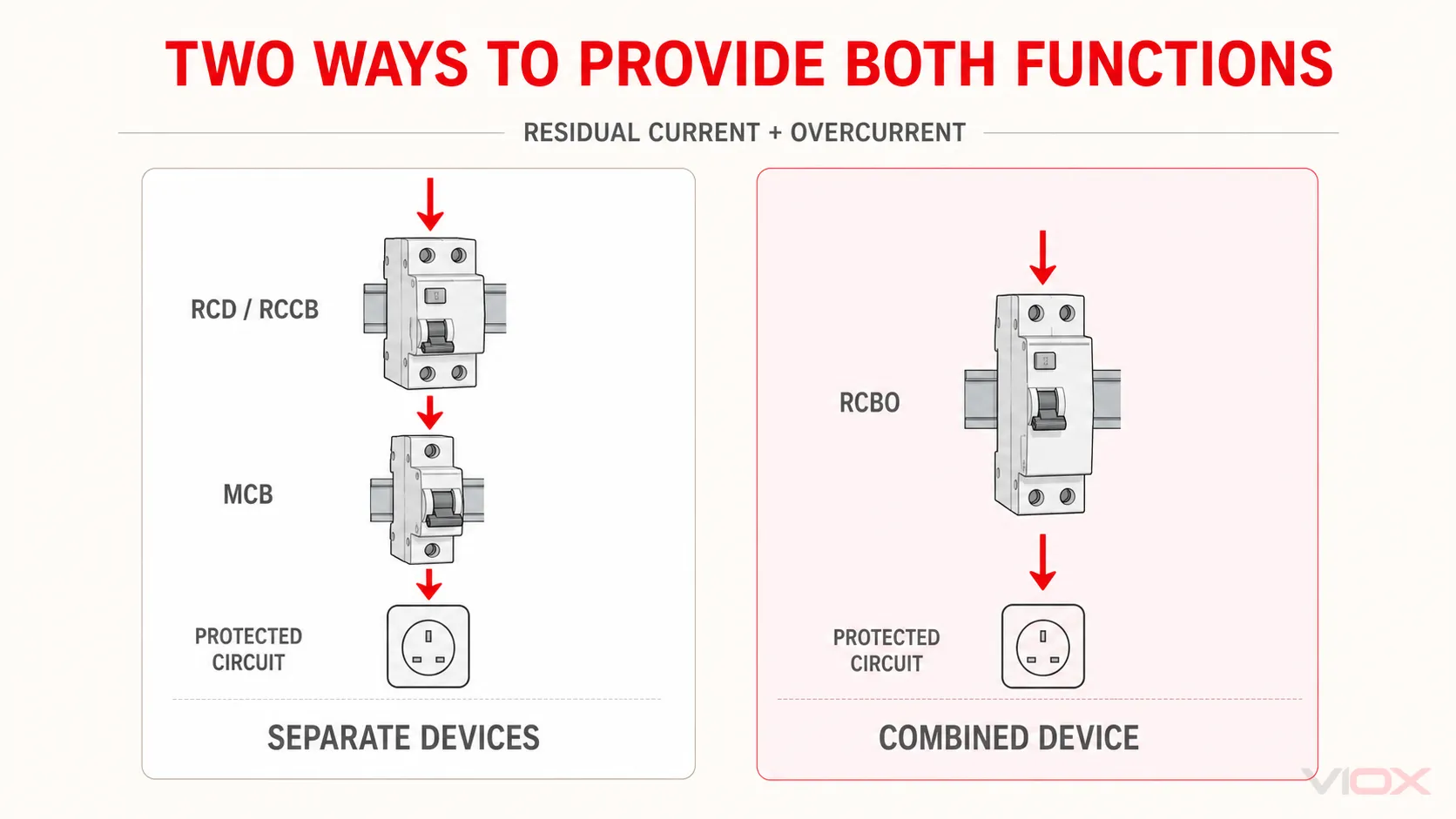
Combining RCD and MCB for Complete Protection
Approach 1: Separate RCD + MCB
Install an RCD upstream (closer to the source) protecting a group of MCBs downstream.
- Advantage: Cost-effective.
- Disadvantage: If RCD trips, all downstream circuits lose power.
Approach 2: RCBO (Residual Current Breaker with Overcurrent Protection)
Sebuah RCBO combines RCD and MCB functionality in a single device.
- Advantage: Independent protection per circuit. Better fault diagnosis.
- Disadvantage: Higher cost per circuit.

Kesalahan Umum Pemasangan dan Cara Menghindarinya
- Mistake #1: Using MCB Alone in Wet Locations. Fix: Install 30 mA RCD protection.
- Mistake #2: Wrong RCD Type for Modern Loads. Fix: Use Type A or Type B for variable-speed drives/EVs.
- Mistake #3: Shared Neutrals Across RCD-Protected Circuits. Fix: Ensure each RCD circuit has a dedicated neutral.
- Mistake #4: Oversized MCB for Cable Rating. Fix: Select MCB rating ≤ cable CCC.
- Mistake #5: Ignoring RCD Test Button. Fix: Test quarterly.
Pertanyaan yang Sering Diajukan
Can I replace an MCB with an RCD?
No. An MCB protects against overcurrent; an RCD protects against shock. You need both.
How often should I test my RCD?
Test every RCD at least quarterly (every 3 months) using the built-in test button.
Why does my RCD keep tripping?
Common causes include genuine ground faults, cumulative leakage from too many appliances, transient surges, or shared neutral wiring errors.
Standar & Sumber yang Dirujuk
- IEC 61008-1:2024 (RCCBs)
- IEC 61009-1:2024 (RCBOs)
- IEC 60898-1:2015+A1:2019 (MCBs)
- IEC 62955:2018 (RDC-DD for EVs)
- NEC 2023 (NFPA 70)
- BS 7671:2018+A2:2022
Pernyataan Ketepatan Waktu: All technical specifications, standards, and safety data accurate as of November 2025.
Need help selecting the right protection devices for your application? VIOX Electric offers a complete range of IEC-compliant RCDs, MCBs, and RCBOs for residential, commercial, and industrial installations. Our technical team can assist with device selection, compliance verification, and application engineering. Hubungi kami for specifications and support.