

Sa pahinang ito
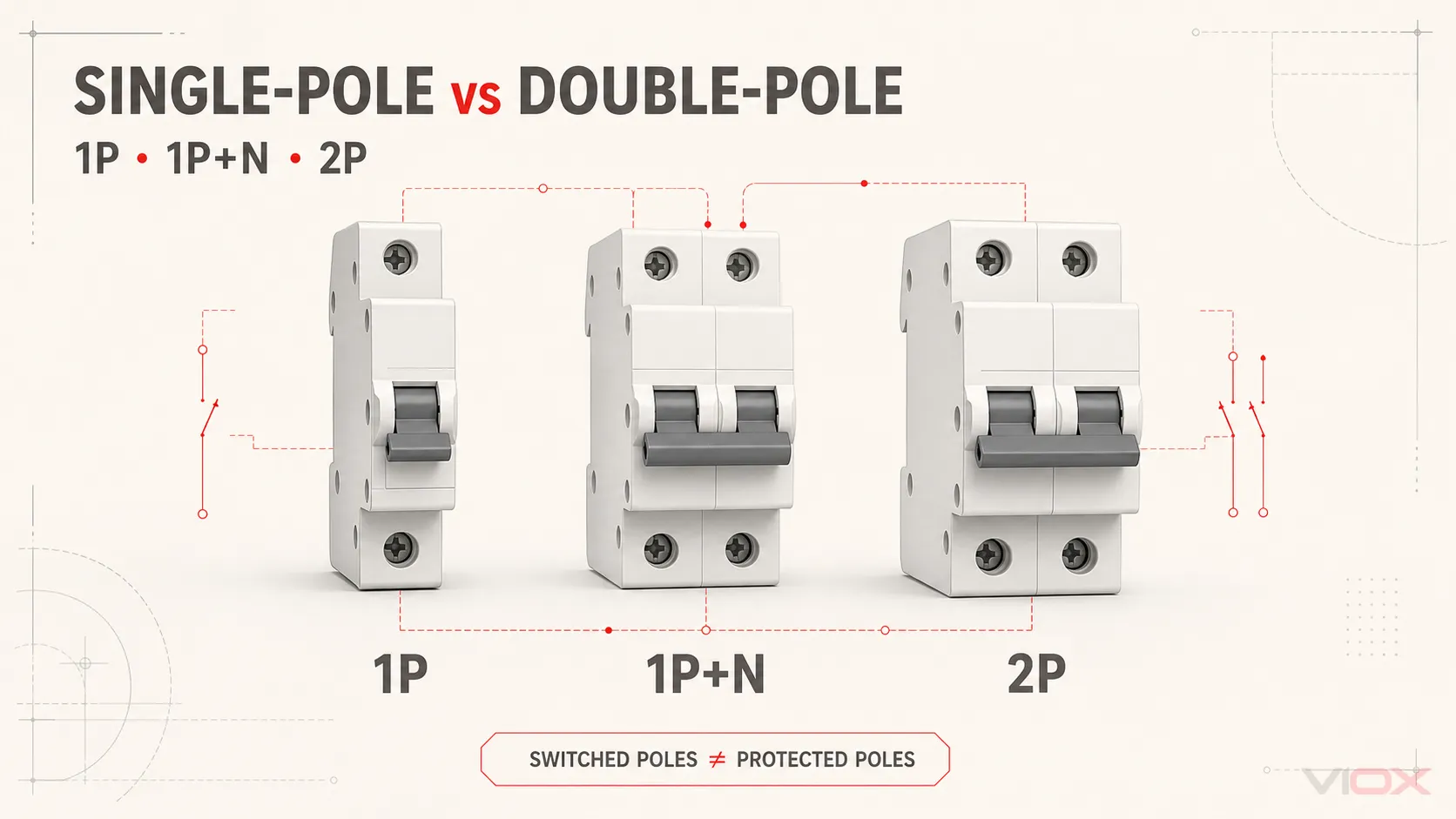
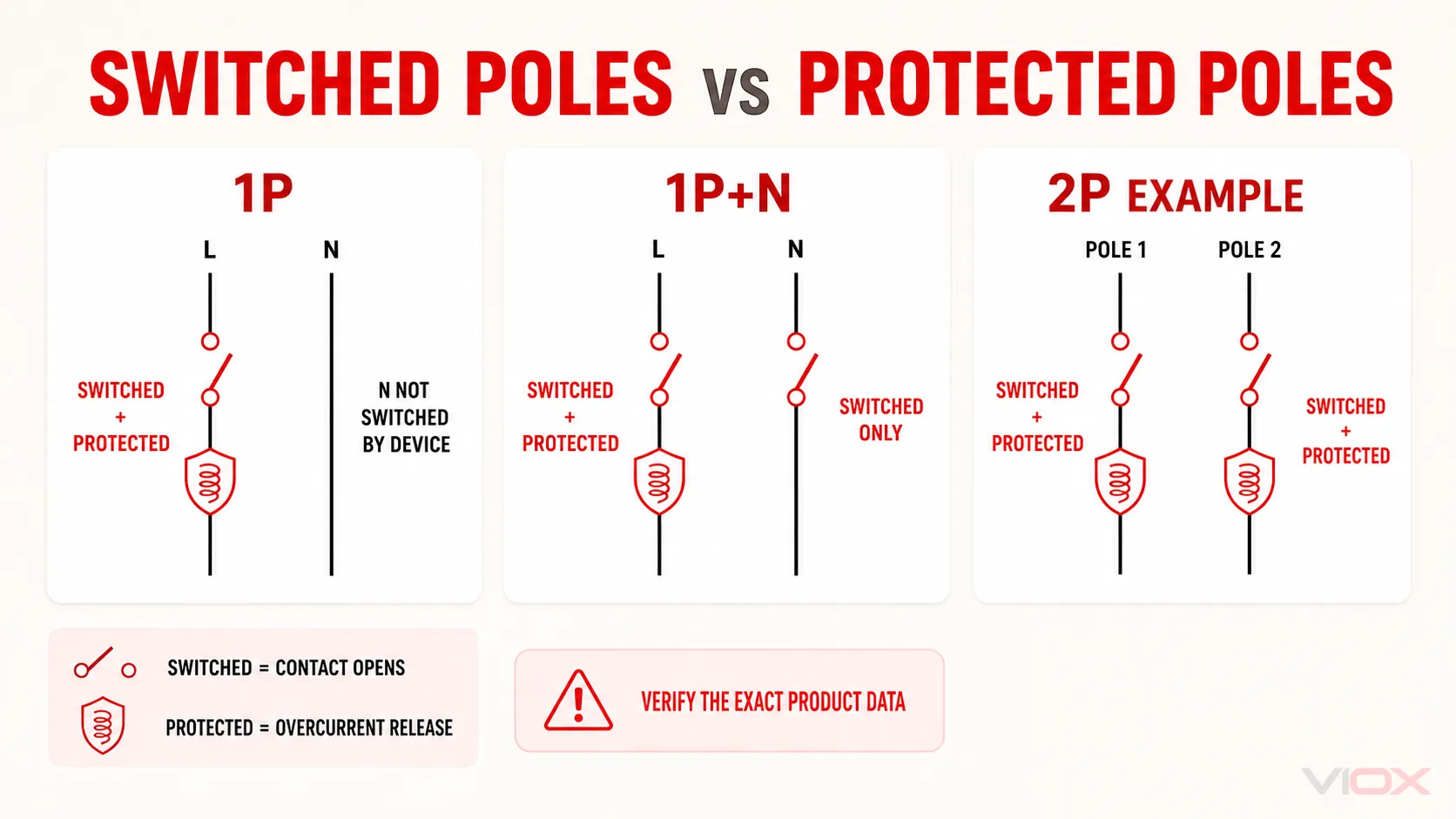
A single-pole breaker opens one conductor. A double-pole breaker opens two conductors together. An IEC-style 1P+N breaker normally switches both phase and neutral but provides overcurrent protection on the phase pole only. A 2P breaker switches two conductors and may have an overcurrent release in both poles, but the exact protected-pole arrangement must be confirmed from the product marking and datasheet.
The correct choice is not a simple 1P → 1P+N → 2P safety upgrade. It depends on the supply conductors, which conductors must be disconnected, which poles are protected, the breaker and panel design, and the rules that apply to the installation.
1P vs 1P+N vs 2P at a Glance
| Configuration | Mga konduktor na may switch | Typical protected-pole arrangement | Karaniwang konteksto | Huwag mag-assume |
|---|---|---|---|---|
| 1P | Isa | Isang protected pole | One ungrounded/phase conductor | That it suits every circuit described as “single phase” |
| 1P+N | Phase and neutral | Phase protected; neutral switched but normally not overcurrent-protected | IEC-style phase-to-neutral final circuits where neutral switching is required or selected | That N means the neutral has an overcurrent release |
| 2P | Dalawa | Often two protected poles, subject to product design and marking | Two ungrounded conductors, or a phase-neutral arrangement that requires two protected poles | That one pole must be neutral, or that every 2P device has the same trip construction |
This table describes common low-voltage arrangements, not a universal wiring instruction. Product designations vary, and some manufacturers use more detailed notation to distinguish the number of switched poles from the number of protected poles.
If you need the underlying device basics first, see what a miniature circuit breaker is. The broader mga uri ng circuit breaker guide places MCBs within the complete breaker family.
Pole Count and Protected-Pole Count Are Different Questions
A poste is a current path that the breaker can open. A protected pole has an overcurrent release or is otherwise included in the device’s declared overcurrent-protection function. These concepts overlap, but they are not identical.
That difference explains 1P+N:
- The phase pole carries the overcurrent release.
- The neutral pole opens with the phase pole.
- The neutral pole is normally identified as a switched neutral rather than a protected pole.
By contrast, a two-pole breaker may provide overcurrent protection in both poles. This is important when both conductors are ungrounded, as in many line-to-line circuits. It can also matter in a phase-neutral circuit where the installation design requires protection of the neutral conductor. The actual product—not the shorthand 2P alone—must establish the trip arrangement.
Do not infer pole construction from enclosure width. Compact 1P+N devices, two-module products, North American panelboard breakers, and industrial circuit breakers use different mechanical formats.
North American Single-Pole vs Double-Pole Breakers
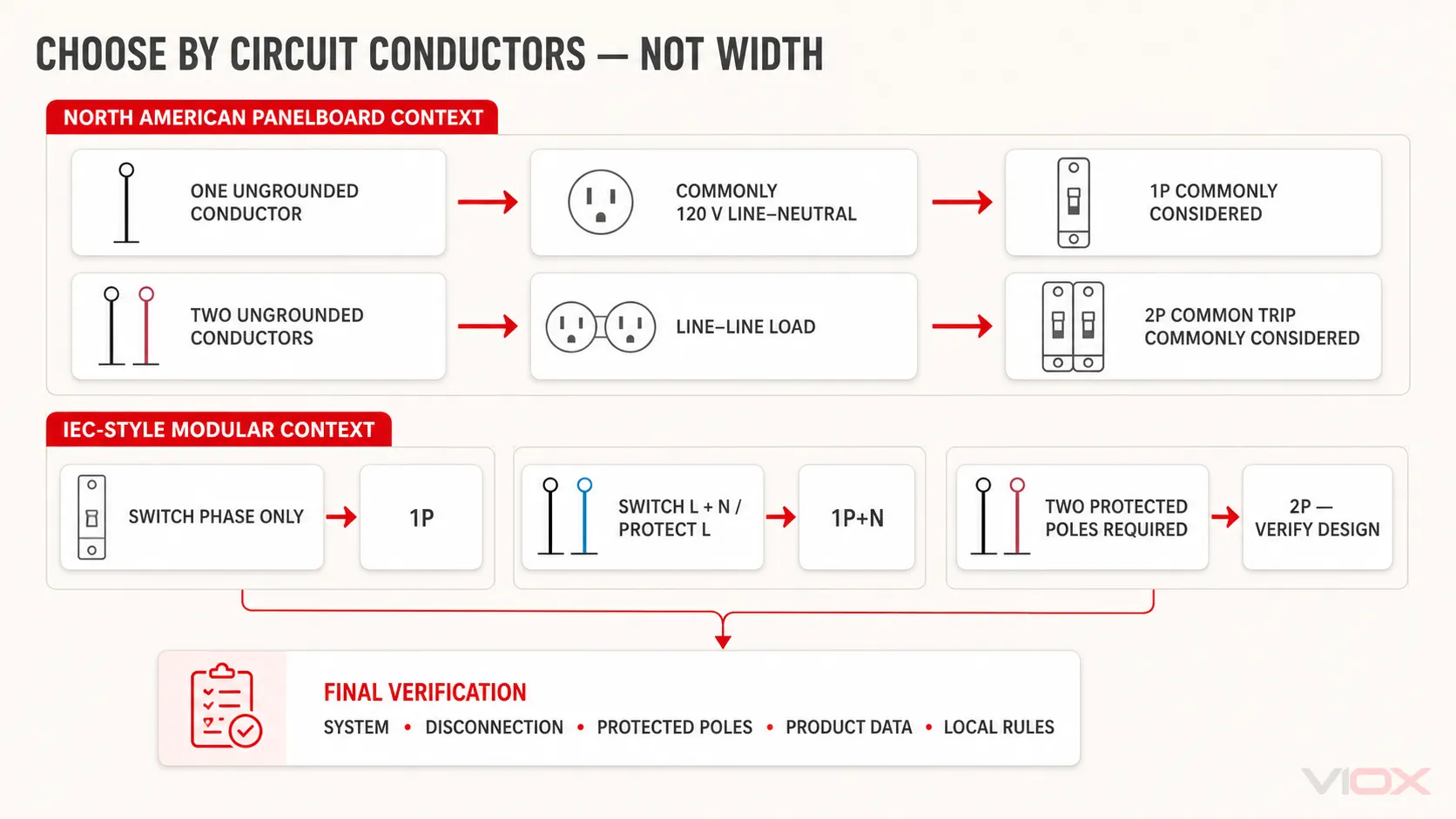
In a typical North American 120/240 V single-phase dwelling service, the comparison usually concerns ungrounded conductors:
- A single-pole breaker connects to one ungrounded conductor and commonly supplies a 120 V line-to-neutral branch circuit.
- A two-pole common-trip breaker connects to two ungrounded conductors and commonly supplies a 240 V line-to-line load. Some loads also use a neutral for 120 V components, but the neutral is not what makes the breaker two-pole.
A two-pole breaker can also be applied on other documented systems. For example, a line-to-line load on a 120/208 V three-phase wye system sees 208 V, not 240 V. Pole count therefore does not create a voltage; the source configuration and the conductors selected determine the circuit voltage.
Common Trip Is Not the Same as a Handle Tie
Two handles moving together do not automatically prove that a breaker has an internal common-trip mechanism.
- Common trip means an overcurrent condition on one pole causes all poles of the breaker to open through the device’s internal trip mechanism.
- Independent trip with a handle tie can provide simultaneous manual disconnection, but the tie alone does not convert the devices into a common-trip breaker.
UL Solutions distinguishes common-trip and independent-trip products and notes that an external handle tie does not itself qualify as common trip. Whether an identified handle-tied arrangement is permitted depends on the circuit, product markings, panel documentation, and applicable code. Never improvise a tie or substitute two loose single-pole breakers for a listed multipole device.
IEC-Style 1P, 1P+N, and 2P Breakers
In IEC-style modular distribution, 1P, 1P+N, and 2P are often compared on phase-to-neutral circuits. Here the decisive issue is whether the neutral is only switched or is also fitted with overcurrent protection.
1P
A 1P device switches and protects one conductor, normally the phase conductor in a phase-to-neutral final circuit. The neutral remains connected to the neutral bar unless another suitable device provides isolation.
1P+N
A 1P+N device switches phase and neutral together while normally sensing overcurrent on the phase pole. This arrangement can provide all-pole circuit disconnection in a compact format, but it does not mean that the neutral pole has the same overcurrent release as the phase pole.
2P
A 2P device switches two conductors. Many IEC-style 2P circuit breakers have protected poles on both current paths, but the datasheet or protected-pole designation must confirm this. A two-pole device can serve two phase conductors or a phase and neutral, depending on the system and approved application.
Ang pariralang double-pole breaker therefore needs context. In North American residential language it usually points to two ungrounded conductors and a common-trip panelboard breaker. In IEC modular language it may refer to a device with two switched and two protected poles. These descriptions should not be blended into one universal wiring rule.
Which Configuration Fits the Circuit?
Start with the conductors and protection requirement, not with the physical width of the breaker.
| Kondisyon ng circuit | Configuration commonly considered | Ano ang dapat i-verify |
|---|---|---|
| One ungrounded conductor supplying a line-to-neutral branch circuit | 1P | System voltage, panel compatibility, conductor protection, and whether neutral disconnection is required |
| IEC-style phase-neutral final circuit requiring simultaneous phase and neutral switching | 1P+N | The neutral pole is identified correctly, opening/closing sequence where relevant, and local installation rules |
| Two ungrounded conductors supplying a line-to-line load | 2P common-trip or another approved multipole arrangement | Voltage rating, common-trip requirement, panel listing, and interrupting rating |
| Phase-neutral circuit where both current-carrying conductors require overcurrent protection | 2P or another specifically documented arrangement | Whether neutral overcurrent protection is required and permitted, and the exact protected-pole configuration |
| Multiwire or shared-neutral circuit | An identified simultaneous-disconnection or common-trip arrangement as required by the application | Applicable code, load arrangement, handle-tie/common-trip distinction, and panel documentation |
| Three-phase circuit | 3P, 3P+N, TPN, or 4P depending on system | Use the dedicated three-phase pole-selection analysis rather than extrapolating from this table |
For the broader relationship between poles, system voltage, and current paths, see how circuit-breaker poles affect voltage and current protection. Three-phase configurations belong in the separate SP, TP, TPN, and 4P guide.
Neutral Protection, Earthing Systems, and Harmonics
Neutral treatment cannot be reduced to “TN-S uses 1P+N, TT uses 2P, and IT always uses 2P.” Earthing arrangement matters, but it is only one design input.
The installation designer may need to consider:
- whether the neutral is reliably identified and distributed;
- whether all live conductors must be isolated;
- the neutral conductor cross-section;
- upstream short-circuit and residual-current protection;
- nonlinear loads and triplen harmonic current in three-phase four-wire systems;
- continuity-of-service requirements in an IT system;
- national deviations and the current edition of the applicable installation standard.
IEC 60364-4-43:2023 covers protection of conductors against overcurrent and includes neutral or midpoint conductor requirements with and without triplen harmonics. It does not support a universal rule that every electronic load requires a 2P breaker. Neutral sizing and protection must be assessed for the actual circuit architecture.
Never switch or interrupt a protective conductor. A combined protective earth and neutral conductor, such as a PEN conductor, requires special treatment under the applicable installation rules and must not be handled as an ordinary switched neutral.
Four Checks Before Selecting or Replacing a Breaker
Before specifying 1P, 1P+N, or 2P, verify all four items:
- Identify every circuit conductor. Determine which are ungrounded/phase conductors, neutral conductors, and protective conductors. Do not use “single phase” as a substitute for a conductor diagram.
- Define the required disconnection. Establish which live conductors must open together for fault clearing, isolation, maintenance, or the connected equipment.
- Confirm the protected poles. Read the product marking, wiring information, and datasheet. The number of switched poles alone does not prove where the overcurrent releases are installed.
- Verify the complete product application. Match rated voltage, current, interrupting or breaking capacity, trip characteristic, AC/DC suitability, panel or busbar compatibility, terminals, and applicable approvals.
Physical fit and matching ampere labels are not sufficient evidence of interchangeability. Installation or replacement inside a distribution board should be performed by a qualified person using the panel documentation, breaker instructions, and local requirements. For the separate installation workflow, see how to install and connect an MCB.
Madalas Na Tinatanong Na Mga Katanungan
What is the main difference between a single-pole and double-pole breaker?
A single-pole breaker opens one conductor; a double-pole breaker opens two conductors together. In common North American residential use, that often means 120 V line-to-neutral versus 240 V line-to-line, but those voltage values are consequences of the supply system—not universal definitions of pole count.
Is 1P+N the same as 2P?
Usually not. A typical 1P+N breaker protects the phase pole and switches the neutral pole. A 2P breaker may protect both poles. Confirm the exact manufacturer’s protected-pole designation because naming conventions and product designs vary.
Does a double-pole breaker need a neutral?
No. A two-pole breaker frequently protects two ungrounded conductors supplying a line-to-line load, with no neutral required by that load. Other loads use two ungrounded conductors plus a neutral for mixed-voltage functions.
Is a two-pole breaker safer than a single-pole breaker?
Not as a general rule. A two-pole breaker is correct when the circuit requires two conductors to be opened and its ratings and trip arrangement match the application. Adding poles does not repair an incorrect voltage rating, fault rating, conductor size, trip characteristic, or panel mismatch.
Can two single-pole breakers replace one double-pole breaker?
Only where the exact identified products, handle-tie or common-trip function, circuit arrangement, panel documentation, and applicable rules permit it. A field-added handle tie does not create an internal common-trip mechanism.
Selecting a VIOX MCB Configuration
Once the circuit conductors and protected-pole requirement are known, compare the available VIOX miniature circuit breaker configurations. Request the exact series datasheet and destination-market documentation rather than selecting from pole count alone.
Mga Sanggunian
- IEC 60898-1 — circuit breakers for household and similar installations
- IEC 60364-4-43:2023 — protection against overcurrent
- Schneider Electric — isolation of the neutral conductor
- Schneider Electric — 1P+N versus 2P and 3P+N versus 4P
- UL Solutions — Gabay sa Pagmamarka at Aplikasyon ng Molded Case Circuit Breaker
- Eaton — example two-pole 120/240 V common-trip breaker data