
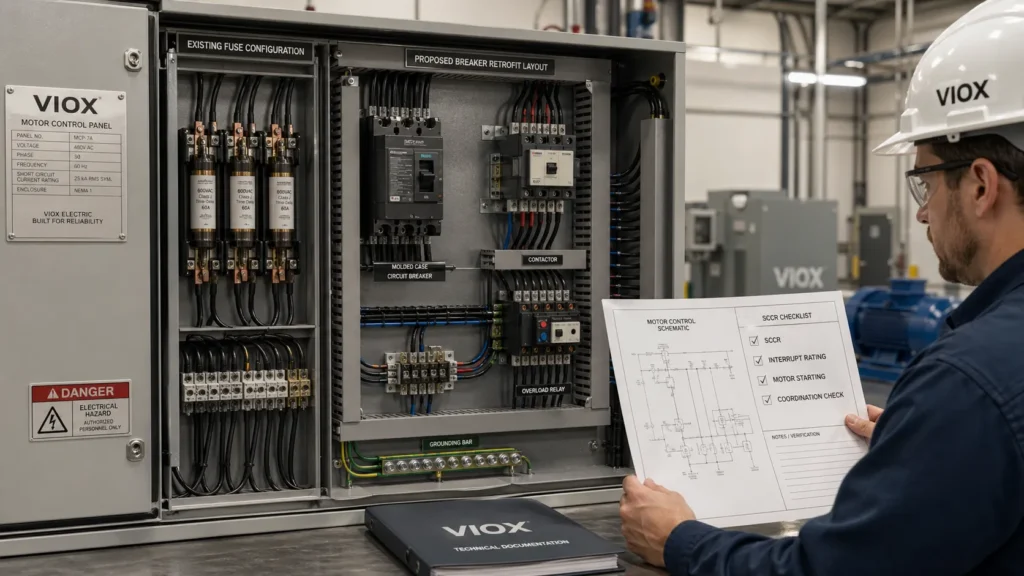
Kapag ang isang motor control panel ay nakakaranas ng paulit-ulit na paghinto dahil sa mga pumutok na fuse, madalas itanong ng mga maintenance team: “Maaari ba nating palitan ang mga fuse na ito ng mga circuit breaker?” Ang sagot ay kumplikado—ang pagpapalit ng fuse sa breaker ay maaaring makapagpabuti nang malaki sa operational efficiency, ngunit lamang kung isasagawa nang may tamang pagsusuri sa inhinyeriya.
Ang komprehensibong gabay na ito ay naglalakad sa mga teknikal na kinakailangan, mga konsiderasyon sa kaligtasan, at mga pamantayan sa pagpili para sa matagumpay na pagpapalit ng mga motor control panel mula sa proteksyon na nakabatay sa fuse patungo sa proteksyon na nakabatay sa breaker. Kung ikaw ay isang electrical engineer na sinusuri ang isang proyekto sa pagpapalit o isang maintenance manager na naghahanap upang mabawasan ang paghinto, ang artikulong ito ay nagbibigay ng balangkas na kailangan mo upang makagawa ng isang may kaalamang desisyon.
Ano ang Pagpapalit ng Fuse sa Breaker?
Ang pagpapalit ng fuse sa breaker ay kinabibilangan ng pagpapalit ng mga tradisyonal na fuse holder at fuse sa isang motor control panel ng mga circuit breaker—karaniwan ay molded case circuit breaker (MCCB) o motor protection circuit breaker. Ang layunin ay karaniwang upang mapabuti ang kaginhawaan sa pag-reset, mapahusay ang visibility sa pag-troubleshoot, at mabawasan ang imbentaryo ng mga ekstrang piyesa habang pinapanatili o pinapabuti ang proteksiyon na pagganap ng mga motor branch circuit.
Gayunpaman, ito ay wala isang simpleng pagpapalit ng ampere rating na isa-sa-isa. Ang mga katangian ng proteksyon, pag-uugali sa pagputol ng fault, at mga kinakailangan sa koordinasyon ay lubhang nagkakaiba sa pagitan ng mga fuse at breaker, kaya't mahalaga ang wastong pagsusuri ng engineering para sa isang ligtas at sumusunod sa kodigong retrofit.
Bakit Gumagamit ng mga Fuse o Breaker ang mga Motor Control Panel
Bago sumisid sa mga pagsasaalang-alang sa retrofit, mahalagang maunawaan ang arkitektura ng proteksyon sa mga motor control panel.
Ang Dalawang-Layer na Estratehiya ng Proteksyon
Karaniwang gumagamit ang mga motor circuit ng dalawang-layer na proteksyon:
Layer 1: Proteksyon sa Short-Circuit at Ground-Fault
- Ibinibigay ng mga upstream fuse o circuit breaker
- Mabilis na nililinis ang mga high-magnitude fault
- Pinoprotektahan ang mga konduktor ng sangay ng sirkito, kagamitan sa pagkontrol, at mga panimulang motor
- Dapat may sapat na interrupting rating para sa available na fault current
Layer 2: Proteksyon sa Sobrang Karga
- Ibinibigay ng mga thermal overload relay o mga elektronikong aparato sa proteksyon ng motor
- Tumutugon sa matagalang kondisyon ng sobrang kuryente
- Pinoprotektahan ang motor mula sa sobrang pag-init sa panahon ng naka-lock na rotor, pagkawala ng phase, o mga kondisyon ng sobrang karga
- Karaniwang naaayos upang tumugma sa full-load current ng motor
Ang pagkakaibang ito ay kritikal: ang piyusa o breaker sa unahan ay pangunahing para sa proteksyon sa short-circuit, hindi para sa proteksyon sa sobrang karga ng motor. Kaya naman ang pagpapalit ng piyusa sa breaker ay dapat suriin bilang bahagi ng kumpletong proteksyon ng sangay ng motor circuit, hindi bilang isang hiwalay na pagpapalit ng device.
Para sa mas malalim na pag-unawa kung paano nagkakaiba ang mga protective device na ito sa mga aplikasyon ng motor, tingnan ang MCB vs Fuse: Bakit Patuloy na Nagfa-fail ang Iyong mga Motor Circuit.
Mga Pangunahing Pagkakaiba: Mga Piyusa vs Circuit Breaker sa mga Motor Panel
Ang pag-unawa sa mga pangunahing pagkakaiba sa pagitan ng mga piyusa at circuit breaker ay nakakatulong upang ipaliwanag kung bakit kailangan ng masusing pagsusuri sa mga retrofit:
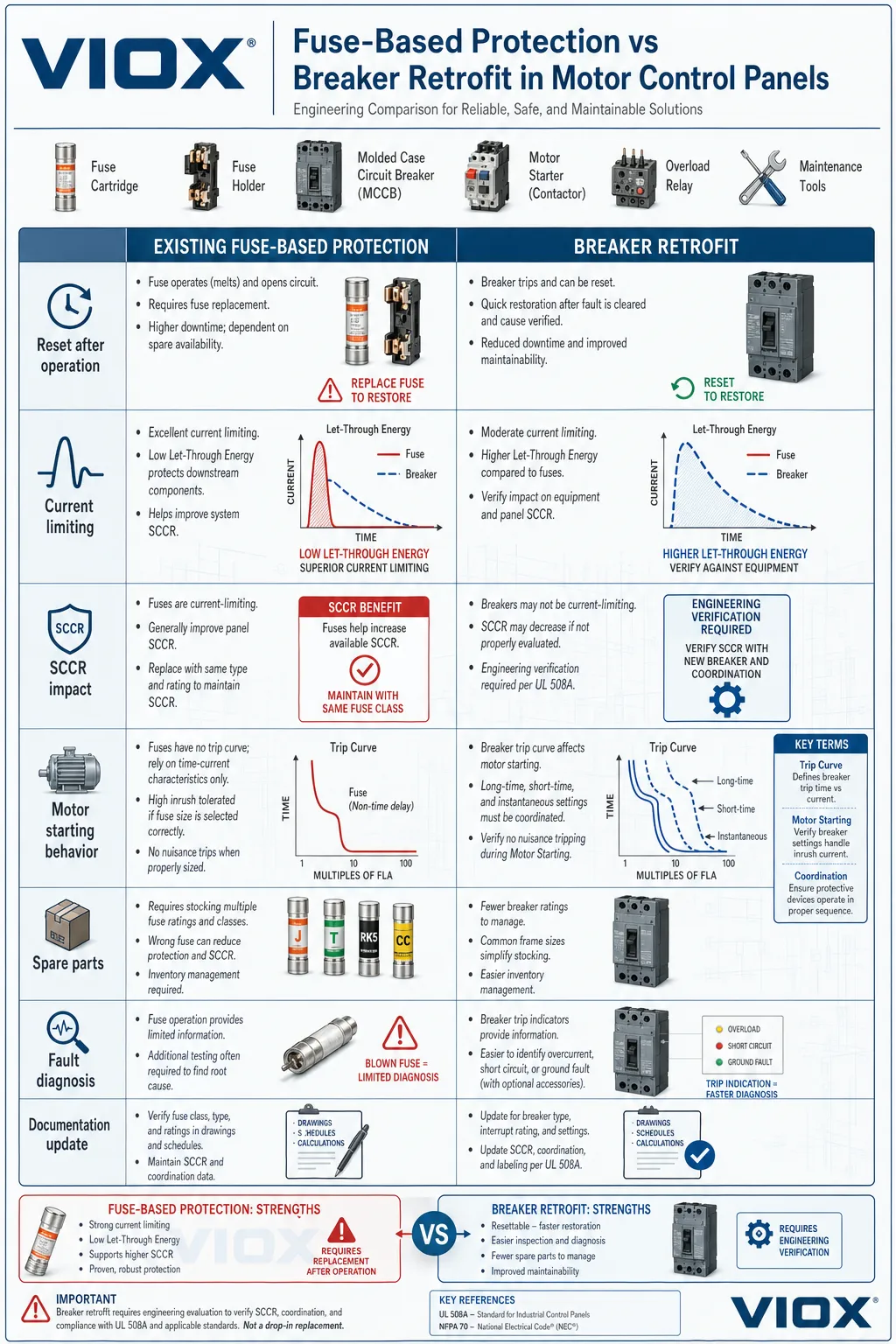
| Katangian | Mga piyus | Mga Circuit Breaker |
|---|---|---|
| Paraan ng pag-reset | Kailangang pisikal na palitan pagkatapos ng operasyon | Maaaring i-reset pagkatapos maayos ang sira (kung hindi nasira) |
| Indikasyon ng pagkakatisod (Trip) | Putok na piyusa ay nakikita ngunit kailangan ng inspeksyon | Ang posisyon ng handle ng trip ay malinaw na nagpapahiwatig ng operasyon |
| Kasalukuyang limitasyon | Ang mga piyus na Class RK1, RK5, J, at CC ay nagbibigay ng mahusay na limitasyon sa agos (current) | Ang pagganap ng paglilimita ng agos (current) ay nag-iiba ayon sa disenyo at modelo ng breaker |
| Let-through na enerhiya | Ang mababang halaga ng I²t ay nagpapababa ng stress sa mga kagamitan sa ibaba (downstream) | Mas mataas na enerhiya na pinapadaan maliban kung espesipikong idinisenyo bilang current-limiting |
| Koordinasyon | Nahuhulaang mga kurba ng oras-kuryente, napakahusay para sa selective coordination | Mas komplikadong koordinasyon; nangangailangan ng maingat na pagsusuri ng kurba |
| Pagpapanatili | Nangangailangan ng tamang imbentaryo ng pamalit na fuse | Potensyal para sa pag-abuso sa pag-reset kung ang mga fault ay hindi iniimbestigahan |
| Pagpaparaya sa pag-start ng motor | Mga time-delay fuse na espesipikong idinisenyo para sa motor inrush | Nangangailangan ng tamang instantaneous trip setting o magnetic trip adjustment |
| Kakayahang mag-diagnose | Limitado sa visual na inspeksyon | Maaaring kabilangan ng mga auxiliary contact, indikasyon ng pagka-trip, at remote monitoring |
| Kinakailangang espasyo | Karaniwang mga compact na fuse holder | Ang mga breaker ay madalas na nangangailangan ng mas maraming espasyo sa panel at wire bending room |
Para sa isang pangunahing paghahambing ng mga protective device na ito, sumangguni sa Fuse vs Circuit Breaker: Ano ang Pagkakaiba?
Bakit Kinukonsidera ng mga Pasilidad ang Pagpapalit ng Fuse sa Breaker
1. Nabawasang Downtime Pagkatapos ng Pag-clear ng Fault
Ang pinakanakakahimok na benepisyo sa operasyon ay ang pag-aalis ng oras ng pagpapalit ng fuse. Kapag ang isang transient fault ay nag-trip ng breaker, maaaring inspeksyunin ng mga tauhan ng maintenance ang circuit, beripikahin na na-clear na ang fault, at ibalik ang power sa pamamagitan ng simpleng pag-reset—madalas sa loob ng ilang minuto sa halip na mga oras na kinakailangan upang hanapin, kunin, at ikabit ang mga pamalit na fuse.
Sa mga continuous process industries—chemical plants, water treatment facilities, food processing—ang pagtitipid na ito sa oras ay maaaring makapagpigil sa magastos na pagkalugi sa produksyon.
2. Pinahusay na Kakayahan sa Diagnostic
Ang mga modernong molded case circuit breaker ay nag-aalok ng mga feature na hindi kayang ibigay ng mga tradisyonal na fuse holder:
- Malinaw na indikasyon sa paglalakbay: Agad na ipinapakita ng posisyon ng handle ng breaker kung aling device ang umandar
- Mga pantulong na contact: Paganahin ang remote trip indication at integration sa SCADA o building management systems
- Mga electronic trip unitNagbibigay ng proteksyon sa ground-fault, naaayos na mga kurba ng oras-kasalukuyan, at pagtatala ng fault
- Kakayahan sa shunt tripNagbibigay-daan sa remote o emergency shutdown integration
Ang mga katangiang ito ay nagpapabuti sa kahusayan sa pag-troubleshoot at sumusuporta sa mga estratehiya ng predictive maintenance.
Pinasimpleng Pamamahala ng Spare Parts
Ang mga motor control panel na nakabatay sa fuse ay madalas na nangangailangan ng maraming klase ng fuse (Class RK5, Class J, Class CC), iba't ibang ampere ratings, at iba't ibang voltage ratings. Ang isang mahusay na planong breaker retrofit ay maaaring pagsamahin ang imbentaryong ito sa mas maliit na bilang ng mga breaker frame size at trip units, na nagpapababa sa mga gastos sa pagdadala at nagpapaliit sa panganib ng maling pag-install ng fuse.
Pinahusay na Kaligtasan at Pagsunod sa Lockout-Tagout
Ang mga circuit breaker na may pinagsamang disconnect function at mga lockable handle ay maaaring pasimplehin ang mga pamamaraan ng lockout-tagout. Maraming breaker ang tumatanggap ng mga karaniwang lockout device nang mas madali kaysa sa mga fuse holder, na nagpapabuti sa pagsunod sa mga kinakailangan ng OSHA 1910.147 at NFPA 70E.
Para sa mga aplikasyon na nangangailangan ng molded case circuit breakers, tuklasin ang linya ng produkto ng VIOX MCCB para sa mga opsyon na pang-industriya.
Mga Kritikal na Panganib sa Pagpapalit ng Fuse sa Breaker
Habang kaakit-akit ang mga benepisyo sa pagpapatakbo, maraming teknikal na panganib ang maaaring magpabago sa isang maayos na pagpapalit sa isang panganib sa kaligtasan o paglabag sa code.
Panganib 1: Nabawasang Panel Short-Circuit Current Rating (SCCR)
Ito ang pinakamahalagang teknikal na panganib sa anumang pagpapalit ng fuse sa breaker.
Maraming motor control panel ang nakakamit ang kanilang nakatalagang short-circuit current rating (SCCR) sa pamamagitan ng current-limiting action ng Class J, Class RK1, o Class CC fuses. Dramatikong binabawasan ng mga fuse na ito ang peak let-through current at I²t energy sa panahon ng malalaking pagkakamali, na nagpapahintulot sa mga downstream component—contactors, overload relays, terminal blocks, busbars—na makayanan ang mga kondisyon ng pagkakamali na hindi nila kayang tiisin.
Kapag pinalitan mo ang mga fuse na naglilimita ng kuryente (current-limiting fuses) ng isang circuit breaker na may mas mataas na enerhiya na pinapadaan (let-through energy), maaaring bumaba ang SCCR (Short-Circuit Current Rating) ng panel nang mas mababa sa available na fault current sa lugar ng pagkakabit. Lumilikha ito ng isang mapanganib na kondisyon kung saan ang panel ay hindi na sapat ang rating para sa lokasyon nito.
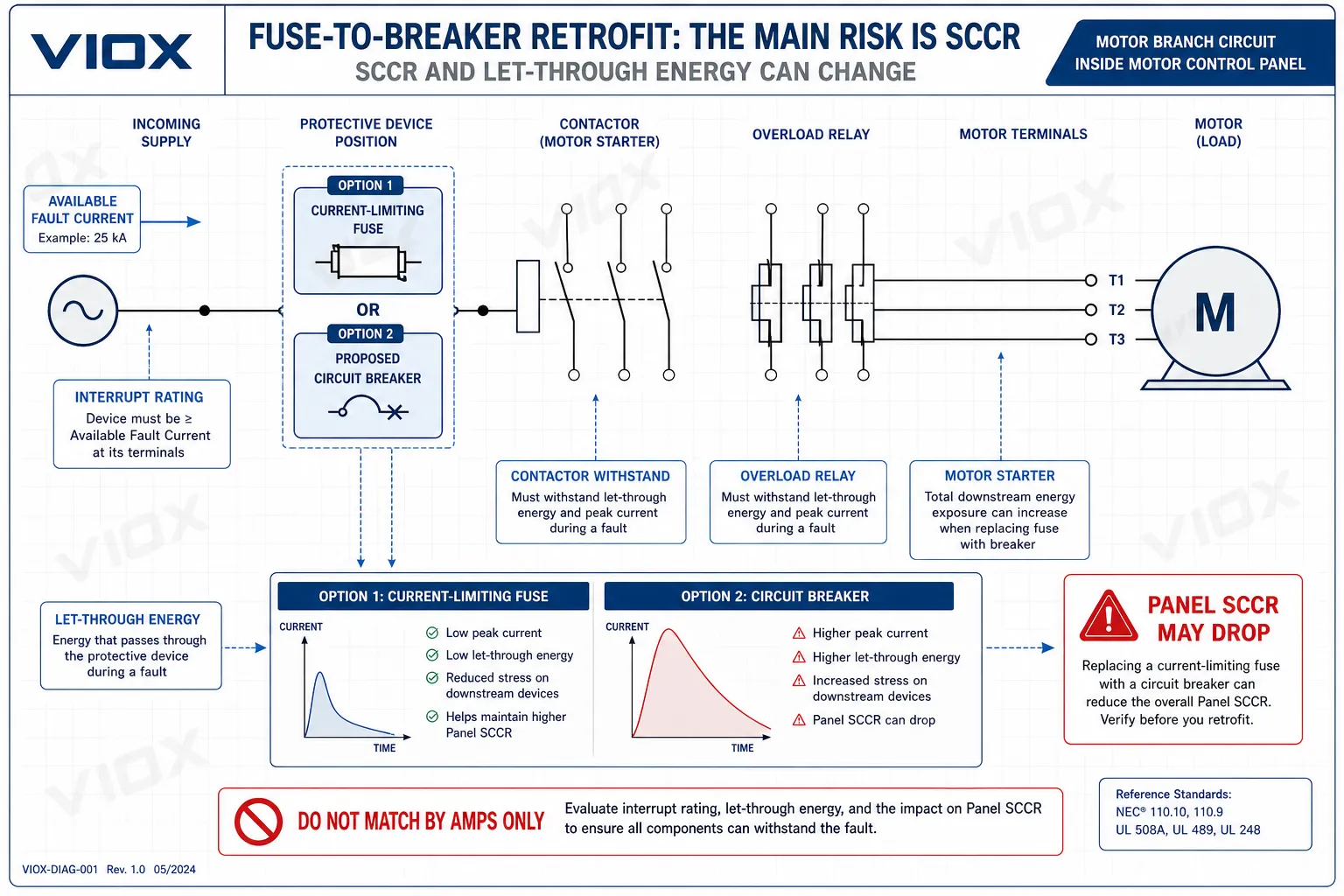
Kinakailangan sa inhenyeriya: Bago ang anumang retrofit, dapat mong:
- Tukuyin ang available na fault current sa mga terminal ng linya ng panel
- Patunayan ang interrupting rating ng iminumungkahing breaker
- Muling kalkulahin ang SCCR ng panel gamit ang mga katangian ng enerhiya na pinapadaan (let-through characteristics) ng breaker
- Kumpirmahin na ang muling kinalkulang SCCR ay lumampas sa available na fault current
- I-update ang paglalagay ng label sa panel upang ipakita ang bagong SCCR.
Para sa detalyadong paliwanag ng interrupting ratings ng breaker, tingnan ang Mga Rating ng Circuit Breaker: Icu, Ics, Icw, at Icm.
Panganib 2: Nuisance Tripping Habang Nag-uumpisa ang Motor
Ang starting current ng motor ay karaniwang nasa 6 hanggang 8 beses ng full-load current para sa across-the-line starting, at maaaring magpatuloy ng ilang segundo depende sa laki ng motor at load inertia. Ang mga time-delay fuse ay sadyang idinisenyo na may mga katangian ng pagkatunaw na tumatagal sa inrush na ito.
Gumagamit ang mga circuit breaker ng iba't ibang mekanismo ng trip:
- Thermal-magnetic breaker: Ang magnetic trip element ay dapat itakda nang sapat na mataas upang maiwasan ang mga nuisance trip.
- Mga electronic trip breaker: Dapat i-accommodate ng instantaneous pickup setting ang starting current.
Kung ang instantaneous trip setting ng breaker ay masyadong sensitibo, ang motor ay magti-trip sa bawat pagsisimula nito—na nagiging hindi katanggap-tanggap ang retrofit sa operasyon kahit na ito ay “tama” sa papel pagdating sa kuryente.
Kinakailangan sa inhenyeriya: Ikumpara ang locked-rotor current at acceleration time ng motor sa time-current curve ng breaker, lalo na sa instantaneous trip region. Para sa mga motor na may mataas na inertia loads o madalas na pag-start, ang pagsusuring ito ay kritikal.
Para sa gabay sa pagtutugma ng mga protective device sa mga katangian ng motor, sumangguni sa Paano Pumili ng Mga Contactor at Circuit Breaker Batay sa Power ng Motor.
Panganib 3: Pagkawala ng Selective Coordination
Ang selective coordination ay nangangahulugan na ang protective device lamang na agad na nasa upstream ng isang fault ang gagana, na nag-iiwan sa lahat ng iba pang mga circuit na energized. Ito ay lalong mahalaga sa mga motor control center na nagsisilbi sa maraming kritikal na load.
Ang mga fuse ay may predictable, non-overlapping time-current characteristics na nagpapadali sa selective coordination. Ang mga circuit breaker—lalo na ang mga may adjustable trip settings—ay maaaring magkaroon ng overlapping trip curves na nagiging sanhi upang ang mga upstream device ay gumana nang hindi kinakailangan.
Ang praktikal na resulta: ang isang fault sa isang motor branch ay nagti-trip sa main feeder breaker, na nagpapatay sa isang buong seksyon ng planta sa halip na ang faulted circuit lamang.
Kinakailangan sa inhenyeriya: Magsagawa ng coordination study gamit ang aktwal na time-current curves para sa iminungkahing breaker, upstream protective devices, at downstream motor protection. Huwag umasa lamang sa ampere ratings.
Para sa mga prinsipyo ng koordinasyon, tingnan ang Ano ang Selektibidad ng Breaker?
Panganib 4: Hindi Sapat na Proteksyon para sa mga Komponent sa Ibaba
Binabawasan ng mga current-limiting fuse ang peak current at thermal energy na nararanasan ng mga komponent sa ibaba sa panahon ng mga fault. Ang mga contactor, overload relay, at control transformer sa mga motor starter ay madalas na nirarating batay sa pag-aakala na may current-limiting fuse sa itaas.
Kapag pinalitan mo ang fuse na iyon ng breaker na may mas mataas na let-through energy, ang mga komponent sa ibaba ay maaaring malantad sa mga fault current na lampas sa kanilang short-circuit withstand ratings—kahit na ang breaker mismo ay may sapat na interrupting capacity.
Kinakailangan sa inhenyeriya: Siguraduhin na ang lahat ng mga komponent sa ibaba—lalo na ang motor starter contactor at overload relay—ay may short-circuit withstand ratings na sapat para sa let-through energy ng iminungkahing breaker. Maaaring kailanganin nito ang pagkonsulta sa mga combination rating ng manufacturer o mga nasubok na starter assembly.
Panganib 5: Mga Implikasyon sa Paglilista ng Panel at Paglalagay ng Label sa Field
Sa Hilagang Amerika, karamihan sa mga motor control panel ay ginagawa at nakalista sa ilalim ng UL 508A (Industrial Control Panels). Ang SCCR ng panel, mga uri ng protective device, at mga detalye ng konstruksyon ay bahagi ng dokumentasyon ng paglilista.
Ang pagpapalit mula sa mga piyus patungo sa mga breaker ay maaaring makaapekto sa:
- Ang SCCR ng panel (tulad ng tinalakay sa itaas)
- Ang batayan ng orihinal na listahan o pagtatasa sa larangan
- Kinakailangang paglalagay ng etiketa sa panel ayon sa NEC 409.110
- Pagsunod sa awtoridad na may hurisdiksyon (AHJ)
Kinakailangan sa inhenyeriya: Tukuyin kung ang retrofit ay nangangailangan ng na-update na dokumentasyon ng panel, binagong paglalagay ng etiketa ng SCCR, o pagtatasa sa larangan. Sa ilang mga hurisdiksyon, ang mga makabuluhang pagbabago sa mga nakalistang panel ay nangangailangan ng pagsusuri at pag-apruba ng AHJ.
Panganib 6: Mga Hamon sa Pisikal na Pag-install
Kahit na ang isang breaker ay angkop sa kuryente, ang pisikal na pag-install ay maaaring magpakita ng mga hadlang:
- Mga hadlang sa espasyo: Ang mga breaker ay madalas na mas malapad at mas malalim kaysa sa mga fuse holder
- Espasyo para sa pagbaluktot ng wire: Ang NEC 312.6 at UL 508A ay nangangailangan ng sapat na espasyo para sa pagbaluktot ng wire; ang mga terminal ng breaker ay maaaring mangailangan ng mas maraming espasyo
- Pag-alis ng init: Ang mga breaker ay lumilikha ng mas maraming init kaysa sa mga fuse; mahalaga ang sapat na bentilasyon
- Mga interlock ng pinto: Kung ang panel ay gumagamit ng mga fuse holder na nakakabit sa pinto na may mga mekanismo ng interlock, ang pagkakabit ng breaker ay maaaring mangailangan ng mga mekanikal na pagbabago
- Mga probisyon sa pag-lock: Ang mga aparato sa pag-lock ng breaker ay maaaring hindi magkasya sa magagamit na espasyo
Kinakailangan sa inhenyeriya: Siguraduhin ang pisikal na pagkakasya, pagsunod sa espasyo para sa pagbaluktot ng wire, pamamahala ng init, at paggana ng mekanikal na interlock bago mag-order ng kagamitan.
Talaan ng Dapat Tiyakin Bago Mag-Retrofit (Pre-Retrofit Engineering Checklist)
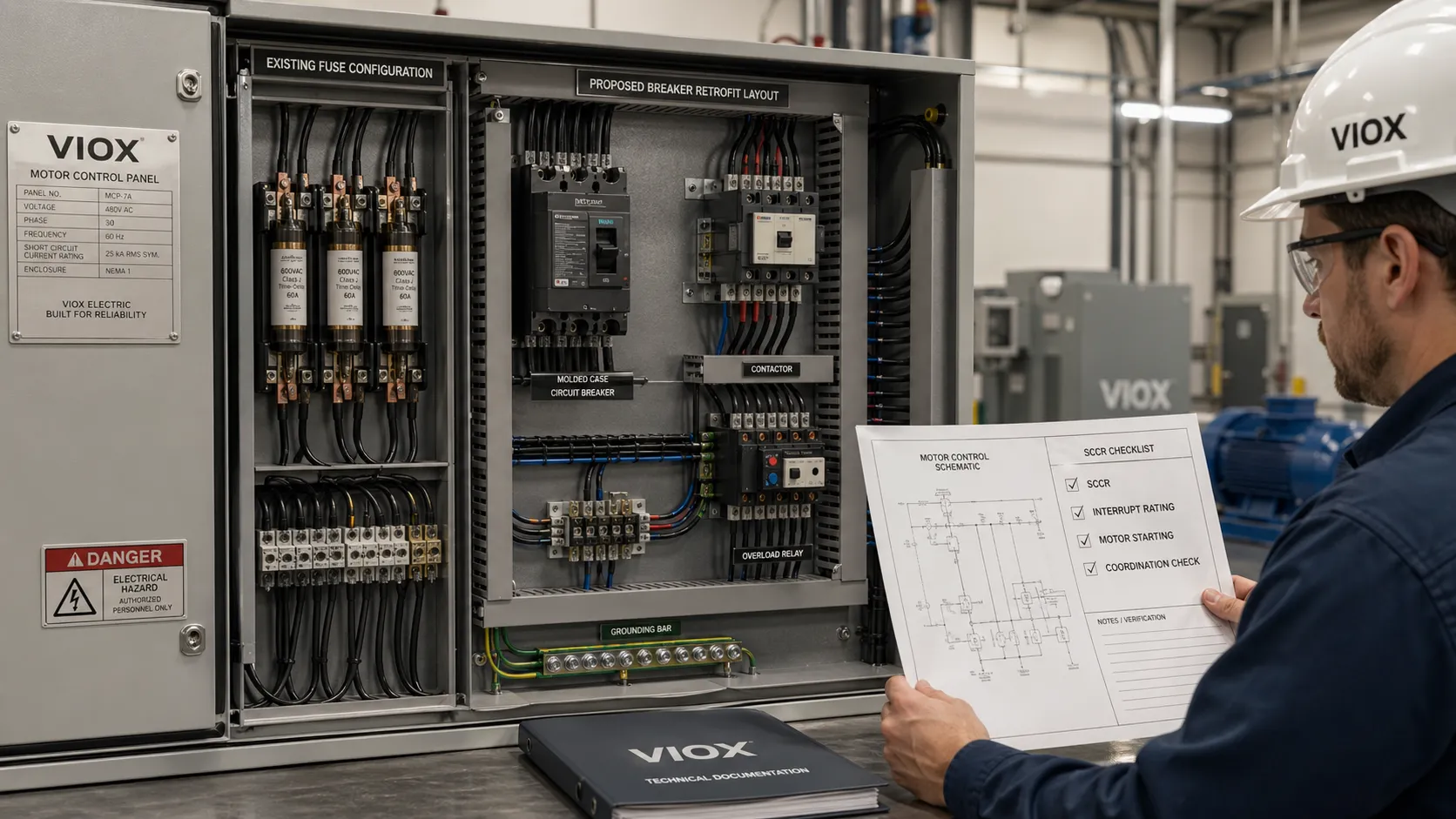
Gamitin ang sistematikong talaang ito bago aprubahan ang anumang proyekto ng retrofit mula fuse patungo sa breaker:
Pagsusuri sa Kuryente (Electrical Analysis)
- [ ] Natukoy ang available na fault current sa mga terminal ng linya ng panel (mula sa utility o pag-aaral ng koordinasyon ng pasilidad)
- [ ] Dokumentado ang mga kasalukuyang detalye ng fuse: klase, ampere rating, voltage rating, interrupting rating, mga katangian ng time-delay
- [ ] Kinumpirma ang mga iminungkahing detalye ng breaker: laki ng frame, trip rating, interrupting rating (AIC o kA), uri ng trip curve, pamantayan (UL 489, IEC 60947-2)
- [ ] Muling kinakalkula ang Panel SCCR gamit ang iminungkahing mga katangian ng let-through ng breaker
- [ ] Ang muling kinakalkulang SCCR ay lumampas sa available fault current na may naaangkop na safety margin
- [ ] Sinuri ang motor starting current laban sa instantaneous trip setting ng breaker para sa bawat sangay ng motor
- [ ] Pag-aaral ng koordinasyon ay kumpleto na nagpapakita ng piling operasyon sa mga kagamitan sa itaas at ibaba ng agos
- [ ] Mga rating ng kagamitan sa ibaba ng agos ay naberipika: kontaktor, overload relay, mga terminal, konduktor, control transformer
- [ ] Mga kinakailangan sa proteksyon sa ground-fault sinuri ayon sa NEC 430.51 at 430.52
Mekanikal at Pagrepaso sa Pag-install
- [ ] Mga pisikal na dimensyon ay naberipika: Ang breaker ay kasya sa espasyo na available sa panel
- [ ] Nasuri ang espasyo para sa pagbaluktot ng wire Ayon sa NEC 312.6 at pamantayan sa paggawa ng panel
- [ ] Kinumpirma ang konfigurasyon ng terminal: Uri ng lug, saklaw ng wire, mga espesipikasyon ng torque
- [ ] Napatunayan ang paraan ng pagkakabit: DIN rail, pagkakabit sa panel, o iba pa
- [ ] Pagkakatugma sa interlock ng pinto kinumpirma kung naaangkop
- [ ] Mga probisyon sa Pag-lock at Pag-tag-out naberipika para sa kaligtasan sa pagpapanatili
- [ ] Pagtatasa sa pamamahala ng init: sapat na bentilasyon at espasyo ayon sa mga kinakailangan ng tagagawa
- [ ] Pananatilihin ang rating ng enclosure: NEMA 1, 3R, 4, 4X, o 12 ayon sa kinakailangan
Pagsunod sa Kodigo at Dokumentasyon
- [ ] Mga kinakailangan ng Artikulo 430 ng NEC Sinuri para sa proteksyon ng branch-circuit ng motor
- [ ] Mga implikasyon ng UL 508A Sinuri para sa paglilista ng industrial control panel
- [ ] Mga kinakailangan sa paglebel ng panel Tinukoy: Pagmamarka ng SCCR, mga rating ng device, uri ng proteksyon sa short-circuit
- [ ] Orihinal na dokumentasyon ng panel Sinuri: Mga guhit, bill of materials, mga ulat ng pagsubok
- [ ] Mga kinakailangan sa pagsusuri sa larangan tinukoy kung apektado ang listahan ng panel
- [ ] Awtoridad na may hurisdiksyon (AHJ) proseso ng pag-abiso at pag-apruba ay nakumpirma
- [ ] Binalangkas na dokumentasyon ayon sa pagkakagawa itinatag: mga na-update na guhit, mga etiketa, mga pamamaraan sa pagpapanatili
Mga Pagsasaalang-alang sa Pagpapatakbo at Pagpapanatili
- [ ] Mga pamamaraan sa pagpapanatili ay na-update para sa operasyon, pagsubok, at mga protocol sa pag-reset ng breaker
- [ ] Binuong plano ng pagsasanay para sa mga tauhan ng operasyon at pagpapanatili
- [ ] Estratehiya sa mga ekstrang piyesa binago: imbentaryo ng breaker, mga kapalit na trip unit, mga aksesorya
- [ ] Mga pamamaraan ng lockout-tagout na-update upang ipakita ang mga bagong lokasyon ng breaker at mga uri ng handle
- [ ] Pagsusuri ng arc-flash nirepaso at inayos ang mga label kung kinakailangan
- [ ] Iskedyul ng preventive maintenance itinatag para sa inspeksyon at pagsubok ng breaker
Pagpili ng Tamang Uri ng Circuit Breaker
Hindi lahat ng circuit breaker ay angkop na pamalit sa mga piyus ng motor panel. Mahalaga ang pag-unawa sa mga uri at pamantayan ng breaker.
Mga Molded Case Circuit Breaker (MCCBs)
Para sa karamihan ng mga retrofit ng industrial motor control panel, ang mga MCCB ang nararapat na pagpipilian. Nag-aalok sila ng:
- Mga rating ng kuryente mula 15 A hanggang 2500 A
- Mga interrupting rating hanggang 200 kA (depende sa frame at manufacturer)
- Mga opsyon sa thermal-magnetic o electronic trip
- Naaayos na mga setting ng instantaneous trip (sa maraming modelo)
- Auxiliary contact at compatibility sa accessory
Ang mga MCCB ay pinamamahalaan ng UL 489 sa North America at IEC 60947-2 sa buong mundo. Kapag pumipili ng MCCB para sa retrofit ng motor panel, tiyakin na ito ay nakalista bilang isang branch-circuit protective device, hindi isang supplementary protector.
Mag-explore ng mga opsyon na pang-industriya sa VIOX MCCB.
Miniature Circuit Breakers (MCB)
Karaniwan ang mga MCB sa mga control circuit at mas maliliit na aplikasyon ng motor, ngunit mayroon silang mga limitasyon para sa mga retrofit ng motor panel:
- Mas mababang current ratings (karaniwan hanggang 125 A)
- Mas mababang interrupting ratings (madalas 10 kA o mas mababa)
- Nakatakdang mga trip curve (B, C, D, o K curves)
- Limitadong pag-aayos
Ang mga MCB ay maaaring angkop para sa maliliit na sangay ng motor sa mga control panel na may mababang available fault current, ngunit hindi dapat ipagpalagay na angkop ang mga ito nang walang beripikasyon.
Para sa mas maliliit na aplikasyon ng breaker, tingnan ang VIOX MCB.
Motor Protection Circuit Breakers (MPCBs)
Pinagsasama ng mga motor protection circuit breaker ang proteksyon sa short-circuit, proteksyon sa overload, at manual disconnect sa isang solong device. Maaari nilang gawing simple ang disenyo ng motor starter ngunit nangangailangan ng maingat na pagtatasa:
- Maaari nilang palitan ang parehong upstream fuse at ang overload relay
- Ang tamang paglaki ay nangangailangan ng pagtutugma sa partikular na full-load current at mga katangian ng pagsisimula ng motor
- Dapat silang suriin bilang bahagi ng isang nasubok na kombinasyon ng starter assembly
- Hindi lahat ng mga circuit breaker na pangprotekta sa motor ay angkop para sa lahat ng uri ng starter.
Para sa karagdagang impormasyon tungkol sa mga estratehiya sa pagprotekta ng motor, sumangguni sa Motor Protection Circuit Breakers: Ang Ultimate Guide.
Combination Starters kumpara sa Non-Combination Starters
Maaari ring makaapekto ang retrofit kung ang motor starter ay ikinategorya bilang combination starter (na may disconnect at proteksyon sa short-circuit) o non-combination starter (ang proteksyon sa short-circuit ay ibinibigay nang hiwalay).
Ang pag-unawa sa pagkakaibang ito ay mahalaga para sa pagsunod sa code at tamang paggamit. Tingnan ang Combination Starter kumpara sa Non-Combination Starter para sa detalyadong gabay.
Kailan Makatuwiran ang Fuse-to-Breaker Retrofit
Ang isang retrofit ay karaniwang makatwiran kapag lahat ng mga sumusunod na kondisyon ay natutugunan:
- Malinaw ang benepisyo sa operasyon: Ang downtime dahil sa pagpapalit ng piyusa ay isang dokumentadong problema, o ang pinahusay na kakayahan sa diagnostic ay nagbibigay ng nasusukat na halaga
- Natutugunan ang mga kinakailangan sa kuryente: Napatunayan ang available na fault current, SCCR, tolerance sa pag-start ng motor, at koordinasyon
- Maari ang pisikal na pag-install: Nakumpirma ang sapat na espasyo, wire bending room, at thermal management
- Napapanatili ang pagsunod sa codeTinalakay ang listahan ng panel, paglalagay ng label, at mga kinakailangan ng AHJ.
- Paborable ang pagsusuri sa gastos at benepisyo.Ang gastos sa pag-retrofit ay nabibigyang-katwiran ng nabawasang downtime, pinahusay na kaligtasan, o pinasimple na pagpapanatili.
Ito ang senaryo kung saan ang pag-retrofit ng breaker ay naghahatid ng tunay na pagpapabuti sa operasyon nang hindi nakokompromiso ang kaligtasan o pagsunod.
Kailan Mo Dapat Panatilihin ang mga Fuse
Sa ilang sitwasyon, ang pagpapanatili ng kasalukuyang proteksyon na nakabatay sa fuse ay ang mas mahusay na desisyon sa engineering:
- Ang mga current-limiting fuse ay mahalaga para sa SCCR ng panel.Hindi makamit ng panel ang sapat na SCCR sa pamamagitan ng mga available na breaker.
- Kailangan ng limitasyon sa kuryente para sa mga kasangkapang nasa ibaba.: Ang mga contactor, overload relay, o iba pang kasangkapan ay hindi na-rate para sa enerhiya na pinapadaan ng breaker.
- Mataas na available na fault current.: Ang instalasyon ay may napakataas na fault current na lumalagpas sa praktikal na interrupting ratings ng breaker.
- Mga hadlang sa espasyo: Hindi kayang tanggapin ng panel ang mga breaker na may kinakailangang wire bending space.
- Hindi malutas ang nuisance tripping.: Dahil sa mga katangian ng pag-start ng motor, hindi praktikal ang paggamit ng breaker.
- Mga isyu sa listing o field evaluation.Ang pagpapalit ay magpapawalang-bisa sa listahan ng panel maliban kung may malinaw na paraan para sa muling sertipikasyon.
- Matatag na kasalukuyang pamamahala ng piyusa.Ang pasilidad ay mayroon nang epektibong kontrol sa imbentaryo ng piyusa at mga pamamaraan ng pagpapalit.
Ang mga piyusa ay hindi “makaluma” o dehado bilang default. Sa maraming motor control panel—lalo na sa mga may mataas na fault current o mga kinakailangan sa paglilimita ng kasalukuyang—ang mga piyusa ay nananatiling pinakaangkop na proteksiyon na aparato.
Halimbawa ng Retrofit sa Tunay na Mundo: Bakit Nabigo ang Ampere Rating Lamang
Ang isang planta sa pagpoproseso ng pagkain ay nagpapatakbo ng motor control center na may 60 A time-delay, current-limiting Class J na mga piyusa na nagpoprotekta sa ilang 30 HP na motor starter. Humiling ang maintenance ng retrofit sa 60 A molded case circuit breaker upang maalis ang downtime sa pagpapalit ng piyusa.
Paunang Pagsusuri
Ipinapalagay ng maintenance team na ito ay isang simpleng pagpapalit: parehong ampere rating, parehong boltahe, modernong teknolohiya ng breaker.
Mga Natuklasan sa Pagsusuri ng Inhinyeriya
Nagsasagawa ang electrical engineer ng retrofit analysis at natukoy ang tatlong kritikal na isyu:
Isyu 1: Pagbaba ng SCCR (Short-Circuit Current Rating)
- Available na fault current sa MCC (Motor Control Center): 42 kA
- Orihinal na SCCR ng panel na may Class J fuses: 65 kA
- Iminungkahing interrupting rating ng breaker: 35 kA
- Resulta: Hindi sapat ang iminungkahing breaker; bababa ang SCCR ng panel sa ibaba ng available na fault current
Isyu 2: Pagkakatugma sa Pagpapaandar ng Motor
- Isang 30 HP na motor ang nagpapaandar ng high-inertia conveyor na may 8 segundong acceleration time
- Nakakandadong rotor current: 480 A
- Iminungkahing instantaneous trip ng breaker: 600 A (10× rating)
- Resulta: Malamang na mag-trip ang breaker sa normal na pag-start
Isyu 3: Pagkawala ng Koordinasyon
- Ang orihinal na Class J fuses ay nagbibigay ng selective coordination sa 200 A upstream fuses
- Ang iminungkahing time-current curve ng breaker ay nagsasanib sa upstream na proteksyon sa saklaw na 5-10 kA
- Resulta: Ang isang motor fault ay maaaring mag-trip sa buong MCC feeder
Solusyong Pang-inhinyero
Ang inhinyero ay nagmumungkahi ng tatlong alternatibo:
Opsyon A: Mag-upgrade sa current-limiting MCCB na may 65 kA interrupting rating at adjustable instantaneous trip, pinapanatili ang panel SCCR at motor starting compatibility. Halaga: katamtaman; nangangailangan ng mas malaking espasyo sa panel.
Opsyon B: Panatilihin ang kasalukuyang Class J fuses para sa high-inertia motor; i-retrofit ang ibang branches na may tamang rated breakers. Halaga: mababa; nakakamit ang bahagyang benepisyo.
Opsyon C: Panatilihin ang lahat ng fuses; ipatupad ang pinahusay na fuse inventory management na may color-coded labels at nakalaang storage. Halaga: minimal; tinutugunan ang pinagmulan ng problema sa maintenance.
Pinili ng pasilidad ang Option C matapos matukoy na ang tunay na problema ay ang pagkalito sa fuse inventory, hindi ang teknolohiya ng fuse mismo. Ang isang simpleng pagpapabuti sa paglalagay ng label at storage ay nalutas ang operational issue nang walang gastos at panganib ng isang retrofit.
Pangunahing aral: Ang pinakamahusay na retrofit ay kung minsan ay walang retrofit—kapag ang kasalukuyang protection scheme ay technically sound at ang operational problem ay maaaring malutas sa pamamagitan ng mas mahusay na maintenance practices.
Mga Karaniwang Pagkakamali sa Retrofit na Dapat Iwasan
Pagkakamali 1: Pagtutugma Lamang ng Ampere Rating
Ang isang 60 A na piyus at isang 60 A na breaker ay may parehong current rating ngunit maaaring mayroong ganap na magkaibang:
- Interrupting ratings
- Time-current characteristics
- Pagganap na naglilimita sa kasalukuyan
- Let-through na enerhiya
- Pagpaparaya sa pag-start ng motor
Ang Ampere rating ay isa lamang sa maraming kritikal na espesipikasyon.
Pagkakamali 2: Pagbalewala sa Fuse Class
Ang orihinal na fuse class (RK1, RK5, J, CC, T) ay nagbibigay ng mahalagang impormasyon tungkol sa current-limiting performance, time-delay characteristics, at interrupting rating. Ang pagpapalit ng Class J current-limiting fuse sa isang standard breaker ay radikal na nagpapabago sa proteksyon scheme.
Pagkakamali 3: Pag-aakala na ang mga Breaker ay Palaging Mas Mahusay
Nag-aalok ang mga circuit breaker ng mga bentahe sa pagpapatakbo, ngunit nagbibigay ang mga fuse ng higit na mahusay na limitasyon sa kasalukuyang daloy at maaaring mas matipid sa mga aplikasyon na may mataas na fault-current. Ang “mas mahusay” na aparato ay ganap na nakadepende sa mga kinakailangan ng aplikasyon.
Pagkakamali 4: Pagkakamali sa Pagitan ng Proteksyon sa Short-Circuit at Proteksyon sa Overload
Sa mga motor circuit, ang upstream breaker o fuse ay nagbibigay ng proteksyon sa short-circuit at ground-fault, habang ang overload relay ay nagbibigay ng proteksyon sa motor overload. Ang isang breaker retrofit ay hindi nag-aalis ng pangangailangan para sa maayos na laki ng proteksyon sa overload.
Pagkakamali 5: Paggamit ng mga Supplementary Protector bilang Proteksyon sa Branch-Circuit
Sa Hilagang Amerika, ang mga UL 1077 supplementary protector ay hindi pamalit sa mga UL 489 branch-circuit breaker sa mga motor control panel. Ang pagkakaibang ito ay kritikal para sa pagsunod sa code at kaligtasan.
Pagkakamali 6: Pagpapabaya sa mga Update sa Dokumentasyon
Pagkatapos ng isang retrofit, ang mga drawing ng panel, bill of materials, SCCR label, device schedules, at mga pamamaraan sa pagpapanatili ay dapat na i-update. Ang hindi kumpletong dokumentasyon ay lumilikha ng mga panganib sa kaligtasan at mga problema sa inspeksyon.
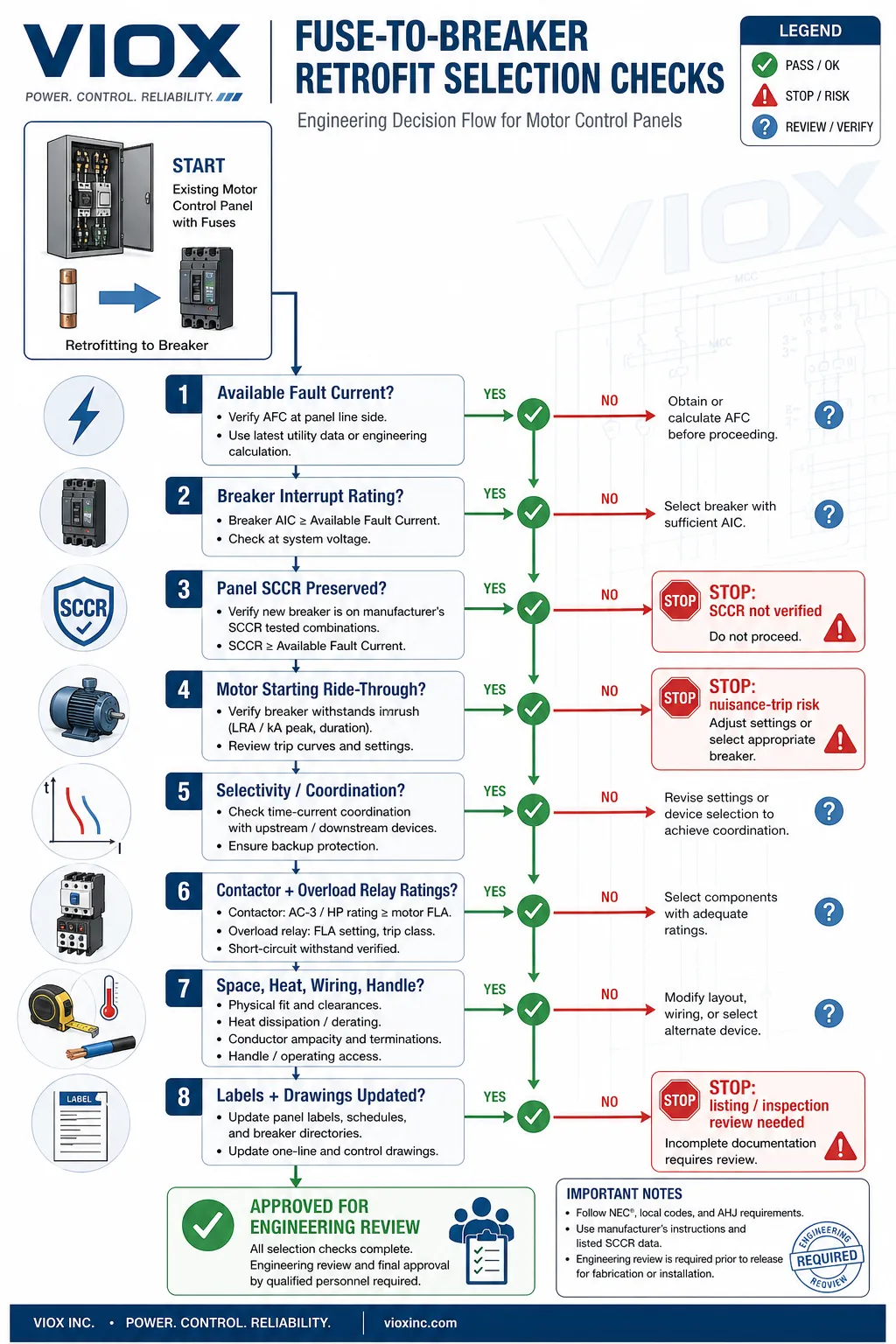
Hakbang-hakbang na Proseso ng Pagpapalit
Kapag ang pagpapalit mula fuse patungo sa breaker ay teknikal na makatwiran, sundin ang sistematikong prosesong ito:
Yugto 1: Pagsusuring Pang-inhinyero (Bago Bumili ng Kagamitan)
- Idokumento ang kasalukuyang konfigurasyon ng panel at mga espesipikasyon ng fuse
- Tukuyin ang available na fault current sa lokasyon ng panel
- Kalkulahin ang kinakailangang SCCR ng panel
- Suriin ang motor starting current para sa bawat branch
- Magsagawa ng coordination study kasama ang mga iminungkahing breaker
- Beripikahin ang mga rating ng mga kasunod na piyesa.
- Pumili ng mga breaker na tumutugma sa lahat ng kinakailangan sa kuryente.
- Kumpirmahin ang pisikal na akma at pagiging posible ng pag-install.
- Tukuyin ang pagsunod sa code at mga kinakailangan sa pag-label.
- Kumuha ng pag-apruba mula sa AHJ kung kinakailangan.
Yugto 2: Pagpaplano at Pagkuha
- Bumuo ng detalyadong mga guhit ng retrofit.
- Maghanda ng na-update na talaan ng mga materyales.
- Mag-order ng mga breaker, hardware para sa pagkakabit, at mga accessories
- Ihanda ang mga bagong label ng panel (SCCR, mga rating ng device, mga babala)
- Mag-iskedyul ng pagkakabit sa panahon ng planadong pagkawala ng kuryente
- Bumuo ng mga pamamaraan para sa pagkakabit at pagsubok
- Ihanda ang na-update na dokumentasyon sa pagpapanatili
- Magplano ng pagsasanay para sa mga tauhan ng operasyon at pagpapanatili
Phase 3: Pagkakabit at Pagsubok
- Patayin ang panel at beripikahin ang zero energy state
- Tanggalin ang mga lumang piyus at piyus holder.
- Ikabit ang mga breaker at mga mounting hardware.
- Siguraduhin ang mga wire termination at torque specifications.
- Suriin ang wire bending space at conductor routing.
- Ikabit ang mga bagong panel label.
- Magsagawa ng insulation resistance testing
- Bigyan ng kuryente ang panel at siguraduhin ang operasyon ng breaker.
- Subukan ang bawat motor starter para sa tamang pag-start at operasyon.
- Siguraduhin ang koordinasyon ng mga protective device sa pamamagitan ng functional testing kung maaari.
Yugto 4: Dokumentasyon at Pagsasanay
- I-update ang mga guhit at iskedyul ng panel ayon sa aktwal na pagkakagawa
- Rebisahin ang mga pamamaraan sa pagpapanatili para sa pagsubok at pag-reset ng breaker
- I-update ang mga pamamaraan ng lockout-tagout
- Rebisahin ang imbentaryo ng mga ekstrang piyesa
- Sanayin ang mga tauhan sa operasyon sa pagpapatakbo ng breaker at indikasyon ng trip
- Sanayin ang mga tauhan sa pagpapanatili sa pagsubok at pag-troubleshoot ng breaker
- I-archive ang dokumentasyon ng retrofit para sa sanggunian sa hinaharap
Madalas Na Tinatanong Na Mga Katanungan
Maaari ko bang palitan ang mga piyus ng mga circuit breaker sa isang motor control panel?
Oo, ngunit pagkatapos lamang ng komprehensibong pagsusuri ng inhinyero. Ang pamalit na breaker ay dapat tumugma o humigit sa orihinal na proteksyon sa mga tuntunin ng interrupting rating, panel SCCR, motor starting tolerance, koordinasyon, at proteksyon ng mga downstream component. Hindi ito isang simpleng pagpapalit ng parehong ampere-rating.
Ano ang pinakamalaking panganib sa isang fuse-to-breaker retrofit?
Ang pinakamahalagang panganib ay ang pagbaba ng short-circuit current rating (SCCR) ng panel sa ibaba ng available fault current sa instalasyon. Nangyayari ito kapag ang mga current-limiting fuse ay pinalitan ng mga breaker na may mas mataas na let-through energy, na potensyal na naglalantad sa mga downstream component sa mga fault current na lampas sa kanilang mga rating.
Aalisin ba ng isang circuit breaker ang pangangailangan para sa proteksyon sa motor overload?
Kadalasan hindi. Sa karaniwang mga motor starter circuit, ang upstream breaker o fuse ay nagbibigay ng short-circuit at ground-fault na proteksyon, habang ang isang hiwalay na overload relay ay nagbibigay ng proteksyon sa motor overload. Ang ilang mga espesyal na motor protection circuit breaker ay nagsasama ng parehong mga function, ngunit dapat itong patunayan sa pamamagitan ng uri ng device, listing, at pamantayan ng aplikasyon.
Paano ko maiiwasan ang nuisance tripping sa panahon ng pag-start ng motor?
Pumili ng isang breaker na may time-current curve at instantaneous trip setting na tumutugma sa locked-rotor current at acceleration time ng motor. Ang mga time-delay o motor-rated breaker ay partikular na idinisenyo para sa aplikasyong ito. Ihambing ang starting profile ng motor laban sa trip curve ng breaker sa high-current region.
Kailangan ko bang i-update ang paglalagay ng label sa panel pagkatapos ng retrofit?
Oo. Kung ang retrofit ay nagpapabago sa SCCR ng panel, mga uri ng protective device, o interrupting ratings, ang paglalagay ng label sa panel ay dapat i-update ayon sa NEC 409.110. Kabilang dito ang pagmamarka ng SCCR, mga rating ng device, at anumang mga babala o tagubilin. Ang pagkabigong i-update ang mga label ay lumilikha ng mga isyu sa inspeksyon at pananagutan.
Anong pamantayan ng breaker ang dapat kong tukuyin?
Para sa mga panel ng kontrol ng motor sa Hilagang Amerika, tukuyin ang UL 489 (Molded-Case Circuit Breakers) para sa proteksyon ng branch-circuit. Para sa mga internasyonal na aplikasyon, ang IEC 60947-2 ang nauugnay na pamantayan para sa mga industrial circuit breaker. Iwasan ang paggamit ng UL 1077 supplementary protectors bilang kapalit ng mga branch-circuit breaker sa mga motor panel.
Maaari ko bang i-retrofit ang ilang mga branch at panatilihin ang mga fuse sa iba?
Oo. Ang isang hybrid na diskarte—ang pag-retrofit ng mga breaker kung saan kapaki-pakinabang habang pinapanatili ang mga fuse kung saan teknikal na nakahihigit—ay madalas na ang pinaka-praktikal na solusyon. Nagbibigay-daan ito sa iyo na makakuha ng mga benepisyo sa pagpapatakbo sa mga angkop na branch habang pinapanatili ang kasalukuyang limitasyon ng proteksyon kung kinakailangan.
Paano ko kakalkulahin ang bagong SCCR ng panel pagkatapos ng retrofit?
Ang pagkalkula ng SCCR ng panel ay nakasalalay sa mga katangian ng let-through ng iminungkahing breaker at ang mga short-circuit withstand ratings ng lahat ng downstream na mga bahagi. Para sa mga UL 508A panel, gamitin ang mga pamamaraan sa UL 508A Supplement SB upang kalkulahin ang SCCR batay sa peak let-through current at I²t values ng breaker. Para sa mga kumplikadong panel, kumunsulta sa tagagawa ng panel o isang kwalipikadong electrical engineer.
Paano kung ang available na fault current ay lumampas sa interrupting rating ng breaker?
Huwag ikabit ang breaker. Pumili ng breaker na may sapat na interrupting rating, isaalang-alang ang current-limiting breakers na nagpapababa ng let-through current, imbestigahan ang series-rated combinations kung naaangkop, o panatilihin ang kasalukuyang proteksyon na nakabatay sa fuse. Ang pagkakabit ng breaker na may hindi sapat na interrupting rating ay lumilikha ng isang seryosong panganib sa kaligtasan.
Maaapektuhan ba ng retrofit ang UL listing ng aking panel?
Posibleng oo. Ang pagpapalit ng mga uri ng protective device sa isang UL 508A industrial control panel ay maaaring makaapekto sa batayan ng orihinal na listing, lalo na kung ang SCCR ay nagbago o kung ang mga fuse ay bahagi ng isang nasubok na kombinasyon. Kumonsulta sa orihinal na dokumentasyon ng panel at, kung kinakailangan, makipagtulungan sa tagagawa ng panel o isang field evaluation service upang mapanatili ang pagsunod.
Konklusyon: Inhinyeriya Muna, Kaginhawahan Pangalawa
Ang fuse-to-breaker retrofit sa isang motor control panel ay maaaring maghatid ng malaking benepisyo sa operasyon—mas mabilis na pagbawi ng fault, mas mahusay na diagnostics, pinasimple na pamamahala ng spare parts, at pinahusay na workflow ng pagpapanatili. Ngunit ang mga benepisyong ito ay natatamo lamang kapag ang retrofit ay nakabatay sa matibay na pagsusuri sa inhinyeriya, hindi lamang sa apela ng resettable protection.
Ang pangunahing prinsipyo: ang isang circuit breaker ay dapat tumugma o humigit sa protective performance ng fuse na pinapalitan nito, isinasaalang-alang ang interrupting rating, panel SCCR, motor starting tolerance, selective coordination, at downstream component protection.
Kapag natugunan ang mga kinakailangang ito, ang pagpapalit ng breaker ay maaaring maging isang mahusay na pamumuhunan. Kapag hindi, ang pagpapanatili ng kasalukuyang proteksyon na nakabatay sa fuse—o pagpapabuti ng mga kasanayan sa pamamahala ng fuse—ay maaaring maging mas mahusay na desisyon.
Bago aprubahan ang anumang proyekto sa pagpapalit, sistematikong suriin ang checklist ng engineering, beripikahin ang lahat ng mga kinakailangan sa electrical at mechanical, at tiyakin na ang pagsunod sa code at dokumentasyon ay natutugunan. Ang layunin ay hindi palitan ang mga fuse ng mga breaker bilang isang bagay ng kagustuhan, ngunit upang piliin ang proteksiyon na aparato na pinakamahusay na nagsisilbi sa aplikasyon habang pinapanatili ang kaligtasan at pagiging maaasahan.
Para sa karagdagang teknikal na mapagkukunan sa proteksyon ng motor at pagpili ng circuit breaker, galugarin ang:
- VIOX MCCB Product Line – Mga pang-industriyang molded case circuit breaker
- Gabay sa Motor Protection Circuit Breakers – Komprehensibong mga estratehiya sa proteksyon ng motor
- Ipinaliwanag ang mga Rating ng Circuit Breaker – Pag-unawa sa Icu, Ics, Icw, at Icm
- Pagpili at Koordinasyon ng Breaker – Pagkamit ng piling koordinasyon
Tungkol sa VIOX: Ang VIOX ay nagdadalubhasa sa mga solusyon para sa proteksyon at kontrol ng kuryente sa industriya, nag-aalok ng komprehensibong linya ng produkto kabilang ang mga molded case circuit breaker, miniature circuit breaker, contactor, at mga kagamitan para sa proteksyon ng motor. Ang aming mga teknikal na mapagkukunan ay tumutulong sa mga electrical engineer, tagabuo ng panel, at mga propesyonal sa pagpapanatili na gumawa ng mga desisyong may kaalaman para sa ligtas at maaasahang mga sistema ng kuryente.