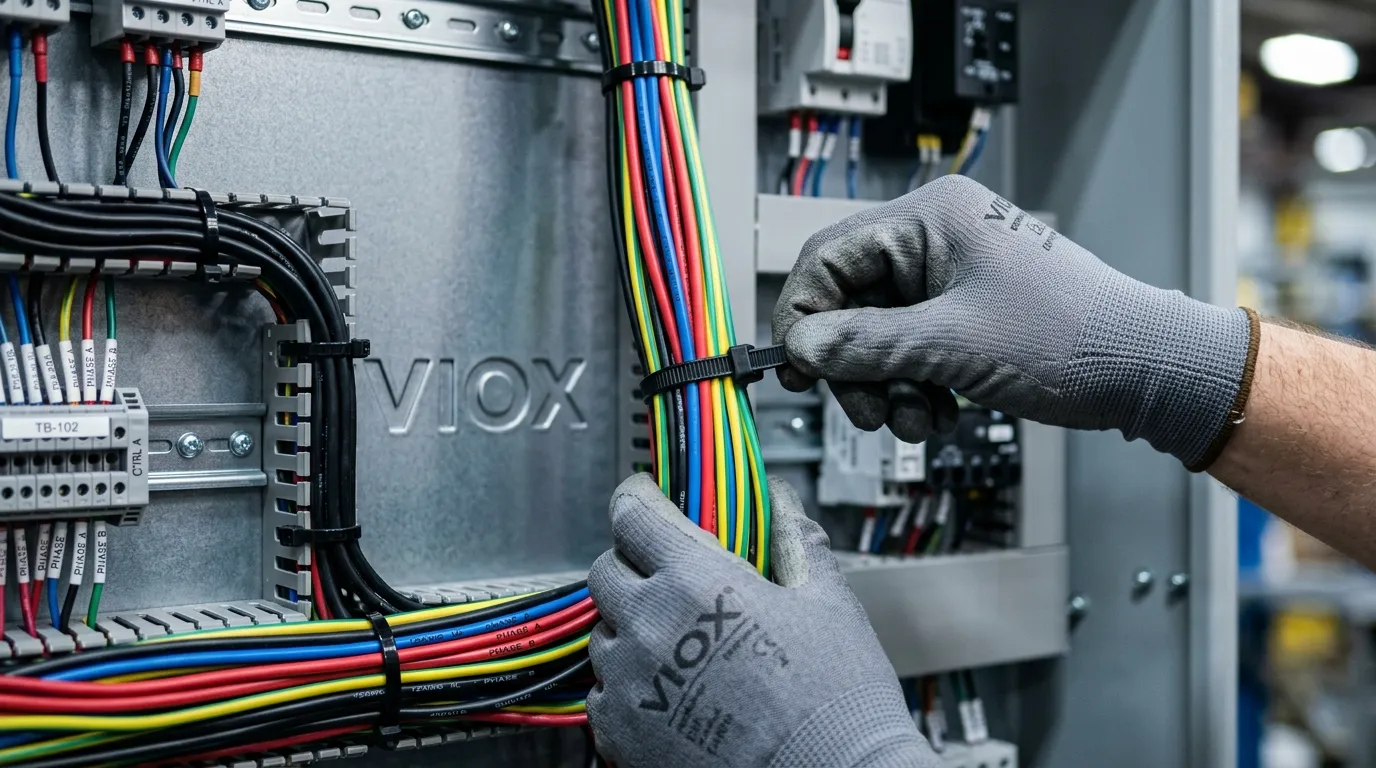
Which Cable Tie Type Delivers Better Performance for Industrial Applications?
Self-locking cable ties provide superior tensile strength (up to 175 lbs) and permanent security for critical installations, while reusable cable ties offer adjustable, repeatable fastening with release mechanisms ideal for temporary or frequently modified assemblies—each excels in distinct engineering scenarios where their mechanical characteristics align with application requirements.
The choice between self-locking and reusable cable ties represents a fundamental engineering decision that impacts installation reliability, maintenance efficiency, and long-term operational costs. While both fastening systems utilize similar nylon 6/6 construction and tooth-based locking mechanisms, their divergent design philosophies create measurably different performance characteristics in tensile strength, vibration resistance, and service life. Understanding these technical distinctions enables specification of the optimal cable tie type for each application context, from permanent electrical panel installations to dynamic industrial equipment requiring frequent reconfiguration.
Pengambilan Utama
- Tensile strength differential: Self-locking ties achieve 18-175 lbs loop tensile strength with one-way ratchet mechanisms, while reusable ties typically reach 18-50 lbs due to release mechanism design compromises
- Locking mechanism architecture: Self-locking ties employ irreversible pawl engagement with serrated teeth; reusable ties integrate trigger-release or extended-tooth mechanisms enabling controlled disengagement
- Application domain separation: Permanent installations (electrical panels, structural cable management, outdoor infrastructure) demand self-locking ties; temporary assemblies, prototyping environments, and maintenance-intensive systems benefit from reusable alternatives
- Cost-performance analysis: Self-locking ties offer lower unit cost ($0.05-0.30) for single-use applications; reusable ties ($0.30-1.50) achieve cost parity after 3-5 reuse cycles in appropriate contexts
- Material degradation patterns: Self-locking ties maintain consistent strength until catastrophic failure; reusable ties experience gradual pawl wear and reduced clamping force across multiple use cycles
Understanding Self-Locking Cable Tie Mechanics
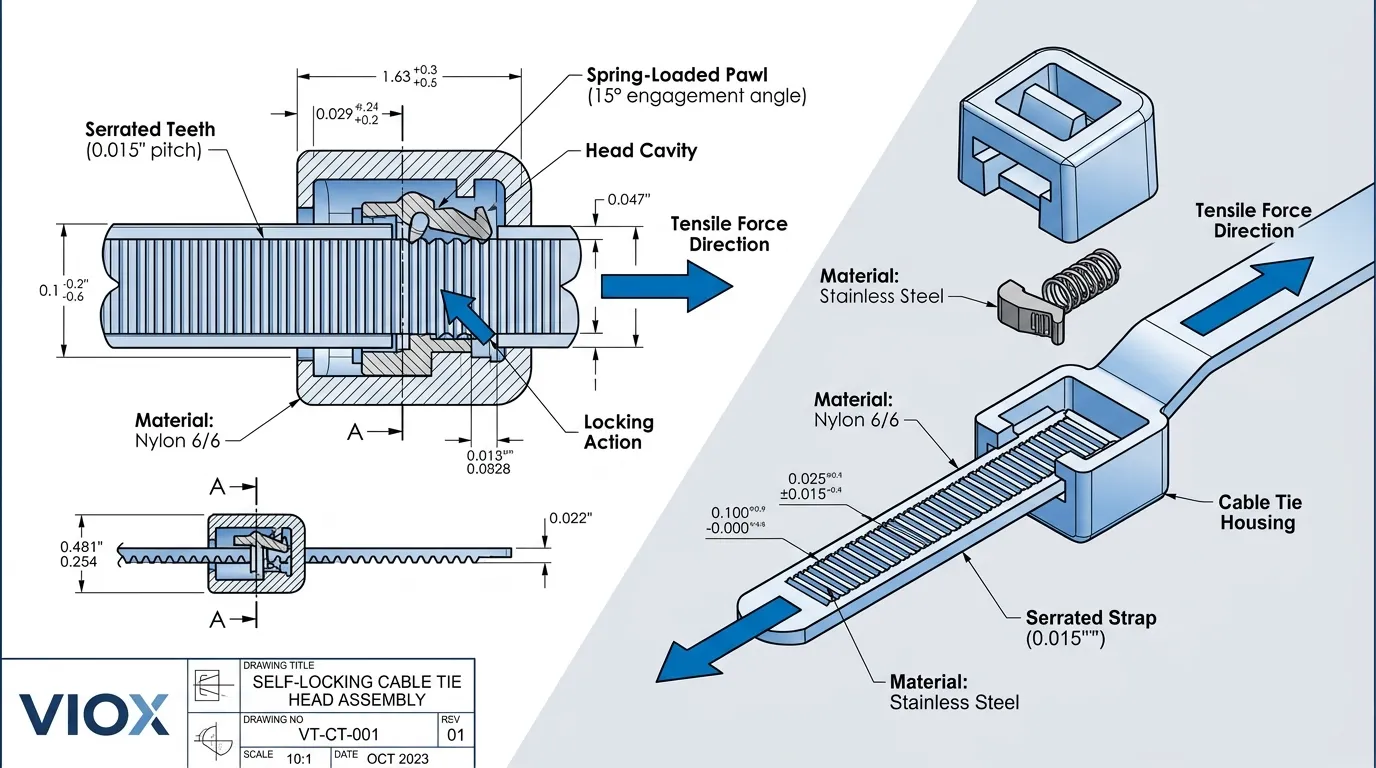
Self-locking cable ties function through an irreversible mechanical engagement system where a flexible nylon strap featuring molded serrations passes through a rigid head containing a spring-loaded pawl. As the installer pulls the strap through the head assembly, each serration engages the pawl in a one-directional ratchet action. The pawl’s angled geometry permits forward strap movement while mechanically preventing reverse motion, creating a progressively tightening loop that locks permanently once tension is applied.
The engineering elegance of this design lies in its force multiplication characteristics. The pawl angle—typically 15-20 degrees from perpendicular—creates a wedging action that increases holding force proportionally to applied tension. This mechanical advantage allows relatively thin nylon straps (0.040-0.120 inches thick) to achieve remarkable loop tensile strengths. Standard miniature ties with 0.040-inch strap thickness reliably hold 18 lbs, while heavy-duty variants with 0.120-inch straps and reinforced head geometries reach 175 lbs before material failure occurs.
Material selection critically influences self-locking tie performance. Nylon 6/6 (polyamide 66) dominates industrial applications due to its exceptional tensile strength (11,800 psi), wide operating temperature range (-40°F to 185°F continuous, 250°F intermittent), and superior resistance to oils, greases, and most common solvents. The polymer’s semi-crystalline structure provides the necessary combination of flexibility for installation and rigidity for long-term load retention. UV-stabilized formulations incorporate carbon black additives (2-3% by weight) to prevent photodegradation in outdoor applications, extending service life from months to decades in direct sunlight exposure.
The head geometry represents another critical design parameter. Low-profile heads (0.25-0.35 inches height) minimize snag hazards in tight spaces and reduce the likelihood of accidental release through impact. Wider head bases (0.35-0.50 inches) distribute clamping forces across larger strap contact areas, reducing stress concentrations that could initiate crack propagation under sustained loads or thermal cycling. Some manufacturers incorporate ribbed head designs that further enhance structural rigidity and increase resistance to side-load forces that might otherwise cause premature failure in high-vibration environments.
Reusable Cable Tie Release Mechanisms Explained
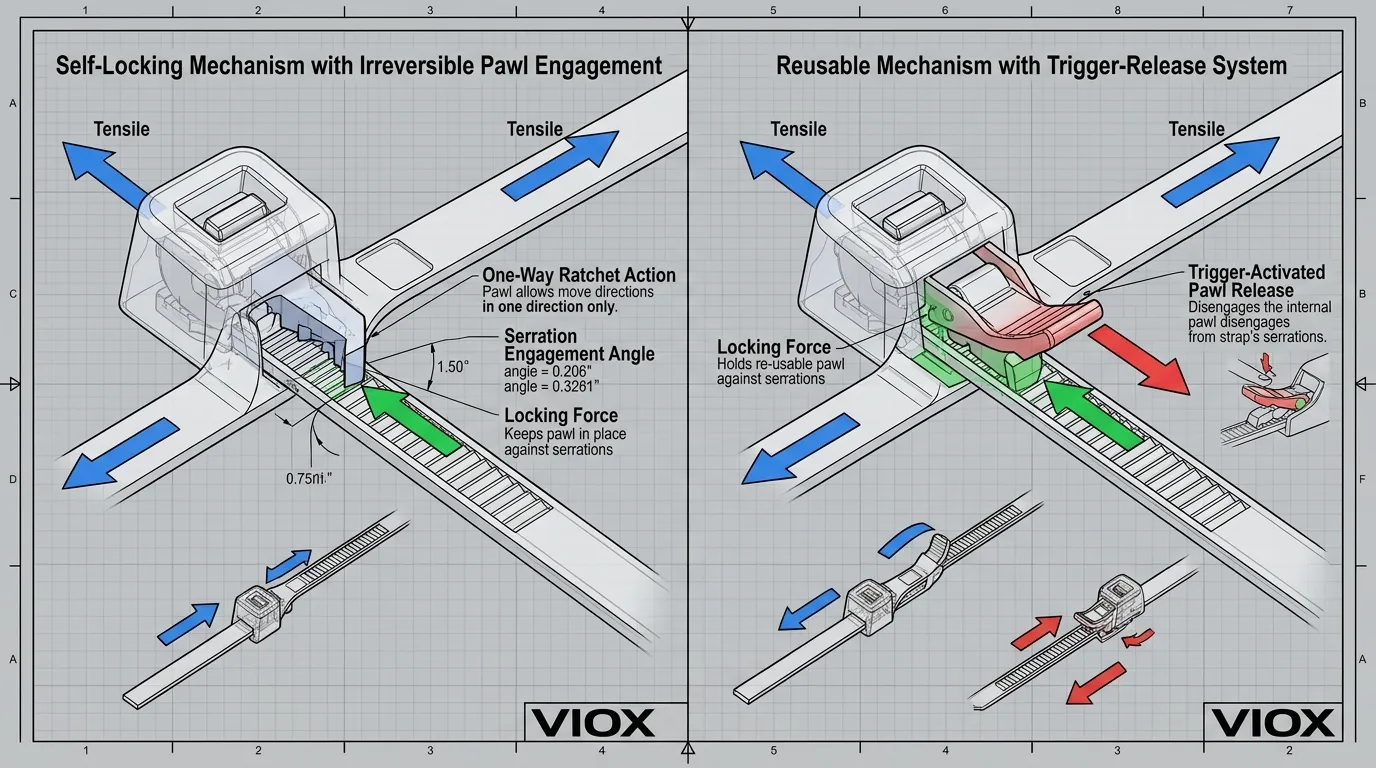
Reusable cable ties achieve their distinctive reversibility through specialized pawl designs that permit controlled disengagement while maintaining adequate holding force during normal service. Two primary release mechanism architectures dominate the market: trigger-release systems and extended-tooth configurations. Each approach balances the competing requirements of secure retention during use and convenient release when reconfiguration becomes necessary.
Trigger-release mechanisms incorporate a flexible tab molded integrally with the head assembly. This tab connects mechanically to the pawl through a lever arm arrangement. During normal operation, the pawl engages the strap serrations identically to self-locking designs, providing comparable holding force. When release is desired, pressing the trigger tab pivots the pawl away from the serrations, disengaging the mechanical lock and allowing the strap to slide freely through the head. The trigger’s ergonomic design enables one-handed operation—a significant advantage in field installations where the technician must simultaneously support cable bundles and manipulate fasteners.
Extended-tooth mechanisms take a different approach, utilizing longer serration teeth (0.020-0.030 inches versus 0.015-0.020 inches in self-locking designs) combined with a modified pawl geometry. The extended teeth provide sufficient engagement depth for secure locking while allowing the installer to manually flex the strap at a specific angle that disengages the pawl without requiring a separate release trigger. This design simplifies the head molding process and reduces manufacturing costs, though it typically requires two-handed operation for release—one hand to flex the strap and another to pull it through the head.
The mechanical trade-offs inherent in reusable designs become apparent when examining tensile strength specifications. While self-locking ties achieve their rated tensile strength consistently across their service life, reusable ties experience gradual performance degradation with repeated use cycles. The release mechanism introduces additional stress concentration points in the head assembly, and the pawl geometry must be less aggressive to enable disengagement, reducing the mechanical advantage that contributes to high holding forces in self-locking designs. Consequently, reusable ties typically achieve 60-80% of the tensile strength of equivalent-sized self-locking ties in initial installations, with further reductions of 5-10% per use cycle as pawl edges wear and plastic deformation accumulates in high-stress regions.
Material considerations for reusable ties extend beyond the nylon 6/6 base polymer to include the specific formulation additives that influence fatigue resistance. Manufacturers incorporate impact modifiers and plasticizers that enhance the material’s ability to withstand repeated flexing cycles without developing stress cracks. These additives slightly reduce ultimate tensile strength compared to standard nylon 6/6 formulations but dramatically improve the tie’s ability to survive 10-20 use cycles without catastrophic failure—a critical requirement for applications where the economic value proposition depends on multiple reuses.
Comparative Performance Analysis: Tensile Strength and Reliability
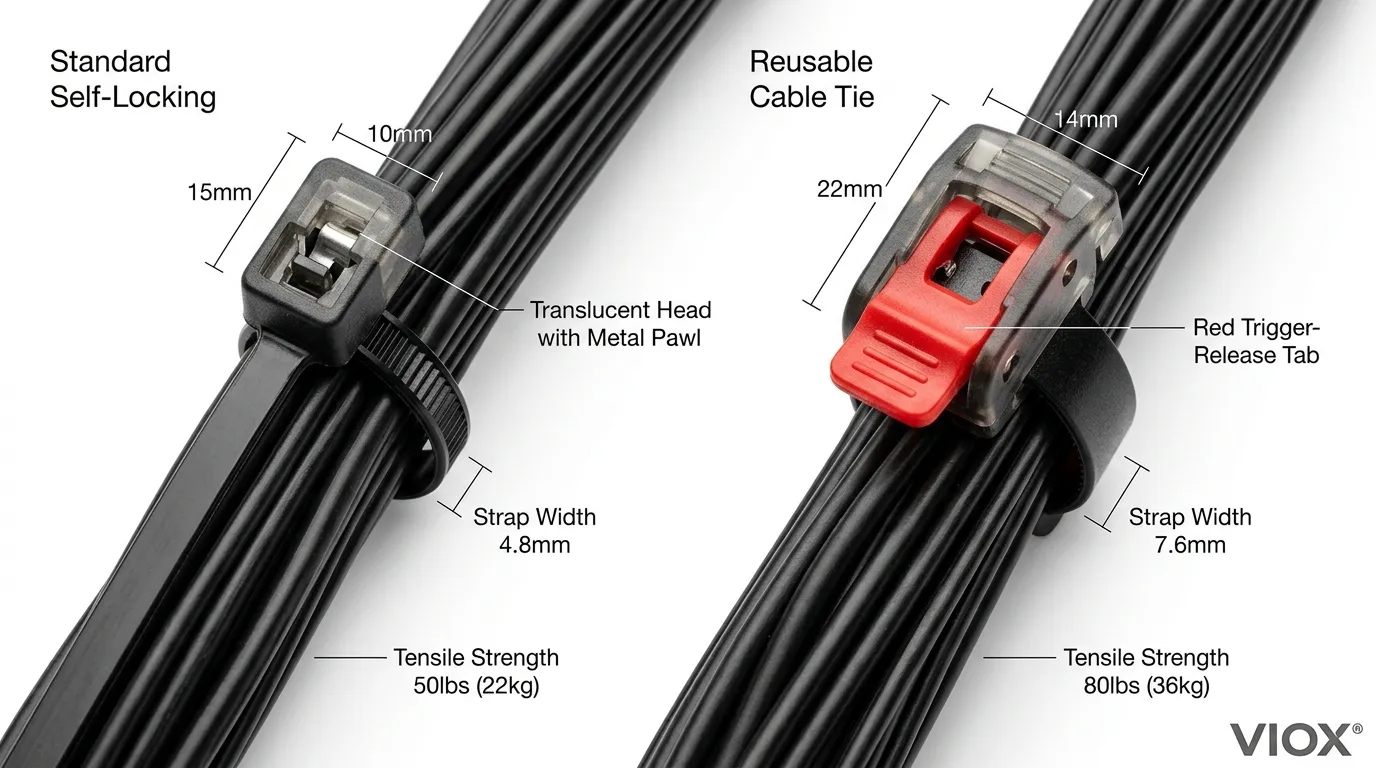
Loop tensile strength represents the primary mechanical specification for cable tie selection, measuring the maximum force the assembled tie can withstand before failure occurs. This metric directly determines the tie’s suitability for specific cable bundle weights and dynamic loading conditions. Standard testing protocols, defined by UL 62275 and IEC 62275, specify measurement procedures where the tie is looped around a mandrel of defined diameter and subjected to steadily increasing tensile force until breakage occurs.
Self-locking cable ties demonstrate predictable strength characteristics across their standard size ranges. Miniature ties (4-6 inches length, 0.040-0.050 inch width) consistently achieve 18 lbs tensile strength. Intermediate ties (8-12 inches length, 0.070-0.090 inch width) reach 40-50 lbs. Heavy-duty industrial ties (14-24 inches length, 0.100-0.120 inch width) deliver 120-175 lbs. These ratings represent minimum guaranteed values; actual failure loads typically exceed specifications by 15-25% due to conservative rating practices and manufacturing process controls that ensure consistent polymer quality.
Reusable cable ties exhibit more complex strength profiles due to their release mechanism designs. Initial installation strength typically ranges from 18-50 lbs depending on size, representing 60-80% of equivalent self-locking tie capacity. However, the critical distinction emerges when examining strength retention across multiple use cycles. Engineering testing reveals that trigger-release designs maintain 85-90% of initial strength through five use cycles, declining to 70-75% by the tenth cycle. Extended-tooth mechanisms show slightly faster degradation, retaining 80-85% strength after five cycles and 65-70% after ten cycles. These degradation patterns result from cumulative plastic deformation in the pawl engagement surfaces and microscopic crack initiation in high-stress regions of the head assembly.
The practical implications of these strength differentials become apparent when calculating safety factors for critical installations. Engineering best practice recommends maintaining a 2:1 safety factor between cable tie tensile strength and maximum anticipated bundle weight, accounting for dynamic loads from vibration, thermal expansion, and installation tension variations. For a 10-pound cable bundle in a high-vibration environment, a self-locking tie rated at 40 lbs provides a comfortable 4:1 safety factor. A reusable tie with 30 lbs initial strength offers 3:1 initially but may decline to 2.1:1 after ten use cycles—still acceptable but with diminished safety margin. This analysis explains why permanent installations universally specify self-locking ties while reusable alternatives find appropriate application in temporary assemblies and frequently reconfigured systems where the ties are replaced before significant degradation occurs.
Environmental factors further differentiate performance characteristics. Self-locking ties maintain their rated strength across the full nylon 6/6 operating temperature range (-40°F to 185°F continuous). Reusable ties experience accelerated pawl wear at elevated temperatures due to increased polymer creep rates, potentially reducing effective service life by 30-40% in sustained high-temperature applications above 150°F. Conversely, both tie types exhibit increased brittleness below -20°F, though self-locking designs typically retain greater low-temperature impact resistance due to their simpler geometry and absence of stress-concentrating release mechanisms.
Kriteria Pemilihan Khusus Aplikasi
Proper cable tie selection requires systematic evaluation of installation requirements, environmental conditions, and maintenance expectations. The decision framework begins with classifying the application into one of three categories: permanent installations, semi-permanent assemblies, or temporary configurations. Each category exhibits distinct characteristics that favor either self-locking or reusable tie architectures.
Permanent installations encompass electrical panel wiring, building infrastructure cable management, outdoor telecommunications equipment, and industrial control systems where cable routing remains fixed throughout the equipment’s service life. These applications demand maximum tensile strength, long-term environmental resistance, and tamper-evident security. Self-locking ties excel in this domain, providing irreversible fastening that maintains consistent holding force for decades. The inability to release without cutting the tie becomes an advantage rather than a limitation, as it prevents unauthorized modifications and provides visual evidence of tampering through cut tie remnants. Specification should prioritize UV-stabilized nylon 6/6 formulations for outdoor installations, with tensile strength ratings providing minimum 2:1 safety factors accounting for worst-case bundle weights and dynamic loading.
Semi-permanent assemblies include manufacturing equipment, test fixtures, and industrial machinery where cable routing may require occasional modification during maintenance or upgrades but remains stable during normal operation. This category presents the most nuanced selection challenge, as either tie type may prove appropriate depending on specific circumstances. The decision hinges on anticipated modification frequency and the economic value of reusability versus the performance advantages of self-locking designs. If modifications occur less frequently than quarterly, self-locking ties typically provide superior value through their higher strength ratings and lower unit costs, with the expense of cutting and replacing ties during maintenance representing minimal impact on total cost of ownership. If modifications occur monthly or more frequently, reusable ties become economically advantageous despite their higher unit costs and lower strength ratings, as the ability to release and reuse the same tie multiple times eliminates recurring material costs and reduces installation labor.
Temporary configurations—prototyping environments, trade show displays, temporary event installations, and laboratory test setups—clearly favor reusable cable tie architectures. These applications prioritize flexibility and reconfigurability over maximum strength, and the cable bundles typically involve lighter loads well within reusable tie capacity. The ability to quickly release and reposition ties without tools accelerates setup and teardown operations, directly reducing labor costs. In these contexts, the higher unit cost of reusable ties is offset by their reusability across multiple events or experimental iterations, and their lower tensile strength rarely constrains application suitability.
Specific environmental factors may override these general guidelines. High-vibration environments (industrial machinery, automotive applications, heavy equipment) strongly favor self-locking ties regardless of modification frequency, as their more aggressive pawl engagement and absence of release mechanisms provide superior vibration resistance. Corrosive chemical exposure may necessitate stainless steel cable ties (which universally employ self-locking ball-lock mechanisms) rather than nylon alternatives. Extreme temperature applications above 185°F require specialized high-temperature nylon formulations or metal ties, both of which typically utilize self-locking designs due to the technical challenges of maintaining reliable release mechanism function under thermal stress.
Installation Best Practices and Common Mistakes
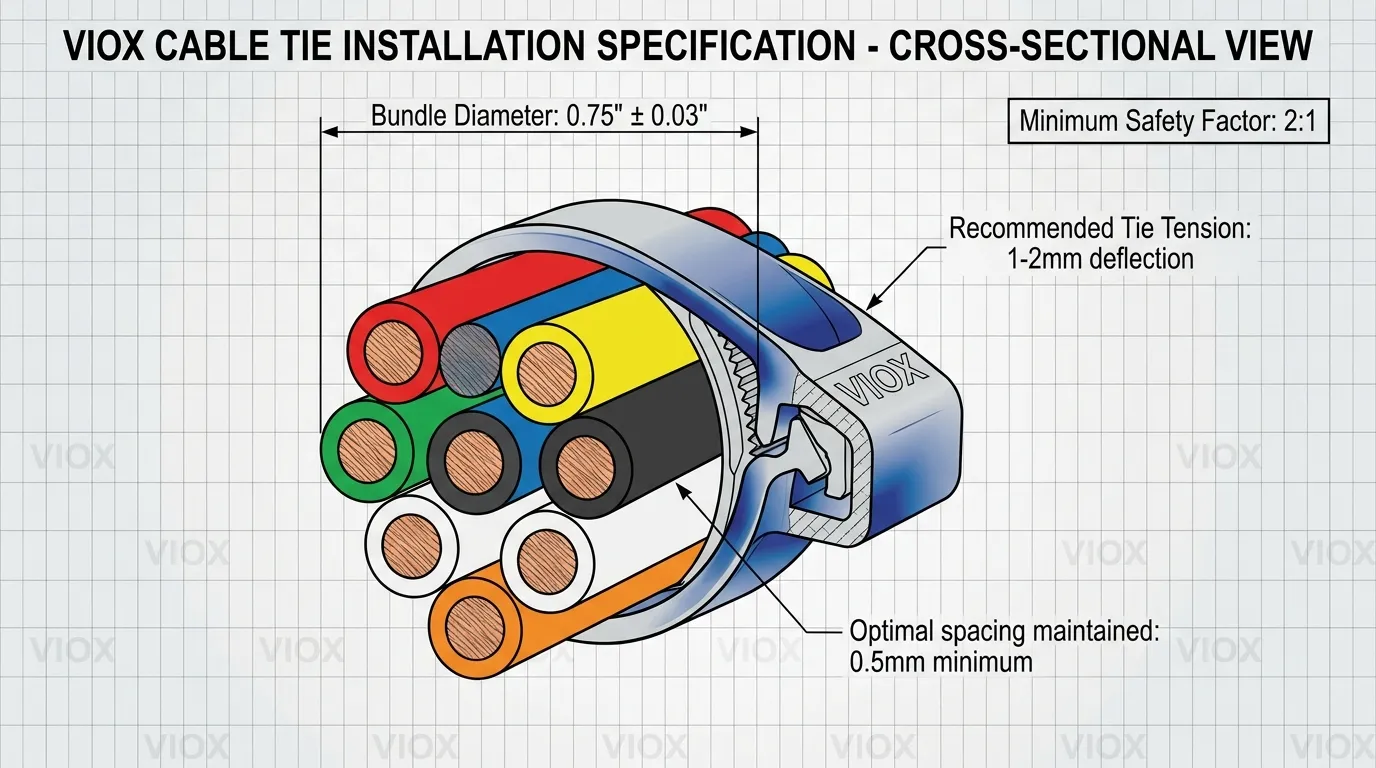
Proper installation technique significantly influences cable tie performance and service life, regardless of whether self-locking or reusable designs are employed. The installation process appears deceptively simple—thread the strap through the head and pull tight—but subtle execution details determine whether the tie achieves its rated tensile strength or fails prematurely under operational loads.
Bundle preparation represents the critical first step that many installers overlook. Cables should be grouped into neat, parallel arrangements with consistent spacing before tie application. Twisted or crossed cables create uneven load distribution that concentrates stress on individual conductors and reduces the effective clamping force the tie can apply. For bundles containing cables of varying diameters, position larger cables toward the bundle center and smaller cables around the periphery to create a more circular cross-section that maximizes tie contact area. This arrangement also prevents smaller cables from being crushed by excessive localized pressure when the tie is tightened.
Threading technique affects both installation ease and final tie performance. Insert the strap tip into the head opening at a slight angle (10-15 degrees) rather than perfectly perpendicular, as this alignment helps the strap serrations engage the pawl more smoothly during initial threading. Pull the strap through the head with steady, consistent force rather than jerking motions that can cause the pawl to skip serrations or create uneven tension distribution. For self-locking ties, continue pulling until the tie is snug but not excessively tight—over-tightening represents one of the most common installation errors and a primary cause of premature failure.
Optimal tightening tension balances secure bundle retention against conductor insulation protection. The tie should be tight enough to prevent cable movement within the bundle but not so tight that it deforms cable insulation or creates visible indentation. A practical field test involves attempting to rotate individual cables within the bundle; if cables rotate freely, the tie is too loose, but if cables cannot be rotated at all with moderate finger pressure, the tie is likely over-tightened. Quantitatively, proper tension typically results in 1-2mm of tie strap deflection when moderate thumb pressure is applied to the bundle surface. Specialized cable tie installation tools with adjustable tension settings eliminate guesswork by automatically cutting the strap when predetermined tension is reached, ensuring consistent installation quality across multiple ties and different installers.
Tail trimming completes the installation process and directly impacts safety and aesthetics. The excess strap extending beyond the head should be cut flush or nearly flush (within 1-2mm) using diagonal cutters positioned perpendicular to the strap. Leaving long tails creates snag hazards that can catch on clothing, tools, or adjacent equipment, potentially causing injury or inadvertently pulling the bundle loose. Conversely, cutting too close to the head—particularly at an angle that creates a sharp point—creates a different hazard where the cut edge can cause lacerations during subsequent work in the area. Professional installations typically employ flush-cut cable tie tools that automatically trim the tail at the optimal distance and angle during the tightening operation, simultaneously improving installation speed and quality.
Reusable cable ties require additional installation considerations due to their release mechanisms. The trigger tab or release point should be positioned for easy access during future maintenance, typically oriented toward the front of the equipment or the direction from which technicians will approach during service operations. Avoid positioning the release mechanism against solid surfaces or in locations where it could be inadvertently activated by vibration or contact with adjacent components. When reusing ties, inspect the pawl and serrations for visible wear, cracks, or deformation before reinstallation; ties showing significant degradation should be discarded rather than reused, as their reduced strength may not provide adequate safety margins for the application.
Cost Analysis: Total Cost of Ownership Comparison
Economic evaluation of cable tie selection extends beyond simple unit price comparison to encompass total cost of ownership across the installation’s expected service life. This comprehensive analysis incorporates material costs, installation labor, maintenance expenses, and replacement frequency to determine the most cost-effective solution for specific application contexts.
Self-locking cable ties offer compelling unit economics for permanent installations. Standard nylon 6/6 ties in common sizes cost $0.05-0.15 per unit in industrial quantities (1,000+ pieces), with heavy-duty variants reaching $0.20-0.30. Installation labor typically requires 15-30 seconds per tie including bundle preparation, threading, tightening, and tail trimming, translating to $0.10-0.25 in labor cost at typical industrial electrician rates ($25-30/hour). The combined material and installation cost ranges from $0.15-0.55 per tie, with no recurring costs throughout the installation’s service life assuming proper initial specification and installation. For a typical electrical panel containing 50-100 cable ties, total fastening costs range from $7.50-55.00—a negligible fraction of overall panel assembly costs.
Reusable cable ties present higher initial unit costs ($0.30-1.50 depending on size and quality) but offer potential economic advantages through multiple use cycles. The cost-effectiveness calculation depends critically on reuse frequency and the number of cycles achieved before tie replacement becomes necessary. Consider a manufacturing environment where equipment undergoes quarterly maintenance requiring cable bundle reconfiguration. Using self-locking ties, each maintenance event requires cutting and replacing all ties, generating recurring material costs of $0.05-0.15 per tie per quarter. Over a five-year equipment life (20 maintenance cycles), cumulative tie costs reach $1.00-3.00 per location. Reusable ties costing $0.50-1.00 initially and surviving 10-15 use cycles before replacement require only 1-2 replacement purchases over the same period, yielding total costs of $1.00-2.00 per location—comparable to or lower than self-locking alternatives despite higher unit prices.
The economic crossover point where reusable ties become cost-effective occurs at approximately 3-5 replacement cycles, depending on the specific unit price differential between tie types. Applications requiring fewer than three reconfigurations over the equipment’s service life favor self-locking ties, while those requiring more than five reconfigurations favor reusable alternatives. This analysis assumes that reusable ties achieve their expected 10-15 use cycle life; if ties are lost, damaged, or degraded more rapidly, the economic advantage diminishes or disappears entirely.
Installation labor costs introduce additional complexity to the economic analysis. Self-locking ties require cutting for removal, adding 10-15 seconds per tie to maintenance labor costs. Reusable ties eliminate cutting but require 5-10 seconds for release operation, partially offsetting the time savings. The net labor advantage for reusable ties approximates 5-10 seconds per tie per maintenance cycle, translating to $0.03-0.07 in labor savings at typical rates. Over 20 maintenance cycles, cumulative labor savings reach $0.60-1.40 per tie location—a significant contribution to total cost of ownership that strengthens the economic case for reusable ties in high-frequency reconfiguration scenarios.
Environmental and disposal costs represent an emerging consideration in cable tie economics as organizations increasingly account for sustainability in procurement decisions. Self-locking ties generate plastic waste with each replacement cycle, while reusable ties reduce waste generation by 80-90% through extended service life. Some jurisdictions impose waste disposal fees or require recycling programs that add $0.01-0.05 per discarded tie to total costs. These incremental expenses further improve the economic position of reusable ties in applications where their technical characteristics prove suitable.
Material Science and Environmental Resistance
The polymer chemistry underlying cable tie performance determines their suitability for diverse environmental conditions and directly influences service life in challenging applications. Nylon 6/6 dominates the cable tie market due to its exceptional combination of mechanical properties, chemical resistance, and cost-effectiveness, but understanding its limitations and the characteristics of alternative materials enables optimal specification for specialized requirements.
Nylon 6/6 (polyamide 66) achieves its superior performance through its semi-crystalline molecular structure, where ordered crystalline regions provide mechanical strength and rigidity while amorphous regions contribute flexibility and impact resistance. The polymer’s tensile strength of 11,800 psi and elongation at break of 60-80% create the ideal balance for cable tie applications, allowing sufficient flexibility for installation around varying bundle diameters while maintaining high holding force once locked. The material’s glass transition temperature of 122°F and melting point of 509°F establish its usable temperature range, with continuous operation ratings of -40°F to 185°F and intermittent exposure capability to 250°F for short durations.
Chemical resistance represents another critical nylon 6/6 advantage. The polymer exhibits excellent resistance to oils, greases, hydraulic fluids, and most common solvents, making it suitable for industrial environments where cable bundles may be exposed to these substances. However, nylon 6/6 demonstrates poor resistance to strong acids and bases, limiting its application in chemical processing environments. The material also exhibits hygroscopic behavior, absorbing 2-3% moisture by weight at equilibrium with typical atmospheric conditions. This moisture absorption reduces tensile strength by approximately 15-20% and increases flexibility, though these changes occur gradually over weeks to months and remain consistent once equilibrium is reached, allowing designers to account for them in initial specification.
UV degradation represents the primary environmental limitation of standard nylon 6/6 formulations. Ultraviolet radiation initiates photochemical reactions that break polymer chains, progressively reducing molecular weight and mechanical properties. Unprotected nylon 6/6 cable ties exposed to direct sunlight lose approximately 50% of their tensile strength within 6-12 months and become brittle and prone to sudden failure. UV-stabilized formulations incorporate carbon black additives (2-3% by weight) that absorb UV radiation before it can damage the polymer matrix, extending outdoor service life to 5-10 years or more depending on exposure intensity and climate conditions. The carbon black also imparts the characteristic black color of outdoor-rated cable ties, providing visual confirmation of UV protection.
Alternative materials address specific application requirements where nylon 6/6 proves inadequate. Polypropylene cable ties offer superior chemical resistance to acids and bases and lower moisture absorption (less than 0.1%) but sacrifice tensile strength (approximately 60-70% of nylon 6/6) and exhibit reduced low-temperature performance, becoming brittle below 20°F. Tefzel (ETFE) and PVDF cable ties provide exceptional chemical resistance across nearly the entire pH range and maintain properties at elevated temperatures to 300°F, but their significantly higher costs ($2-5 per tie) restrict application to specialized chemical processing and high-temperature environments. Stainless steel cable ties deliver maximum tensile strength (up to 500+ lbs) and operate across extreme temperature ranges (-100°F to 1000°F+) while resisting virtually all chemical exposures, but their rigidity, higher cost ($1-3 per tie), and potential for galvanic corrosion when contacting dissimilar metals limit their use to applications where polymer alternatives prove inadequate.
Piawaian Industri dan Keperluan Pematuhan
Cable tie specifications and performance requirements are governed by multiple international standards that establish minimum quality criteria, testing protocols, and safety requirements. Understanding these standards enables informed procurement decisions and ensures installations meet applicable regulatory requirements, particularly in electrical and telecommunications applications where cable tie failure could compromise system safety or reliability.
UL 62275 represents the primary North American standard for cable ties and cable tie accessories. Published by Underwriters Laboratories, this standard defines mechanical performance requirements including minimum loop tensile strength, temperature ratings, and flammability characteristics. UL 62275 specifies standardized testing procedures for measuring these properties, ensuring consistent and comparable results across different manufacturers. Cable ties bearing UL recognition marks have undergone third-party testing and ongoing factory inspections to verify compliance with standard requirements. For electrical installations, UL 62275 compliance is often mandated by local electrical codes and represents a minimum acceptable specification for professional installations.
IEC 62275 provides the international equivalent to UL 62275, establishing similar performance requirements and testing protocols recognized globally outside North America. While the two standards share common technical foundations and generally yield comparable results, subtle differences exist in specific test parameters and acceptance criteria. Manufacturers serving global markets typically pursue both UL and IEC certifications to ensure their products meet requirements across all major markets. For multinational organizations standardizing cable tie specifications across facilities in multiple countries, specifying products certified to both standards eliminates potential compliance issues and simplifies procurement.
Flammability ratings represent a critical subset of cable tie standards, particularly for installations in air-handling spaces (plenums) where building codes impose strict requirements to limit fire propagation and toxic smoke generation. The UL 94 standard establishes flammability classifications, with UL 94 V-0 representing the highest rating for self-extinguishing materials that cease burning within 10 seconds of ignition source removal and do not produce flaming drips. Plenum-rated cable ties must additionally meet UL 910 requirements for flame spread and smoke generation in air ducts, ensuring they do not contribute to fire propagation through HVAC systems. These specialized ties typically cost 2-3 times more than standard nylon 6/6 versions due to their specialized polymer formulations and lower production volumes, but their use is mandatory in plenum spaces to maintain building code compliance.
The National Electrical Code (NEC) establishes installation requirements for cable ties in electrical applications, though it references them indirectly through general requirements for cable support and securing. NEC Article 300.11 requires cables to be secured and supported at specified intervals, with cable ties representing one acceptable method of compliance. NEC Article 725 addresses low-voltage wiring and specifies support intervals for different cable types, typically requiring support every 4.5 feet for vertical runs and every 6 feet for horizontal runs. These requirements directly influence cable tie quantity and spacing in electrical installations, and compliance verification represents a standard component of electrical inspections.
For industrial control panels, UL 508A establishes construction requirements that include specifications for internal wiring support and securing. The standard requires that wiring be supported to prevent excessive stress on terminations and to maintain separation between different voltage classes. Cable ties represent the standard method for achieving these requirements, with installation quality directly impacting panel certification. Panel builders pursuing UL 508A listing must demonstrate that their cable tie selection and installation practices meet standard requirements, including use of appropriately rated ties and proper installation techniques that avoid over-tightening or insulation damage.
Specialized Cable Tie Variants and Innovations
Beyond standard self-locking and reusable designs, specialized cable tie variants address specific application challenges through modified geometries, integrated features, or novel materials. These innovations expand the range of problems addressable through cable tie solutions while maintaining the fundamental advantages of quick installation and reliable performance.
Mounting head cable ties integrate a screw mounting hole directly into the tie head, enabling simultaneous cable bundling and attachment to equipment surfaces or mounting rails. This design eliminates the need for separate mounting hardware and reduces installation time by combining two operations into one. The mounting hole typically accommodates #6 or #8 screws and includes a countersink that allows the screw head to sit flush with the tie head surface. Applications include securing cable bundles to equipment chassis, mounting harnesses to vehicle structures, and attaching wire runs to building surfaces. The integrated mounting feature adds minimal cost ($0.02-0.05 per tie) while delivering significant labor savings in applications requiring both bundling and mounting.
Releasable mounting head ties combine the reusable tie concept with integrated mounting capability, creating a solution optimized for equipment requiring frequent access to internal wiring. The release mechanism allows bundle reconfiguration without removing mounting screws, accelerating maintenance operations. These specialized ties find primary application in telecommunications equipment, test fixtures, and industrial machinery where cable routing must be modified during service while maintaining secure mounting to equipment structures.
Metal detectable cable ties address a critical requirement in food processing and pharmaceutical manufacturing where foreign object contamination represents a serious safety and regulatory concern. These specialized ties incorporate metal additives (typically stainless steel powder at 10-15% by weight) that enable detection by metal detectors and X-ray inspection systems used to identify foreign objects in finished products. If a tie breaks during production and enters the product stream, detection systems will identify and reject the contaminated product before it reaches consumers. The metal additives slightly reduce tensile strength (approximately 10-15% compared to standard nylon 6/6) but provide essential contamination control in regulated industries. Unit costs typically run 3-5 times higher than standard ties due to specialized materials and lower production volumes, but this premium is readily justified by the risk mitigation they provide.
Stainless steel cable ties represent the ultimate solution for extreme environment applications where polymer ties prove inadequate. Available in 304 and 316 stainless steel grades, these ties withstand temperatures from -100°F to 1000°F+, resist virtually all chemical exposures, and provide tensile strengths from 100 lbs to over 500 lbs depending on size and construction. The locking mechanism typically employs a ball-lock design where a stainless steel ball bearing engages ladder-style perforations in the strap, creating a secure lock that maintains holding force under extreme conditions. Applications include exhaust systems, high-temperature industrial processes, marine environments, and chemical processing where polymer degradation would cause rapid failure. Installation requires specialized tools to achieve proper tension and cut the excess strap, and unit costs range from $1-5 depending on size and grade.
Push-mount cable ties integrate a plastic mounting base with an integral tie, creating a complete bundling and mounting solution in a single component. The mounting base features a push-in design that snaps into pre-drilled holes in equipment panels or chassis, eliminating the need for screws or other fasteners. This design dramatically reduces installation time in high-volume manufacturing environments where speed and consistency are paramount. Automotive wire harness assembly represents the primary application, where push-mount ties enable rapid harness installation during vehicle assembly. The integrated design costs more than separate ties and mounting hardware ($0.20-0.50 per assembly) but delivers net cost savings through reduced installation labor.
Maintenance, Inspection, and Replacement Guidelines
Systematic cable tie inspection and maintenance programs prevent premature failures and ensure continued installation reliability throughout the equipment’s service life. While cable ties are often considered “install and forget” components, periodic inspection identifies degradation before it progresses to failure, particularly in harsh environments or critical applications where tie failure could compromise safety or system operation.
Inspection frequency should be risk-based, with critical installations and harsh environments requiring more frequent examination than benign indoor applications. For outdoor installations exposed to UV radiation, annual inspections identify ties showing signs of photodegradation before strength loss becomes severe. Indoor electrical panels in controlled environments may require inspection only during scheduled maintenance outages every 2-3 years. High-vibration equipment should be inspected quarterly or semi-annually, as vibration accelerates tie fatigue and can cause premature failure even when ties are properly specified and installed.
Visual inspection represents the primary assessment method, focusing on several key degradation indicators. Surface cracking, particularly around the head assembly or in areas of high flexural stress, indicates advanced UV degradation or fatigue damage. Discoloration from the original black or natural color to gray or chalky white suggests UV damage in outdoor installations. Visible deformation of the head or strap indicates over-tightening during installation or excessive load during service. Any tie exhibiting these symptoms should be replaced immediately, as its remaining strength may be significantly compromised. The inspection process should also verify that cable bundles remain properly secured without excessive movement, as bundle shifting indicates either tie failure or inadequate initial installation.
For reusable cable ties, inspection must include assessment of the release mechanism’s condition and function. Examine the trigger tab or release point for cracks or deformation that could cause premature failure or prevent proper release during future maintenance. Test the release mechanism by partially loosening the tie and verifying that it releases smoothly without excessive force or binding. Inspect the pawl and serrations for visible wear, particularly if the tie has been through multiple use cycles. Replace reusable ties showing significant wear or degradation rather than continuing to reuse them, as their reduced strength may not provide adequate safety margins.
Replacement procedures should follow the same best practices as initial installation, with particular attention to avoiding over-tightening—a common error when replacing failed ties. Analyze the cause of the original tie failure to determine whether specification changes are necessary. If multiple ties in the same area have failed, consider whether environmental conditions are more severe than initially anticipated, requiring upgraded tie specifications such as UV-stabilized formulations, higher tensile strength ratings, or alternative materials. Document tie failures and replacements to identify patterns that may indicate systematic specification or installation issues requiring corrective action.
For critical installations where tie failure could compromise safety or cause significant operational disruption, consider implementing preventive replacement programs that replace ties on a scheduled basis before degradation progresses to failure. This approach is common in aerospace, medical device manufacturing, and other high-reliability applications where the cost of premature tie replacement is negligible compared to the consequences of unexpected failure. Replacement intervals are typically set at 50-70% of the tie’s expected service life based on environmental conditions and historical failure data, ensuring ties are replaced while still maintaining adequate safety margins.
Comparison Table: Self-Locking vs. Reusable Cable Ties
| Ciri | Self-Locking Cable Ties | Reusable Cable Ties |
|---|---|---|
| Mekanisme Mengunci | Irreversible pawl engagement with serrated teeth | Trigger-release or extended-tooth mechanism enabling controlled disengagement |
| Tensile Strength Range | 18-175 lbs depending on size | 18-50 lbs (60-80% of equivalent self-locking tie) |
| Strength Retention | Consistent until catastrophic failure | 85-90% after 5 cycles; 70-75% after 10 cycles |
| Unit Cost (Industrial Qty) | $0.05-0.30 | $0.30-1.50 |
| Masa Pemasangan | 15-30 saat | 15-30 seconds (initial); 10-20 seconds (reuse) |
| Removal Method | Must be cut; not reusable | Press release tab; fully reusable |
| Optimal Applications | Permanent electrical installations, outdoor infrastructure, high-vibration environments | Temporary assemblies, prototyping, maintenance-intensive equipment |
| Rintangan Getaran | Excellent due to aggressive pawl engagement | Good but inferior to self-locking designs |
| Julat Suhu | -40°F to 185°F continuous (nylon 6/6) | -40°F to 185°F continuous (accelerated wear above 150°F) |
| Jangka Hayat Perkhidmatan yang Dijangka | 5-10+ years outdoors (UV-stabilized); decades indoors | 10-20 use cycles before replacement recommended |
| Safety Factor Consideration | Maintains rated strength throughout service life | Requires accounting for strength degradation with use cycles |
| Tamper Evidence | Excellent (must be cut for removal) | None (designed for easy release) |
| Kesan Alam Sekitar | Single-use generates plastic waste | Reusability reduces waste by 80-90% |
Sering Bertanya Soalan-Soalan
Can reusable cable ties achieve the same tensile strength as self-locking ties?
No. Reusable cable ties typically achieve 60-80% of the tensile strength of equivalent-sized self-locking ties due to the mechanical compromises required for their release mechanisms. The pawl geometry must be less aggressive to enable disengagement, reducing the mechanical advantage that creates high holding forces in self-locking designs. Additionally, the release mechanism introduces stress concentration points that limit maximum achievable strength.
How many times can a reusable cable tie be used before replacement?
Quality reusable cable ties typically survive 10-20 use cycles before replacement becomes necessary, though this varies based on application conditions and handling care. Tensile strength degrades approximately 5-10% per use cycle due to cumulative plastic deformation and pawl wear. Ties should be inspected before each reuse and replaced if visible wear, cracks, or deformation are present, regardless of the number of previous cycles.
Are self-locking cable ties acceptable for temporary installations?
Yes, though they are less economical than reusable alternatives for applications requiring frequent reconfiguration. Self-locking ties must be cut for removal, generating recurring material costs with each modification. However, their lower unit cost and higher tensile strength may make them preferable even for temporary installations if modifications occur infrequently (less than 3-4 times over the installation’s life) or if maximum strength is required.
Do UV-stabilized cable ties cost significantly more than standard versions?
UV-stabilized cable ties typically cost 10-20% more than standard nylon 6/6 versions due to the carbon black additives and specialized formulations required for outdoor durability. This modest price premium is easily justified for outdoor applications, as standard ties will fail within 6-12 months of UV exposure while UV-stabilized versions last 5-10+ years. The incremental cost is negligible compared to the expense of premature replacement.
Can I use reusable cable ties in high-vibration environments?
Reusable cable ties are not recommended for high-vibration applications. Their release mechanisms and less aggressive pawl engagement provide inferior vibration resistance compared to self-locking designs. Vibration can cause gradual loosening or premature release in reusable ties, potentially allowing cable bundles to shift or separate. High-vibration environments should specify self-locking ties with appropriate tensile strength ratings and safety factors.