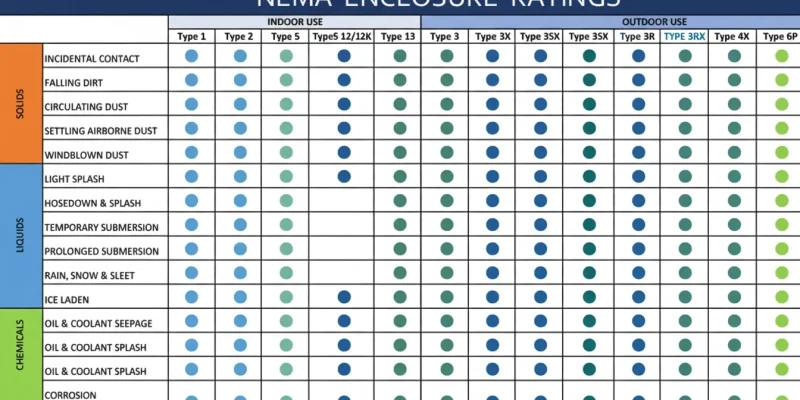
Senin pagi, pukul 7:15. Inspektur kesehatan masuk ke pabrik pengolahan makanan Anda, menunjuk ke kotak kontrol motor di area pengemasan, dan mengucapkan empat kata yang menghentikan produksi seketika: “Ini gagal dalam inspeksi.”
Kotak tersebut adalah NEMA 3R—tahan cuaca, dirating untuk penggunaan luar ruangan, cocok untuk hujan dan hujan es. Namun, ini bukan lingkungan luar ruangan yang ringan. Dua kali per shift, kru Anda menyemprot setiap permukaan di ruangan itu dengan selang bertekanan tinggi dan larutan pembersih kaustik, dan kotak NEMA 3R diuji untuk hujan jatuh, bukan semprotan 1.000 PSI dari jarak tiga kaki. Air berhasil masuk melewati gasket selama pencucian pukul 6 pagi. Saat inspektur tiba, kelembapan terlihat di dalam kotak, kondensasi terbentuk pada kumparan kontaktor, dan seluruh lini produksi Anda—yang dijadwalkan memproduksi 2.400 karton hari itu—terhenti.
Perbaikannya: Lepas NEMA 3R, pesan kotak stainless steel NEMA 4X (\$1.850 vs. \$680 yang Anda bayar untuk 3R), tunggu empat hari untuk pengiriman, pasang kembali semua kabel, dan ajukan ulang untuk inspeksi. Total biaya: \$47.000 dalam bentuk kehilangan produksi, tenaga kerja, dan pengiriman premium. Penyebab utamanya? Terjebak dalam Jebakan Pencucian—berasumsi bahwa kotak berperingkat luar ruangan apa pun cocok untuk lingkungan basah.
So how do you match NEMA enclosure ratings to your actual environment without under-protecting (failed inspections, equipment damage) or over-engineering (30-60% cost premiums for features you don’t need)?
Quick Answer: NEMA Ratings at a Glance
Most engineers miss this: The Higher-Number Lie. NEMA 12 isn’t “better” than NEMA 4. They’re designed for completely different environments—NEMA 12 for indoor dust and drips, NEMA 4 for outdoor hose-down. The numbers don’t represent a progressive scale of protection; they represent distinct environmental test profiles.
NEMA ratings, defined by ANSI/NEMA 250-2020, classify enclosures based on the environmental tests they pass. Indoor types (1, 2, 5, 12, 12K, 13) protect against dust, drips, and non-corrosive liquids. Outdoor types (3, 3R, 3S, 4, 4X, 6, 6P) add protection against rain, snow, windblown dust, and in some cases, hose-directed water or submersion. The “X” suffix (3X, 4X) indicates added corrosion resistance—typically stainless steel or fiberglass construction.
Here’s how the most common NEMA types compare:
| Tipe NEMA | Lokasi | Protection Against | Kisaran Biaya Umum | Kasus Penggunaan Terbaik |
| 1 | Dalam | Falling dirt, accidental contact | \$50-\$200 | Clean indoor panels, office environments |
| 3R | Luar ruangan | Rain, sleet, snow, falling dirt | \$150-\$400 | Outdoor utility, metering, general service |
| 4 | Luar ruangan | Rain, hose-down, windblown dust | \$300-\$800 | Washdown areas (non-corrosive), outdoor industrial |
| 4X | Luar ruangan | All Type 4 + corrosion resistance | \$600-\$1,850 | Coastal, marine, chemical, food processing |
| 12 | Dalam | Dust, lint, drips, non-corrosive liquids | \$120-\$350 | Manufacturing, factories, non-washdown industrial |
| 13 | Dalam | Type 12 + oil/coolant seepage | \$180-\$450 | Machine tool environments, CNC enclosures |
Notice the functional divide: outdoor types withstand weather and hose-down, while indoor types handle dust and splashes. When you fall into Jebakan Pencucian—choosing 3R for a hose-down environment because “it’s outdoor-rated”—you’re selecting a rain-tested enclosure for a pressure-spray application. That’s the \$47K mistake from the opening.
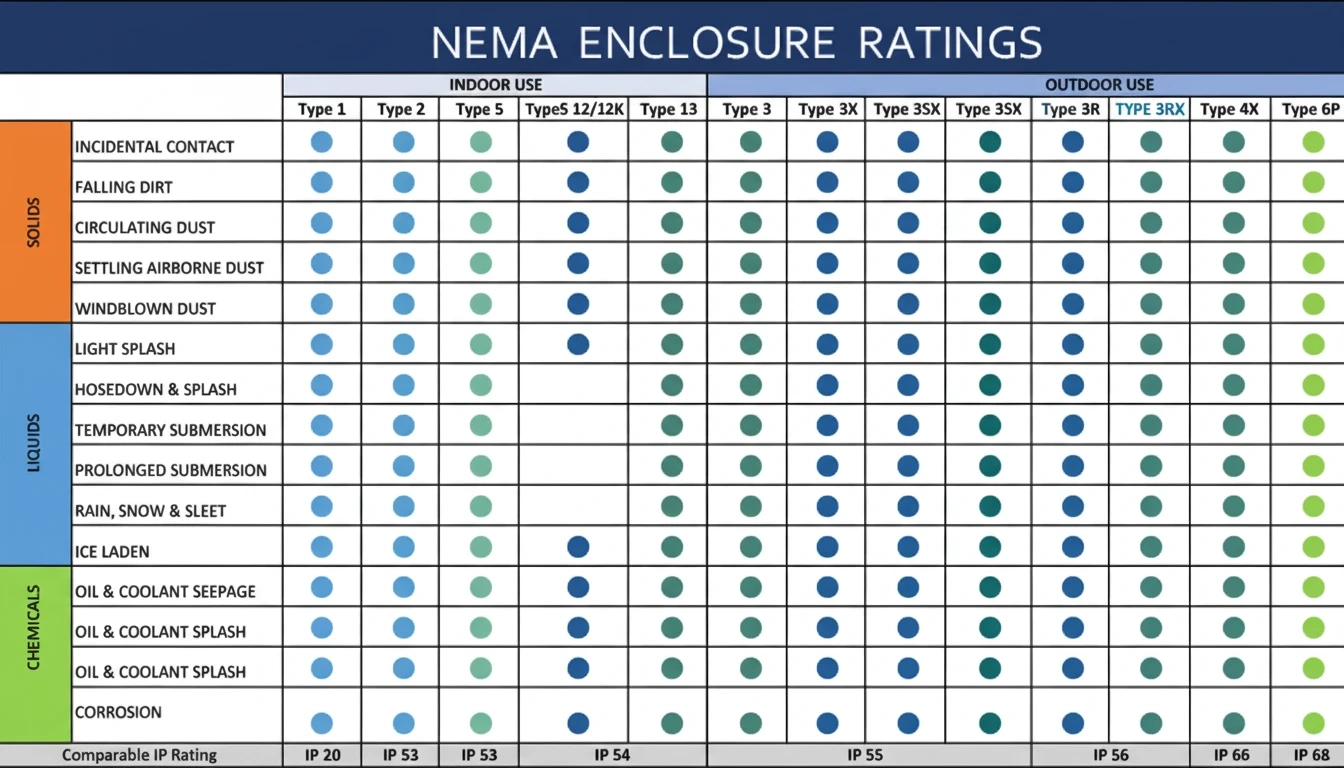
Figure 1: NEMA rating comparison matrix showing protection features for Types 1 through 6P. This chart provides a quick reference for matching enclosure types to environmental hazards—dust protection, water exposure levels, and corrosion resistance.
The Standards Foundation: ANSI/NEMA 250-2020
NEMA doesn’t just assign numbers to boxes and call it a day. The rating system is backed by ANSI/NEMA 250-2020, Enclosures for Electrical Equipment (1,000 Volts Maximum), approved December 8, 2020. This standard defines the construction requirements, environmental test methods, and marking specifications for every NEMA type.
What ANSI/NEMA 250 actually tests:
Each NEMA type must pass specific design tests defined in Section 5 of the standard. These aren’t abstract ratings—they’re measurable environmental simulations:
- Rain test (Section 5.4): Enclosure exposed to falling water at 5 inches per hour for 30 minutes. Water must not enter and affect operation. Types 3, 3R, 3S, 4, 4X, 6, 6P pass this test.
- Hose-down test (Section 5.7): Enclosure sprayed with 65 GPM water stream from a 1-inch nozzle at 65 PSI from all angles. No water ingress allowed. Only Types 4 and 4X pass this test—not Type 3R.
- Dust tests (Section 5.5): Windblown dust, circulating dust, and settling dust tests. Type 3/4 resist windblown dust. Type 12 resists circulating dust and lint. Type 5 is dust-tight (complete exclusion).
- Corrosion tests (Section 5.10): Salt spray (600 hours for outdoor X-variants) and CO2/SO2/air exposure. Types 3X, 3RX, 3SX, 4X, and 6P require added corrosion protection and must pass these extended tests.
- Submersion tests (Sections 5.11-5.12): Type 6 withstands temporary submersion (occasional, limited depth). Type 6P handles prolonged submersion.
NEMA doesn’t certify enclosures. Manufacturers self-declare NEMA compliance, and third-party testing labs (NRTLs like UL) list products to UL 50 (construction) and UL 50E (environmental) standards, which align with NEMA 250. When you spec an enclosure, look for the UL listing mark—that’s your verification it passed the tests.
Pro-Tip #1: NEMA types define environmental protection, but they don’t address thermal management. A sealed NEMA 4X enclosure can’t use a simple fan that draws outside air—that would compromise the seal. You’ll need closed-loop cooling (air conditioners, heat exchangers) which adds \$800-\$3,500 to your system cost. If your application doesn’t need hose-down protection, choosing NEMA 12 with filtered ventilation saves significant cooling costs.
Indoor NEMA Types: When Clean Environments Need Protection
Indoor NEMA types (1, 2, 5, 12, 12K, 13) are designed for controlled environments where rain and outdoor weather aren’t concerns. But “indoor” doesn’t mean “no protection needed”—these ratings address dust, drips, splashes, and in industrial settings, oil and coolant exposure.
NEMA Type 1: General Purpose Indoor
Perlindungan: Basic protection against accidental contact with live parts and limited falling dirt. Not dust-tight. Minimal protection against water (drip/light splash only).
Aplikasi: Clean office environments, residential panels, equipment rooms with controlled conditions. Think panelboards in commercial buildings, PLC cabinets in climate-controlled server rooms, and indoor switch enclosures where dust and moisture aren’t concerns.
Biaya: \$50-\$200 for typical sizes (12×12×6 to 24×24×10 inches).
When it fails: Put a Type 1 enclosure in a dusty factory, and circulating dust will enter through ventilation openings and settle on components. Put it where condensation forms (near HVAC equipment, laundry facilities), and moisture ingress can cause corrosion or hubungan arus pendek.
NEMA Type 2: Indoor with Drip Protection
Perlindungan: Similar to Type 1 with enhanced protection against dripping and light splashing water. Still not dust-tight.
Aplikasi: Laundry facilities, cooling equipment rooms, areas with condensation but not heavy splashing. Less common than Types 1 or 12 in industrial settings.
Biaya: \$80-\$250 for typical sizes.
NEMA Type 5: Dust-Tight Indoor
Perlindungan: Completely dust-tight (no dust ingress), plus protection against dripping and light splashing water. This is the highest dust protection rating for indoor enclosures.
Aplikasi: Steel mills, cement plants, powder handling facilities—anywhere airborne dust is a major concern. Also suitable for environments with lint or fibers (textile mills).
Biaya: \$200-\$500 for typical sizes. Gasket construction and sealing add cost compared to Type 1.
Key distinction from Type 12: Type 5 is completely dust-tight (zero ingress). Type 12 resists dust but isn’t hermetically sealed. For heavy dust environments, Type 5 is the right choice.
NEMA Type 12 and 12K: Industrial Indoor Workhorse
Perlindungan: Non-ventilated gasketed construction. Protects against falling dirt, circulating dust, lint, fibers, dripping water, and light splashing of non-corrosive liquids. Not oil-resistant.
Aplikasi: General-purpose industrial environments—manufacturing floors, assembly lines, warehouses, distribution centers. This is the most common indoor industrial enclosure rating. Type 12K includes knockouts for conduit entry; standard Type 12 may not.
Biaya: \$120-\$350 for typical sizes (16×16×8 to 30×24×10 inches).
When it works: A motor control panel in a clean manufacturing facility where dust is present but not extreme, and there’s no hose-down or oil exposure. Dripping water from overhead piping or light splashing during cleaning (mop and bucket, not pressure spray) is acceptable.
When it fails: Put a Type 12 in a CNC machine tool environment with oil mist and coolant spray, and the gaskets will eventually degrade from oil exposure. That’s when you need Type 13.
NEMA Type 13: Oil and Coolant Resistance
Perlindungan: All Type 12 protections plus resistance to spraying, splashing, and seepage of oil and non-corrosive coolants. Gaskets and seals are oil-resistant elastomers.
Aplikasi: CNC machine tools, metalworking environments, hydraulic systems—anywhere oil mist, cutting fluids, or hydraulic fluid spray is present.
Biaya: \$180-\$450 for typical sizes. Oil-resistant gaskets and sealing add 20-30% vs. Type 12.
Pro-Tip #2: When specifying indoor enclosures, consider UV exposure from skylights or windows. Standard painted steel Type 12 enclosures can suffer UV degradation (fading, chalking) over 5-10 years in direct sunlight. If your “indoor” environment has significant sunlight, specify UV-resistant powder coating or consider polycarbonate enclosures with UV stabilizers.

Figure 2: Construction differences between NEMA 12 (indoor gasketed), NEMA 4 (outdoor hose-down sealed), and NEMA 4X (corrosion-resistant stainless steel). Notice the gasket sealing, material specifications, and intended application environments for each type.
Outdoor NEMA Types: Rain, Hose-Down, and The Washdown Trap
Outdoor NEMA types (3, 3R, 3S, 3X, 3RX, 3SX, 4, 4X, 6, 6P) add weather resistance and, critically, different levels of water protection. This is where Jebakan Pencucian catches engineers: assuming all outdoor ratings handle high-pressure water.
NEMA Type 3 and 3R: Weatherproof Outdoor
Type 3 Protection: Rain, sleet, snow, windblown dust, and ice formation. Enclosure must remain operable when ice forms on the exterior.
Type 3R Protection: Rain, sleet, snow, and falling dirt—but no windblown dust protection. The “R” stands for “rain-proof.” Drainage provisions prevent water accumulation. Lower cost than Type 3 due to simplified gasket requirements.
Aplikasi:
- Type 3: Construction sites, ship docks, outdoor industrial equipment in dusty environments.
- Type 3R: Most common outdoor utility enclosure—metering, disconnect switches, outdoor lighting controls, residential service equipment. If windblown dust isn’t a concern, 3R is more economical than 3.
Biaya: Type 3R runs \$150-\$400 for typical sizes. Type 3 adds 20-30% for enhanced gasket sealing.
Critical limitation: Types 3 and 3R pass the rain test (5 inches/hour falling water) but do not pass the hose-down test. If your environment includes pressure washing, you’ve just walked into Jebakan Pencucian.
NEMA Type 3S: Ice-Operable Outdoor
Perlindungan: All Type 3 protections, plus the enclosure must remain operable when covered with ice. External operating mechanisms (handles, locks) can’t freeze shut.
Aplikasi: Utilities in northern climates, outdoor substations, any equipment that must remain accessible during ice storms.
Biaya: \$250-\$600 for typical sizes. Ice-resistant mechanisms and heated options add cost.
NEMA Type 4 and 4X: Hose-Down Protection
Type 4 Protection: All Type 3 protections plus hose-directed water (Section 5.7 test: 65 GPM at 65 PSI from all angles). This is the critical distinction—Type 4 seals must withstand direct spray, not just falling rain.
Type 4X Protection: All Type 4 protections plus corrosion resistance (600-hour salt spray test, CO2/SO2 exposure). Requires stainless steel, fiberglass, or corrosion-resistant materials.
Aplikasi:
- Type 4: Washdown areas with mild steel acceptable—food processing (non-corrosive zones), beverage plants, pharmaceutical clean rooms, outdoor industrial equipment with periodic hose-down maintenance.
- Type 4X: Corrosive environments—coastal/marine installations, chemical processing, wastewater treatment, oil & gas platforms, any outdoor or washdown environment with salt, chemicals, or corrosive atmospheres.
Biaya:
- Type 4 (mild steel): \$300-\$800 for typical sizes
- Type 4X (stainless steel 304): \$600-\$1,850 for typical sizes—often double the cost of Type 4
This is The 3R vs 4X Crossroads: The most common outdoor enclosure decision. Ask yourself: “Will this enclosure ever be hose-washed, or is it just exposed to rain?” If hose-washing is possible (maintenance cleaning, nearby washdown operations), you need Type 4 or 4X. If it’s truly rain-only, Type 3R saves 50-60% vs. 4X.
Pro-Tip #3: Installation orientation matters for drainage. NEMA 3R and 4 enclosures have drain holes or weep provisions at the bottom. Mount the enclosure level and oriented per manufacturer instructions—tilting or inverting can trap water inside. Check the mounting instructions; some enclosures are approved for vertical wall-mount only, not horizontal surface-mount.
NEMA Type 6 and 6P: Submersible Enclosures
Type 6 Protection: All Type 4 protections plus temporary submersion in water (occasional submersion at limited depth for limited time, per manufacturer specifications—typically 6 feet for 30 minutes).
Type 6P Protection: Prolonged submersion at greater depth (per manufacturer rating). Not intended for continuous underwater operation, but can handle extended flooding or temporary underwater installation.
Aplikasi:
- Type 6: Manholes, utility pits, tunnels, pump stations—anywhere temporary flooding is possible.
- Type 6P: Wastewater lift stations, sump pump controls, floodplain installations.
Biaya: \$800-\$2,500 for typical sizes. Submersion-rated gaskets, cable glands, and sealing add significant cost.
Rare in most industrial applications: Unless you’re in water/wastewater utilities or flood-prone areas, you won’t need Type 6/6P. Type 4X handles most harsh outdoor environments without the submersion premium.
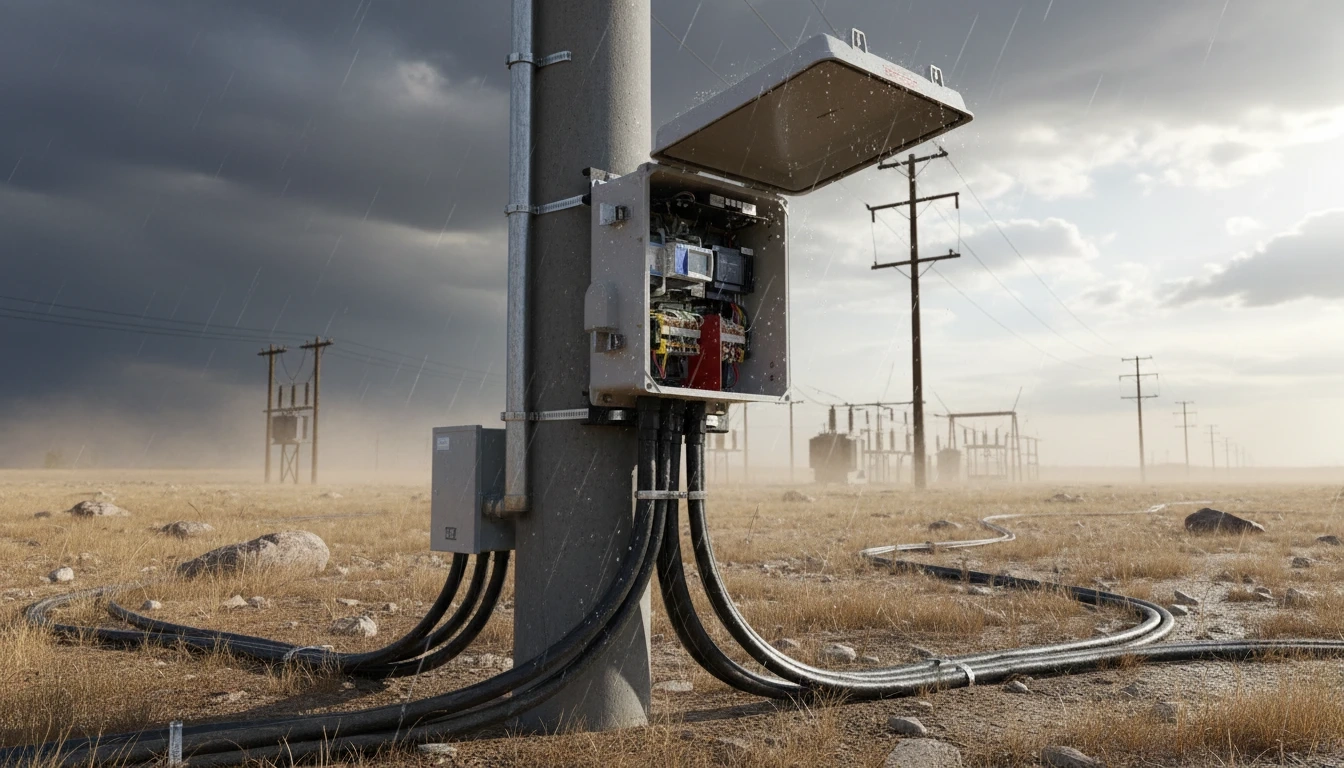
Figure 3: Real-world outdoor NEMA enclosure installation on utility pole. This type of deployment typically requires NEMA 3R (rain-only) or NEMA 4X (if hose-down maintenance or coastal corrosion is a concern). Proper mounting orientation ensures drainage per manufacturer specifications.
The Corrosion “X” Variants: When Stainless Steel Is Worth It
The “X” suffix in NEMA ratings (3X, 3RX, 3SX, 4X, 6P) signals corrosion resistance. This isn’t a minor upgrade—it’s a fundamental material change that triggers extended corrosion testing and typically 40-150% cost premium. Welcome to The Corrosion Tax.
What “X” actually requires (ANSI/NEMA 250-2020 Section 5.10):
- 600-hour salt spray test (outdoor X-variants): Enclosure exposed to 5% NaCl salt fog for 600 continuous hours. No corrosion or degradation of function allowed.
- CO2/SO2/air corrosion test: 1,200-hour exposure to corrosive gas mixture simulating industrial atmospheres.
- Material requirements (Section 3.5.7): Stainless steel (304 or 316 grade), fiberglass-reinforced polyester, polycarbonate, or other corrosion-resistant materials with appropriate surface protection.
Cost breakdown for Type 4 vs 4X (18×16×8-inch wall-mount enclosure):
- Type 4 (mild steel, powder coated): \$450-\$650
- Type 4X (304 stainless steel): \$850-\$1,200 (+89-85% premium)
- Type 4X (316 stainless steel): \$1,200-\$1,850 (+167-185% premium)
- Type 4X (fiberglass): \$700-\$1,100 (+56-69% premium)
When The Corrosion Tax is worth paying:
- Coastal and marine environments: Within 1 mile of saltwater, salt spray accelerates corrosion dramatically. Mild steel Type 4 may show rust in 6-18 months. Stainless 4X lasts 15-25+ years.
- Chemical processing: Exposure to acids, bases, solvents, or corrosive fumes. Even mild exposure over 5-10 years degrades coatings and causes rust-through.
- Food and beverage (corrosive cleaning): Caustic cleaning chemicals (sodium hydroxide, phosphoric acid) attack mild steel. 4X stainless is standard in FDA-regulated environments.
- Wastewater and water treatment: Hidrogen sulfida (H2S) yang keluar, klorin, dan kelembapan tinggi mempercepat korosi. 4X atau fiberglass adalah standar.
- Iklim tropis luar ruangan: Panas tinggi + kelembapan tinggi + udara yang mengandung garam (bahkan di pedalaman) menciptakan kondisi korosi yang agresif.
Kapan Anda dapat melewati varian X dan menghemat 40-150%:
- Iklim luar ruangan yang kering (gurun, wilayah kering) tanpa paparan garam atau bahan kimia—baja ringan Tipe 3R atau 4 berfungsi dengan baik selama 10-20 tahun dengan lapisan bubuk yang baik.
- Luar ruangan beriklim sedang non-pesisir, non-industri—instalasi utilitas pinggiran kota, eksterior bangunan komersial tanpa paparan bahan kimia.
- Lingkungan dalam ruangan, bahkan dengan pencucian, jika bahan kimia tidak korosif (hanya air dan deterjen ringan)—baja ringan Tipe 4 mungkin cukup.
Pemilihan material dalam 4X:
- Baja tahan karat 304: Ketahanan korosi tujuan umum. Baik untuk pesisir (bukan zona percikan langsung), pengolahan makanan, paparan bahan kimia umum.
- Baja tahan karat 316: Ketahanan korosi yang ditingkatkan, terutama klorida dan lingkungan laut. Tentukan 316 untuk paparan air laut langsung, platform lepas pantai, pabrik kimia dengan senyawa berklorin.
- Fiberglass: Tidak konduktif, ketahanan kimia yang sangat baik, tahan UV, 30-50% lebih ringan dari baja. Ideal untuk lingkungan kimia yang sangat korosif atau di mana isolasi listrik diperlukan. Kekurangan: ketahanan benturan lebih rendah dari baja.
Pro-Tip #4: Periksa pelat daftar UL dan tanda NEMA di dalam enklosur. Label harus menyatakan tipe NEMA dan mencantumkan nomor file UL. Jika Anda membayar Pajak Korosi untuk 4X, verifikasi daftarnya—enklosur “setara 4X” yang tidak terdaftar mungkin tidak memenuhi uji semprotan garam 600 jam. Selama inspeksi, AHJ (Otoritas yang Memiliki Yurisdiksi) akan mencari tanda UL itu.
Jenis Lokasi Berbahaya: Lingkungan Kelas I dan Kelas II
Jika instalasi Anda berada di lokasi berbahaya (terklasifikasi) sesuai Pasal 500 NEC, tipe NEMA standar tidak cukup. Anda memerlukan enklosur yang mencegah penyalaan gas, uap, atau debu yang mudah terbakar.
Tipe NEMA 7: Kelas I, Divisi 1 Tahan Ledakan
Perlindungan: Memenuhi persyaratan untuk lokasi berbahaya Kelas I, Divisi 1 (gas atau uap yang mudah terbakar hadir dalam kondisi operasi normal). Enklosur dirancang untuk menahan ledakan internal dan mencegah penyalaan atmosfer di sekitarnya. Diuji sesuai UL 1203 (Peralatan Listrik Tahan Ledakan dan Tahan Debu).
Aplikasi: Kilang petrokimia, pabrik kimia, bilik semprot cat, area pengeluaran bahan bakar—di mana pun uap yang mudah terbakar (bensin, pelarut, hidrogen) hadir.
Biaya: \$1.500-\$8.000+ tergantung pada ukuran dan peringkat Kelas/Divisi/Grup. Konstruksi tahan ledakan (pengecoran dinding tebal, sambungan penahan api) mahal.
Instalasi: Memerlukan sambungan saluran berulir dengan kedalaman keterlibatan yang ditentukan, fitting penyegelan dalam jarak 18 inci dari pintu masuk enklosur, dan kepatuhan ketat terhadap persyaratan NEC 501.
Tipe NEMA 9: Kelas II, Divisi 1 Tahan Penyalaan Debu
Perlindungan: Memenuhi persyaratan untuk lokasi Kelas II, Divisi 1 (debu yang mudah terbakar hadir dalam kondisi normal—debu logam, debu batu bara, debu biji-bijian). Enklosur mencegah masuknya debu dan tidak akan memungkinkan percikan atau panas internal untuk menyalakan lapisan debu eksternal.
Aplikasi: Elevator biji-bijian, pabrik tepung, penanganan batu bara, pengolahan bubuk logam, pabrik penggergajian kayu.
Biaya: \$1.200-\$6.000+ tergantung pada ukuran dan peringkat kelompok debu.
Tipe NEMA 10: Keselamatan Tambang (MSHA)
Perlindungan: Memenuhi persyaratan Administrasi Keselamatan dan Kesehatan Pertambangan (MSHA) untuk digunakan di tambang batu bara dengan bahaya metana.
Aplikasi: Hanya pertambangan batu bara bawah tanah.
Jarang ditentukan di luar pertambangan: Kecuali Anda merancang untuk tambang batu bara bawah tanah, Anda tidak akan menemukan Tipe 10.
Poin Kunci: Enklosur lokasi berbahaya memerlukan kepatuhan terhadap Pasal 500-506 NEC dan biasanya daftar UL 1203 atau UL 698. Jangan pernah mengganti NEMA 4X atau 12 standar di area terklasifikasi—risiko penyalaan menciptakan bahaya keselamatan jiwa dan pelanggaran kode besar-besaran. Bekerja dengan perancang atau insinyur lokasi berbahaya bersertifikat jika proyek Anda melibatkan area Kelas I atau Kelas II.
Peringkat NEMA vs IP: Mengapa Konversi Langsung Gagal
Proyek global sering kali memerlukan peralatan dengan peringkat NEMA (Amerika Utara) dan IP (Komisi Elektroteknik Internasional IEC 60529). Insinyur sering bertanya: “Apa IP yang setara dengan NEMA 4X?” Jawabannya: tidak ada yang sempurna.
Perbedaan mendasar:
- Peringkat NEMA (ANSI/NEMA 250): Kategori perlindungan lingkungan holistik yang mencakup persyaratan konstruksi, berbagai bahaya (debu, air, korosi, minyak), dan metode pengujian khusus untuk standar Amerika Utara.
- Peringkat IP (IEC 60529): Kode perlindungan masuk dua digit yang hanya berfokus pada partikel padat (digit pertama, 0-6) dan masuknya cairan (digit kedua, 0-9). Tidak ada persyaratan korosi, ketahanan minyak, atau konstruksi eksplisit.
Struktur kode IP: IPXY
- Digit pertama (padatan): 0 = tidak ada perlindungan, 1 = objek >50mm, 2 = >12,5mm, 3 = >2,5mm, 4 = >1mm, 5 = terlindungi dari debu, 6 = kedap debu.
- Digit kedua (cairan): 0 = tidak ada perlindungan, 1 = air menetes (vertikal), 2 = air menetes (kemiringan 15°), 3 = air semprot (60° dari vertikal), 4 = percikan, 5 = semprotan air, 6 = semprotan air yang kuat, 7 = perendaman sementara, 8 = perendaman terus menerus, 9 = semprotan tekanan tinggi/suhu tinggi.
Pemetaan perkiraan (ANSI/NEMA 250-2020 Lampiran A dan NEMA BI 50014-2024):
| Tipe NEMA | Perkiraan IP yang Setara | Peringatan |
| 1 | IP10 | NEMA 1 mencakup perlindungan tetesan terbatas; IP10 minimal |
| 3, 3R | IP24 (sometimes IP54) | NEMA 3R lacks windblown dust (IP5X); rain test ≠ IP water jet test |
| 4, 4X | IP65 or IP66 | NEMA hose-down ≈ IP65/66 jets, but test methods differ |
| 12, 13 | IP54 or IP52 | NEMA 12/13 focus on indoor dust/drip; IP54 is broader |
| 6, 6P | IP67 or IP68 | NEMA temporary vs prolonged submersion ≈ IP67 vs IP68 |
Why you can’t rely on direct conversion:
- Test methods differ: NEMA hose-down uses 65 GPM at 65 PSI. IP66 uses 100 liters/min at 100 kPa from 3 meters. Similar but not identical.
- NEMA includes additional requirements: Corrosion resistance (X-suffix) isn’t part of IP rating. Oil exclusion (NEMA 13) has no IP equivalent.
- IP doesn’t address construction: NEMA specifies gasket materials, mounting, marking. IP only tests ingress.
- Regulatory acceptance: NEC and UL require NEMA ratings in North America. CE marking in Europe requires IP ratings per IEC 60529.
Practical guidance for global projects:
- Dual-rated enclosures: Specify equipment listed to both NEMA and IP standards (e.g., “NEMA 4X / IP66”). Many manufacturers offer dual-rated products.
- Verify test reports: If a vendor claims “NEMA 4X equivalent to IP65,” ask for test reports showing compliance with both ANSI/NEMA 250 and IEC 60529.
- Don’t assume equivalence: A European enclosure rated IP54 may not meet NEMA 12 requirements if gasket materials, construction, or marking don’t align.
For detailed comparison, check NEMA BI 50014-2024, Degrees of Protection Provided by Enclosures (IP Code): A Brief Comparison, published by NEMA to clarify these distinctions.
5-Question Decision Framework: Matching Environment to NEMA Type
You’ve seen the types, the test methods, and the cost implications. Now here’s the practical framework: answer these five questions, and you’ll know which NEMA rating your application needs.
Question 1: Indoor or Outdoor Installation?
Dalam (controlled environment, no rain or weather exposure):
→ Start with NEMA 1, 2, 5, 12, or 13. Go to Question 2.
Luar ruangan (exposed to weather):
→ Start with NEMA 3, 3R, 3S, 4, 4X, 6, or 6P. Go to Question 3.
Question 2 (Indoor): What Are Your Environmental Hazards?
Dust/lint/fibers present?
- Minimal dust, clean environment → NEMA 1
- Moderate dust, industrial environment → NEMA 12
- Heavy dust, need complete exclusion → NEMA 5
Oil, coolant, or cutting fluids present?
- No oil exposure → NEMA 1 atau 12
- Oil mist, coolant spray → NEMA 13
Dripping water or condensation?
- Dry environment → NEMA 1
- Drips or light splashing → NEMA 2 atau 12
Kebutuhan pengelolaan termal?
- Jika Anda membutuhkan ventilasi untuk pendinginan, NEMA 1 atau 12 dengan kisi-kisi/kipas dapat dilakukan. Jika Anda membutuhkan lingkungan tertutup untuk debu, NEMA 5 atau 12 memerlukan pendinginan loop tertutup (Kiat Pro #1).
→ Lanjutkan ke Pertanyaan 5 (pertimbangan biaya/material).
Pertanyaan 3 (Luar Ruangan): Hanya Terkena Hujan atau Semprotan Air?
Ini adalah Jebakan Pencucian titik keputusan.
Hanya hujan, hujan es, salju (tanpa pencucian bertekanan):
- Debu yang tertiup angin menjadi perhatian → NEMA 3
- Debu yang tertiup angin tidak menjadi perhatian → NEMA 3R (opsi luar ruangan paling ekonomis)
- Harus beroperasi saat tertutup es → NEMA 3S
Semprotan air, pencucian bertekanan, atau semburan air:
→ Diperlukan NEMA 4 atau 4X. Tipe 3R akan gagal. Lanjutkan ke Pertanyaan 4 untuk penilaian korosi.
Kemungkinan banjir atau perendaman sementara:
→ NEMA 6 atau 6P (jarang; sebagian besar aplikasi luar ruangan dipenuhi dengan 4/4X).
Pertanyaan 4 (Luar Ruangan): Penilaian Paparan Korosi
Ini adalah The Corrosion Tax keputusan.
Risiko korosi tinggi (memerlukan akhiran X):
- Lokasi pesisir (dalam jarak 1 mil dari laut) → 3X, 3RX, atau 4X
- Lingkungan laut (paparan langsung air laut) → 4X dengan baja tahan karat 316
- Pabrik kimia atau atmosfer korosif → 4X (baja tahan karat atau fiberglass)
- Pengolahan makanan dengan pembersihan kaustik → 4X baja tahan karat
- Pengolahan air limbah/air → 4X atau fiberglass
Risiko korosi rendah (baja ringan dapat diterima):
- Iklim kering atau sedang, tanpa garam/bahan kimia → 3, 3R, atau 4 baja ringan
- Penghematan biaya yang signifikan (40-150% lebih rendah daripada varian X)
Pemilihan material untuk varian X:
- Korosi umum → 304 baja tahan karat
- Paparan laut/klorida → 316 baja tahan karat
- Bahan kimia yang sangat korosif + masalah berat → Serat kaca
Pertanyaan 5: Klasifikasi Lokasi Berbahaya?
Apakah ini area yang diklasifikasikan (berbahaya) sesuai Pasal 500 NEC?
Ya, Kelas I, Divisi 1 (gas/uap yang mudah terbakar):
→ Tipe NEMA 7 (tahan ledakan, terdaftar di UL 1203)
Ya, Kelas II, Divisi 1 (debu yang mudah terbakar):
→ Tipe NEMA 9 (tahan terhadap penyalaan debu)
Ya, tambang batu bara bawah tanah:
→ Tipe NEMA 10 (Disetujui MSHA)
Tidak, tidak terklasifikasi:
→ Gunakan jawaban Anda dari Pertanyaan 1-4.
Kritis: Jangan pernah mengganti NEMA 4 atau 12 standar di area terklasifikasi. Risiko ledakan/penyalaan sangat penting untuk keselamatan jiwa.
Ringkasan Pohon Keputusan
MULAI DI SINI:
- Lokasi berbahaya?
- Ya, Kelas I → Tipe 7
- Ya, Kelas II → Tipe 9
- Tidak → Buka #2
- Di dalam atau di luar ruangan?
- Di dalam ruangan → Buka #3
- Di luar ruangan → Buka #4
- Bahaya di dalam ruangan?
- Bersih, debu minimal → Tipe 1
- Debu/serat ada → Tipe 12
- Debu tebal, perlu kedap debu → Tipe 5
- Semprotan oli/pendingin → Tipe 13
- Paparan air di luar ruangan?
- Hanya hujan (tidak ada penyemprotan) → Tipe 3R atau 3 (jika berdebu)
- Penyemprotan/pencucian bertekanan → Buka #5
- Kemungkinan terendam → Tipe 6/6P
- Paparan korosi?
- Tinggi (pesisir, laut, kimia, kaustik) → Tipe 4X
- Rendah (sedang, kering, tanpa garam/bahan kimia) → Tipe 4
Beginilah cara Anda menghindarinya Jebakan Pencucian (3R di lingkungan penyemprotan), The Higher-Number Lie (berpikir 12 > 4), dan The Corrosion Tax (membayar untuk 4X ketika 3R atau 4 berfungsi).

Gambar 4: Bagan alur keputusan untuk pemilihan tipe penutup NEMA. Ikuti kerangka kerja 5 langkah ini untuk mencocokkan bahaya lingkungan (di dalam/di luar ruangan, paparan air, korosi, klasifikasi lokasi berbahaya) dengan peringkat NEMA yang sesuai, menghindari kesalahan spesifikasi umum seperti The Washdown Trap dan The Corrosion Tax.
Implikasi Biaya dan Kesalahan Spesifikasi Umum
Pemilihan tipe NEMA secara langsung memengaruhi anggaran proyek—terkadang sebesar 40-150%. Inilah cara menghindari kesalahan yang mahal.
Tolok Ukur Biaya (penutup pemasangan di dinding 18×16×8 inci)
| Tipe NEMA | Bahan | Biaya Khas | Premium vs NEMA 1 |
| 1 | Baja ringan, lapisan bubuk | \$120-\$180 | Dasar |
| 3R | Baja ringan, diberi gasket | \$250-\$380 | +108-111% |
| 4 | Baja ringan, disegel | \$450-\$650 | +275-261% |
| 4X | 304 baja tahan karat | \$850-\$1,200 | +608-567% |
| 4X | 316 baja tahan karat | \$1,200-\$1,850 | +900-928% |
| 12 | Baja ringan, diberi gasket | \$220-\$320 | +83-78% |
Pemberitahuan The Corrosion Tax: Meningkatkan dari 4 ke 4X (baja tahan karat 304) menambah 89-85%. Meningkatkan ke baja tahan karat 316 menambah 167-185%. Selama proyek 50 penutup, itu \$20.000-\$60.000 hanya dalam biaya material.
Kesalahan Spesifikasi Umum
Kesalahan #1: Menentukan 4X untuk semua aplikasi luar ruangan
Mengapa itu terjadi: Engineers default to “best protection” or clients demand stainless for perceived quality.
The cost: A suburban utility installation with 20 enclosures in temperate climate (no salt, no chemicals) specified 4X stainless. Cost: \$32,000. If they’d specified 3R mild steel (adequate for rain-only), cost would have been \$7,600—\$24,400 saved.
Perbaikan: Ask: “Is corrosion exposure high?” If no, 3R or 4 mild steel works. Save The Corrosion Tax for environments that actually need it.
Mistake #2: Using 3R in washdown environments (The Washdown Trap)
Mengapa itu terjadi: “Outdoor-rated” seems sufficient for “wet environment.”
The cost: The \$47K mistake from the opening—failed inspection, production loss, enclosure replacement, rewiring labor.
Perbaikan: Ask: “Will this enclosure be hose-washed?” If yes, Type 4/4X required. Rain test ≠ hose-down test.
Mistake #3: Selecting 12 instead of 4 (The Higher-Number Lie)
Mengapa itu terjadi: Assuming higher NEMA number = better protection.
The cost: An outdoor motor control installation specified NEMA 12 because “12 is higher than 4.” After one rainstorm, water entered the non-weather-sealed enclosure. Replacement cost: \$8,500 in labor + materials.
Perbaikan: Understand that NEMA types are environmental categories, not progressive scale. 12 is for indoor dust. 4 is for outdoor hose-down. Different hazards, different types.
Mistake #4: Over-ventilating sealed enclosures
Mengapa itu terjadi: Thermal management needs conflict with environmental sealing.
The cost: A NEMA 4X enclosure with VFD and PLC required cooling. Engineer added filtered fan intake/exhaust. This compromised the 4X seal (fans draw in dust and moisture). Six months later, humidity caused VFD failures. Enclosure had to be retrofitted with closed-loop air conditioner (\$2,800) instead of \$300 fan.
Perbaikan: Ingat Pro-Tip #1—sealed enclosures (4X, 12) can’t use fans that exchange outside air. Budget for closed-loop cooling from the start if heat dissipation is significant.
Mistake #5: Ignoring installation orientation
Mengapa itu terjadi: Mounting convenience overrides drainage requirements.
The cost: A NEMA 4 enclosure installed horizontally (door facing up) instead of vertically. Rainwater pooled on door surface and eventually found entry. Water damage to components: \$3,200.
Perbaikan: Mengikuti Pro-Tip #3—NEMA 3R, 4, and 6 enclosures have drainage provisions that require proper orientation. Check manufacturer installation instructions and mounting requirements.
Pertimbangan Biaya Siklus Hidup
Initial cost isn’t the only factor. Consider 15-20 year lifecycle:
- Corrosion replacement: Mild steel Type 4 in moderate coastal environment may need replacement in 8-12 years (\$650 enclosure + \$1,500 labor to rewire). Type 4X stainless lasts 20-25+ years. Over 20 years, 4X may be cheaper despite 85% higher initial cost.
- Maintenance access: Sealed enclosures (4, 4X, 12) reduce component exposure to contaminants, lowering maintenance frequency. Open-ventilated Type 1 may require more frequent cleaning.
- Manajemen termal: Closed-loop cooling for sealed enclosures adds \$800-\$3,500 initial cost plus \$200-\$600/year in energy and maintenance. Factor this into Type 4X vs Type 1 decisions.
The Right Rating for the Right Environment
Remember that \$47,000 washdown mistake from the opening? It happened because someone fell into Jebakan Pencucian—choosing NEMA 3R for an environment that needed 4X. The rating seemed close enough. The test methods told a different story.
Here’s what actually matters:
The Higher-Number Lie is real. NEMA 12 isn’t better than NEMA 4—they protect against entirely different hazards. NEMA types are environmental categories, not a progressive scale. Match the rating to your specific hazards: indoor dust (12), outdoor rain (3R), outdoor hose-down (4), corrosive exposure (4X).
Jebakan Pencucian catches engineers who assume “outdoor-rated” handles all water exposure. It doesn’t. NEMA 3R passes a rain test (5 inches/hour falling water). NEMA 4 passes a hose-down test (65 GPM at 65 PSI from all angles). If your environment includes pressure washing, 3R will fail. Spend the extra \$200-\$400 upfront and avoid the \$47K mistake.
The Corrosion Tax is steep—40-150% cost premium for X-suffix ratings—but it’s worth paying when corrosion risk is high. Coastal installations, chemical plants, marine environments, and food processing with caustic cleaning all justify stainless steel 4X. Temperate climates with no salt or chemical exposure? Mild steel 3R or 4 saves thousands per enclosure.
The 3R vs 4X Crossroads is your most common decision point for outdoor enclosures. Ask two questions: (1) “Will this be hose-washed?” If yes, you need 4 or 4X. (2) “Is corrosion exposure high?” If yes, you need 4X. If both answers are no, 3R saves 60-70% vs 4X.
Use the 5-Question Decision Framework: hazardous location classification, indoor vs outdoor, water exposure level (rain vs hose-down), corrosion risk, and thermal management needs. Answer those five questions with your actual environmental conditions, and the right NEMA type becomes clear.
Pro-Tip #5: When in doubt, reference the standards. ANSI/NEMA 250-2020 defines the test methods. UL 50 and UL 50E certify compliance. If a vendor claims a NEMA rating, verify the UL listing mark inside the enclosure. Your AHJ will check during inspection—make sure it’s there.
Choose based on your environment, not assumptions. Test methods, not marketing. Lifecycle cost, not just initial price. Get it right the first time, and you’ll never pay for that \$47K washdown mistake.
Pertanyaan yang Sering Diajukan
What is a NEMA rating for enclosures?
A NEMA rating is a standardized classification defined by ANSI/NEMA 250-2020 that indicates the level of environmental protection an electrical enclosure provides. Ratings specify which environmental hazards the enclosure can withstand—such as dust, rain, hose-directed water, corrosion, or submersion—based on passing specific design tests. NEMA types range from Type 1 (basic indoor protection) to Type 4X (outdoor hose-down with corrosion resistance) to Type 7/9 (explosion-proof/dust-ignition-proof for hazardous locations).
What is the difference between NEMA 4 and NEMA 4X?
NEMA 4 provides protection against windblown dust, rain, sleet, snow, and hose-directed water (65 GPM at 65 PSI). Enclosures are typically mild steel with powder coating.
NEMA 4X provides all NEMA 4 protections plus corrosion resistance. It requires materials like stainless steel (304 or 316 grade) or fiberglass and must pass a 600-hour salt spray test and CO2/SO2 corrosion exposure test. The cost premium is typically 40-150% vs NEMA 4.
When to choose 4X over 4: Coastal/marine environments, chemical plants, wastewater facilities, food processing with caustic cleaning, or any outdoor installation with salt, corrosive chemicals, or aggressive atmospheres.
Is NEMA 3R suitable for outdoor use?
Yes, NEMA 3R is designed for outdoor use and provides protection against rain, sleet, snow, and falling dirt. It’s the most economical outdoor NEMA rating and is widely used for outdoor utility enclosures, metering, disconnect switches, and general outdoor electrical equipment.
However, NEMA 3R does not protect against:
- Windblown dust (use NEMA 3 or 4 if dust is a concern)
- Hose-directed water or pressure washing (use NEMA 4 or 4X)
- Corrosive environments (use NEMA 3RX or 4X)
If your outdoor environment includes hose-down cleaning or corrosive exposure, NEMA 3R will fail—this is Jebakan Pencucian.
What does NEMA 12 protect against?
NEMA 12 protects against:
- Falling dirt
- Circulating dust, lint, and fibers
- Dripping water and light splashing of non-corrosive liquids
It does tidak protect against:
- Oil or coolant seepage (use NEMA 13)
- Outdoor rain or hose-down (use NEMA 3R or 4)
- Lingkungan korosif
Best applications: General-purpose indoor industrial environments—manufacturing floors, warehouses, assembly lines, non-washdown factories.
Can you use a NEMA 4 enclosure indoors?
Yes, NEMA 4 can be used indoors and provides protection that exceeds most indoor requirements (dust-tight, drip-tight, splash-resistant). However, it’s often over-specified for typical indoor environments:
- NEMA 4 is sealed: No ventilation openings, which limits cooling options. You’ll need closed-loop cooling (air conditioner, heat exchanger) if heat dissipation is significant—adding \$800-\$3,500 to system cost.
- NEMA 12 is usually sufficient for indoor industrial use (dust, drips, light splashing) and costs 30-50% less than NEMA 4.
- Use NEMA 4 indoors when: You need hose-down cleaning capability (food processing, pharmaceutical, washdown rooms) or dust-tight sealing beyond NEMA 12.
What is the difference between NEMA and IP ratings?
NEMA ratings (ANSI/NEMA 250) are North American standards that classify enclosures based on holistic environmental protection—including construction requirements, materials, corrosion resistance, and multiple hazards (dust, water, oil).
IP ratings (IEC 60529) are international standards that use a two-digit code (IPXY) to indicate ingress protection: first digit = solid particle protection (0-6), second digit = liquid protection (0-9). IP ratings focus solely on ingress; they don’t address corrosion, oil resistance, or construction standards.
Approximate equivalents (per NEMA BI 50014-2024):
- NEMA 1 ≈ IP10
- NEMA 3R ≈ IP24 (sometimes IP54)
- NEMA 4/4X ≈ IP65 or IP66
- NEMA 12 ≈ IP54
- NEMA 6/6P ≈ IP67 or IP68
Key point: These are approximate mappings. Test methods differ, and NEMA includes requirements (corrosion resistance, oil exclusion) that IP doesn’t address. For global projects, specify dual-rated enclosures (e.g., “NEMA 4X / IP66”) and verify compliance with both standards.
What NEMA rating do I need for a food processing plant?
Food processing plants typically require NEMA 4X stainless steel for several reasons:
- Washdown requirements: USDA and FDA regulations mandate regular high-pressure washdown with hot water and caustic cleaning chemicals (sodium hydroxide, phosphoric acid). NEMA 4X passes the hose-down test; 3R does not.
- Ketahanan terhadap korosi: Caustic cleaners attack mild steel. Stainless steel (304 or 316 grade) is required for long-term durability.
- Sanitary design: Smooth stainless surfaces are easier to clean and sanitize than painted mild steel.
Material choice: 304 stainless is standard. Use 316 stainless if cleaning chemicals include chlorinated compounds or if the plant is coastal.
Biaya: NEMA 4X stainless runs \$600-\$1,850 for typical sizes (vs \$150-\$400 for NEMA 3R mild steel). The premium is justified by regulatory compliance, longer lifespan, and avoiding failed inspections.
Are NEMA ratings required by code?
NEMA ratings themselves are not code requirements—the National Electrical Code (NEC) doesn’t mandate specific NEMA types. However:
- NEC 110.3(B) requires equipment to be installed per manufacturer instructions and listing, which includes environmental suitability.
- NEC Article 500-506 requires explosion-proof or dust-ignition-proof enclosures (NEMA 7, 9) in hazardous (classified) locations.
- Local codes and AHJs (Authorities Having Jurisdiction) often require enclosures suitable for the installation environment. If an inspector determines the enclosure isn’t adequately protected for the environment (e.g., NEMA 3R in a hose-down area), they can fail the installation.
Best practice: Specify NEMA ratings that match the environmental hazards, and ensure enclosures carry UL 50/50E listing marks. Inspectors look for UL marks as verification of compliance.
How long do NEMA enclosures last?
Lifespan depends on NEMA type, material, environment, and maintenance:
- NEMA 1 indoor (mild steel, dry environment): 15-25+ years with minimal maintenance.
- NEMA 3R outdoor (mild steel, temperate climate): 10-15 years; may show rust/degradation in 5-10 years in humid or coastal areas.
- NEMA 4 outdoor (mild steel, moderate exposure): 8-12 years before coating degradation and rust in humid/coastal climates.
- NEMA 4X stainless (304 or 316): 20-30+ years in most environments. Coastal 316 stainless can last 30+ years with minimal corrosion.
- NEMA 4X fiberglass: 20-25+ years in chemically aggressive environments; UV and chemical resistant.
Lifecycle cost consideration: A NEMA 4X stainless enclosure costs 85% more initially than NEMA 4 mild steel but lasts 2-3× longer in corrosive environments. Over 20 years, 4X can be more economical when replacement labor is factored in.
Technical Standards Referenced
- ANSI/NEMA 250-2020 – Enclosures for Electrical Equipment (1,000 Volts Maximum)
- UL 50 – Enclosures for Electrical Equipment, Non-Environmental Considerations (construction)
- UL 50E – Enclosures for Electrical Equipment, Environmental Considerations
- IEC 60529 – Degrees of protection provided by enclosures (IP Code)
- NEMA BI 50014-2024 – Degrees of Protection Provided by Enclosures (IP Code): A Brief Comparison
- UL 1203 – Explosion-Proof and Dust-Ignition-Proof Electrical Equipment for Use in Hazardous (Classified) Locations
- NEC Article 500-506 – Hazardous (Classified) Locations
- NEC 110.3(B) – Installation and Use (manufacturer instructions and listing compliance)
As of November 2025, all standards and specifications in this guide reflect the latest published editions and industry practices.