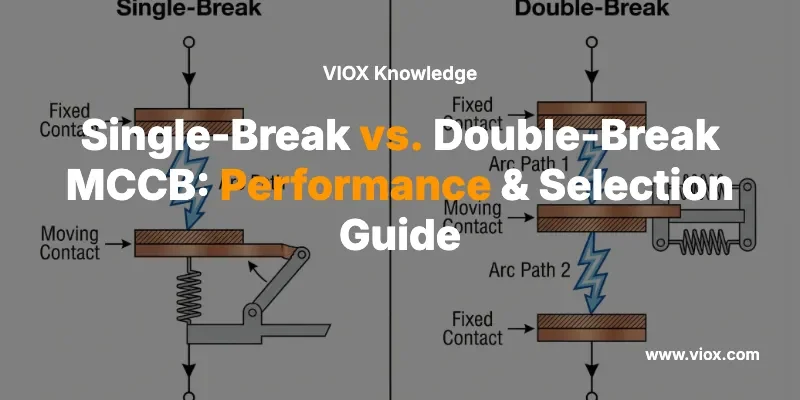
When specifying molded case circuit breakers (MCCBs) for industrial or commercial installations, you’ll encounter two fundamental contact design approaches: single-break and double-break configurations. The distinction isn’t merely technical jargon—it affects how the breaker interrupts fault currents, influences breaking capacity ratings, and determines which applications each design serves best.
Both technologies comply with IEC 60947-2 standards and deliver reliable protection when properly specified. The question isn’t which design is universally “better,” but rather which suits your specific fault-current regime, voltage level, and protection requirements. A double-break MCCB excels in high-fault environments where aggressive current limiting matters; a single-break design may offer cost advantages and stable performance in lower-fault applications.
This guide breaks down the mechanical differences, arc interruption principles, and performance trade-offs between single-break and double-break MCCBs. You’ll learn how each technology works, what IEC 60947-2 test data reveals about their performance, and how to select the right configuration for your installation.
Understanding Contact Configuration
The terms “single-break” and “double-break” describe how many interruption points exist per pole when the MCCB opens. This mechanical difference fundamentally shapes arc behavior, voltage development, and interrupting performance.
Single-Break Design
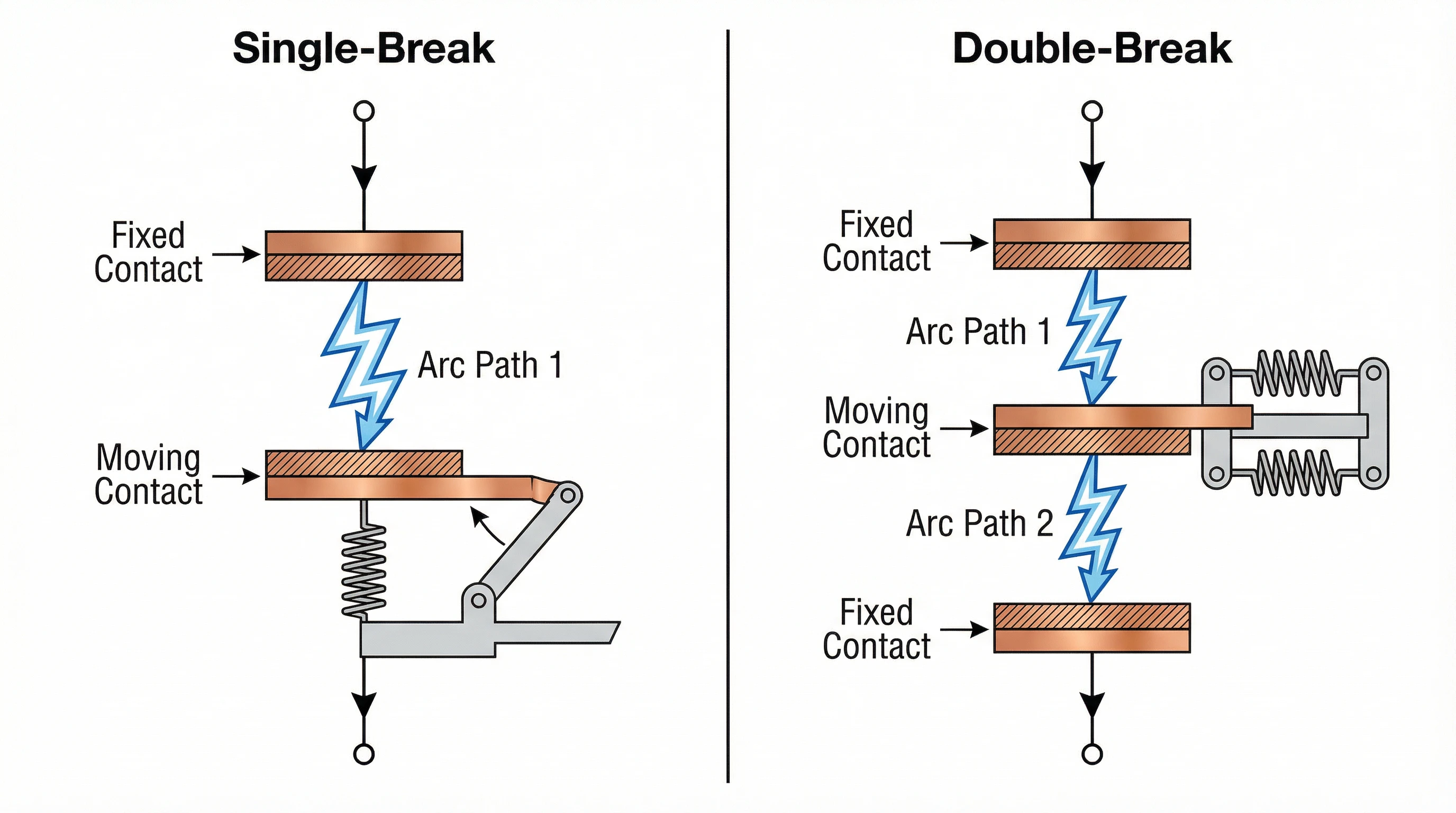
In a single-break configuration, each pole has one pair of contacts—one fixed, one moving. When a fault occurs and the trip mechanism activates, the moving contact separates from the fixed contact, creating a single arc path. The current flows through this one interruption point until the arc is extinguished in the arc chamber.
Mechanical characteristics:
- One moving contact per pole
- One fixed contact per pole
- One arc chamber per pole
- Simpler contact assembly with fewer moving parts
- Arc energy concentrated in one extinguishing chamber
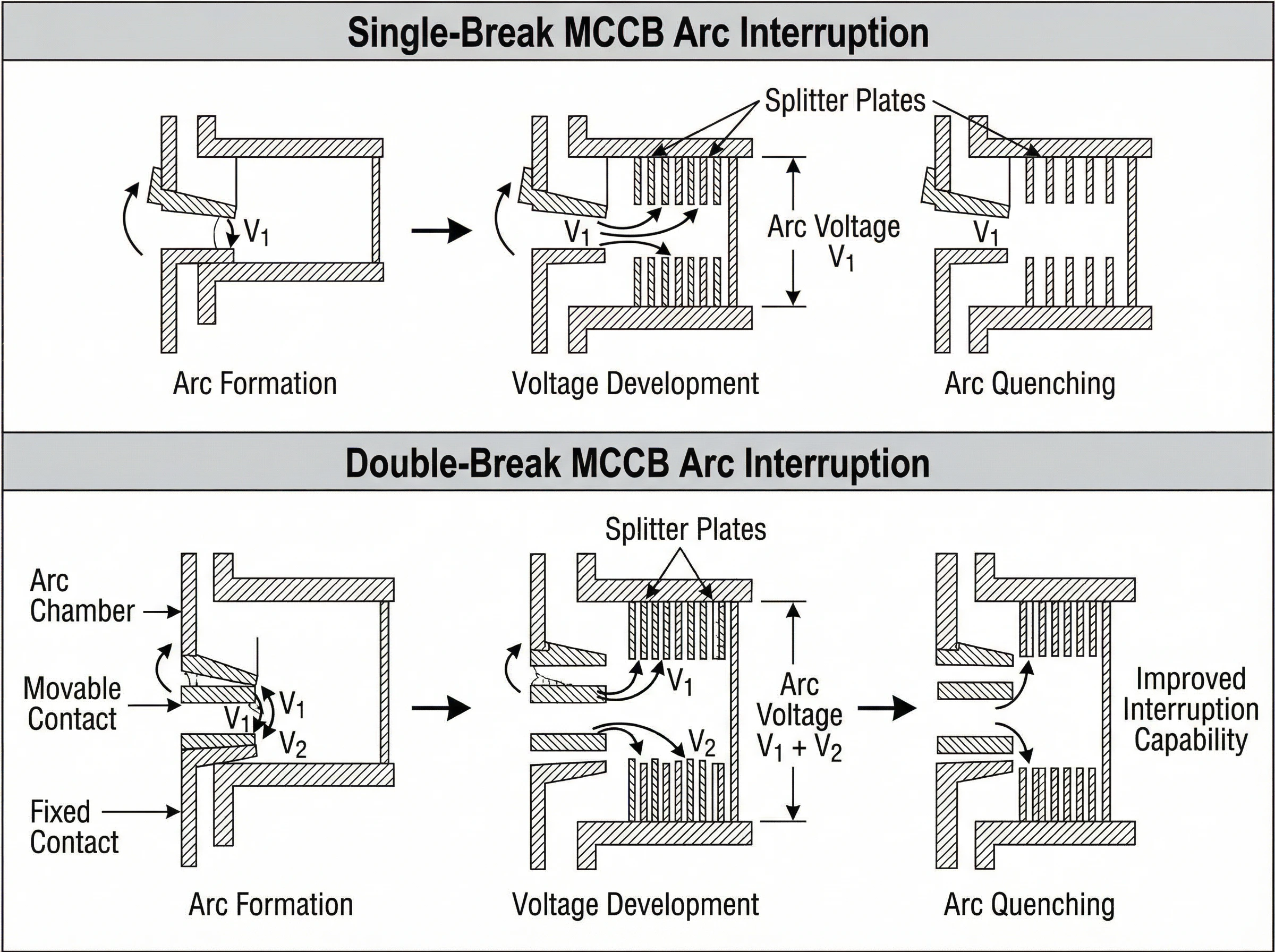
Single-break MCCBs rely on robust arc chamber design—splitter plates, magnetic blow-out coils, and chamber geometry—to quench the arc quickly. The entire arc voltage must develop across this single gap.
Double-Break Design
A double-break configuration uses two sets of contacts per pole. Typically, a central moving contact separates from two fixed contacts (one above, one below), creating two arc paths in series. When the breaker trips, current must flow through both interruption points simultaneously.
Mechanical characteristics:
- One central moving contact per pole
- Two fixed contacts per pole (or variations with multiple moving/fixed combinations)
- Two arc chambers per pole (or a shared chamber handling both arcs)
- More complex contact assembly and arc management
- Arc energy split between two interruption points
Because the two arcs develop in series, the total arc voltage is the sum of both gaps. This higher arc voltage can drive faster current limiting, but it also increases mechanical stress on the arc chambers and requires careful chamber design to manage pressure and material erosion.

Arc Interruption Principles
When an MCCB opens under fault conditions, the contacts separate and an electric arc forms—a plasma channel conducting fault current across the air gap. Interrupting this arc is the breaker’s primary job. How single-break and double-break designs manage this process differs significantly.
How Arc Voltage Drives Interruption
Arc interruption depends on building sufficient arc voltage to oppose the system voltage and drive current toward zero. The arc voltage rises as the contact gap widens and as the arc interacts with the arc chamber (cooling, stretching, and splitting through splitter plates). Once arc voltage exceeds system recovery voltage at a current zero crossing (in AC systems), the arc extinguishes and the breaker successfully interrupts the fault.
Key principle: Higher arc voltage = faster current reduction = stronger current limiting.
Single-Break Arc Behavior
In a single-break MCCB, one arc develops per pole. The arc voltage depends on:
- Contact separation distance
- Arc chamber design (number and spacing of splitter plates)
- Magnetic blow-out strength (if present)
- Arc cooling rate in the chamber
Typical single-break arc voltages range from 30V to 100V depending on chamber design and current level. The breaker must rely on efficient chamber geometry and fast contact motion to achieve rapid current limiting.
Performance considerations:
- Arc energy is concentrated in one chamber, which must handle all the thermal and pressure stress
- At high fault currents, achieving sufficient arc voltage may require longer contact travel or more aggressive chamber design
- At low fault currents, single-break designs have demonstrated stable performance without the transient re-closing behavior observed in some double-break implementations
Double-Break Arc Behavior
In a double-break MCCB, two arcs form in series per pole. The total arc voltage is approximately the sum of both arcs:
V_arc_total ≈ V_arc_1 + V_arc_2
If each arc develops 50V, the total arc voltage reaches 100V—double that of a comparable single-break design with similar chamber characteristics. This higher voltage can drive faster di/dt (rate of current reduction), delivering stronger current limiting.
Performance considerations:
- Higher arc voltage accelerates current limiting, reducing peak let-through current and I²t energy
- Two arcs in a compact chamber create higher pressure and material evaporation, requiring robust chamber materials and venting
- At low fault-current levels, some double-break designs have exhibited contact re-closing during interruption, momentarily increasing let-through energy (I²t and arc energy); this behavior is design-specific and not universal to all double-break MCCBs
- Proper chamber design must manage the interaction between two arcs to avoid arc instability
Arc Chamber Design Trade-offs
Both designs rely on arc chambers with splitter plates (also called deion plates) to cool and extinguish the arc. The chamber divides the arc into multiple smaller arcs in series, increasing total arc voltage.
Single-break chambers: Focus on maximizing voltage rise from one arc path. Typically use 10-20 splitter plates depending on voltage and breaking capacity. Chamber volume and plate spacing are optimized for single-arc cooling.
Double-break chambers: Must handle two arcs simultaneously. In compact designs where both arcs share chamber space, pressure and erosion are higher. Some manufacturers use separate chambers per arc; others optimize a shared chamber for two-arc management.
The effectiveness of either design depends heavily on implementation quality—splitter plate material (steel, copper, ceramic-coated), spacing, magnetic field strength, and chamber venting. You cannot generalize that “double-break is always better” or vice versa; specific product testing under IEC 60947-2 sequences is the only reliable performance indicator.

Breaking Capacity and IEC 60947-2 Standards
IEC 60947-2 is the international standard that defines performance requirements and test procedures for low-voltage circuit breakers, including all MCCBs. Understanding how this standard evaluates breaking capacity helps you compare single-break and double-break technologies objectively.
Icu: Rated Ultimate Short-Circuit Breaking Capacity
Icu represents the maximum prospective fault current (in kA) that the breaker can successfully interrupt at rated voltage without being destroyed. It’s the breaker’s absolute limit—tested under IEC Sequence III (test duty 1: O-t-CO).
After an Icu-level fault interruption, the breaker may not be fit for continued service. The standard requires verification that the device successfully opened the circuit and did not catch fire or explode, but does not require that it remain operational afterward.
Selection rule: Always specify Icu ≥ maximum prospective fault current at the installation point. Undersizing Icu creates a catastrophic safety hazard—the breaker may fail violently during a fault.
Ics: Rated Service Short-Circuit Breaking Capacity
Ics represents the fault-current level at which the breaker can interrupt and remain ready for service. IEC Sequence II (test duty 2: O-CO-CO) verifies this—the breaker must successfully interrupt three times at the Ics level and still meet performance criteria (dielectric test, temperature rise, operation test).
IEC 60947-2 requires:
- Ics ≥ 25% of Icu (minimum)
- Common practice targets 50%, 75%, or 100% of Icu
- Premium MCCBs achieve Ics = Icu (100%), meaning the breaker remains serviceable even after interrupting its maximum rated fault
Why Ics matters: In critical installations where rapid service restoration is essential (hospitals, data centers, industrial processes), specify Ics as close to Icu as possible. If your fault level is 40kA, a breaker rated Icu = 50kA / Ics = 50kA (100%) ensures the device remains operational after a 40kA fault. A breaker rated Icu = 50kA / Ics = 25kA (50%) may require replacement after the same event.
Does Contact Design Affect Icu/Ics?
Both single-break and double-break MCCBs can achieve high Icu and Ics ratings—the contact configuration alone does not determine breaking capacity. What matters is the complete pole design:
- Contact material and mass (silver-plated copper, tungsten-copper alloys)
- Arc chamber effectiveness (splitter plates, magnetic fields, cooling)
- Mechanical strength of the contact assembly and operating mechanism
- Thermal management (heat dissipation, material withstand)
You will find single-break MCCBs rated 100kA Icu and double-break MCCBs rated 50kA Icu, and vice versa. The design choice (single vs. double break) is one factor among many. Always verify the manufacturer’s declared Icu and Ics values—these are the only reliable indicators of performance.
Selectivity and Coordination
IEC 60947-2 uses the term over-current selectivity (formerly “discrimination”) to describe coordination between upstream and downstream protective devices. Proper selectivity ensures that only the downstream breaker nearest the fault trips, leaving upstream breakers closed to maintain service to unaffected circuits.
Both single-break and double-break MCCBs can provide selectivity when properly coordinated. Coordination depends on time-current curve characteristics, trip unit settings (thermal and magnetic thresholds), and the current-limiting performance of each device. Manufacturers provide selectivity tables showing which breaker combinations achieve total selectivity up to specific fault levels.
In high-fault installations, the stronger current limiting of a well-designed double-break MCCB may improve selectivity by reducing let-through current and I²t stress on upstream devices. However, this is product-specific—verify coordination using manufacturer data, not generic assumptions about contact design.
مقایسه عملکرد
Benchmark testing and field data reveal that single-break and double-break MCCBs exhibit different performance profiles depending on fault-current level, chamber design, and application context. Neither technology is universally superior—each excels in specific scenarios.
High Fault-Current Performance (>20kA)
At high prospective fault currents, effective current limiting becomes critical to protect downstream equipment and cables from excessive thermal and mechanical stress.
Double-break advantages:
- Two arcs in series generate higher total arc voltage, accelerating current reduction
- Faster di/dt (rate of current drop) reduces peak let-through current
- Lower I²t energy delivered to downstream circuits reduces thermal stress on cables and busbar
- Stronger current limiting can improve selectivity with downstream devices by reducing fault magnitude
Double-break challenges:
- Higher arc-chamber pressure and material evaporation require robust chamber design and venting
- Two arcs interacting in compact chambers demand precise chamber geometry to avoid instability
- Greater mechanical stress on contact assembly and operating mechanism
Single-break at high fault levels: Single-break MCCBs can achieve high breaking capacity (80-100kA Icu) with optimized arc chambers, but may deliver slightly higher let-through current and I²t compared to equivalent double-break designs. The difference narrows as chamber design improves—modern single-break MCCBs with advanced splitter-plate arrays and magnetic blow-out perform competitively.
Low to Medium Fault-Current Performance (5-20kA)
In this regime, absolute current limiting is less critical—fault currents are manageable without extreme arc voltage. Stability and consistent interruption behavior matter more.
Single-break advantages:
- Simpler contact mechanism with fewer moving parts reduces likelihood of mechanical issues
- Arc energy concentrated in one chamber simplifies thermal management
- Benchmark tests show stable interruption without transient re-closing in this fault range
- Lower chamber pressure and erosion may extend contact life
Double-break challenges:
- Some double-break designs have exhibited contact re-closing during low-level faults, momentarily increasing I²t and arc energy let-through
- This behavior is design-specific (not universal to all double-break MCCBs) and depends on contact dynamics, spring tension, and chamber pressure interaction
- At lower fault currents, the current-limiting advantage of double-break diminishes—the higher arc voltage provides less benefit when the fault current is already moderate
Double-break at low-medium fault levels: Well-designed double-break MCCBs perform reliably across the entire fault range. The re-closing issue is a design flaw, not an inherent limitation of the technology. Verify product-specific test data—reputable manufacturers publish time-current curves and let-through characteristics across the full fault spectrum.
Current-Limiting Characteristics
Current-limiting MCCBs reduce peak fault current below the prospective (available) fault current by rapidly building arc voltage. This protects downstream equipment and improves coordination.
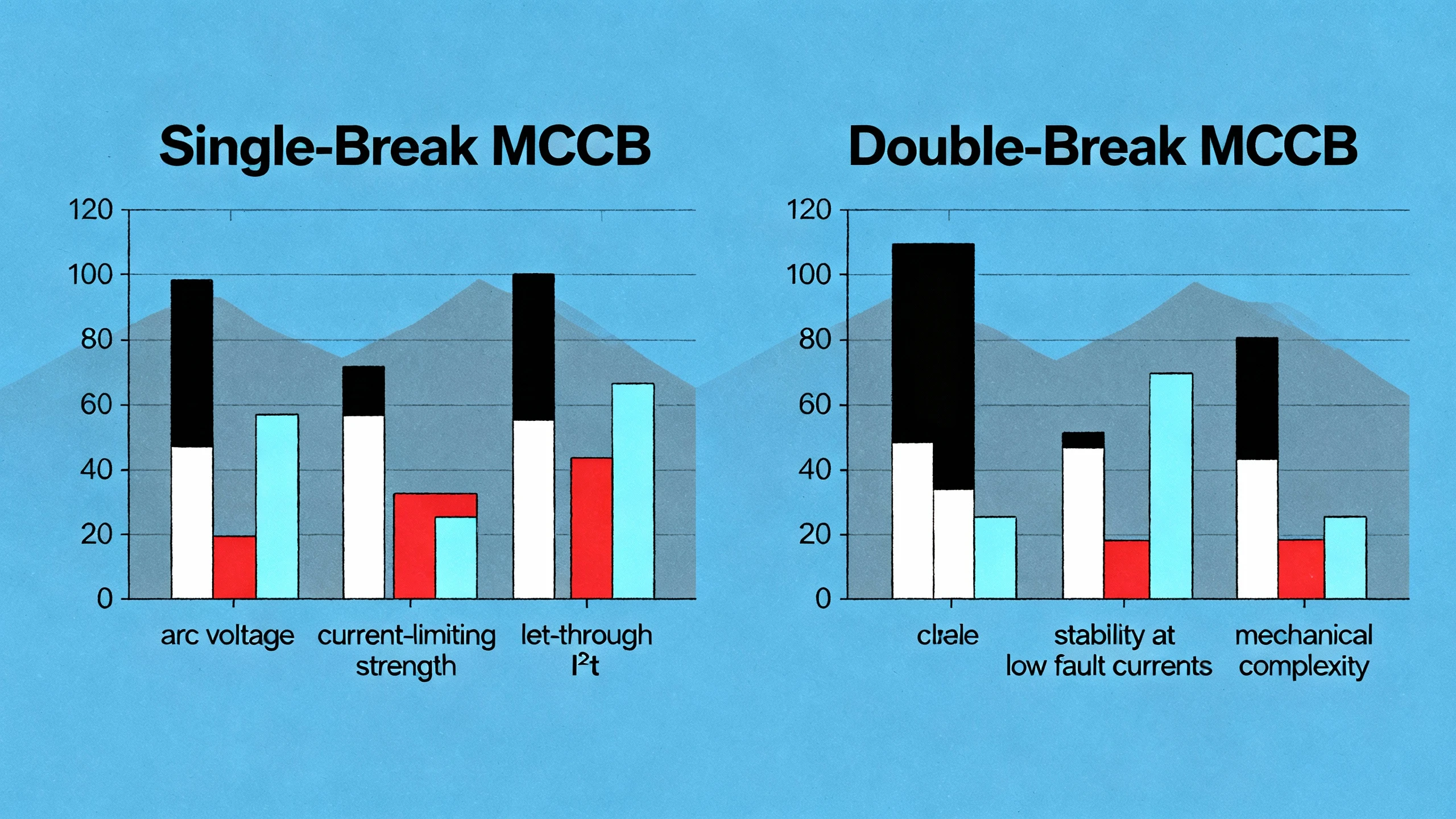
| Performance Metric | Single-Break (typical) | Double-Break (typical) |
| Arc voltage per gap | 30-100V (one arc) | 30-100V per arc (x2) |
| Total arc voltage | 30-100V | 60-200V |
| Current-limiting strength | متوسط تا زیاد | High to very high |
| Let-through I²t (high fault) | متوسط | کم تا متوسط |
| Stability (low fault) | High (consistent behavior) | Variable (design-dependent) |
| Peak let-through current | 10-30kA (at 50kA available) | 8-25kA (at 50kA available) |
Note: Values are illustrative. Actual performance depends on specific product design, frame size, and chamber optimization. Always consult manufacturer data.
Mechanical Reliability and Service Life
Both designs provide long service life when properly applied within rated limits.
Single-break: Fewer moving parts and simpler contact assembly generally translate to lower mechanical complexity. Arc erosion concentrates in one chamber, which may accelerate contact wear in high-duty applications (frequent high-current interruptions).
Double-break: More complex mechanism with additional contact interfaces. Arc energy distributed across two chambers may reduce per-chamber erosion, but higher pressure and temperature in compact dual-arc chambers can offset this benefit.
Maintenance intervals and expected operational life depend more on duty cycle, fault frequency, and environmental conditions than on contact design. IEC 60947-2 mechanical endurance tests (open-close cycles) apply equally to both technologies.
Cost and Size Considerations
Manufacturer-specific factors dominate cost and physical dimensions. You cannot reliably conclude that “single-break is cheaper” or “double-break is more compact” without comparing specific products.
General observations:
- Both designs are available across the full MCCB current range (16A to 1600A)
- Premium features (electronic trip units, communication, high Ics/Icu) affect cost more than contact configuration
- Frame size and breaking capacity (Icu) determine physical dimensions—a 630A / 85kA MCCB occupies similar space whether single- or double-break
When comparing quotes, evaluate total cost of ownership: breaker price, panel space, coordination performance, and expected service life. The contact design is one component of this analysis, not the defining factor.

Selection Criteria: When to Choose Each Technology
The “better” MCCB is the one that matches your specific application requirements, fault conditions, and protection goals. Use these criteria to guide your specification decision.
Choose Double-Break MCCBs When:
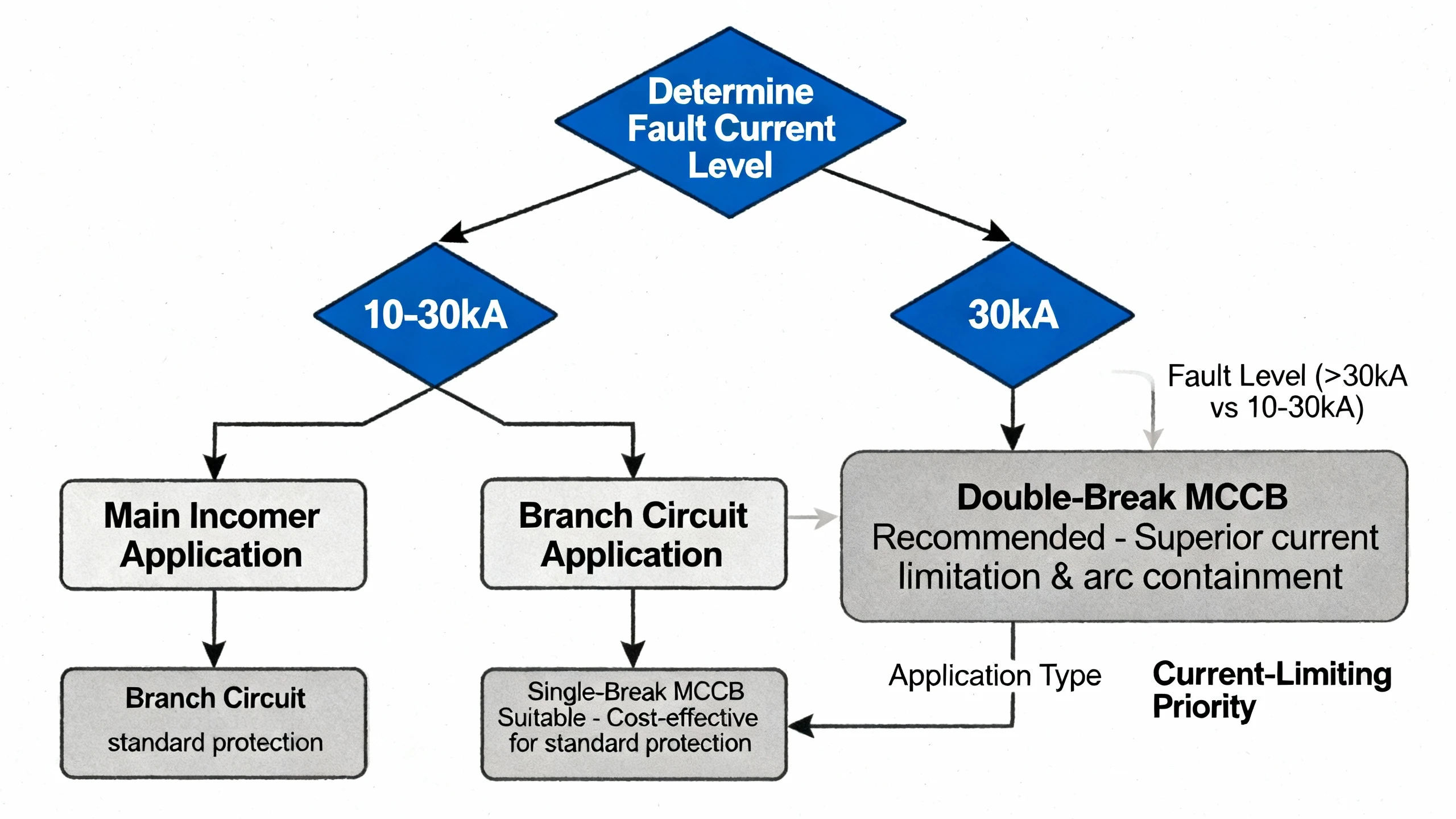
1. High Fault-Current Environments (>30kA)
If your short-circuit study shows prospective fault currents above 30kA at the installation point, double-break designs with strong current limiting offer clear benefits:
- Reduced peak let-through current protects downstream equipment from mechanical stress
- Lower I²t energy reduces thermal stress on cables, busbar, and connected devices
- Improved selectivity coordination with downstream breakers due to effective fault-current reduction
Example application: Main incomer MCCB at a 1600kVA transformer secondary with calculated fault current of 55kA. A double-break MCCB rated 800A / 65kA Icu with strong current limiting will reduce stress on downstream feeders and improve overall system coordination.
2. Transformer Secondary Protection
Transformer secondary circuits experience high inrush currents (8-12x rated current) and high available fault currents. Double-break MCCBs with electronic trip units provide:
- Adjustable trip settings (Ir, Isd) to avoid nuisance tripping on inrush while maintaining fault protection
- Strong current limiting to protect transformer windings and secondary busbar from high-fault stress
- Better selectivity with downstream distribution breakers
3. Critical Installations Requiring Maximum Current Limiting
Applications where minimizing fault energy is a priority:
- Data centers with sensitive electronic equipment
- Hospitals with critical life-support systems
- Industrial processes with expensive machinery sensitive to voltage sags
- High-rise buildings with long vertical busbar risers
4. When Manufacturer Test Data Confirms Superior Performance
If comparing specific MCCB models and the double-break option demonstrates measurably better current limiting, lower I²t, and proven stability across the fault range in IEC test reports—choose the double-break design.
Choose Single-Break MCCBs When:
1. Low to Medium Fault-Current Applications (10-30kA)
In commercial buildings, light industrial facilities, or branch feeders where fault currents are moderate, single-break MCCBs provide reliable protection without the complexity of double-break designs:
- Simpler mechanism with fewer moving parts reduces potential points of failure
- Stable interruption performance across the fault range
- Lower chamber pressure and erosion may extend service life
Example application: Sub-main feeder in an office building rated 400A, with fault level of 25kA. A single-break MCCB rated 400A / 36kA Icu provides adequate protection, reliable coordination, and cost-effective performance.
2. Motor Protection and Control Circuits
Motor feeders typically see moderate fault currents and frequent switching operations. Single-break MCCBs offer:
- Robust contact design for frequent mechanical operations
- Adjustable magnetic trip settings (Im) to accommodate motor starting inrush
- Reliable overload protection (Ir) without excessive current limiting that might affect motor starting
3. Cost-Sensitive Projects Without Extreme Fault Levels
When budget constraints matter and the fault-current regime does not demand maximum current limiting, single-break MCCBs deliver code-compliant protection at potentially lower cost. Verify that:
- Icu ≥ prospective fault current
- Ics appropriate for service reliability requirements (recommend 75-100% of Icu)
- Coordination verified with upstream/downstream devices
4. When Proven Field Performance Matters
If your facility or organization has positive long-term experience with specific single-break MCCB models—known reliability, consistent performance, established maintenance procedures—there may be operational advantages to maintaining equipment continuity.
ماتریس تصمیمگیری

Universal Selection Rules (Apply to Both Technologies)
| Selection Factor | Favor Single-Break | Favor Double-Break |
| Prospective Fault Current | 10-30kA | >30kA |
| نوع برنامه | Branch feeders, motors, sub-mains | Main incomers, transformer sec. |
| Current Limiting Priority | Moderate (standard protection) | High (minimize let-through I²t) |
| Selectivity Requirements | Standard coordination | Tight selectivity, complex system |
| Installation Environment | Commercial, light industrial | Heavy industrial, data centers |
| Budget Constraints | پروژههای حساس به هزینه | Performance priority |
| Mechanical Simplicity | Prefer fewer moving parts | Accept complexity for performance |
| Service Reliability (Ics) | 50-75% Icu acceptable | Target Ics = 100% Icu |
| Downstream Equipment Sensitivity | Standard cables, panels | Sensitive electronics, critical loads |
Regardless of contact configuration, every MCCB selection must satisfy:
- Icu ≥ Maximum Prospective Fault Current: Non-negotiable. Conduct a short-circuit study and verify the breaker’s Icu rating meets or exceeds the calculated fault level at rated voltage.
- Ics Appropriate for Application Criticality: For critical installations (hospitals, data centers, continuous industrial processes), specify Ics = 75-100% of Icu to ensure the breaker remains serviceable after fault interruption.
- Coordination Verified: Use manufacturer time-current curves and selectivity tables to confirm upstream/downstream coordination. Do not assume coordination based on contact design—verify with specific product data.
- IEC 60947-2 Compliance: Confirm the MCCB carries IEC marking and has been type-tested under the standard’s test sequences. Request test certificates if specifying for critical applications.
- Consult Manufacturer Application Guides: Major MCCB manufacturers (Schneider, ABB, Siemens, Eaton, VIOX) publish application guides and white papers comparing their single-break and double-break offerings. Use these resources—they provide product-specific test data and selection tools.
توصیه نهایی
Do not select an MCCB based solely on “single-break vs. double-break” marketing claims. Both technologies are mature, reliable, and widely deployed. The correct choice depends on:
- Your installation’s fault-current profile (short-circuit study results)
- Application type and criticality (main vs. branch, critical vs. standard)
- Coordination requirements (selectivity tables and time-current analysis)
- Manufacturer-specific test data (Icu, Ics, I²t let-through, time-current curves)
Start with a short-circuit study, define your protection requirements, then evaluate specific MCCB models (regardless of contact design) that meet those requirements. The contact configuration is a technical detail that matters—but it is not the primary decision driver.
نتيجه گيری
The question “What is better: single-break or double-break MCCB?” has no universal answer. Both contact configurations comply with IEC 60947-2 standards, deliver reliable fault protection, and serve distinct application profiles effectively.
Double-break MCCBs excel in high-fault environments (>30kA) where aggressive current limiting reduces stress on downstream equipment and improves system coordination. Their higher arc voltage accelerates current reduction, making them ideal for main incomers, transformer secondaries, and critical installations where minimizing let-through energy matters.
Single-break MCCBs provide robust, cost-effective protection for moderate fault-current applications (10-30kA). Their simpler mechanism and stable interruption performance across the fault range make them well-suited for branch feeders, motor circuits, and commercial installations where extreme current limiting is not required.
The right choice depends on your short-circuit study results, application criticality, and coordination requirements—not on marketing claims about contact design superiority. Start with a fault-current analysis, define your protection goals (Icu, Ics, current limiting, selectivity), then select the MCCB that meets those requirements based on manufacturer test data.
Both technologies are mature, field-proven, and capable of long service life when properly specified. Focus on matching the breaker’s performance characteristics to your installation’s protection needs, and you’ll achieve reliable, code-compliant electrical protection regardless of contact configuration.