

Sa pahinang ito
Choose a waterproof distribution box by defining its actual exposure first, then verifying the protection of the installed assembly: enclosure, door, cable entries, unused openings and moisture-control accessories. IP65 is a useful candidate for many rain-exposed installations; IP66 addresses more severe water-jet exposure. Neither label alone establishes resistance to sunlight, salt, internal condensation or overheating.
For an outdoor board, the decisive question is not simply “What IP rating is printed on the box?” It is “What configuration was assessed, and will this installation preserve it?”
Mga pangunahing takeaway
- Separate sheltered splash exposure, direct rain, washdown and coastal corrosion before choosing a rating.
- Specify the cable-to-gland seal and the gland-to-box seal; both must work.
- Treat condensation and internal heat as separate design checks, even in a well-sealed box.
This guide addresses environmental selection. Circuit capacity and electrical protection still need to be designed for the project; use Paano Pumili ng Distribution Box for ways, DIN modules and the broader assembly specification.
Start with the Exposure, Not the IP Number
Record the mounting location, shelter, water direction, cleaning method, sunlight, dust, impact risk and corrosive substances. Also record whether flooding or standing water can reach the box. “Outdoor” is not one exposure class.
Sheltered locations
Under a substantial canopy or inside a garden outbuilding, occasional splashing may be the relevant water exposure. IP54 can be a candidate where that assessment is valid and the product is declared suitable for the conditions. Wind-driven rain, sprinklers or a cleaning hose can change the requirement even when a roof is present.
Specify what the shelter actually prevents. Do not classify a box as sheltered merely because it sits beneath a narrow eave.
Direct rain and windblown dust
For an exposed wall or open installation, start by assessing a weather-suitable IP65 enclosure. Verify the permitted mounting orientation, door condition, entry arrangement and sunlight exposure. If powerful jets are credible, assess IP66 instead.
This is a selection starting point, not an IEC rule assigning one minimum rating to every outdoor site. Position the board away from roof runoff and irrigation where possible; follow the manufacturer’s mounting instructions rather than inventing a universal mounting height or tilt.
Hose cleaning and washdown
Describe the cleaning process before choosing the box: nozzle, pressure, distance, water temperature, chemicals and direction. IP55 and IP65 address water jets; IP66 addresses powerful water jets under the relevant test conditions.
IP66 does not automatically authorize close-range pressure washing, hot-water cleaning or steam cleaning. Ask the supplier to confirm the actual process. Relocation or a physical barrier may be more appropriate than relying on a higher number.
Coastal salt and aggressive atmospheres
Select the water and dust rating from exposure, then add a separate corrosion requirement. A coastal IP66 box still needs suitable housing material, screws, hinges, mounting brackets, glands and seals. Salt deposits and cleaning chemicals can affect several materials in the same assembly.
If the project specifies a NEMA enclosure type, retain that requirement and consult the NEMA vs IP enclosure-rating comparison. An IP label is not a substitute for the required documentation.
Read Both IP Digits—and Specify IK Separately
IEC 60529 defines the IP classification. For these four codes, read the dust and water requirements separately:
| Rating | First digit: dust | Second digit: water | Implikasyon sa pagpili |
|---|---|---|---|
| IP54 | 5: dust-protected; limited ingress must not cause harmful effects | 4: splashing water | Consider for assessed sheltered splash exposure |
| IP55 | 5: dust-protected | 5: water jets | Adds jet protection without making the enclosure dust-tight |
| IP65 | 6: dust-tight | 5: water jets | Consider when dust-tight construction and jet protection are needed |
| IP66 | 6: dust-tight | 6: powerful water jets | Consider where the water exposure warrants the stronger jet test |
These are classifications under defined test conditions, not promises of indefinite weather resistance. They do not establish UV durability, chemical compatibility, corrosion performance or immunity to condensation.
Mechanical impact is a separate requirement under IEC 62262, the IK code. Specify a documented IK level appropriate to the installation and check whether the evidence covers the door, viewing window and mounting configuration. A plastic body does not imply a low IK rating, and a metal body does not establish a particular IK rating. Vehicle contact may require a separate guard or relocation; an IK declaration is not a crash-protection specification.
The Installed Rating Depends on Every Opening
A high-rated empty enclosure can lose its intended protection at a single interface. Equally, buying a higher-rated gland does not automatically raise the rating of the box. The supplier must identify the permitted combination and installation conditions.
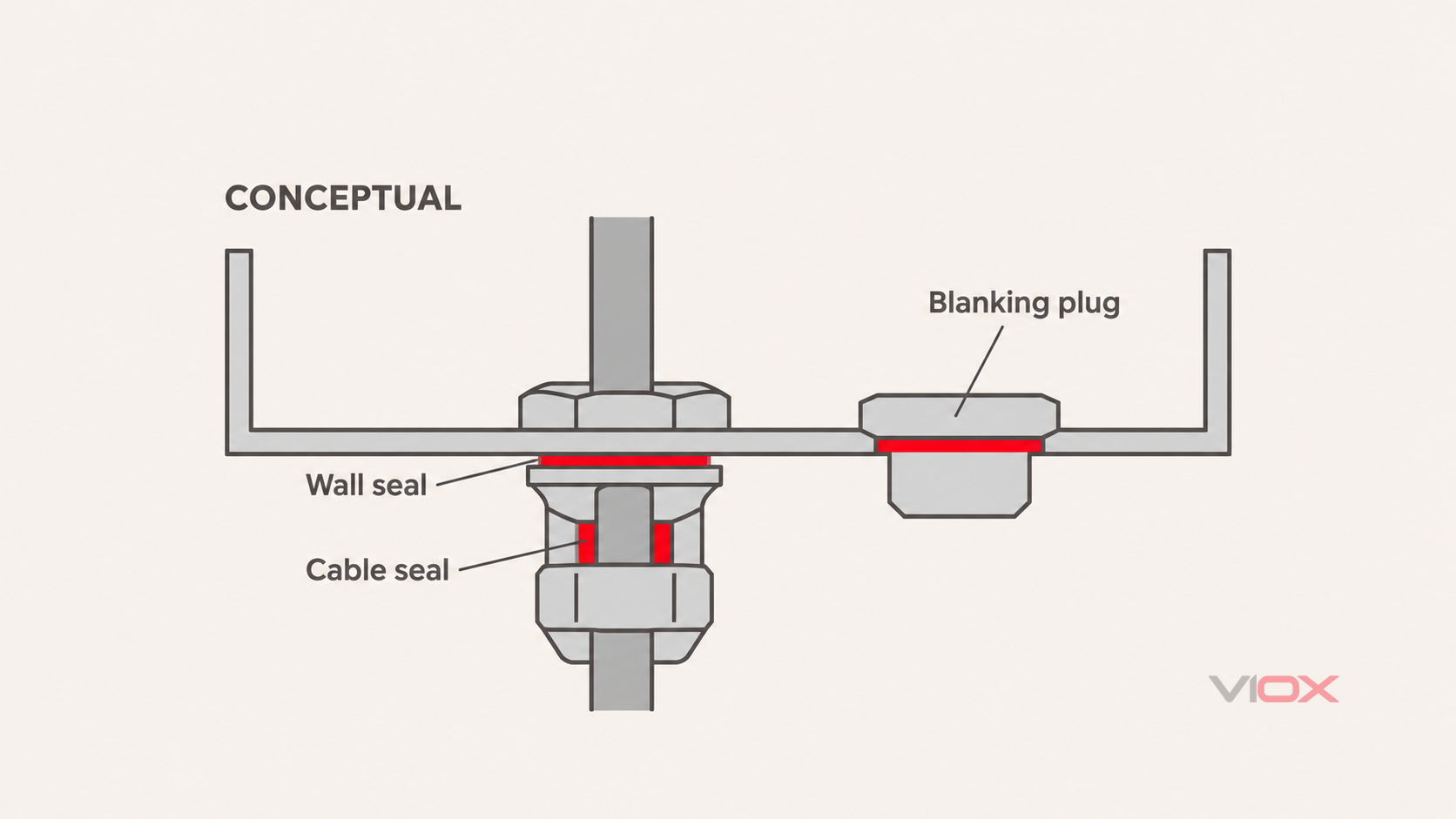
Check both seals at each cable entry
There are two different boundaries:
- Cable to gland: the insert seals against the actual cable sheath. Check the cable’s outside diameter, shape, sheath condition and the gland’s permitted clamping range. Several cables through one ordinary single-hole insert are not a substitute for a purpose-designed multi-cable seal.
- Gland to enclosure: the fitting must seal against the wall or entry plate using its specified interface. Thread engagement, wall thickness, flatness, washers or O-rings, and tightening instructions all matter. A locknut secures a fitting; it is not automatically a water seal.
Plan entry direction and cable support together. Approved bottom entries can reduce direct runoff exposure, but they do not eliminate water migration along a cable or through a conduit. Where appropriate, route external cable so water drips away before reaching the entry. Do not let cable weight or a tight bend continuously load the seal.
For gland types and component selection, see the watertight cable gland guide; the box specification should record the selected fitting and its approved interface.
Treat drilling as a controlled modification
Drilling a hole does not automatically invalidate every possible IP claim, but the original claim cannot simply be assumed to cover an arbitrary modification. Ask whether field entries are permitted, where they may be made, which fittings are approved, and who is responsible for confirming the finished protection.
An oversized or irregular hole, a damaged sealing land, cracked plastic or exposed metal at a cut edge can undermine the design. Use the manufacturer’s specified preparation and corrosion-protection method. Seal unused entries with approved blanking components; tape, packing material and improvised plugs do not establish an IP rating.
Include door and gasket aging in procurement
Check that the gasket is continuous where the design requires it, correctly seated and compressed by the specified closures. Dirt, trapped conductors, warped doors and damaged hinges can prevent a sound seal even when the gasket itself is intact.
Request seal compatibility with the actual temperature, sunlight and chemicals. Do not rank silicone, EPDM or another elastomer as universally best: formulation, profile and exposure matter. Ask about replacement gasket availability and inspection criteria for cracking, hardening, loss of resilience or permanent deformation. Use manufacturer-defined maintenance guidance and site conditions, not an invented universal replacement interval.
A Sealed Box Can Still Condense Water Inside
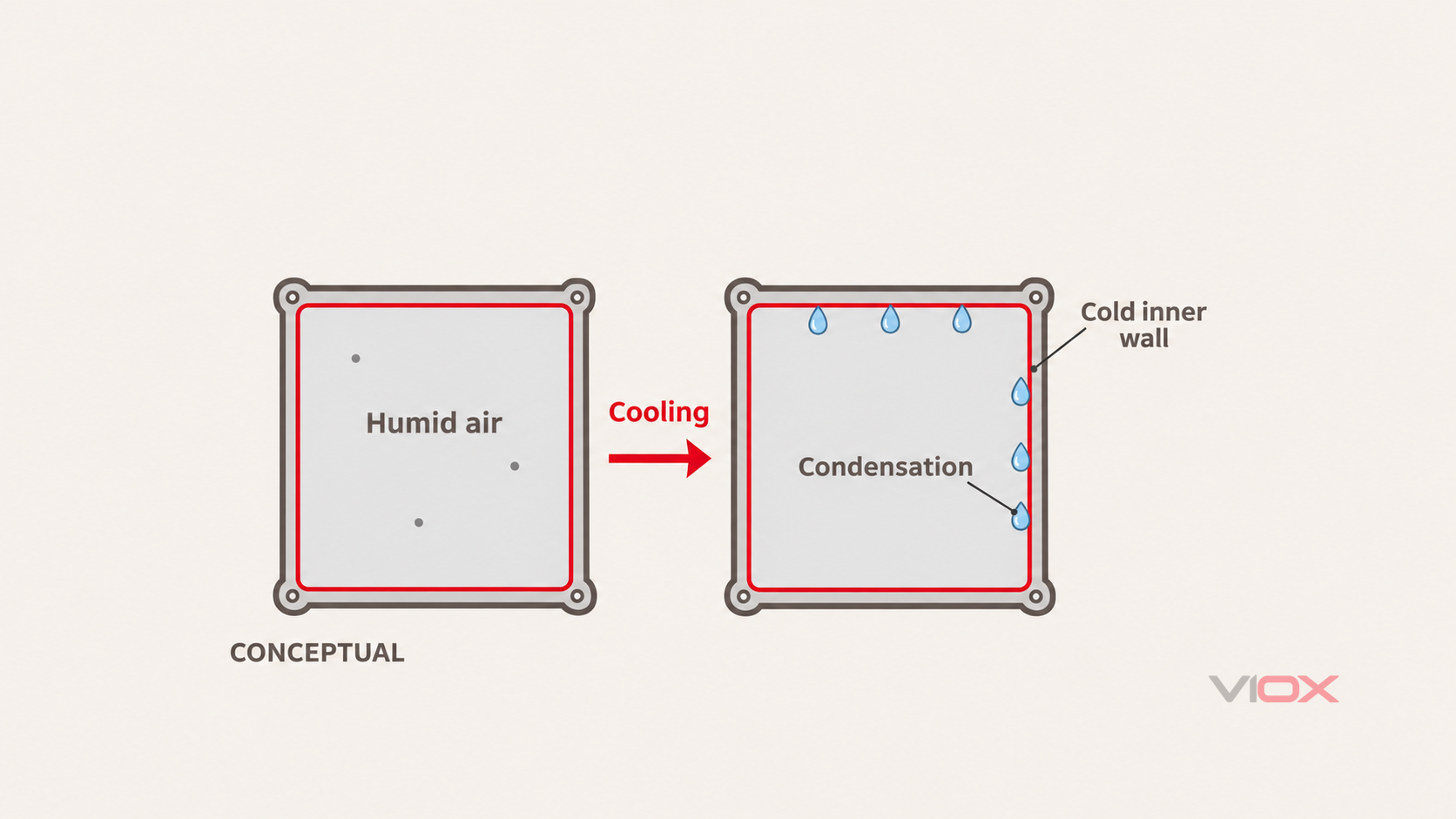
Condensation does not require visible rain leakage. Moist air may already be inside when the door is closed. When an internal surface cools to the air’s dew point, water can form on it—the same physical mechanism explained by the Met Office’s dew guidance.
Day-to-night cooling, a cold rain shower after solar heating, or equipment switching off can change conditions inside a box. Temperature changes can also drive pressure differences and air exchange through available paths. IP protection against external water does not mean the enclosure is hermetically sealed or contains dry air.
Before specifying a remedy, distinguish rain-entry evidence from condensation risk. Water tracks beneath a fitting suggest a leak path worth investigating; droplets on a cold inner surface suggest condensation, but neither observation alone proves the cause. Inspection must be performed safely with the equipment isolated as required.
Breathing, drainage and heating do different jobs
- Pressure-equalization vent: a manufacturer-approved membrane vent can provide a controlled air path while resisting liquid entry within its declared conditions. It is not a dehumidifier, cannot guarantee condensation-free operation and should not be assumed to provide useful cooling airflow.
- Drainage: an approved drain can release accumulated liquid at the intended low point. A membrane breather is not automatically a drain. Confirm orientation, obstruction risk and the protection of the completed enclosure with the drain installed.
- Controlled heating or dehumidification: where needed, a designed moisture-control system can address internal conditions. Check the control method, electrical safety, component clearances and added thermal load.
Do not drill an informal “drain hole” and continue calling the box IP65 or IP66. Specify the moisture-control arrangement with the enclosure supplier, including its effect on the final rating. Assemble under dry conditions where practicable, close unused entries and prevent conduits from becoming uncontrolled moisture paths.
Choose PC, ABS or Metal from the Exposure Evidence
Material names are only the beginning of a specification. Evaluate the complete housing, lid, window, seals and hardware.
| Material option | When to consider it | Evidence and limitations to check |
|---|---|---|
| Polycarbonate (PC) | A lightweight nonmetallic housing or viewing cover is useful | Exact outdoor-grade formulation, UV evidence, chemical compatibility and finished-enclosure IK; “PC” alone proves none of these |
| Acrylonitrile butadiene styrene (ABS) | A molded housing meets the project’s mechanical and environmental needs | Explicit outdoor suitability for the supplied grade and color; do not assume generic ABS tolerates sustained sunlight |
| Coated metal | A rigid housing and robust mounting arrangement are priorities | Coating system, cut-edge treatment, fasteners, corrosion exposure and protective-bonding provisions |
| Stainless steel or other specified metal | The site requires a documented material/finish response to corrosion | Exact alloy, finish, fabrication details, mating hardware and chemical exposure; “stainless” does not mean corrosion-proof |
For plastics, request weathering evidence for the supplied material and the finished product’s intended use. UL’s plastics recognition program treats outdoor suitability as a specific evaluation topic. A generic resin name or flammability designation is not proof of outdoor durability.
For coastal installations, inspect the whole material combination: a nonmetallic shell can still have vulnerable screws, brackets or glands. For metal boxes, preserve the required bonding arrangement. A plastic housing does not remove protective-earth requirements for the enclosed electrical system.
Check Temperature Rise Before Accepting the Sealed Configuration
A sealed distribution box still has to dissipate heat from its devices and connections. Direct sun adds another heat input. The ambient temperature outside the box is not necessarily the temperature around a breaker or terminal inside it.
Provide the assembler with the actual device schedule, simultaneous loading, duty, expected ambient range, solar exposure and mounting conditions. Request confirmation of permitted loading and any device or assembly derating for that configuration. IEC 61439-1 addresses assembly verification, including temperature rise; the relevant product part and manufacturer documentation must also be applied.
Do not apply a universal “outdoor derating percentage,” assume spare DIN modules prove thermal capacity, or treat a membrane vent as a cooling fan. A larger box, approved sunshield or engineered cooling arrangement may help, but each changes the design assumptions. Adding a fan opening or louvre requires a fresh check of ingress protection. An anti-condensation heater also belongs in the heat assessment.
Scenario Quick Reference
Ito ay mga candidate specification directions, not legal minima or guarantees. Confirm local rules and the exact assembly. The location name alone cannot determine the rating.
| Senaryo | Exposure-led starting point | What must accompany the rating |
|---|---|---|
| Garden outbuilding | IP54 for verified sheltered splash conditions; assess IP55/IP65 where jets or windblown dust matter | Roof leaks, irrigation, seasonal condensation, outdoor material suitability and safe mounting |
| Electric-vehicle (EV) supply board | Assess IP65 for exposed rain and dust; IP66 where powerful jets are credible | Long-duration loading, sunlight, user access, impact/vehicle protection and approved entries; this does not select the charger’s protection system |
| Photovoltaic (PV) installation | Assess IP65/IP66 from actual rain, dust and washing exposure | UV, solar heat, daily thermal cycling, cable support and assembly suitability for its AC or DC duty |
| Swimming-pool plant room | Select splash or jet protection from the cleaning process; assess IP65/IP66 where appropriate | Humidity, chemical compatibility, leak paths, placement and applicable pool electrical rules; a plant-room board is not underwater equipment |
| Coastal installation | Select IP65/IP66 where the dust/jet assessment supports it, plus a separate corrosion specification | Housing, glands, brackets, hinges, fasteners and gasket compatibility with salt exposure |
| Agricultural building | IP54 only where assessed dust/splash conditions permit; assess IP65/IP66 for dusty or washed areas | Fertilizers, ammonia or disinfectants, impact, rodents and moisture; hazardous dust or gas classification needs a separate assessment |
Where burial, flooding or immersion is part of the task, do not extend this rain-and-washdown table. Use the separate waterproof junction box IP68 guide for that topic, and obtain project-specific suitability evidence. An immersion-rated junction box is not automatically an appropriate distribution-board assembly.
RFQ Checklist Before Ordering
Send a request for quotation (RFQ) with the exposure description and require the supplier to identify what is included in the offer.
| RFQ item | Impormasyon na ibibigay o hihilingin |
|---|---|
| Site and exposure | Photos or drawing; shelter; rain/runoff; dust; washdown process; salt and chemicals; flood risk |
| Purchase boundary | Empty enclosure, equipped enclosure or verified complete distribution assembly; identify who owns final integration |
| Mga rating sa kapaligiran | Required IP and IK; exact model, tested configuration, mounting orientation and documentation |
| Housing and accessories | Body/lid/window materials, outdoor/UV suitability, finish, hardware and seal compatibility |
| Cable-entry schedule | Actual cable outside diameters and quantities, entry sides, fitting models, plugs, adapters and wall seals |
| Field modification | Approved entry zones, hole preparation, cut-edge treatment and responsibility for the finished rating |
| Moisture control | Expected humidity and temperature cycling; approved vents, drains or heating; final protection with accessories installed |
| Mga kondisyong thermal | Ambient and sun exposure, component losses/loading information, accepted layout and applicable derating evidence |
| Disenyong elektrikal | Reference the separate circuit and protection schedule; confirm assembly documentation and bonding provisions |
| Maintenance and acceptance | Closure/entry instructions, inspection criteria, replacement seals, approved parts list and supplied verification records |
Before acceptance, compare the delivered enclosure and accessory list with the configuration in the supporting documents. Record substitutions, additional holes and omitted seals for resolution before installation. A visual check is useful, but it is not a substitute for rating evidence or required commissioning verification.
Ang VIOX distribution-box range provides a starting point for product enquiries. Send the completed RFQ to [email protected], requesting model-specific documentation for the environmental and thermal conditions above. Range-level descriptions do not establish the rating of an individual proposed assembly.
FAQ
Is IP65 enough, or do I need IP66?
Choose from the water exposure: IP65 addresses water jets; IP66 addresses powerful water jets. For exposed rain without powerful jet exposure, a suitable IP65 assembly may be enough. Confirm the actual installation and cleaning conditions rather than upgrading solely because the box is outdoors.
Why does a sealed distribution box develop condensation?
Sealing does not remove moisture already inside. If an internal surface reaches the dew point, droplets can form. Check both leakage and temperature cycling, then specify an approved moisture-control arrangement; tightening the door alone may not resolve it.
Does drilling a hole invalidate the IP rating?
An undocumented opening can put the installation outside the assessed configuration. An approved field entry may preserve the intended protection when the correct fitting, preparation and installation conditions are followed. Obtain written instructions for the finished arrangement.
Which lasts longer outdoors: a plastic box or a metal box?
Neither material category has a universal lifespan advantage. Compare the exact plastic’s outdoor suitability or the metal’s alloy and finish, then check impact, chemicals, seals and hardware. The least durable exposed component can determine when the assembly needs repair.