Your HVAC died last summer. The pool pump burned out two months later. Then your smart home hub wouldn’t boot. Three repairs, $4,200 out of pocket, and the electrician finally said what you’d been missing: “You need surge protection at the panel, not just those power strips.”
Most homeowners assume that $30 surge protector strip under the TV is protecting the house. It’s not. It’s protecting six outlets. Your refrigerator, HVAC, well pump, garage door opener, and hardwired smart devices? Completely exposed.
Here’s the reality: whole house surge protectors (installed at your electrical panel) and power strip surge protectors (plugged into outlets) serve two different protection zones. Whole house SPDs defend your entire electrical system at the service entrance. Power strips guard only what’s plugged in. Neither replaces the other—and in many cases, you need both.
This guide explains what each type protects, how they work, what they cost (equipment + installation), and when you need one, the other, or a layered combination. If you’ve ever wondered whether that panel-mounted SPD is worth $500–1,000, or whether your power strips are enough, you’ll have the framework to decide by the end.
What Is a Whole House Surge Protector?
A whole house surge protector (technically a Type 1 or Type 2 Surge Protective Device, or SPD, under UL 1449) is a permanently installed device that mounts at or near your main electrical panel. Its job: intercept voltage spikes entering your home via utility lines before they reach branch circuits, outlets, or hardwired equipment.
When lightning strikes a transformer two blocks away, or the utility switches a capacitor bank, or your neighbor’s HVAC compressor kicks on, transient overvoltages propagate through the grid. A whole house SPD clamps these surges at the service entrance, limiting voltage spikes across your entire electrical system—every circuit, every outlet, every hardwired appliance.
What whole house SPDs protect:
- All branch circuits—kitchen, bedrooms, garage, basement. Every outlet benefits from panel-level clamping.
- Hardwired equipment—HVAC systems, well pumps, garage door openers, ceiling fans, electric water heaters, pool equipment. These can’t plug into a power strip, so panel-level protection is their only defense.
- ස්මාර්ට් නිවාස උපාංග—hardwired hubs, security panels, lighting controllers, doorbell transformers.
- 240V appliances—electric ranges, dryers, EV chargers, heat pumps.
තාක්ෂණික පිරිවිතර:
- සර්ජ් ධාරා ශ්රේණිගත කිරීම: 40 kA to 100 kA+ (much higher than point-of-use devices). This is the maximum surge current the SPD can divert without failure.
- Nominal discharge current (In): Typically 10 kA to 20 kA. The 2023 NEC requires In ≥ 10 kA for SPDs on dwelling services and certain feeders.
- Type classification (UL 1449 Ed.5):
- Type 1: Installed between the utility transformer and the service equipment overcurrent device (line side of main breaker), or on the load side. Includes meter-socket SPDs.
- 2 වර්ගය: Installed on the load side of service equipment (at main panels or sub-panels). Most common for residential retrofit.
- ස්ථාපනය: Requires a licensed electrician. Typically DIN-rail mounted inside the panel or wired to a dedicated breaker.
කේත අනුකූලතාව: The 2023 National Electrical Code (NEC) requires Type 1 or Type 2 SPDs on all dwelling-unit services, plus expanded requirements for certain feeders and occupancies (dorms, hospitals, guest rooms). If you’re building or upgrading a panel, a whole house SPD is no longer optional in most jurisdictions—it’s code.
Whole house SPDs address surges entering via the utility service. They don’t protect against surges entering through cable TV coax, phone lines, or antenna connections. For complete protection, use coax surge protectors at cable/satellite entry points and ensure proper grounding per NEC Article 810.
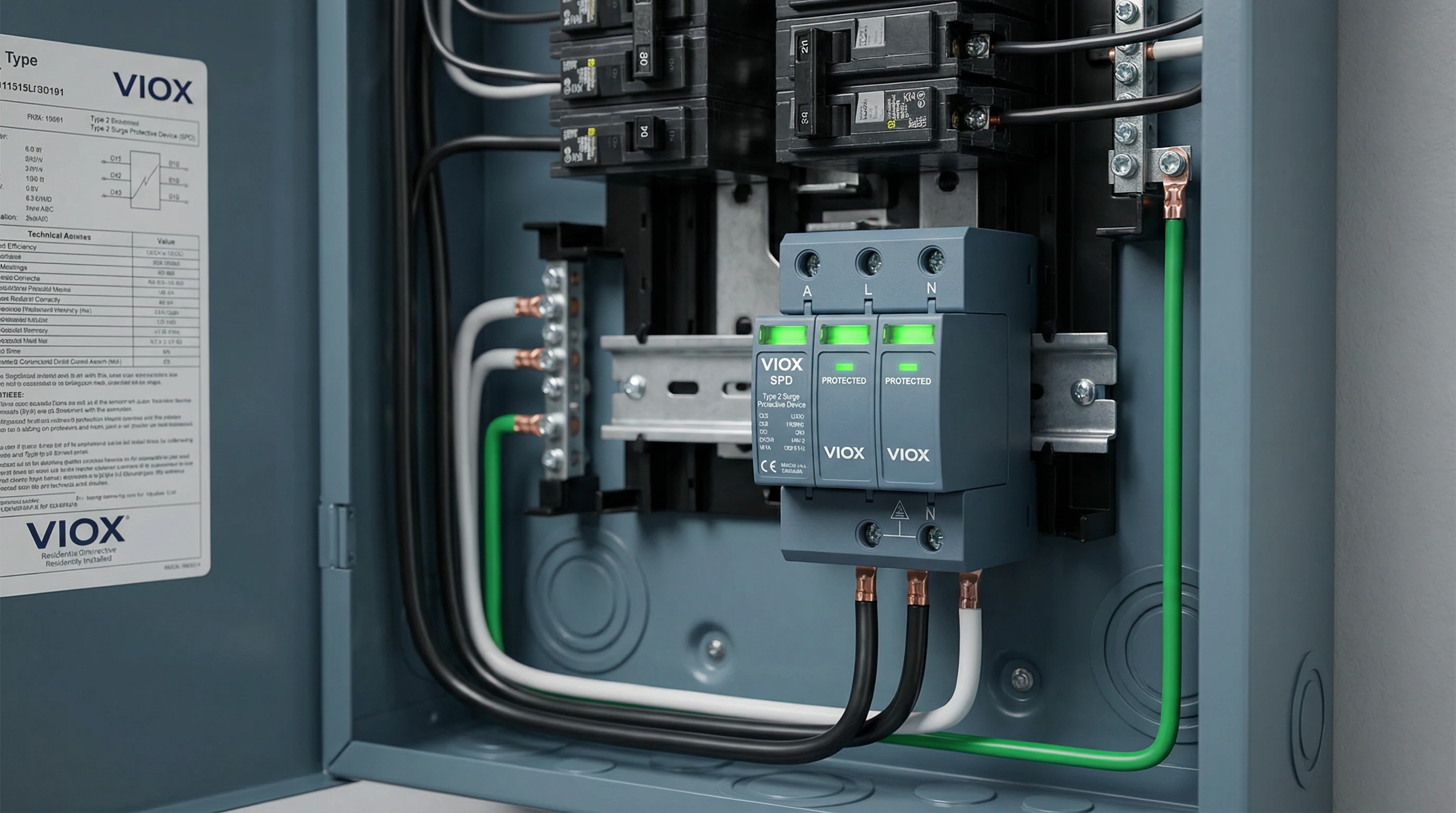
Figure 1: Professional Type 2 SPD installation at residential electrical panel. The device mounts on DIN rail with color-coded wiring (black-hot, white-neutral, green-ground) and includes LED status indicators showing MOV health. This panel-level installation protects all downstream circuits, hardwired appliances, and outlets throughout the home.
What Is a Power Strip Surge Protector?
A power strip surge protector (technically a 3 SPD වර්ගය under UL 1449) is a cord-connected, plug-in device that protects equipment at a single outlet location. You plug it into a wall receptacle, then plug your devices into its outlets. Internal components—typically metal-oxide varistors (MOVs)—clamp voltage spikes at the point of use, limiting the surge voltage your connected equipment sees.
Unlike whole house SPDs that protect at the service entrance, Type 3 devices operate at the endpoint. They’re the last line of defense for sensitive electronics: computers, TVs, routers, gaming consoles, audio equipment.
What power strip surge protectors protect:
- Devices plugged into the strip—desktop computers, monitors, routers, printers, TVs, gaming consoles, audio receivers.
- Against residual surges—even if you have a whole house SPD, some residual voltage can reach outlets. A point-of-use SPD provides a second stage of clamping for sensitive electronics.
What they do NOT protect:
- Other circuits or outlets—only the equipment plugged into that specific strip.
- Hardwired equipment—your HVAC, well pump, or garage door opener can’t plug into a strip.
- Other entry paths—they don’t protect against surges entering via cable TV coax, Ethernet, or phone lines unless the strip includes dedicated coax/Ethernet ports (some models do).
තාක්ෂණික පිරිවිතර:
- Joule rating: 300 to 3,000+ joules. This measures total energy absorption capacity before the MOVs degrade. Higher is better, but joules alone don’t tell the full story—clamping voltage and response time also matter.
- Clamping voltage (Voltage Protection Rating, or VPR): The threshold at which the SPD clamps the surge. Lower is better:
- 330V: Excellent protection (rare in consumer units).
- 400V: Good protection. Common in quality Type 3 SPDs.
- 500V විදුලි මෝටරය: Acceptable. Budget SPDs.
- 600V+: Marginal. Avoid for sensitive electronics.
- ප්රතිචාර කාලය: MOVs typically respond in < 1 nanosecond. Some hybrid designs include gas discharge tubes (GDTs) for high-energy coordination, but GDTs are slower (100+ ns).
- UL 1449 listing: Verify the package says “UL 1449” or shows the UL mark with “Surge Protective Device.” If it doesn’t, it’s not tested as an SPD—it’s just a power strip with a පරිපථ බිඳින්නන්.
The lifespan problem: MOVs degrade with each surge event. After enough surges—or one massive surge—they fail. Sometimes they fail open (no protection, but outlets still work and the green LED stays on). Sometimes they fail short and trigger the strip’s thermal fuse, shutting down the outlets. Replace surge protector strips every 3–5 years, or immediately after a known major surge event (nearby lightning strike, power outage with visible flicker/buzz). Many strips have a “protected” or “grounded” LED that goes dark when MOVs fail; if yours has one and it’s off, replace the strip immediately.
Pro-Tip: Never daisy-chain surge protector strips or plug one into another. It creates ground loop issues, exceeds load ratings, and violates UL listings. Plug SPDs directly into wall outlets.
Key Differences: Coverage, Protection Level & Installation
The fundamental difference between whole house and power strip surge protectors isn’t just where they install—it’s what they protect සහ how they fit into a protection strategy.
Protection Coverage
| මානය | Whole House SPD (Type 1/2) | Power Strip SPD (Type 3) |
| Installation location | At service entrance or main/sub-panel | At wall outlet (point of use) |
| Protection scope | Entire electrical system (all circuits, all outlets, hardwired equipment) | Only devices plugged into that strip |
| Hardwired equipment | ✓ Protected (HVAC, well pump, garage door, etc.) | ✗ Cannot protect |
| 240V appliances | ✓ Protected (range, dryer, EV charger) | ✗ Typically not (some strips offer 240V models, but rare) |
| Multiple rooms/circuits | ✓ All circuits protected | ✗ Only the outlet where strip is plugged in |
| Coax/phone line protection | ✗ No (separate devices needed) | Some models include coax/Ethernet/phone ports |
තාක්ෂණික කාර්ය සාධනය
| පිරිවිතර | Whole House SPD (Type 1/2) | Power Strip SPD (Type 3) |
| සර්ජ් ධාරා ශ්රේණිගත කිරීම | 40 kA to 100 kA+ | Typically 6 kA to 15 kA (lower) |
| Clamping/VPR | Varies; typically 600V–1,200V (higher let-through, but handles massive energy) | 330V–600V (tighter clamping for sensitive electronics) |
| ප්රතිචාර කාලය | < 1 ns (MOVs) or 100+ ns (GDTs in hybrid designs) | < 1 ns (MOVs) |
| Energy coordination | Designed to handle direct lightning-induced surges and utility transients | Designed for residual surges after whole-house clamping, or standalone use in low-risk areas |
| Lifespan/replacement | 10+ years typical (check status indicators annually) | 3–5 years (MOVs degrade faster in point-of-use applications) |
ස්ථාපන අවශ්යතා
Whole House SPD:
- Requires licensed electrician—installed inside electrical panel or adjacent enclosure.
- Permit and inspection may be required depending on jurisdiction.
- Permanent installation—hardwired or DIN-rail mounted.
- Typical install time: 1–2 hours for an experienced electrician.
Power Strip SPD:
- DIY-friendly—plug into any wall outlet.
- No permit or electrician required.
- Portable—move between rooms or take to a new home.
- Install time: 30 seconds.
When One Protects What the Other Doesn’t
Whole house SPDs protect hardwired equipment and all circuits. If a surge enters via the utility and you have only power strip SPDs at your computer desk and TV, your HVAC control board, well pump, garage door opener, and every other outlet in the house is unprotected. This is why whole house SPDs are now code-required for new construction and service upgrades under the 2023 NEC.
Power strip SPDs provide localized clamping with lower let-through voltage. Even with a whole house SPD, some residual voltage reaches your outlets. For sensitive electronics—computers with SSDs, home theater gear, network equipment—a point-of-use SPD with 400V VPR adds a second stage of protection that whole house SPDs (with higher clamping thresholds) don’t offer.
Whole house SPDs are broad but blunt. They handle high energy across the entire system but let through more voltage than sensitive electronics prefer. Power strip SPDs are narrow but precise. They clamp tightly at the device but protect only what’s plugged in. Neither replaces the other. In most scenarios—especially homes with valuable electronics and hardwired appliances—you need දෙකම.
In commercial or high-value residential settings, engineers specify coordinated SPD cascades: Type 1 or 2 at service, Type 2 at sub-panels, and Type 3 at sensitive equipment. Each stage reduces surge energy before the next. This is the “layered protection” strategy recommended by IEEE and NFPA.

Figure 2: Direct comparison between whole house SPD (Type 2, left) and power strip SPD (Type 3, right). Key differences include installation location (panel vs. outlet), protection scope (entire system vs. single location), surge current capacity (40-100kA vs. 6-15kA), and cost structure (professional installation required vs. DIY plug-in). Neither replaces the other—most homes benefit from both.
Cost Comparison: Equipment & Installation
Protection has a price. Here’s what whole house and power strip surge protectors actually cost, including equipment, installation, and long-term replacement.
Whole House SPD Costs
Equipment (Type 2 SPD for typical residential retrofit):
- Budget models: $75–150 (20 kA to 40 kA surge rating, basic status indicator)
- Mid-range models: $150–300 (40 kA to 65 kA, LED status, replaceable MOV modules)
- Premium models: $300–600+ (80 kA to 100 kA+, remote monitoring, surge counters, hybrid MOV+GDT designs)
Installation (licensed electrician required):
- Labor: $150–400 depending on panel accessibility, local labor rates, and whether a new breaker is needed.
- Permit/inspection: $50–150 in jurisdictions that require it.
- Total installed cost: $300–1,000 for most residential installations.
Replacement/maintenance:
- Most Type 2 SPDs last 10+ years. Premium models with replaceable MOV modules let you swap components without replacing the entire unit ($50–150 per module).
- Check the status LED annually. If it indicates failure, replace immediately.
Scenario: A homeowner in Florida (high lightning risk) installs a mid-range 50 kA Type 2 SPD. Equipment: $250. Electrician labor: $300. Permit: $75. Total: $625. Over 10 years, that’s $62.50/year for whole-house protection.
Power Strip SPD Costs
Equipment (Type 3 SPD, typical 6-outlet strip):
- Budget models: $10–25 (300–900 joules, 500–600V VPR, basic or no status indicator)
- Mid-range models: $25–60 (1,000–2,000 joules, 400–500V VPR, “protected” LED, USB charging ports)
- Premium models: $60–150+ (2,000–3,000+ joules, 330–400V VPR, coax/Ethernet protection, replaceable fuses, remote outlets)
ස්ථාපනය:
- DIY: Plug it in. $0 labor.
ආදේශනය:
- Every 3–5 years, or after major surge events. If you buy a $40 strip and replace it every 4 years, that’s $10/year per strip.
Scenario: A homeowner protects 3 locations (home office, entertainment center, network closet) with mid-range strips at $40 each. Upfront: $120. Over 4 years before replacement: $30/year total, or $10/year per location.
Combined Protection: Layered Strategy Cost
Most homes benefit from දෙකම whole house and point-of-use protection. Here’s what that looks like:
Initial investment:
- Whole house SPD: $625 (equipment + installation)
- 3–4 power strip SPDs for sensitive equipment: $120–160
- Total upfront: $745–785
Ongoing costs (per year, averaged):
- Whole house SPD amortized over 10 years: $62.50/year
- Power strip replacements (4 strips every 4 years): $40/year
- Total annual: ~$100/year for comprehensive home protection
Cost vs. Risk: The Break-Even Calculation
A single HVAC control board replacement: $300–800. A well pump motor: $500–1,200. A desktop computer with data loss: $1,000+ in hardware and recovery. A home theater receiver: $400–1,500. One major surge event can cost more than 5–10 years of full surge protection.
If you live in a high-risk area (frequent lightning, rural overhead lines, unstable utility) and your home contains $5,000+ of electronics and appliances, the payback period for a $750 layered protection system is a single avoided failure.
Some homeowner’s insurance policies offer discounts (5–10%) for whole-house surge protection. Check with your carrier—the annual savings may cover your power strip replacements.
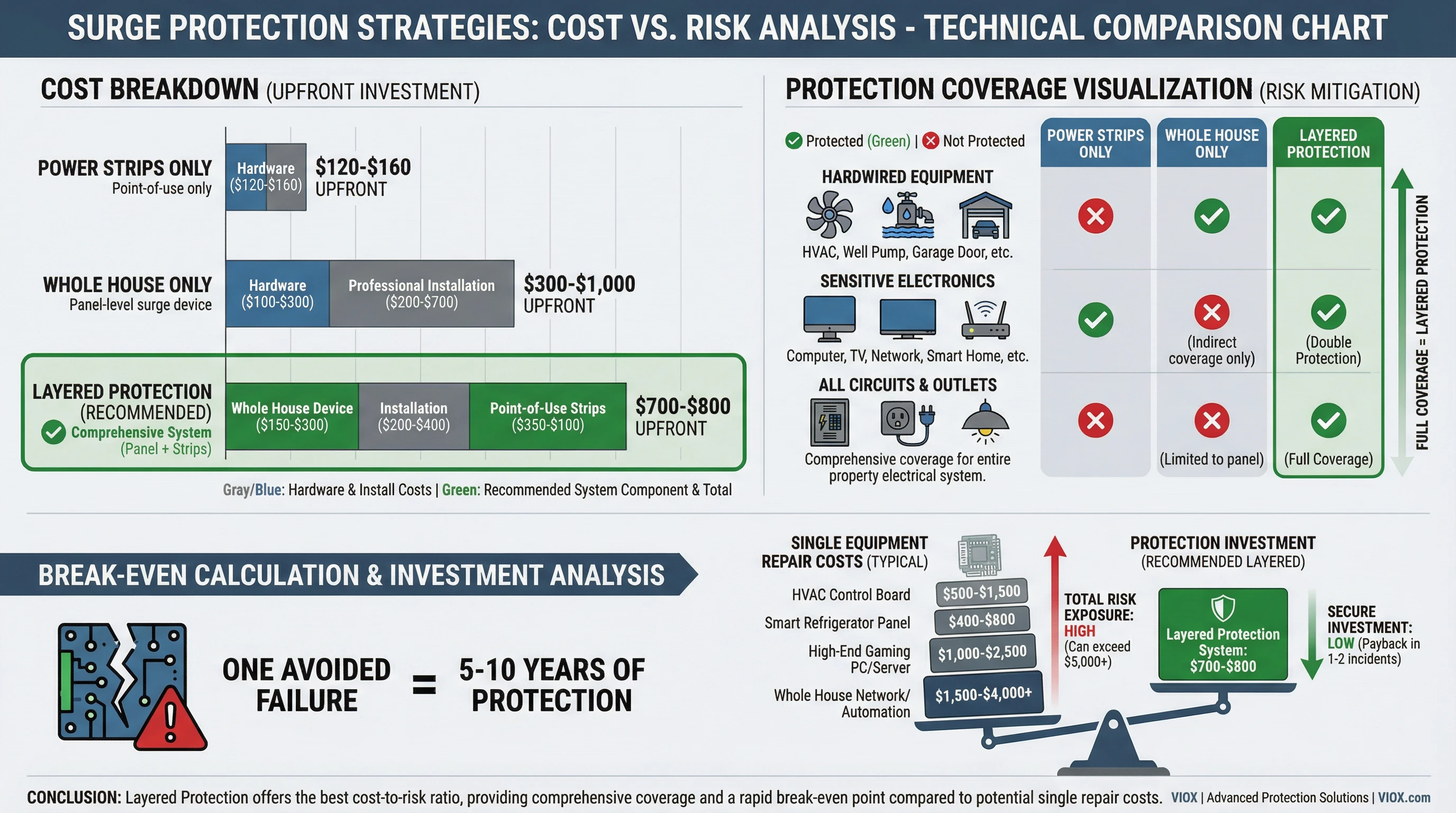
Figure 3: Cost-benefit analysis comparing three surge protection strategies. Layered protection (whole house + power strips, $700-800 upfront) provides comprehensive coverage for all equipment types. The break-even point is a single avoided equipment failure—one HVAC board replacement or computer with data loss exceeds the cost of 5-10 years of full protection.
When to Use Each (or Both)
Not every home needs whole-house protection, and not every device needs a power strip SPD. Here’s a risk-based decision framework.
Use Whole House SPD (Required or Strongly Recommended)
Code-required scenarios (2023 NEC):
- New construction or service upgrades on dwelling units
- Certain feeders and occupancies (dorms, hospitals, guest rooms)
- Any scenario where your local jurisdiction enforces NEC 2023 surge protection requirements
Strongly recommended (high-risk or high-value):
- High lightning frequency: You live in Florida, the Gulf Coast, mountain regions, or anywhere with 25+ thunderstorm days per year.
- Rural overhead power lines: Your utility service enters via above-ground lines (not underground). Overhead lines are far more vulnerable to lightning-induced surges.
- Hardwired equipment you can’t afford to replace: HVAC systems ($3,000–10,000+), well pumps ($800–2,500), solar inverters ($1,500–5,000), EV chargers ($500–2,000).
- History of surge damage: You’ve already lost equipment to surges in the past.
- Whole-home automation or security systems: Hardwired hubs, sensors, and control panels that can’t plug into power strips.
Use Power Strip SPD (Point-of-Use Protection)
අත්යවශ්ය:
- High-value electronics: Desktop computers ($800+), workstations, gaming PCs, home theater receivers ($400+), 4K/8K TVs, audio equipment.
- Data-critical devices: Computers with irreplaceable files, NAS/RAID arrays, servers, point-of-sale systems.
- Sensitive network equipment: Routers, switches, modems, Wi-Fi access points. Even brief surges can corrupt firmware.
- Multiple devices at one location: Home office setups (computer + monitor + printer + router), entertainment centers (TV + receiver + gaming console + streaming box).
Skip power strip SPDs for:
- Low-value, non-electronic loads: lamps, fans, coffee makers.
- Devices with internal surge protection: Most modern phone/tablet chargers include basic MOV filtering.
- Resistive heating appliances (but watch load limits): Toasters, space heaters—but never plug high-draw appliances (1,200W+) into strips. Run them directly from wall outlets.
Use Both (Layered Protection)
This is the recommended best practice for most homes, especially those with:
- A mix of hardwired equipment (HVAC, well pump) සහ sensitive plug-in electronics (computers, home theater).
- High-value equipment throughout the home ($5,000+ total replacement cost).
- Geographic or utility risk factors (lightning-prone area, overhead lines, unstable grid).
Why layered protection works:
- The whole house SPD clamps the massive energy surge at the service entrance (40 kA to 100 kA capacity).
- Residual voltage (reduced but not eliminated) reaches your outlets.
- The power strip SPD at your desk or entertainment center clamps that residual surge with tighter voltage limits (400V VPR vs. 1,000V+ at the panel).
- Your sensitive electronics see minimal voltage stress, while your hardwired equipment (HVAC, etc.) is also protected by the panel-level device.
Scenario 1: Homeowner in suburban Ohio (moderate lightning risk, underground utility service, $8,000 in electronics and appliances). Recommendation: Whole house SPD (code-required for new construction, recommended for high equipment value) + power strip SPDs at computer desk and entertainment center.
Scenario 2: Apartment renter in urban area (low lightning risk, no control over electrical panel). Recommendation: Power strip SPDs only, at all valuable electronics. No whole-house option available without landlord consent.
Scenario 3: Rural homeowner in Florida (very high lightning risk, overhead power lines, $15,000+ in appliances, solar system, EV charger). Recommendation: Premium whole house SPD (80 kA+, hybrid MOV+GDT) + power strip SPDs at every sensitive device + coax surge protectors at cable/antenna entry.
If you install a whole house SPD, don’t assume power strips are unnecessary. Whole house SPDs have higher clamping voltages (letting through more voltage) because they’re designed to handle enormous energy. Sensitive electronics still benefit from the tighter clamping (330–400V VPR) that point-of-use SPDs provide.
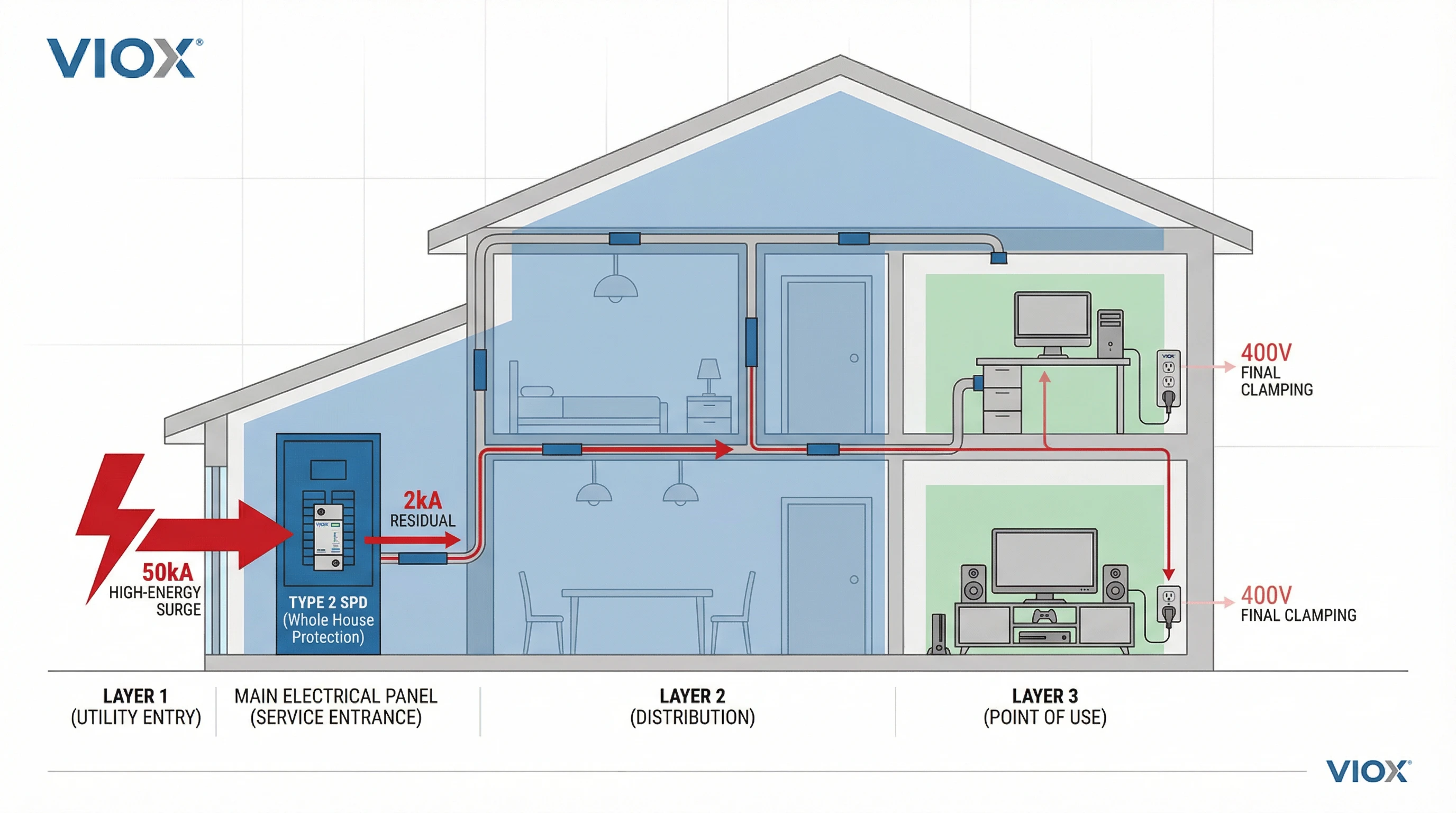
Figure 4: Three-stage layered protection strategy in a residential installation. Stage 1 (blue zone): Type 2 SPD at service entrance clamps 50kA surge to 2kA residual, protecting entire home. Stage 2: Building wiring distributes power to all circuits. Stage 3 (green zones): Type 3 SPDs at sensitive equipment (home office, entertainment center) further clamp residual surge to 400V, ensuring minimal voltage stress on electronics. This coordinated cascade approach is recommended by IEEE, NFPA, and IEC standards.
The Layered Protection Strategy: How Type 1, 2 & 3 SPDs Work Together
In electrical engineering, coordinated surge protection means installing SPDs at multiple points in your electrical system so that each device handles a portion of the surge energy, with later stages facing progressively smaller residual surges. This “cascade” approach is recommended by IEEE, NFPA, and IEC standards for high-value or critical installations.
The Three-Stage Model
Stage 1: Service Entrance (Type 1 or Type 2 SPD at main panel)
- ස්ථානය: At the utility service entrance, either line-side (Type 1, before main breaker) or load-side (Type 2, after main breaker, most common for residential).
- කාර්යය: Intercepts high-energy surges entering via utility lines. Clamps massive transients (40 kA to 100 kA+) before they propagate into the building’s wiring.
- Let-through voltage: Typically 600V to 1,200V (higher clamping threshold to handle extreme energy).
- ආරක්ෂා කරයි.: All downstream circuits, all hardwired equipment, all outlets.
Stage 2: Sub-Panels or Branch Distribution (Type 2 SPD, optional in residential, common in commercial)
- ස්ථානය: At sub-panels serving remote areas (detached garage, workshop, barn) or high-value zones (data center, lab).
- කාර්යය: Clamps residual surges that passed through the Stage 1 SPD, or surges induced locally within the building’s wiring.
- Let-through voltage: 400V to 800V (tighter than Stage 1).
- ආරක්ෂා කරයි.: All circuits downstream of that sub-panel.
Stage 3: Point of Use (Type 3 SPD, power strip or receptacle)
- ස්ථානය: At the outlet where sensitive equipment plugs in.
- කාර්යය: Final clamping stage. Reduces residual voltage to levels sensitive electronics can tolerate.
- Let-through voltage: 330V to 500V (tightest clamping).
- ආරක්ෂා කරයි.: Only the devices plugged into that SPD.
Why Cascading Works: Energy Sharing
Imagine a 50 kA lightning-induced surge entering your service. If only a Type 3 SPD (rated for 6 kA to 15 kA) stood between that surge and your computer, it would fail instantly—vaporized MOVs, melted housing, and your computer likely damaged anyway.
With layered protection:
- එම Type 1/2 SPD at the panel handles the bulk of the energy (let’s say it clamps 48 kA and lets through 2 kA at 800V).
- එම Type 3 SPD at your desk sees that much-reduced 2 kA surge and clamps it to 400V.
- Your computer’s power supply sees 400V (which it can handle briefly) instead of 6,000V+ (instant death).
Each stage operates within its design limits. No single device is overwhelmed.
Coordination Distance: The 10-Meter Rule
UL 1449 specifies that Type 3 SPDs should be installed at least 10 meters (30 feet) of conductor length from the service panel to the point of use. This distance provides impedance (resistance in the wiring) that helps coordinate the surge response between panel-level and point-of-use SPDs. If you plug a Type 3 SPD into an outlet 5 feet from the panel, the two SPDs may not coordinate properly, and one could fail prematurely.
Practical note: Most homes easily meet this rule—your computer desk or entertainment center is typically 30+ feet of wiring away from the panel once you account for routing through walls, up floors, etc.
Real-World Layered Protection Example
Scenario: A homeowner in a rural area (high lightning risk, overhead power lines) installs:
- Type 2 SPD at main panel (80 kA, $300 equipment + $300 install)
- Power strip SPD at home office (2,000 joules, 400V VPR, $40)
- Power strip SPD at entertainment center (1,500 joules, 500V VPR, $35)
- Coax surge protector at cable entry ($25)
Total upfront: $700.
A lightning strike hits a nearby transformer. The 60 kA surge enters via the utility service. The panel SPD clamps it to 1 kA residual. The home office power strip SPD further clamps to 400V. The computer sees a brief 400V spike—well within tolerance. The HVAC, protected only by the panel SPD, sees ~800V—also within its design margin. Nothing fails. The $700 investment just saved $10,000+ in equipment.
Pro-Tip: In commercial settings or high-value residential installations, engineers specify SPD coordination studies to ensure devices at each stage are sized and placed correctly. For typical homes, the simple rule is: panel-level Type 2 SPD + point-of-use Type 3 SPDs at sensitive equipment = adequate coordination.
Decision Matrix: Which Protection Do You Need?
Use this matrix to identify your protection strategy based on your situation.
| Your Situation | Whole House SPD? | Power Strip SPDs? | Priority |
| New construction or major electrical upgrade | අවශ්යයි (2023 NEC) | Recommended at sensitive equipment | Code compliance first, then layered protection |
| High lightning area (FL, Gulf Coast, mountains) + overhead power lines | Essential | Essential at all valuable electronics | Both—highest risk scenario |
| Suburban/moderate risk + underground utility + $5,000+ equipment | Strongly recommended | Essential at computers, home theater, network gear | Layered protection |
| Urban/low lightning risk + renter (no panel access) | කළ නොහැකියි | Essential at all valuable equipment | Power strips only |
| Hardwired high-value equipment (HVAC, well pump, solar, EV charger) | Essential (only way to protect) | Optional (for plug-in devices) | Whole house SPD priority |
| Sensitive electronics only (computers, home theater) + low lightning risk | Optional (good to have) | Essential | Power strips first, consider whole house later |
| Budget-constrained but high-risk area | Essential (protect the whole system first) | Add gradually as budget allows | Whole house SPD first |
| Commercial/light industrial facility | අවශ්යයි (Type 1 or 2 per code) | අවශ්යයි at data equipment, control systems | Both—consult engineer for coordination study |
Quick Decision Tree
Start here: Do you own your home or have control over the electrical panel?
- නෑ (renter, condo with no panel access) → Power strip SPDs only. Protect every device worth more than $200. Replace strips every 3–5 years.
- ඔව් → Continue.
Is your home in a high-lightning area, or do you have overhead power lines?
- ඔව් → Whole house SPD is essential. Add power strip SPDs at sensitive electronics for layered protection.
- No or unsure → Continue.
Do you have hardwired equipment worth $3,000+ (HVAC, well pump, solar, EV charger)?
- ඔව් → Whole house SPD is essential (only way to protect hardwired equipment). Add power strips at plug-in electronics.
- නෑ → Continue.
Do you have plug-in electronics worth $5,000+ total (computers, TVs, home theater, network gear)?
- ඔව් → Power strip SPDs are essential. Whole house SPD is recommended for complete protection, but power strips are your priority if budget is limited.
- නෑ → Low-priority scenario. Consider basic power strip SPDs ($20–40) at your most valuable devices. Whole house SPD is optional unless code-required for new construction.
If you’re planning an electrical panel upgrade in the next 1–2 years, wait and install a whole house SPD during that project (you’ll already have an electrician and permit). In the meantime, use power strip SPDs for immediate protection.
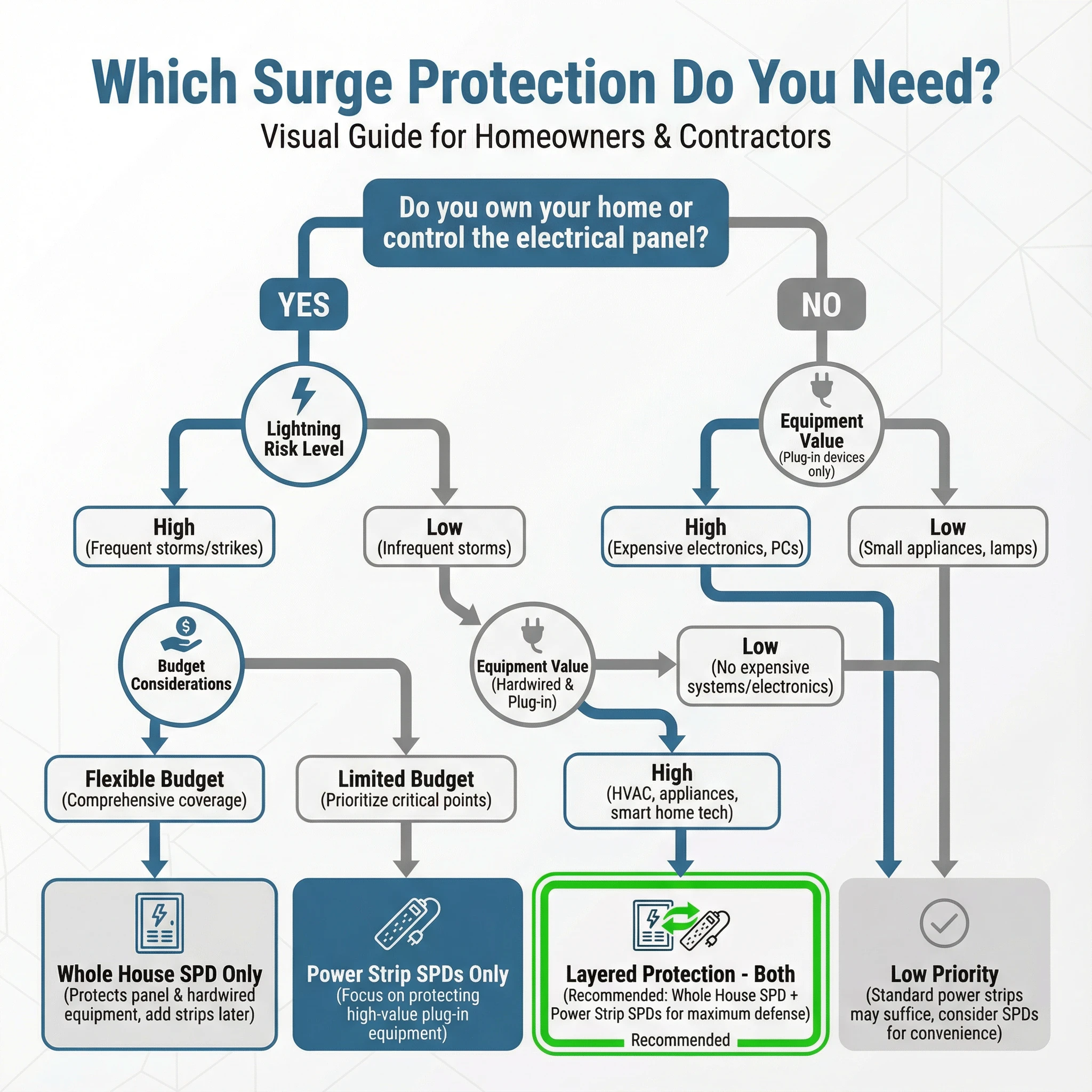
Figure 5: Decision flowchart for surge protection specification. Start by determining panel access (homeowner vs. renter), then evaluate lightning risk, equipment value, and budget. Most scenarios lead to layered protection (whole house + point-of-use SPDs) as the recommended strategy, balancing comprehensive coverage with cost-effectiveness. Use this flowchart to identify your protection priority based on geographic, equipment, and access factors.
VIOX Whole House & Point-of-Use Surge Protection Solutions
At VIOX, we engineer surge protective devices to UL 1449 and IEC 61643-11 standards for residential, commercial, and industrial applications. Our SPD portfolio is designed for engineers, contractors, and facility managers who demand transparency, repeatability, and compliance.
Whole House SPD Solutions (Type 1 & Type 2)
VIOX Type 2 SPDs for Main Panels and Sub-Panels:
- DIN-rail mount for fast, code-compliant installation in residential and commercial panels
- Surge current ratings: 40 kA to 100 kA (8/20 µs waveform per UL 1449)
- Nominal discharge current (In): 10 kA, 15 kA, 20 kA options (meets NEC 2023 In ≥ 10 kA requirement)
- Hybrid MOV+GDT designs for high-energy coordination and extended service life
- Clear protection status indication: Separate LED for MOV health (you know when it’s time to replace, not after equipment fails)
- Remote monitoring options: Dry-contact outputs for integration into building management systems (BMS) or home automation platforms
What sets VIOX SPDs apart:
No vague “joule” marketing. Every VIOX datasheet provides complete test data: measured Voltage Protection Rating (VPR), maximum discharge current (Imax), nominal discharge current (In), temporary overvoltage (TOV) withstand, and short-circuit current rating (ISCCR). If you’re specifying protection for a $50,000 HVAC system or a $20,000 solar array, you need numbers you can verify, not claims you have to trust.
Point-of-Use SPD Solutions (Type 3)
VIOX offers Type 3 SPDs for equipment racks, control cabinets, and sensitive electronics installations:
- Rack-mount SPDs with multiple outlet zones for data centers and server rooms
- Compact DIN-rail Type 3 units for control cabinets and industrial automation equipment
- Verified VPR ratings (330V, 400V, 500V options depending on application)
- Replaceable MOV modules in premium units (extend product life, reduce waste)
Coordination and Layered Protection
VIOX SPDs are designed to coordinate across installation levels. Specify a VIOX Type 2 at your main panel and VIOX Type 3 units at sensitive loads, and you’ll have engineered cascade protection with documented let-through voltage at each stage. For commercial projects requiring formal SPD coordination studies, our technical team provides application support and system design review.
Explore VIOX Surge Protection Solutions → [Contact our technical team for datasheets, application notes, and project-specific recommendations]
When specifying SPDs for new construction, panel upgrades, or facility protection, always request complete test data per UL 1449: VPR, In, Imax, TOV rating, and ISCCR. If the manufacturer won’t provide it, specify a different product. Your equipment’s survival depends on verified performance, not marketing claims.
Final Takeaways
Whole house surge protectors (Type 1/Type 2 SPDs) and power strip surge protectors (Type 3 SPDs) serve different protection zones. One guards your entire electrical system at the service entrance. The other protects individual devices at the point of use. Neither replaces the other, and in most scenarios—especially homes with valuable electronics and hardwired appliances—you need දෙකම.
Whole house SPDs protect what power strips can’t: Hardwired HVAC, well pumps, garage door openers, 240V appliances, solar inverters, EV chargers, and every circuit in your home. They’re now code-required under the 2023 NEC for new construction and service upgrades. Installed cost: $300–1,000. Lifespan: 10+ years.
Power strip SPDs protect sensitive electronics with tighter clamping: Even with a whole house SPD, residual voltage reaches your outlets. A point-of-use SPD with 330–400V VPR adds a second stage of protection for computers, TVs, home theater gear, and network equipment—devices that can’t tolerate the higher let-through voltage (600V–1,200V) of panel-level SPDs. Cost: $10–150 per strip. Lifespan: 3–5 years.
The layered protection strategy combines both: Install a Type 2 SPD at your main panel to handle massive surge energy (40 kA to 100 kA+) and protect all circuits. Add Type 3 SPDs at sensitive equipment for tight clamping (330–500V VPR). This coordinated cascade approach is recommended by IEEE, NFPA, and IEC for high-value installations. Total upfront cost for typical residential layered protection: $700–800. Annual cost (amortized): ~$100.
The break-even calculation is simple: A single HVAC control board, well pump, or computer with data loss costs more than 5–10 years of full surge protection. If you live in a high-risk area (frequent lightning, overhead power lines) or have $5,000+ in equipment, the payback period is one avoided failure.
Action steps:
- If you’re building or upgrading your panel: Install a whole house SPD now. It’s code-required in most jurisdictions and costs less when combined with other electrical work.
- If you’re a homeowner with high-value equipment: Install a whole house SPD ($300–1,000 with electrician) + power strip SPDs at sensitive electronics ($40–150 total).
- If you’re a renter or can’t access the panel: Install power strip SPDs at every device worth more than $200. Replace every 3–5 years or after major surge events.
- If you’re in a high-lightning area (Florida, Gulf Coast, mountains) or have overhead power lines: Layered protection is essential, not optional. Budget for both whole house and point-of-use SPDs.
Never assume protection is working: Check status LEDs annually on both whole house and power strip SPDs. Many strips show a green “power” LED even when MOVs have failed. Look for a dedicated “protected” or “grounded” LED. If it’s off, replace immediately.
That $700 investment in a whole house SPD + power strips can save you $10,000+ in equipment and days of lost productivity. Choose wisely, install correctly, and replace proactively. Your electronics—and your budget—will thank you.