A Lējuma korpusa slēdžiem (MCCB) is an industrial-grade electrical protection device that automatically interrupts circuits during overcurrent, short circuit, and ground fault conditions, handling 15A to 2,500A with breaking capacities up to 200kA—protecting equipment and facilities from catastrophic electrical failures.
2:47 AM. Your data center’s main distribution panel explodes in a flash of plasma that melts the door handle. When the fire marshal arrives, they pull the failed MCCB from the wreckage—a 65kA-rated unit that faced an 85kA fault. The device didn’t protect your facility; it became the hazard. The investigation reveals what every electrical engineer should know but many ignore: Breaking capacity isn’t a suggestion—it’s the line between protection and destruction.
Kāpēc MCCB ir svarīgi: They sit on a critical rung of the “Protection Ladder”—the progression from residential MCBs (up to 100A) through commercial/industrial MCCBs (15A-2,500A) to utility-scale ACBs (800A-6,300A). Understanding when to climb to the next rung, and how to select the right MCCB for your specific application, is essential for electrical system safety, equipment protection, and operational reliability. As of November 2025, the updated IEC 60947-2:2024 standard introduces significant technical revisions, while the global MCCB market reaches $9.48 billion with smart MCCBs growing at 15% annually—the “Smart Protection Revolution” is transforming how industrial facilities manage electrical safety.
Ar ko MCCB atšķiras no standarta ķēdes pārtraucējiem?


VIOX VMM3 Series MCCB – Industrial-grade protection for commercial and industrial applications
Here’s the fundamental difference: MCCBs are built for the electrical conditions that destroy standard breakers. When you move from a 100A residential panel to a 400A industrial distribution system, you’re not just scaling up—you’re entering an entirely different fault current regime.
| Funkcija | MCB (Standard Breaker) | MCCB (Molded Case Breaker) |
|---|---|---|
| Pašreizējais vērtējums | 0.5A – 100A | 15A – 2,500A |
| Pārrāvuma jauda | 6kA – 25kA | 25kA – 200kA |
| Būvniecība | Basic thermoplastic housing | Reinforced molded case with arc containment |
| Ceļojuma mehānismi | Fiksētā termomagnētiskā | Thermal-magnetic OR electronic with programmable settings |
| Pieteikumi | Dzīvojamās ēkas, vieglās komerctelpas | Industrial, heavy commercial, data centers, utilities |
| Regulējamība | None or very limited | Highly adjustable trip settings (electronic models) |
| Monitoring Capabilities | Neviens | Smart models: real-time monitoring, predictive maintenance, IoT connectivity |
| Typical Price Range | $15 – $150 | $100 – $5,000+ |
| Standarti | IEC 60898 / UL 489 | IEC 60947-2:2024 / UL 489 |
That 10-20x higher breaking capacity isn’t marketing exaggeration—it’s the difference between a controlled interruption and an explosive failure. The available fault current in industrial facilities routinely exceeds 50kA, especially near utility transformers or large backup generators. Standard MCBs physically cannot interrupt these currents; they’ll either weld shut or explode. MCCBs are engineered with reinforced arc chutes, heavy-duty contacts, and sophisticated trip mechanisms specifically to handle these extreme conditions.
🔧 Eksperta padoms: Always verify fault current calculations before selecting any protective device. The “Breaking Capacity Gap”—where your available fault current exceeds the device’s interrupting rating—creates liability, not protection. Add a 25% safety margin for future system changes and always round up to the next standard rating.
Kā darbojas MCCB un kā tie nodrošina aizsardzību?
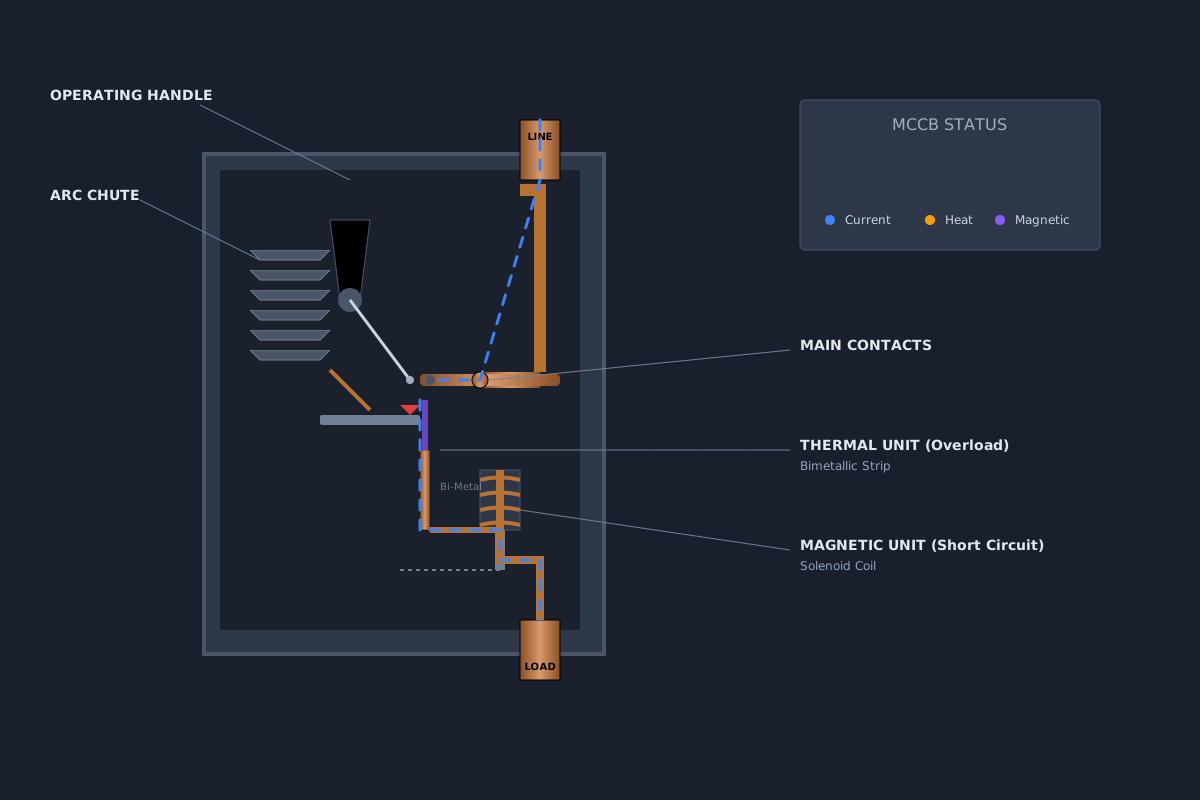
Understanding MCCB protection requires seeing what happens in the first 100 milliseconds after a fault. Here’s the sequence:
t = 0ms: Short circuit occurs—perhaps a wayward drill bit punctures a cable, or insulation finally fails after years of thermal cycling. Current begins rising exponentially.
t = 1-3ms (Magnetic Protection): If this is a hard short circuit (20-50x rated current), the MCCB’s electromagnetic coil detects the surge. A massive magnetic field pulls the trip bar, mechanically forcing the contacts open. This instantaneous trip happens in 16-50 milliseconds—faster than you can blink. Electronic trip units respond even faster: 1-2 milliseconds.
t = 3-50ms (Arc Extinction): When contacts separate under load, you’ve created a sustained electrical arc—essentially 16,000°C plasma conducting thousands of amperes. This is where MCCBs earn their rating. The arc chute system—a series of steel plates—splits the arc into multiple smaller arcs, lengthening the path, cooling the plasma, and finally extinguishing it. Advanced MCCBs use SF6 gas or vacuum chambers for even faster arc extinction.
t = 50-100ms (Overload Protection – Thermal): For lower-level overcurrent (120-800% of rated current), thermal protection takes over. A bimetallic strip heats up as current flows through it. When it reaches threshold temperature, it bends enough to trip the mechanism. This inverse-time characteristic is critical: a 20% overload might trip in 60 seconds, giving motors time to start, while a 300% overload trips in under 5 seconds.
The internal architecture

Figure 1: MCCB internal structure showing thermal-magnetic protection (bimetallic element), magnetic protection (electromagnetic coil), arc extinction system (arc chute), and switching mechanism. Each component plays a critical role in safely interrupting fault currents up to 200kA.
The diagram above reveals why MCCBs cost significantly more than standard breakers. You’re looking at:
1. Thermal Protection System (Overload)
- Precision-calibrated bimetallic strips that heat in proportion to current
- Inverse-time characteristics: higher current = faster trip
- Typical range: 105-130% of rated current for delayed trip
- Response time: 2 seconds to 60 minutes depending on overload magnitude
2. Magnetic Protection System (Short Circuit)
- Electromagnetic coil generates magnetic field proportional to current squared
- Instantaneous trip when magnetic force exceeds threshold
- Typical range: 5-20x rated current (varies by trip curve type B/C/D)
- Response time: 16-50 milliseconds (thermal-magnetic), 1-2ms (electronic)
3. Loka dzēšanas sistēma
- Multiple steel arc chute plates divide and cool electrical arcs
- Arc runners guide plasma into chute chambers
- SF6 gas or vacuum technology in premium models
- Rated to safely interrupt full breaking capacity (25kA-200kA)
This is where “The Breaking Capacity Gap” becomes deadly. An undersized MCCB’s arc chute can’t handle the energy. Instead of extinguishing the arc, the device explodes, showering molten metal and sustaining the fault even longer.
⚠️ Drošības brīdinājums: Never operate MCCBs under load without proper arc flash PPE rated for the available incident energy. Always perform arc flash hazard analysis per NFPA 70E before working on electrical equipment. Even “small” 100A MCCBs can generate 10+ cal/cm² incident energy—enough to cause third-degree burns through standard work clothing.
MCCB types and selection guide (2025 update)
By trip unit technology
The 2025 MCCB market shows a clear trend: thermal-magnetic still dominates at 55% market share ($4.5 billion), but electronic trip units are growing at 15% CAGR as industries embrace the “Smart Protection Revolution.”
| Tips | Tehnoloģija | Pašreizējais diapazons | Galvenās funkcijas | Labākās lietojumprogrammas | 2025 Market Position |
|---|---|---|---|---|---|
| Fiksēts termiski magnētisks | Bimetallic strips + electromagnetic coils, non-adjustable | 15A – 630A | Cost-effective, proven reliability, no programming required | Basic commercial, light industrial, budget-conscious projects | Mature market, stable demand |
| Regulējams termiski magnētisks | Thermal settings adjustable 80-100% of rating | 100A – 1,600A | Flexibility for changing loads, mechanical adjustment | General industrial applications, retrofit projects | Declining as electronic becomes cost-competitive |
| Elektronisko Ceļojuma Vienības | Microprocessor-based protection with LSI curves | 15A – 2,500A | Programmable protection, power monitoring, communication protocols | Critical facilities, smart buildings, any application requiring monitoring | 15% CAGR growth; 95% will feature AI analytics by end of 2025 |
| Motora aizsardzība (MPCB) | Optimized for motor starting characteristics | 0.1A – 65A | Class 10/20/30 trip curves, high inrush tolerance | Motor control centers, VFD applications, pump/compressor protection | Specialized segment, steady growth |
The economics are shifting. Five years ago, electronic trip MCCBs cost 3-4x more than thermal-magnetic equivalents. Today, that premium has shrunk to 2-2.5x, and the gap continues narrowing as volume production scales. Meanwhile, the value proposition has exploded: energy monitoring, predictive maintenance alerts, and remote diagnostics are transforming MCCBs from passive protection into active system intelligence.
By frame construction
Fiksēti MCCB:
- Permanently bolted into panel bus bars
- Lower cost: typically 20-30% less than withdrawable
- Compact footprint
- Best for: Infrequent operation, cost-sensitive applications, space-constrained panels
- Maintenance limitation: Requires complete panel shutdown to replace
Withdrawable (Plug-In) MCCBs:
- Removable from fixed mounting frame while maintaining proper spacing
- Enable maintenance without system shutdown—critical for 24/7 facilities
- Higher cost premium: 20-30% more than fixed equivalents
- Required for: Critical facilities (hospitals, data centers), high-reliability applications
- The cost premium pays for itself the first time you need to replace an MCCB without shutting down your data center or operating room.
🔧 Eksperta padoms: For systems requiring maintenance without downtime, specify withdrawable MCCBs. The 20-30% cost premium is insignificant compared to the cost of a 4-hour facility shutdown. One avoided outage typically pays for the premium 10x over.
Kā izvēlēties pareizo MCCB jūsu lietojumam
Following “The Protection Ladder” means climbing to the right rung—neither too low (inadequate protection) nor unnecessarily high (wasted cost and space). Here’s the systematic approach:
1. darbība: aprēķiniet slodzes prasības
- Nosakiet maksimālo nepārtraukto strāvu from load calculations or connected equipment ratings
- Apply NEC 240.4(B) safety factor: Multiply by 125% for continuous loads (operating 3+ hours)
- Add future expansion margin: Include 25-30% for anticipated system growth
- Izvēlieties nākamo standarta MCCB vērtējumu: Don’t try to hit the exact calculated value
Piemērs: 320A calculated continuous load
- After 125% NEC factor: 320A × 1.25 = 400A
- After expansion factor: 400A × 1.25 = 500A
- Select: 600A MCCB (next standard rating)
That “oversized” 600A MCCB just saved your installation from nuisance tripping and gave you room to grow.
Step 2: Verify breaking capacity (close “The Breaking Capacity Gap”)
This is the step that prevents the 2:47 AM explosion.
- Obtain available fault current data from utility (requires formal request) or calculate using system impedance
- Calculate fault current at MCCB location accounting for transformer impedance, cable length, connection method
- Pārliecinieties, vai MCCB pārtraukšanas jauda pārsniedz īsslēguma strāvu: Not equals—exceeds
- Add 25% safety margin for future system changes, utility upgrades, additional generation sources
Piemērs: Calculated fault current = 52kA
- Safety margin: 52kA × 1.25 = 65kA
- Minimum MCCB breaking capacity: 65kA
- Actual specification: 85kA or 100kA (next standard ratings)
This is non-negotiable. “The Breaking Capacity Gap” is where protection devices become explosive hazards.
3. solis: Izvēlieties ceļojuma raksturlielumus
Trip curve types determine instantaneous magnetic trip point:
- Type B (3-5x rated current): Lighting circuits, resistive loads, long cable runs where high fault currents are unlikely
- Type C (5-10x rated current): Standard commercial/industrial loads, mixed resistive and inductive equipment
- Type D (10-20x rated current): Motors, transformers, welders, any load with high inrush currents 6-10x running current
Choosing Type C for a motor-heavy panel causes nuisance tripping during starts. Choosing Type D for a lighting panel allows dangerous overcurrents to persist.
Step 4: Environmental considerations (“The Altitude Tax” and derating reality)
Datasheet ratings assume 40°C ambient at sea level. Your installation probably doesn’t meet those conditions.
Temperature derating:
- Above 40°C: Derate current capacity ~15% per 10°C
- Example: 600A MCCB in 60°C panel → ~420A effective capacity
- That “oversized” MCCB is suddenly barely adequate
Altitude derating:
- Above 2,000m (6,562 ft): Thinner air reduces cooling and dielectric strength
- Typical derating: 2% per 300m above 2,000m
- At 3,500m elevation: ~10% derating required
Humidity and corrosion:
- Coastal installations: Specify conformal coating or stainless steel components
- High-humidity environments: Verify IP rating (minimum IP30 for industrial panels, IP54+ for outdoor)
The datasheet says 40°C ambient and 2,000m altitude. Denver says 1,609m and Phoenix says 48°C. Who wins? Physics always wins—your MCCB capacity decreases regardless of what the label claims.
MCCB izmēru tabula bieži lietotiem lietojumiem
| Slodzes veids | Tipiskā strāva | Ieteicamais MCCB | Ceļojuma veids | Pārrāvuma jauda | Galvenie Apsvērumi |
|---|---|---|---|---|---|
| HVAC Chiller (Centrifugal) | 200A | 250A | Type D (10-20x) | Minimālais strāvas stiprums 65 kA | High starting current, locked rotor protection |
| Motor Control Center (MCC) | 400A | 500A | Type D (10-20x) | Minimālais strāvas stiprums 85 kA | Coordination with downstream motor starters critical |
| Distribution Panel (Mixed Loads) | 225A | 250A | C tips (5–10x) | Minimālais strāva 35 kA | Balance between selectivity and protection |
| Datu centra UPS | 800A | 1000A | Electronic (programmable) | Minimālais strāva 100 kA | 100% rated MCCB required, smart monitoring essential |
| Resistance Welding Equipment | 150A | 200A | Type D (10-20x) | Minimālais strāvas stiprums 65 kA | Extreme inrush tolerance, duty cycle considerations |
| Lighting Panel (LED/Fluorescent) | 100A | 125A | B tips (3–5x) | Minimālais strāva 25 kA | Low inrush, Type B prevents nuisance trips |
⚠️ Drošības brīdinājums: Never undersize MCCB breaking capacity to save cost. An MCCB with insufficient breaking capacity doesn’t just fail to protect—it can explode, creating arc flash hazards, showering molten metal, and sustaining faults longer than if no protection existed. This isn’t theoretical; it’s the cause of numerous electrical fires and fatalities.
MCCB vs. ACB: When to climb higher on “The Protection Ladder”
Knowing when your application has outgrown MCCBs and requires Air Circuit Breakers (ACBs) is critical for both safety and economics.
| Parametrs | MCCB | ACB (gaisa ķēdes pārtraucējs) |
|---|---|---|
| Current Rating Range | 15A – 2,500A | 800A – 6,300A |
| Typical Voltage Rating | Līdz 1000 V maiņstrāvai | Up to 15kV (low voltage ACBs to 1kV) |
| Pārrāvuma jauda | 25kA – 200kA | 42kA – 150kA |
| Fiziskais Izmērs | Compact (panel mount, ~6-30kg) | Large (floor/wall mount, 50-300kg) |
| Uzstādīšanas sarežģītība | Vienkārša montāža ar skrūvēm | Complex mechanical installation, heavy foundations |
| Tehniskās apkopes prasības | Minimal (sealed unit, replacement-focused) | Regular service required (contact inspection, lubrication, calibration) |
| Tipiskās izmaksas | $100 – $5,000 | $3,000 – $75,000+ |
| Operation Speed (Typical) | 50-100ms (thermal-mag), 25-50ms (electronic) | 25-50ms (standard), 8-15ms (fast-acting) |
| Monitoring & Communication | Basic to comprehensive (depending on model) | Comprehensive monitoring standard, multiple protocols |
| Paredzamais dzīves ilgums | 15-25 years (with proper maintenance) | 25-40 years (with regular maintenance program) |
| Interrupting Operations | Limited mechanical endurance (5,000-25,000 operations typical) | High mechanical endurance (25,000-100,000 operations) |
When to choose MCCB:
- Current requirements 15A-2,500A
- Space-constrained installations (panelboards, switchboards)
- Cost-sensitive projects where initial investment is critical
- Minimal maintenance capability or preference for replace-rather-than-repair approach
- Standarta komerciālie/rūpnieciskie pielietojumi
When ACB becomes necessary:
- Current requirements above 2,500A (ACB territory begins at 800A with overlap to 2,500A)
- Utility substations, power plants, large industrial distribution
- Applications requiring extensive monitoring, metering, and communication
- Systems requiring maximum operational flexibility and adjustability
- Long-term installations (25+ years) where maintenance infrastructure supports regular servicing
🔧 Eksperta padoms: The MCCB vs. ACB decision point typically occurs around 1,600A-2,500A. Below 1,600A, MCCBs offer better value. Above 2,500A, ACBs are required. In the overlap zone (1,600A-2,500A), evaluate based on operational requirements: choose MCCB for simplicity and lower cost, ACB for maximum flexibility and monitoring.
Rūpnieciski un komerciāli pielietojumi
Ražošanas iekārtas
MCCBs protect production equipment, conveyor systems, process machinery, and robotic work cells. Motora aizsardzības MCCB (MPCBs) handle starting currents 6-10x full load amperage without nuisance tripping—essential for maintaining manufacturing uptime.
The key challenge: selective coordination. When a fault occurs on a branch circuit feeding a single machine, only that MCCB should trip—not the upstream feeder protecting the entire production line. Electronic trip MCCBs excel here through programmable time-current curves that create proper separation between protection levels.
Data centers and IT facilities
Elektroniskie atvienojošie MCCB provide real-time monitoring of power consumption, power factor, harmonic distortion, and voltage quality—all critical metrics for data center operators. 100% klases MCCB operate continuously at full rated current without derating, essential for data center reliability where loads routinely run at 80-95% of design capacity 24/7.
The “Smart Protection Revolution” is most advanced in data centers. Smart MCCBs with IoT connectivity feed data to building management systems, enabling predictive maintenance that prevents unplanned outages. When MCCB contact resistance begins increasing—an early failure indicator—the BMS schedules maintenance during the next planned window rather than waiting for emergency failure.
Veselības aprūpes iestādes
Healthcare applications require selective coordination per NEC 700.28 for life safety systems. Emergency power systems absolutely cannot experience upstream tripping during downstream faults—if a fault occurs in Room 312, the breaker protecting only Room 312 must trip, leaving the rest of the wing and all other critical systems energized.
Loka uzliesmojuma samazināšanas MCCB minimize incident energy through zone selective interlocking or maintenance mode settings, critical for hospital environments where maintenance occurs in occupied buildings. Withdrawable MCCBs enable replacement without full system shutdown, essential when you cannot evacuate an ICU to service electrical equipment.
Komerciālās ēkas
HVAC aizsardzība requires MCCBs sized for chiller and air handler motor starting—typically 20-30% oversized compared to running current to handle 6-8x inrush without tripping. Liftu MCCB handle regenerative braking currents when cars descend loaded, plus VFD harmonic currents that increase heating beyond what fundamental frequency current alone would cause.
Commercial buildings increasingly specify electronic trip MCCBs with energy monitoring for demand response programs and energy management systems integration.
🔧 Eksperta padoms: For critical facilities (data centers, hospitals, 24/7 operations), specify withdrawable MCCBs with electronic trip units. The enhanced monitoring and maintenance capabilities justify the 40-60% cost premium through improved reliability, reduced unplanned downtime, and better energy management. The first prevented outage pays for the premium equipment several times over.
Drošības prasības un uzstādīšanas vadlīnijas
The updated IEC 60947-2:2024 (6th edition) introduces significant technical revisions that affect MCCB installation and testing. This standard supersedes the 2016 5th edition and has been adopted as EN IEC 60947-2:2025 in Europe.
Kritiskās drošības prasības MCCB uzstādīšanai
⚠️ Qualified Personnel Only:
- All work must be performed by licensed electricians with proper training
- Arc flash hazard analysis mandatory per NFPA 70E before any work
- Appropriate PPE based on incident energy calculations (minimum ATPV rating)
- Never assume equipment is de-energized—always test
Lockout/Tagout Procedures:
- Implement energy control procedures per OSHA 1910.147 before any work
- Use calibrated test equipment to verify de-energization (voltmeter, not proximity detector)
- Multiple energy sources require multiple lockout points and coordinated procedures
- Stored energy (capacitors, spring-charged mechanisms) must be dissipated
Working Space Requirements (NEC 110.26):
- Minimum 3 feet (1m) clearance for 0-600V installations
- 6.5 feet (2m) height clearance required for working space
- 30 inches (750mm) minimum width for equipment access
- Dedicated electrical space—no foreign systems (plumbing, HVAC) allowed
Soli pa solim instalēšanas process
Step 1: Pre-installation verification
- Verify MCCB specifications match load calculations and fault current studies
- Confirm mounting surface is rigid, properly rated, and fire-rated per code
- Check environmental conditions (temperature, altitude, humidity) and apply derating
- Prepare proper tools including calibrated torque wrench (non-negotiable)
Step 2: Mounting and mechanical installation
- Mount MCCB to panel using manufacturer-specified hardware and torque values
- Ensure proper alignment with bus bars—misalignment creates hot spots
- Verify all required clearances per NEC 110.26 and manufacturer specifications
- Check mechanical operation before electrical connection
Step 3: Electrical connections (where installation fails or succeeds)
- Use manufacturer-specified torque values for all connections—not “tight enough”
- Apply anti-oxidant compound on aluminum conductors (required, not optional)
- Verify conductor sizing per NEC Table 310.16 (formerly 310.15(B)(16))
- Uzstādiet iekārtu zemējuma vadus saskaņā ar NEC 250.122. tabulu.
- Never mix aluminum and copper without rated terminals and anti-oxidant compound
Torque specifications exist because over-tightening damages internal components while under-tightening creates high-resistance connections that overheat and fail. This is where cheap installation costs you dearly—a $15 torque wrench prevents a $50,000 fire.
Step 4: Testing and commissioning
- Perform insulation resistance testing (minimum 50 megohms for new installations)
- Test trip functions at specified current levels using primary injection test set
- Verify protective settings match coordination study
- Program electronic trip units per specifications
- Perform infrared thermography scan after 24-48 hours of operation under load
- Document all test results, settings, and as-built conditions
⚠️ Drošības brīdinājums: Over-tightening terminals damages the MCCB’s internal contact assembly; under-tightening creates dangerous high-resistance connections that overheat and cause fires. Always use calibrated torque wrenches and follow manufacturer specifications exactly. “Tight enough” is not a torque specification—it’s a recipe for failure.
Smart MCCB technologies and the 2025 protection revolution
The global smart MCCB market is experiencing remarkable 15% annual growth (2023-2028), driven by industrial automation, renewable energy integration, and the convergence of IoT, AI, and edge computing. By end of 2025, 95% of new industrial IoT deployments will feature AI-powered analytics—transforming MCCBs from passive protection devices into intelligent system components.
IoT connectivity and monitoring capabilities
Modern smart MCCBs offer:
Real-time Communication:
- Bluetooth/WiFi for local access and commissioning
- Ethernet/Modbus/BACnet for building management system integration
- Cloud connectivity for remote monitoring and analytics
- Mobile app control for diagnostics and settings adjustment
Energy Management Integration:
- Real-time power consumption monitoring (kW, kVA, kVAR)
- Power quality analysis (voltage, current, frequency, harmonics)
- Demand response integration—automatically shed non-critical loads during peak demand
- Energy cost allocation for tenant billing or departmental chargebacks
System Health Monitoring:
- Contact resistance tracking (early failure indicator)
- Operating temperature monitoring
- Mechanical operation counting (tracks remaining mechanical life)
- Trip event logging with timestamp and fault current magnitude
This transforms MCCBs from “install and forget” devices into active system intelligence sources.
Electronic trip unit capabilities
LSI Protection (Long-time, Short-time, Instantaneous):
- L-curve (Overload/Thermal): Adjustable 40-100% of sensor rating, time delay 3-144 seconds
- S-curve (Short Circuit Delay): Adjustable 150-1000% of sensor rating, time delay 0.05-0.5 seconds for coordination
- I-curve (Instantaneous): Adjustable 200-1500% of sensor rating, no intentional delay (<0.05s)
- G-curve (Ground Fault): Adjustable 20-100% of sensor rating, time delay 0.1-1.0 seconds
This programmability enables precise coordination that’s impossible with fixed thermal-magnetic trips. When a downstream 400A MCCB protects a motor, and an upstream 1000A MCCB protects the distribution panel, electronic trips can be programmed to maintain 0.2-0.3 second separation across the entire fault current range—ensuring selective tripping without oversizing.
Advanced Monitoring Features:
- Harmonic analysis up to 31st harmonic—critical for VFD-heavy installations
- Power factor monitoring and trending
- Voltage sag/swell recording
- Load profiling for capacity planning
Predictive maintenance: The killer application
Predictive maintenance has become the #1 use case for 61% of organizations implementing Industrial IoT—and smart MCCBs are central to these strategies.
What smart MCCBs predict:
1. Contact Wear (Contact Resistance Monitoring):
- Healthy contacts: <100 microohms resistance
- Worn contacts: 200-500 microohms
- Critical wear: >500 microohms
- Smart MCCB alerts when resistance increases 50% above baseline—typically 2-3 months before failure
2. Thermal Degradation (Temperature Monitoring):
- Monitors connection temperature continuously
- Alerts when temperature exceeds baseline by 15°C—indicates loose connection or overload
- Trending shows degradation over weeks/months
3. Mechanical Wear (Operation Counting):
- Tracks total operations (typical MCCB rated for 10,000-25,000 operations)
- Alerts at 75% and 90% of rated mechanical life
- Enables proactive replacement during planned maintenance windows
4. AI-Powered Failure Prediction:
- Machine learning algorithms analyze patterns across multiple parameters
- Predicts failure probability 30-90 days in advance
- Reduces unplanned downtime by 30-50% (industry studies)
ROI Reality Check:
- Standard thermal-magnetic 600A MCCB: ~$400
- Smart electronic trip 600A MCCB with IoT: ~$2,000
- Cost premium: $1,600
- Single prevented emergency failure: $10,000-$50,000+ (emergency callout + downtime + expedited shipping)
- Payback period: First prevented failure, typically 12-36 months in high-reliability applications
For data centers, hospitals, continuous manufacturing, and other 24/7 operations, smart MCCBs aren’t premium options—they’re cost-effective reliability insurance.
Leading manufacturer comparison (2025 update)
| Ražotājs | Galvenā tehnoloģija | Viedās funkcijas | Communication Protocols | Tirgus fokuss | Relative Price |
|---|---|---|---|---|---|
| Schneider Electric | EcoStruxure platform, MicroLogic trip units | IoT, digital twin, QR code asset tracking, energy management | Modbus, BACnet, Ethernet/IP | Commercial/Industrial, strong in data centers | $$ |
| ABB | Ekip electronic units, ABB Ability platform | Bluetooth, downloadable trip curves, cloud analytics | Modbus RTU/TCP, Profibus, Ethernet/IP | Industrial/Utility, heavy industrial focus | $$ |
| Siemens | SENTRON 3VA, SENTRON PAC measuring devices | Comprehensive communication, power monitoring, Siemens ecosystem integration | Profinet, Profibus, Modbus, BACnet | Engineering/Industrial, OEM equipment | $$ |
| Eaton | Power Defense molded case switches, ARC-fault detection | Arc flash reduction, maintenance mode, ground fault protection | Modbus RTU/TCP, BACnet, Ethernet/IP | Safety-focused, commercial construction | $$ |
| GE / ABB (post-acquisition) | EnTelliGuard platform, WavePro series | Advanced protection algorithms, comprehensive monitoring | Modbus, BACnet, DNP3 | Utility/Industrial, critical power | $$ |
| Mitsubishi Electric | NF-SH series, compact frame design | Basic to advanced electronic trips, compact footprint | Modbus, CC-Link | Commercial/Light Industrial, space-constrained applications | $ |
| VIOX Electric | VMM3 series, VEM1 electronic trip options | Configurable protection, optional IoT modules, cost-effective smart features | Modbus RTU, optional cloud connectivity | Value-focused industrial/commercial, global markets | $-$ |
🔧 Eksperta padoms: Choose manufacturer based on long-term support and local service availability, not just initial cost. Premium brands cost 20-40% more but offer superior technical support, faster warranty response, and better parts availability 10+ years later. For critical applications, this support infrastructure justifies the premium. Verify local distributor capabilities before specifying.
Problēmu novēršana un apkope

Proper MCCB installation in industrial panel showing adequate spacing, clear labeling, and accessible maintenance access
Common MCCB problems and solutions
Problem: Frequent nuisance tripping
- Iemesls: Circuit overload, incorrect sizing, high ambient temperature, or loose connections causing heating
- Risinājums: Verify load calculations and MCCB rating; check for temperature derating requirements; inspect connections for proper torque; review load profile for transient events
- Profilakse: Use proper load analysis with 125% safety factor; apply environmental derating; install smart MCCBs with event logging to identify patterns
Problem: MCCB won’t trip during fault (catastrophic failure mode)
- Iemesls: Faulty trip mechanism, worn contacts welded shut, or bimetallic strip damage from repeated overloads
- Risinājums: Replace MCCB immediately—never attempt repair of sealed units; investigate root cause of repeated faults
- Profilakse: Follow NEMA AB4 annual testing schedule; replace after fault operations exceeding 80% of breaking capacity; monitor contact resistance in smart models
Problem: Overheating at connections (detected by infrared or visible discoloration)
- Iemesls: Loose connections (most common), undersized conductors, aluminum-copper connection without anti-oxidant, or overload condition
- Risinājums: De-energize and lockout; re-torque all connections to manufacturer specifications using calibrated torque wrench; verify conductor sizing; apply anti-oxidant compound to aluminum conductors
- Profilakse: Annual infrared thermography inspections; quarterly visual inspections; use calibrated torque wrenches during installation (not adjustable wrenches or “feel”)
Problem: MCCB won’t reset after trip
- Iemesls: Fault still present, damaged trip mechanism, or contacts welded from excessive fault current
- Risinājums: Verify fault is cleared using multimeter; inspect for visible damage; if no fault present and MCCB won’t reset, replace unit
- Profilakse: Size MCCBs with adequate breaking capacity; avoid repeated fault operations; investigate and correct root causes of faults
MCCB maintenance checklist (NEMA AB4 compliance)
Quarterly Visual Inspections (5-10 minutes per MCCB):
- ☐ Check for overheating signs: discoloration, warping, burnt smell
- ☐ Verify all connections are tight (torque check annually, visual check quarterly)
- ☐ Look for moisture ingress, condensation, or corrosion—especially in coastal or high-humidity environments
- ☐ Inspect mechanical operating mechanism for smooth operation (operate manually if safe to do so)
- ☐ Check that labels are legible and settings are documented
- ☐ Document any abnormal conditions with photos and dates
Annual Electrical Testing (NEMA AB4 Standards):
- ☐ Insulation resistance testing: Minimum 50 megohms at 1,000V DC (new), minimum 5 megohms for older installations
- ☐ Contact resistance testing: Using 10A DC current source, measure millivolt drop across closed contacts; calculate resistance (typical: <100 microohms for healthy contacts)
- ☐ Overcurrent testing: Verify thermal and magnetic trip points at specified multiples (125% for thermal, 600-800% for magnetic depending on curve)
- ☐ Trip time verification: Measure actual trip times and compare to published time-current curves
- ☐ Ground fault testing: For MCCBs with ground fault protection, verify trip point and time delay
- ☐ Mehāniskā darbība: Exercise MCCB through 5-10 open-close cycles to ensure smooth operation
- ☐ Dokumentācija: Record all test results, compare to baseline and previous tests, document any degradation trends
After Fault Conditions (Mandatory Inspection):
- ☐ Immediate visual inspection for damage: Check case integrity, inspect for arc tracking, look for melted components
- ☐ Complete electrical testing before returning to service (insulation resistance, contact resistance, trip point verification)
- ☐ Replace if:
- Molded case is cracked or damaged
- Visible signs of internal arcing or burning
- Contact resistance exceeds 200% of baseline
- Trip mechanism fails any functional test
- MCCB operated at or near breaking capacity rating (>80%)
- ☐ Document fault conditions: Fault type, estimated magnitude, MCCB response, and any damage observed
⚠️ Drošības brīdinājums: Never attempt internal repairs on MCCBs. They are sealed units designed for replacement, not field repair. Any internal damage, contact wear beyond limits, or case damage requires complete unit replacement. “Repaired” MCCBs have undermined safety certifications (UL, IEC) and create serious liability. Properly dispose of failed MCCBs and install new certified units.
Cost analysis and purchasing guidance (2025 pricing)
Understanding total cost of ownership—not just purchase price—is critical for MCCB selection.
| MCCB tips | Pašreizējais vērtējums | 2025 Price Range | Galvenās funkcijas | Total Cost of Ownership Considerations |
|---|---|---|---|---|
| Basic Thermal-Magnetic (Fixed) | 100A–250A | $100-$450 | Fixed settings, reliable protection, no monitoring | Low initial cost; adequate for simple applications; no predictive maintenance data; limited coordination capability |
| Regulējams termiski magnētisks | 250A–630A | $300-$900 | Adjustable overload (80-100%), improved coordination | 30% premium over fixed; better coordination; mechanical adjustment only; declining market segment |
| Electronic Trip (Standard) | 400A–1600A | $800-$2,800 | Programmable LSI curves, basic monitoring, communication | 100-150% premium justified by precise coordination, energy monitoring, event logging; 3-5 year payback through reduced downtime |
| Smart/IoT-Enabled Electronic | 400A–1600A | $1,500-$4,500 | Full connectivity, predictive maintenance, cloud analytics, AI-powered diagnostics | 200% premium; reduces unplanned downtime 30-50%; enables demand response savings; typical payback 2-4 years for critical applications |
| Izņemamas vienības | 800A–2500A | $2,500-$8,000 | Hot-swappable, enhanced safety, no shutdown required for replacement | 40-60% premium over fixed; critical for 24/7 operations; single avoided outage typically pays for premium 5-10x |
Value considerations and ROI calculations
Initial cost represents only 15-25% of total ownership cost over 20-year lifespan. The larger costs:
- Installation labor: 20-30% of total cost
- Energy losses (I²R heating in connections and internal resistance): 10-15% of total cost
- Maintenance and testing: 15-20% of total cost
- Downtime costs (unplanned outages): 30-50% of total cost—the largest factor by far
Electronic Trip MCCB ROI Example (600A Application):
Scenario: Data center distribution panel, 24/7 operation
Thermal-Magnetic Option:
- Purchase cost: $450
- No monitoring: Failures discovered when equipment goes offline
- Average unplanned downtime: 4 hours per failure event (diagnosis + parts + repair)
- Downtime cost: $15,000 per hour (data center typical)
- Expected failures over 20 years: 2-3
- Total downtime cost: $120,000-$180,000
Smart Electronic Trip Option:
- Purchase cost: $2,100 (premium: $1,650)
- Predictive maintenance: 30-90 day failure warning
- Planned maintenance: 1 hour during scheduled window
- Downtime cost: $0 (scheduled maintenance window)
- Expected unplanned failures: 0-1 (predictive maintenance prevents 60-80% of failures)
- Total downtime cost: $0-$15,000
Net savings: $105,000-$180,000 over 20 years
Payback period: First prevented outage (typically 18-36 months)
For critical facilities, smart MCCBs aren’t luxury options—they’re the lowest total-cost solution.
🔧 Eksperta padoms: Specify electronic trip units for all loads above 400A in commercial/industrial applications. The monitoring capabilities, precise coordination, and maintenance insights justify the premium cost within 3-5 years through reduced downtime, better energy management, and extended equipment life. For critical applications (data centers, hospitals, 24/7 manufacturing), smart MCCBs with predictive maintenance are the only economically rational choice.
Code compliance and standards (2025 update)
IEC 60947-2:2024 (Sixth Edition) – Major Updates
The latest IEC standard for MCCBs introduces significant technical revisions:
Key Changes in 2024/2025 Edition:
- Suitability for Isolation (Revised Requirements)
- Updated requirements for using MCCBs as isolating devices
- New testing protocols for isolation function verification
- Clarified marking requirements for isolating vs. non-isolating MCCBs
- Classification Changes
- Elimination of classifications based on interrupting medium and design
- Simplified categorization focusing on performance characteristics
- Streamlined selection process for specifying engineers
- External Current Adjustment (New Provisions)
- Requirements for adjusting current settings via external devices
- Enables remote setting changes and integration with building management systems
- Security requirements for preventing unauthorized adjustment
- Protective Separation Requirements
- New requirements for circuits with protective separation (PELV, SELV)
- Enhanced insulation coordination requirements
- Additional testing for circuits serving safety-critical applications
- Enhanced Testing Protocols
- Additional tests for ground-fault overcurrent releases
- Dielectric tests with DC voltage in addition to AC
- Tests for individual pole breaking capacity under phase-to-neutral voltage
- Improved power loss measurement methods
- Updated EMC (electromagnetic compatibility) testing
- Introduction of CBI Class W classification
Compliance Implications for 2025:
- MCCBs manufactured after 2024 should comply with 6th edition
- Existing MCCBs compliant with 5th edition (2016) remain acceptable for installation
- Verify manufacturer compliance when specifying new equipment
- As of November 2025, EN IEC 60947-2:2025 is the harmonized European standard
Nacionālā elektroinstalācijas kodeksa (NEC) prasības
240. Pants – Pārstrāvas Aizsardzība:
- 240.4: Protection of conductors (125% rule for continuous loads)
- 240.6: Standard ampere ratings for overcurrent devices
- 240.21: Location in circuit (tap rules)
- 240.87: Arc energy reduction (for MCCBs rated 1,200A and higher)
Article 408 – Switchboards and Panelboards:
- 408.36: Overcurrent protection requirements
- 408.54: Panelboard classification and rating
Article 110.26 – Working Space and Access:
- Minimum clearances (3 feet for 0-600V)
- Working space width and height requirements
- Dedicated electrical space (no foreign systems)
Article 250 – Grounding and Bonding:
- Table 250.122: Equipment grounding conductor sizing
- Grounding electrode system requirements
Testēšanas un veiktspējas standarti
- UL 489: Molded-Case Circuit Breakers, Molded-Case Switches, and Circuit-Breaker Enclosures (North American safety standard)
- IEC 60947-2:2024: International standard (as discussed above)
- NEMA AB4: Guidelines for Inspection and Preventive Maintenance of Molded Case Circuit Breakers
- IEEE C37.13: Standard for Low-Voltage AC Power Circuit Breakers Used in Enclosures
Drošības un loka zibšņu standarti
- NFPA 70E (2024 Edition): Electrical Safety in the Workplace
- Arc flash hazard analysis requirements
- PPE selection based on incident energy calculations
- Bloķēšanas/atvienošanās procedūras
- Energized electrical work permits
- OSHA 1910.303-306: Electrical safety requirements for general industry
- IEEE 1584-2018: Guide for Performing Arc Flash Hazard Calculations
- Incident energy calculation methods
- Arc flash boundary determination
- PPE category selection
🔧 Eksperta padoms: Always verify local code amendments and authority having jurisdiction (AHJ) requirements. Some jurisdictions mandate stricter requirements than national codes, particularly for healthcare facilities (NEC 517), high-rise buildings, places of assembly, and critical infrastructure. Contact the local building department early in design phase to identify special requirements.
Bieži uzdotie jautājumi
How do I know if I need an MCCB instead of a standard MCB?
You need an MCCB when your application requires current ratings above 100A, breaking capacity above 25kA, or when industrial/commercial electrical conditions exist. Specifically, specify MCCBs for: (1) Motor loads above 25 HP, (2) Distribution panels serving multiple loads totaling >100A, (3) Installations within 10 meters of utility transformer or large backup generator (high fault current), (4) Any application requiring selective coordination or advanced protection. Industrial facilities, commercial buildings, data centers, hospitals, and manufacturing plants virtually always require MCCBs, not residential-grade MCBs.
Kāda ir atšķirība starp termomagnētiskajiem un elektroniskajiem MCCB?
Thermal-magnetic MCCBs use bimetallic strips (thermal element) and electromagnetic coils (magnetic element) for protection, offering fixed or limited adjustable settings at lower cost ($300-$900 for 400A). They’re proven, reliable, and adequate for straightforward applications. Electronic trip MCCBs use microprocessors and current transformers, providing fully programmable LSI protection curves, real-time monitoring, communication capabilities, and predictive maintenance features ($800-$4,500 for 400A). Electronic units cost 2-3x more but offer superior coordination precision, energy monitoring, event logging, and—for smart models—IoT connectivity and AI-powered failure prediction. Choose thermal-magnetic for cost-sensitive, simple applications; choose electronic for critical facilities, complex coordination requirements, or anywhere the value of downtime prevention exceeds the premium cost.
Cik bieži jāpārbauda un jāapkopj MCCB?
Sekot NEMA AB4 guidelines: (1) Quarterly visual inspections—check for overheating signs, verify connections, inspect for moisture/corrosion (5-10 minutes per device), (2) Annual electrical testing—insulation resistance (minimum 50 megohms for new, 5 megohms for older units), contact resistance measurement, overcurrent testing at 125% and 600-800% of rating, trip time verification, (3) Exercise monthly for critical applications—manually operate MCCB through open-close cycle to prevent mechanism binding, (4) After any fault operation—conduct complete inspection and testing before returning to service; replace if operated near breaking capacity (>80%). Document all inspections and tests. Infrared thermography annually detects developing hot spots before failure.
Vai MCCB var salabot, ja tie sabojājas?
Nē. MCCBs are sealed units designed for replacement, not field repair. Never attempt internal repairs. Replace MCCBs if: (1) Molded case is cracked or damaged, (2) Internal components are burned or show arc damage, (3) Contacts are severely worn or welded, (4) Trip mechanism fails functional testing, (5) Device operated at/near breaking capacity rating (>80% of rated), or (6) Contact resistance exceeds 200% of baseline. “Repaired” MCCBs void all safety certifications (UL, IEC), create serious liability, and compromise protection reliability. External maintenance—cleaning, connection re-torquing, mechanism exercise—is appropriate; internal repair is not. The only exceptions: Some large-frame MCCBs (1,600A+) and all ACBs have field-replaceable contact kits and trip units, but this work requires factory training and specialized tools.
What smart features should I look for in 2025 MCCBs?
For 2025, prioritize: (1) IoT connectivity (Bluetooth/WiFi for commissioning, Ethernet/Modbus/BACnet for BMS integration), (2) Real-time monitoring of current, voltage, power, power factor, and harmonics, (3) Energy metering for demand response and cost allocation, (4) Predictive maintenance algorithms that track contact resistance, temperature trends, and mechanical operation count—61% of IIoT organizations cite this as their #1 use case, (5) AI-powered failure prediction (available in premium models, 95% of industrial IoT deployments will feature AI by end of 2025), (6) Mobile app integration for diagnostics and remote setting changes, (7) Cloud analytics for fleet-wide monitoring and benchmarking. These features add 50-150% to initial cost but deliver 10:1 ROI through prevented downtime, improved energy management, and optimized maintenance schedules—especially for critical 24/7 operations.
Kā nodrošināt pareizu selektīvu koordināciju ar MCCB?
Selective coordination requires that only the MCCB immediately upstream of a fault operates, leaving all other circuits energized. Achieve this through: (1) Use manufacturer time-current curves to verify minimum 0.2-second separation between upstream and downstream devices across the entire fault current range, (2) Maintain 2:1 current ratio between upstream and downstream MCCBs (e.g., 200A downstream protected by 400A upstream), (3) Electronic trip units excel at coordination through programmable S-curve (short-time) settings that create intentional delay for coordination without oversizing, (4) Zone selective interlocking (ZSI) enables communication between MCCBs—downstream device signals upstream “I see the fault, delay your trip” for 0.1-0.3 seconds, (5) Perform coordination studies using software (SKM PowerTools, ETAP, EasyPower) that overlay time-current curves, (6) Verify during commissioning by testing actual trip times and comparing to coordination study. For healthcare facilities, NEC 700.28 mandates full selective coordination for emergency systems—non-negotiable requirement.
Kāds ir MCCB tipiskais kalpošanas laiks?
Quality MCCBs last 15-25 years with proper maintenance, but several factors affect lifespan: (1) Operating frequency—frequent switching (>5 operations/day) accelerates mechanical wear; typical mechanical endurance is 10,000-25,000 operations, (2) Fault duty—MCCBs that experience multiple high-magnitude faults (>50% of breaking capacity) should be replaced even if still functional, (3) Vides apstākļi—high temperature, humidity, corrosive atmospheres, and vibration significantly reduce life; apply appropriate derating and protection, (4) Maintenance quality—properly maintained MCCBs with annual testing easily achieve 20+ year lifespans; neglected MCCBs may fail in 5-10 years. Monitor contact resistance—when it exceeds 150-200% of baseline, plan replacement within 1-2 years. Smart MCCBs provide mechanical operation counters and remaining-life estimates. Replace proactively at 75-80% of predicted lifespan for critical applications.
Vai veselības aprūpes iestādēs pastāv īpašas prasības attiecībā uz MCCB?
Yes. Healthcare facilities have stringent requirements under NEC Article 517 un 700.28: (1) Mandatory selective coordination for all emergency power systems per NEC 700.28—upstream MCCBs cannot trip for downstream faults under any circumstances; verify coordination through formal studies using worst-case scenarios, (2) 100% klases MCCB for continuous operation without derating—hospital loads often run at 85-95% of design capacity 24/7, (3) Withdrawable MCCBs for critical distribution—enables replacement without evacuating patient areas or shutting down life-safety systems, (4) Loka uzliesmojuma samazināšana through zone selective interlocking or maintenance mode settings—hospital maintenance occurs in occupied buildings requiring minimized incident energy, (5) Zemes vaina aizsardzība with delayed tripping to maintain system availability during ground faults, (6) Visaptveroša uzraudzība to identify developing problems before failures affect patient care. Healthcare facilities should specify premium electronic trip MCCBs with full coordination capability, not cost-optimized thermal-magnetic units. The 40-60% cost premium is insignificant compared to the value of uninterrupted power to life-safety systems.
Conclusion: Climbing “The Protection Ladder” with confidence
Molded Case Circuit Breakers represent the critical middle rung on the electrical Protection Ladder—protecting industrial, commercial, and critical facility applications that have outgrown residential MCBs but don’t yet require utility-scale ACBs. Success depends on three fundamentals: (1) Closing “The Breaking Capacity Gap” through rigorous fault current calculations and proper MCCB specification, (2) Embracing “The Smart Protection Revolution” by deploying IoT-connected MCCBs with predictive maintenance in critical applications, and (3) Applying “The Derating Reality” by accounting for temperature, altitude, and environmental factors that erode rated capacity.
The electrical protection landscape is transforming rapidly. As of November 2025, the global MCCB market reaches $9.48 billion with 15% annual growth in smart models, 95% of industrial IoT deployments featuring AI-powered analytics, and predictive maintenance becoming the #1 use case for 61% of IIoT organizations. The updated IEC 60947-2:2024 standard introduces enhanced testing protocols, external adjustment capabilities, and improved isolation requirements—setting the stage for the next generation of intelligent circuit protection.
Looking forward, the future of MCCB technology includes:
- AI and machine learning integration for autonomous protection optimization and failure prediction 60-90 days in advance
- Digital twin technology enabling virtual commissioning and “what-if” scenario testing before making physical system changes
- 5G connectivity for ultra-low-latency communication enabling coordinated grid-edge protection and demand response
- Blockchain-based maintenance records for tamper-proof equipment history and predictive analytics
- Augmented reality commissioning tools for faster installation, testing, and troubleshooting
Galvenie secinājumi MCCB ieviešanai:
✓ Always verify breaking capacity exceeds available fault current with 25% safety margin—”The Breaking Capacity Gap” creates hazards, not protection
✓ Choose trip characteristics (B/C/D curves) based on actual load inrush characteristics—wrong curve causes either nuisance tripping or inadequate protection
✓ Follow NEC 240.4 requirements (125% factor for continuous loads) and apply environmental derating for temperature and altitude
✓ Specify electronic trip units for applications above 400A—the monitoring, coordination precision, and predictive maintenance capabilities justify the 100-150% cost premium
✓ Deploy smart MCCBs with IoT connectivity for critical 24/7 operations—typical ROI is 18-36 months through prevented downtime
✓ Implement NEMA AB4 maintenance programs with annual electrical testing—properly maintained MCCBs provide 20+ years of reliable service
✓ Use calibrated torque wrenches for all connections—over-tightening damages equipment, under-tightening causes fires
✓ For healthcare facilities and critical infrastructure, specify selective coordination, withdrawable construction, and arc flash reduction features
Professional installation, rigorous testing, and adherence to safety protocols ensure MCCBs provide decades of reliable protection. As electrical systems grow more complex, as renewable energy integration increases fault current variability, and as facility reliability expectations rise, properly specified and maintained MCCBs remain essential for protecting people, equipment, and facilities from electrical hazards while enabling the smart, connected, and resilient electrical infrastructure that modern industry demands.
Need help specifying MCCBs for your specific application? VIOX Electric’s engineering team provides technical support for MCCB selection, coordination studies, and system design. Contact us for application-specific guidance backed by 15+ years of industrial electrical protection experience.
Related Resources: