You’ve done the math. The ROI on that 8kW solar system looks fantastic. The panels are selected, the inverter is spec’d, and the installer is ready to go.
Then the permit application comes back denied.
The reason? Your trusty old 125A electrical panel “can’t handle” the solar backfeed. The installer hands you a new quote: an extra $10,000 to dig a trench through your front yard, rip out the conduit, and upgrade your service to 200A.
Suddenly, your solar ROI just evaporated.
Before you sign that check or cancel the project, put down the shovel. The NEC (National Electrical Code) isn’t trying to bankrupt you; it’s trying to stop you from melting your busbars. And if you understand the physics behind the code, there are three legitimate, code-compliant “backdoors” that can save you that $10,000.
Let’s crack open the panel and look for the money.
The Villain: What is the NEC 120% Rule?
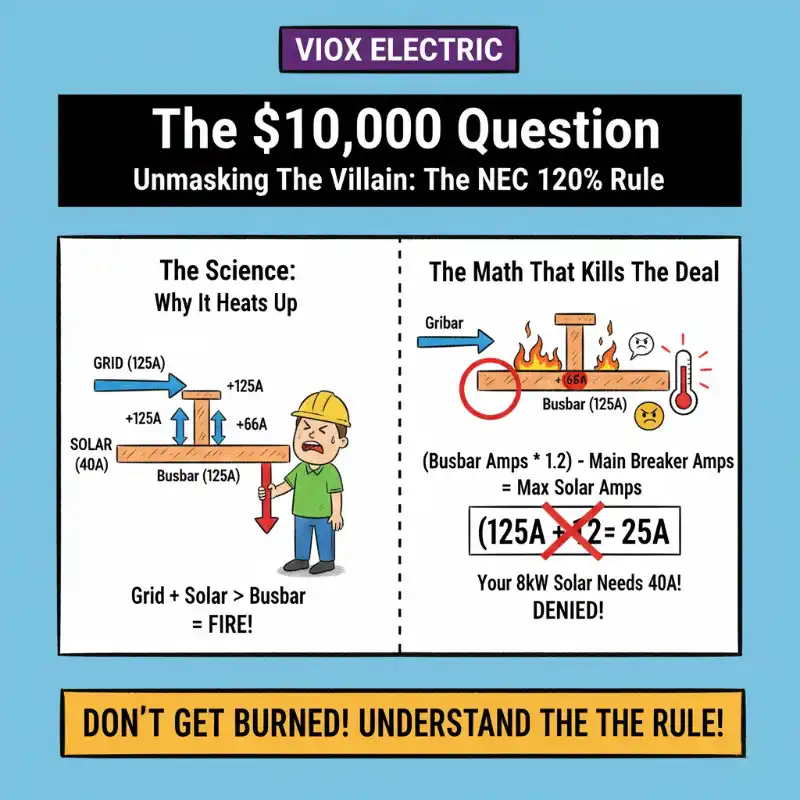
To an engineer, a kopnes is just a copper highway for electrons. But to the NEC inspector, it’s a potential fire hazard.
Portāls NEC 120% Rule (found in NEC 705.12) exists to prevent your panel’s busbar from handling more current than it was designed for.
In a standard home, power flows in one direction: from the grid (Main Breaker) to your loads. But with solar, you are pushing power back into the panel from the bottom. If the grid pushes 125A from the top, and your solar pushes 40A from the bottom, the busbar in the middle could theoretically carry 165A. If that busbar is only rated for 125A, it heats up. It glows. Eventually, it fails.
The Math That Kills the Deal
The code gives you a buffer. It allows the sum of your supply breakers to equal 120% of the busbar rating.
The Formula:
(Busbar Rating × 1.2) – Main Breaker Size = Max Solar Backfeed
Let’s look at the “Solar Murder Mystery” scenario that plagues 125A panels:
- Busbar Rating: 125A
- Galvenais slēdzis: 125A
- Aprēķins: (125 × 1.2) – 125 = 25A
The Problem: You are legally allowed to install 25A of solar (about 4-5kW). But you need 40A for that 8kW system. You are 15A short.
The installer says “Upgrade the service.” We say: “Let’s look at Option 1.”
Solution 1: The “Poor Man’s Fix” (Main Breaker Derating)

If the math formula is the problem, change the variables.
You can’t easily change the Busbar Rating (that’s the physical metal inside the box). But you can change the Main Breaker Size.
By swapping your 125A main breaker for a 100A breaker, you artificially lower the grid’s contribution, freeing up capacity for solar. This is called Derating.
The New Math:
- Busbar: 125A
- Galvenais slēdzis: 100A (Downsized)
- Aprēķins: (125 × 1.2) – 100 = 50A
The Result: Boom. You now have 50A of solar capacity. Your 40A system fits with room to spare. Cost? About $200 for a slēdža swap vs. $10,000 for a trench.
⚠️ The “EV Trap” Warning
Wait. Before you high-five your electrician, ask yourself one question: Can your house actually run on 100A?
This is the “EV Trap.” In the age of gas stoves and gas heating, 100A was plenty. But if you have:
- An Electric Vehicle (EV) charger (40A-60A load)
- An electric induction stove
- Central AC
You might trip that new 100A main breaker on a hot summer evening when you plug in the Tesla and turn on the oven. You solved the solar problem but created a lifestyle problem.
If a Load Calculation (NEC Article 220) shows your peak demand is under 100A, this is the perfect fix. If not? Proceed to Solution 2.
Solution 2: The “Ghost Busbar” (The Jackpot)
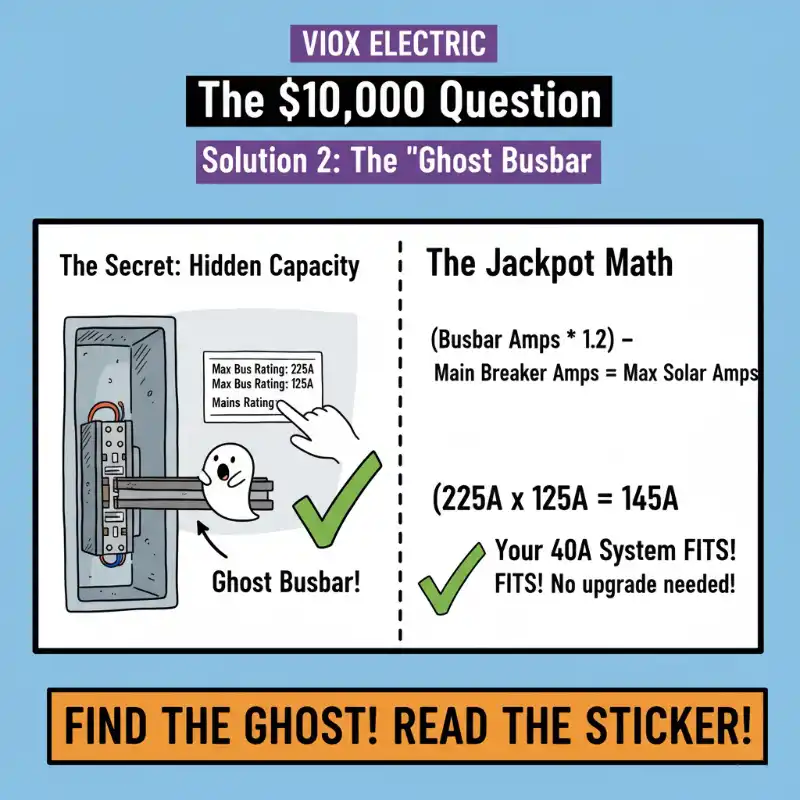
This is the secret that separates rookie installers from the pros.
Manufacturing logistics are weird. Often, it is cheaper for a manufacturer (like Siemens, Square D, or VIOX) to build just one type of heavy-duty panel interior and put it inside different boxes.
There is a solid chance that your “125A Panel” actually has a busbar rated for 200A vai 225A, but it was sold with a 125A main breaker. We call this the “Ghost Busbar” capacity.
How to Find the Ghost
Open your panel door (safety first: don’t touch live components). Look for the technical sticker on the inside wall. You are looking for a line that says:
“Max Bus Rating” vai “Mains Rating”
If that sticker says 200A vai 225A, even though your main breaker is 125A, you have hit the jackpot.
The Ghost Math:
- Busbar Rating: 225A (The hidden spec)
- Galvenais slēdzis: 125A (What you have installed)
- Aprēķins: (225 × 1.2) – 125 = 145A
The Result: You can install practically any residential solar system you want. No breaker swapping, no derating, no digging. You just needed to read the sticker.
Solution 3: The “Loophole” (Line Side Tap)
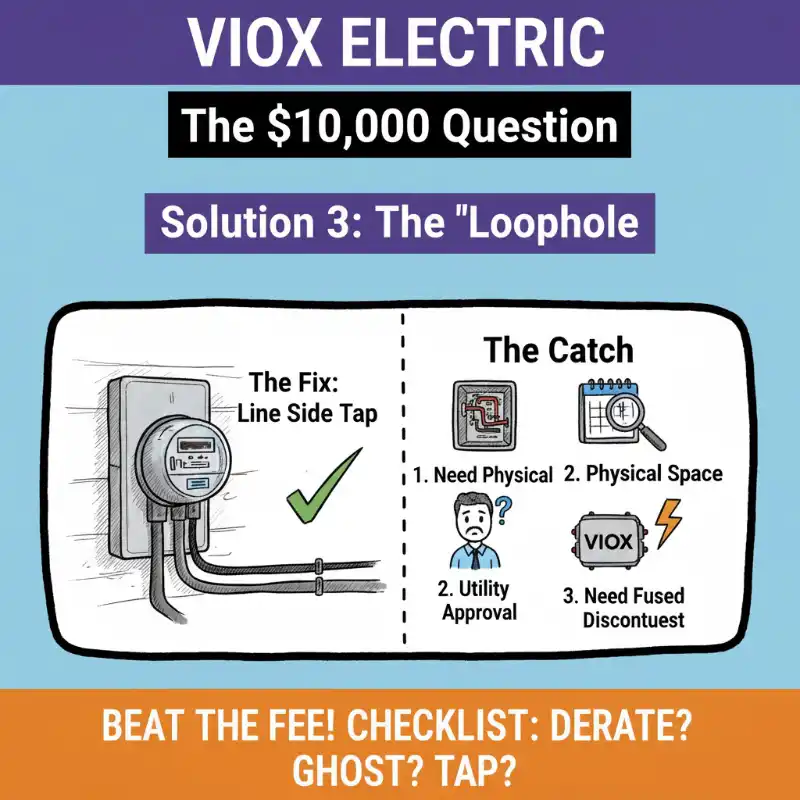
If you can’t derate (loads are too high) and you don’t have a Ghost Busbar, there is one final move: The Line Side Tap.
The 120% rule applies to the load side of the galvenais slēdzis—the busbars where your branch circuits live. But what if you connected the solar before the main breaker?
A Line Side Tap involves splicing the solar output directly into the service entrance conductors between the utility meter and your main breaker.
Why It Works
By connecting ahead of the main breaker, the solar current never touches your panel’s constrained busbar. The 120% rule simply disappears. The only limit is the size of the service wires coming from the street.
The Catch
- Physical Space: You need room in the box to physically clamp onto the wires safely.
- Utility Approval: Some utilities (like PG&E in certain areas) prohibit this or require specific termination boxes.
- Enclosure Specs: You often need a separate fused disconnect switch next to the panel.
Pro-Tip: When performing a Line Side Tap, use a high-quality fused disconnect (like VIOX’s safety switch series) to ensure you have a clean, isolated point of connection that satisfies utility disconnect requirements.
Summary: Put Down the Shovel
The “Service Upgrade” quote is often a lazy solution. It solves the problem with brute force (and your money). Before you authorize the digging, run this checklist:
- Check for Ghosts: Look at the panel sticker. Is the busbar rated higher than the breaker?
- Run the Derate Math: Can your home survive on a smaller main breaker? (Do a proper NEC 220 load calc).
- Check the Tap: Can you bypass the panel entirely with a Line Side Tap?
Only if all three fail should you call the excavator.
Engineering isn’t just about following rules; it’s about understanding why the rules exist so you can find the most efficient path through them.
Technical Accuracy Note
Standards & Sources Referenced
- NEC 705.12(B): Governs load-side source connections and the 120% rule calculation methodology.
- NEC 220: Governs branch-circuit, feeder, and service load calculations required for determining if a main breaker derate is safe.
- NEC 230.82: Governs supply-side (Line Side) connections.
Timeliness Statement
The calculations and interpretations in this article are based on the National Electrical Code (NEC). While specific adoption years (2017, 2020, 2023) vary by state and municipality, the 120% rule remains a fundamental standard for residential solar interconnection as of November 2025. Always verify local utility requirements and municipal code amendments before installation.