

On this page
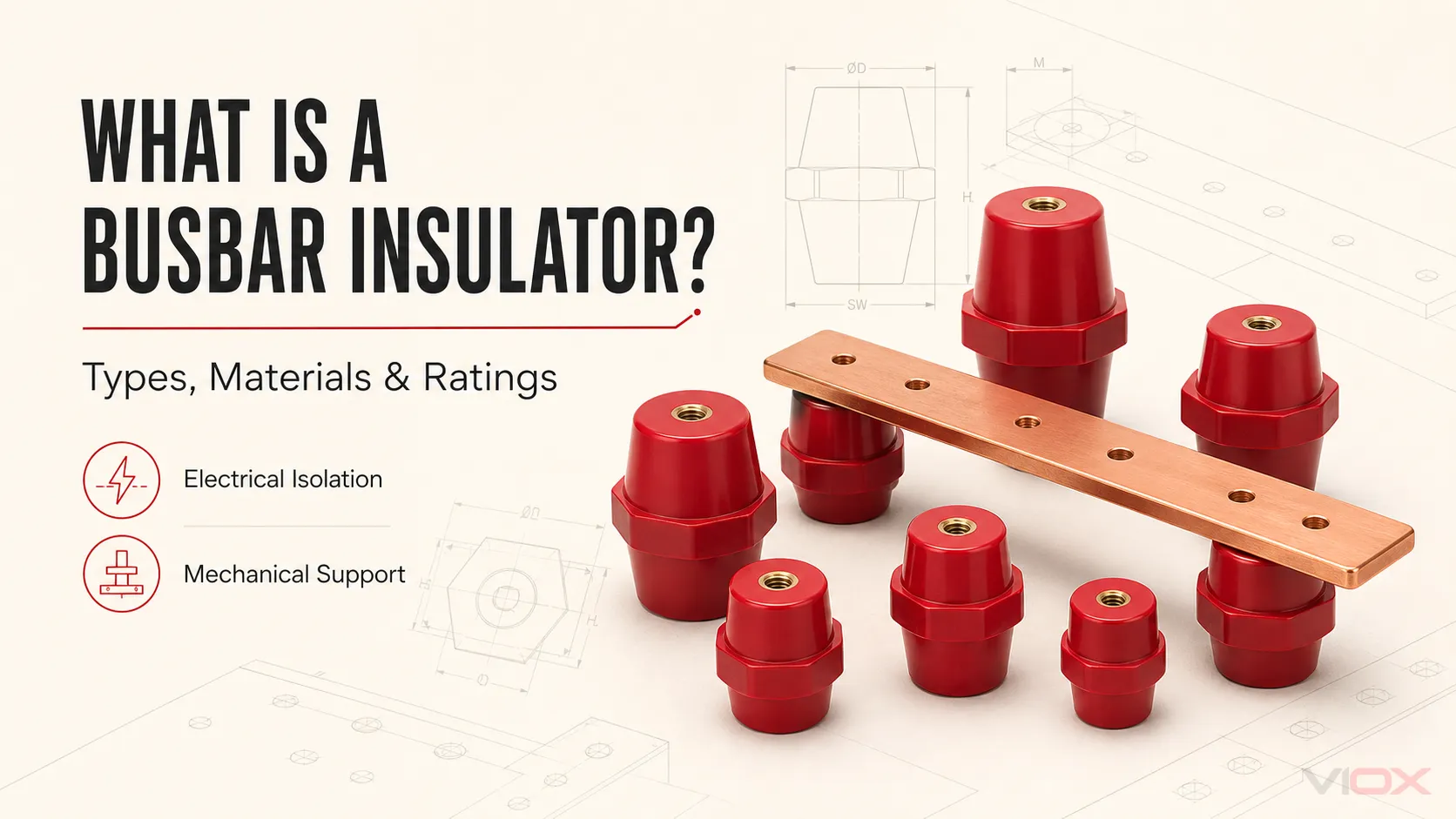
A busbar insulator is a non-conductive support that holds a live copper or aluminum busbar in position while electrically separating it from grounded metalwork, the enclosure, and adjacent conductors. It provides both electrical insulation and mechanical support inside switchgear, distribution boards, control panels, inverter cabinets, and other power assemblies.
A busbar insulator must do more than create physical separation. It helps maintain clearance and creepage distances, carries the busbar’s mechanical load, preserves phase spacing, and resists forces caused by transport, vibration, thermal cycling, and short-circuit events.
| Quick question | Engineering answer |
|---|---|
| What does it do? | Supports a busbar and isolates it from grounded or live conductive parts |
| What are the common types? | Standoff, post, support block, holder, clamp, and custom molded support |
| What materials are used? | BMC/DMC, SMC, epoxy resin, porcelain, and engineered composites |
| What determines selection? | Voltage, creepage, clearance, busbar geometry, support span, short-circuit forces, mounting hardware, and environment |
| Is voltage alone enough? | No. The insulator must be evaluated as part of the complete busbar assembly |
For available sizes and construction options, see the VIOX busbar insulator product range. This article explains the component and its engineering boundaries; the separate busbar insulator selection guide covers the full specification process.
Key Takeaways
- A busbar insulator performs two linked jobs: electrical isolation and structural support.
- Common busbar insulators include threaded standoffs, post insulators, support blocks, and clamp-style supports.
- The product’s height or color does not establish its voltage capability, material performance, or mechanical strength.
- Clearance and creepage are properties of the installed geometry, not simply values created by the insulator body.
- Short-circuit withstand belongs to the complete busbar and assembly design. An individual support rating does not by itself prove an assembly rating.
- Always match the purchased model to its drawing, material documentation, thread arrangement, and model-specific electrical and mechanical data.
What Does a Busbar Insulator Do?
Busbars distribute current through a panel using rigid copper or aluminum conductors. Those conductors must be mounted securely without creating an unintended path to ground or to another phase. A busbar support insulator provides the mechanical interface between the energized conductor and the supporting structure.
1. It Provides Electrical Isolation
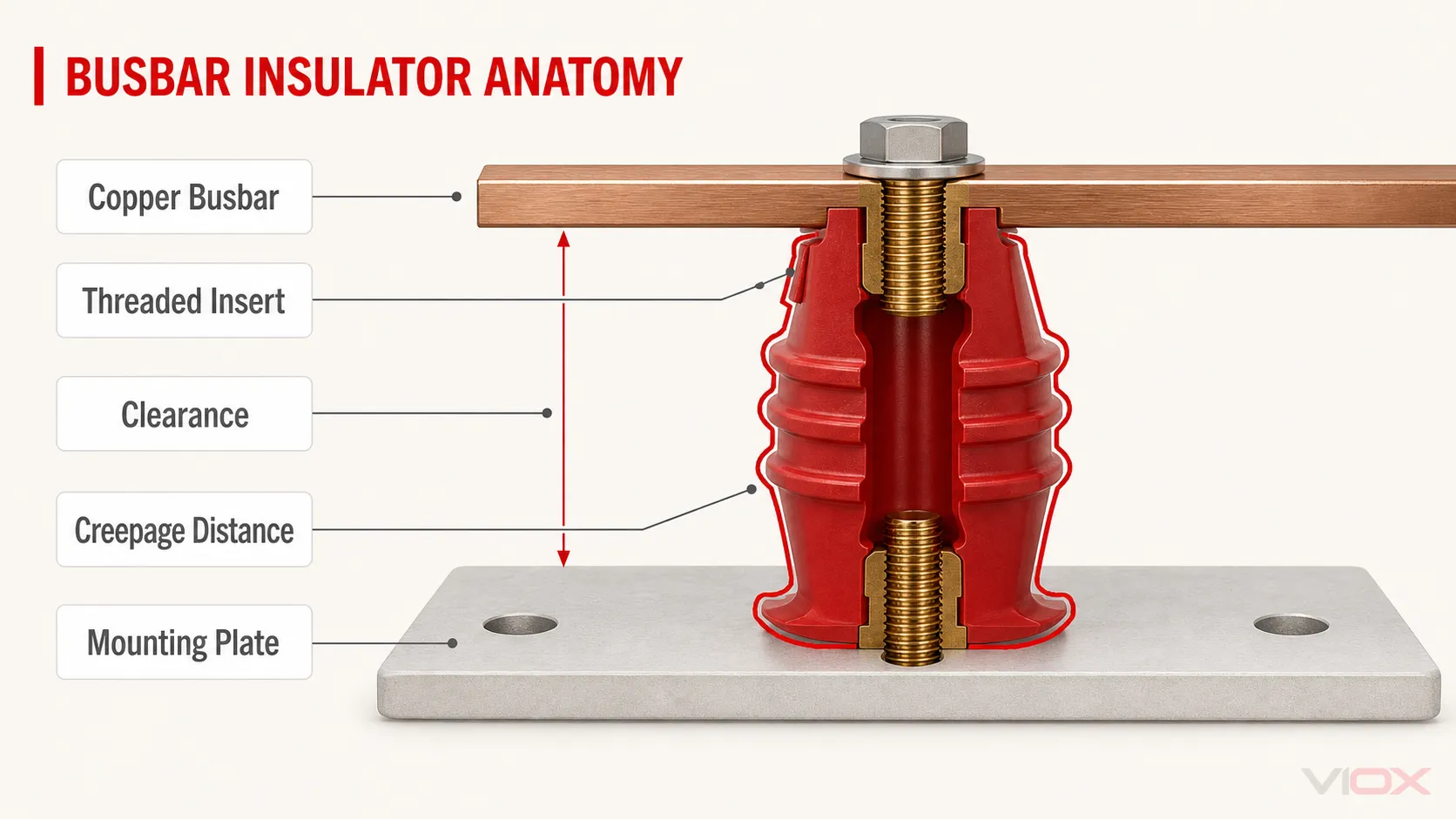
The insulating body separates the live busbar from conductive parts such as:
- the enclosure and mounting plate
- structural frames and rails
- adjacent phase busbars
- cable lugs and terminals
- grounded barriers
- nearby control or protection equipment
Electrical separation depends on several variables, not only the dielectric strength of the molding compound:
- Clearance is the shortest distance through air between two conductive parts.
- Creepage distance is the shortest distance along the surface of an insulating material.
- Pollution degree describes the expected contamination and whether it can become conductive.
- Material group reflects tracking behavior, commonly linked to Comparative Tracking Index (CTI).
- Overvoltage category and system voltage define the expected electrical stress.
- Altitude can affect the air-clearance requirement.
The current consolidated version, IEC 60664-1:2020+AMD1:2025 CSV, provides insulation-coordination principles for equipment connected to low-voltage supply systems up to AC 1,000 V or DC 1,500 V within its stated scope. Busbar insulation design cannot be reduced to a universal rule such as “1 mm per kV.” The required geometry must be determined for the actual system and environment.
2. It Provides Mechanical Support
The same part must carry the busbar and maintain its position. Its mechanical duty can include:
- the mass of the conductor and attached hardware
- forces created by cable connections and bends
- vibration during operation
- shock during transport or installation
- repeated thermal expansion and contraction
- electrodynamic forces during a short circuit
For similar conductor geometry, the peak mechanical force increases rapidly with the peak short-circuit current:
Peak electrodynamic force ∝ iₚ²The peak mechanical force depends mainly on peak short-circuit current, conductor geometry, conductor spacing, support span, and how the load is transferred into the support structure. Fault duration affects the associated thermal stress and the time over which mechanical shock and vibration act on the assembly.
An individual busbar support insulator should therefore never be used as the sole proof of a switchboard’s short-circuit withstand rating.
3. It Maintains the Designed Busbar Geometry
A consistent support system keeps the phases aligned and preserves the intended distances throughout production and service. This is especially important in compact panels, where a small conductor displacement can reduce clearance, load a connection unevenly, or bring a live part closer to grounded metalwork.
For an original equipment manufacturer (OEM), repeatable geometry also improves assembly consistency. A support layout should work across production units, not only in a hand-adjusted prototype.
Busbar Insulator, Support Insulator, and Standoff: What Is the Difference?
The market uses several overlapping names. The correct term depends on the component’s geometry and function.
| Term | Practical meaning | Typical application |
|---|---|---|
| Busbar insulator | Broad term for an insulating part that supports and separates a busbar | Switchgear, distribution cabinets, panelboards, control panels |
| Busbar support insulator | Emphasizes the structural support function | Main and distribution busbar runs |
| Standoff insulator | Threaded spacer-style support that raises a conductor above a mounting surface | Low-voltage panels, inverter cabinets, DC assemblies |
| Post insulator | Taller support, often with a ribbed or stepped profile | Applications requiring more height, surface path, or defined mechanical support |
| Busbar holder or support block | Molded part that locates one or more bars at fixed spacing | Modular and repeat-production busbar assemblies |
| Bushing | Hollow insulation through which a conductor passes across a conductive barrier | Enclosure, transformer, or switchgear penetration |
A standoff insulator is therefore one type of busbar insulator. A bushing is not: it solves a conductor-penetration problem rather than a support-from-below problem.
The phrase busbar isolator appears in some searches, but it is potentially ambiguous because an isolator normally means a disconnector or isolation switch. For support components, busbar insulator or busbar support insulator is clearer engineering English.
Main Busbar Insulator Types and Applications
Busbar insulator types are best classified by mounting form and support function rather than by color or voltage alone.
| Type | Construction | Best suited to | Main checks |
|---|---|---|---|
| Threaded standoff | Cylindrical, hexagonal, conical, or stepped molded body with inserts or studs | Compact low-voltage panels and DC cabinets | Height, body diameter, thread, insert depth, mechanical load |
| Post insulator | Taller body with end fittings and often a ribbed profile | Higher-clearance or higher-insulation applications | Creepage, clearance, bending strength, insulation class |
| Support block | Molded block supporting one or multiple bars | Repeated phase layouts and modular systems | Busbar dimensions, phase spacing, clamping method |
| Clamp or bracket support | Insulating support integrated with a clamp or mounting bracket | Custom conductor routing and confined layouts | Load direction, bracket geometry, mounting holes |
| Custom molded support | Application-specific body, insert, and conductor interface | OEM equipment with non-standard geometry | Drawing control, tooling, material, tolerance, validation |
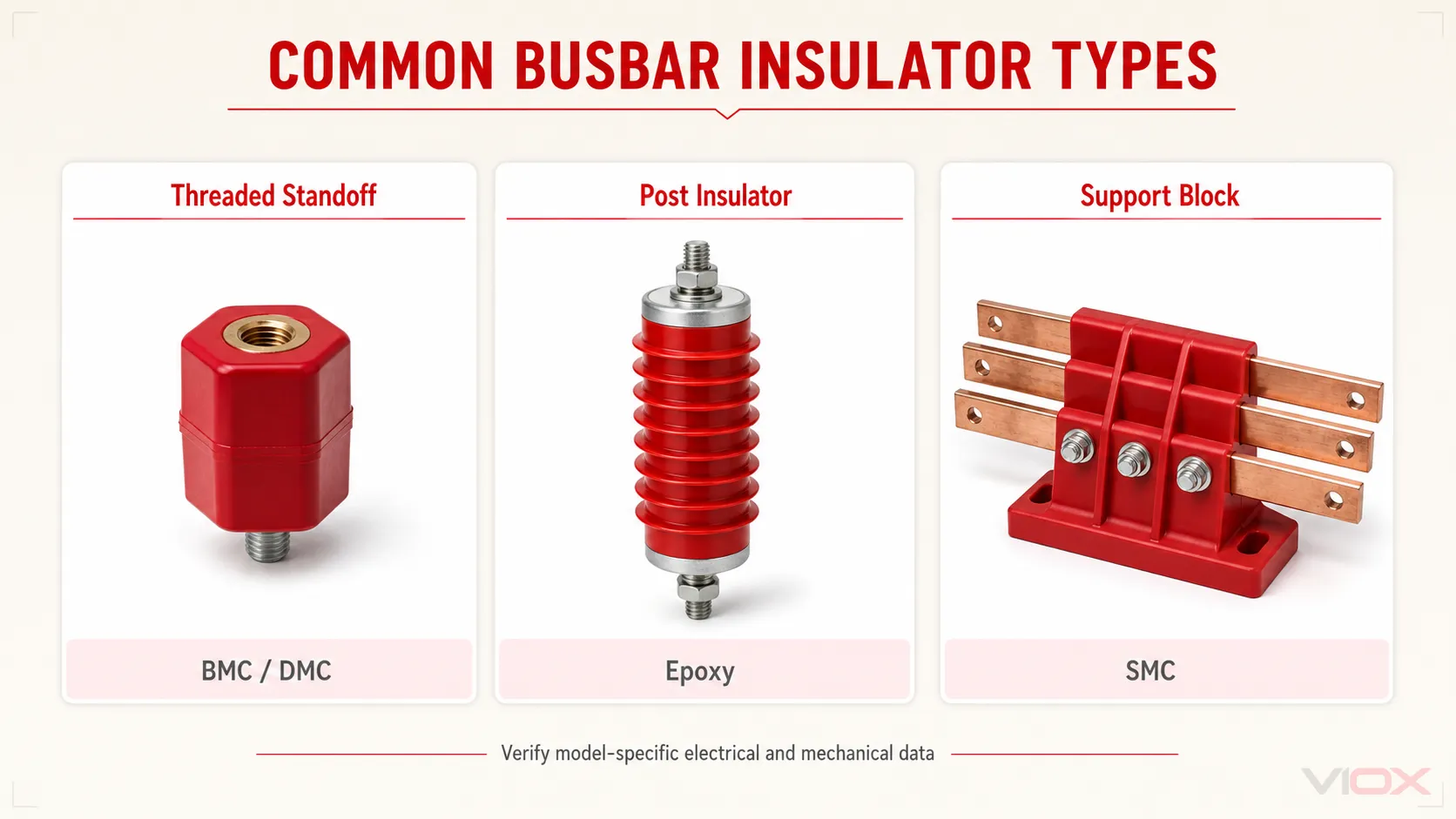
Threaded standoffs are the most common form in compact low-voltage panels, inverter cabinets, DC distribution equipment, BESS cabinets, and EV charging equipment. Their interfaces may be female-to-female, male-to-female, or male-to-male.
Post insulators are generally taller and may use ribs or steps to increase the surface path. Support blocks instead locate one or more busbars at fixed spacing, which can improve production repeatability. These forms are not automatically interchangeable because their fittings, load direction, conductor interface, and applicable tests may differ.
Busbar Insulator Materials Compared
No single busbar insulator material is best for every application. Material selection must consider insulation, tracking, heat, moisture, mechanical load, manufacturing geometry, and the operating environment.
| Material family | Engineering strengths | Important limitations | Common application direction |
|---|---|---|---|
| BMC/DMC thermoset composite | Moldable, rigid, and widely used for compact insulating supports | Performance depends on formulation, reinforcement, and process control | Low-voltage standoffs and standard panel supports |
| SMC thermoset composite | Suitable for larger molded shapes and structural support geometries | Model-level mechanical and electrical data still require verification | Multi-pole supports and larger molded parts |
| Epoxy resin | Rigid construction and adaptable insulation geometry | Can be heavier or more brittle than some engineered polymers; formulation matters | Post supports and engineered higher-insulation applications |
| Porcelain or ceramic | Strong dielectric and environmental stability | Heavy and brittle under impact or installation stress | Outdoor, legacy, and selected higher-voltage applications |
| Engineered polymer composite | Lightweight and adaptable to specialized geometries | Temperature, tracking, moisture, UV, and flame behavior vary by grade | Custom and environment-specific supports |
The material name alone is not a rating. Two products both described as BMC can have different fillers, glass-fiber content, tracking resistance, flammability behavior, water absorption, and mechanical strength.
Useful documentation includes the material grade, CTI or material group where applicable, flammability classification at the tested thickness, dielectric and insulation-resistance test conditions, heat and water-absorption data, relevant mechanical results, and dimensional tolerances.
A UL 94 classification describes material flammability under defined small-scale test conditions. It is not a complete electrical, mechanical, or product-safety certification. UL Solutions explains that V-0, V-1, V-2, HB, and other classifications are assigned according to specific specimen and flame-test conditions.
How to Read a Busbar Insulator Datasheet
One reason busbar insulators are mis-specified is that buyers compare only height and thread size. A useful datasheet review separates dimensional, electrical, mechanical, material, and documentation fields.
| Datasheet field | What it tells you | What it does not prove by itself |
|---|---|---|
| Body height | Distance created between mounting interfaces | Final installed clearance or creepage in every layout |
| Body diameter or width | Footprint and approximate structural geometry | Mechanical strength without test data |
| Thread and insert depth | Fastener compatibility and engagement | Correct torque or pull-out strength |
| Withstand voltage | Performance under the stated test method and duration | Continuous operating voltage or complete assembly insulation rating |
| Tensile or cantilever strength | Capacity under a stated loading direction | Strength under every mounting and fault condition |
| Torque strength | Resistance of the insert/body under the stated test | Permission to apply that torque during installation |
| CTI or material group | Relative surface tracking behavior | Required creepage without pollution and voltage context |
| UL 94 classification | Burning behavior for the tested material/specimen | Complete product compliance or arc resistance |
| Operating temperature | Stated environmental range for the model/material | Acceptable conductor temperature or panel temperature-rise verification |
Example: Published VIOX SM Series Data
The following selected values illustrate how models within one family can differ. They are drawn from the published VIOX SM Series busbar insulator page and should be confirmed against the current drawing and datasheet before specification or purchase.
| Model | Height | Thread | Published withstand voltage | Published tensile strength | Published torque strength |
|---|---|---|---|---|---|
| SM-25 | 25 mm | M6 | 6 kV | 500 lbf / 2.22 kN | 6 ft·lbf / 8.1 N·m |
| SM-40 | 40 mm | M8 | 12 kV | 650 lbf / 2.89 kN | 12 ft·lbf / 16.3 N·m |
| SM-60 | 60 mm | M10 | 20 kV | 1,200 lbf / 5.34 kN | 35 ft·lbf / 47.5 N·m |
| SM-76 | 76 mm | M10 | 25 kV | 1,500 lbf / 6.67 kN | 40 ft·lbf / 54.2 N·m |
Catalog values only: The cited public product page does not specify the complete test waveform, frequency, duration, conditioning, or acceptance criteria. Request the model-specific test method and report before specification.
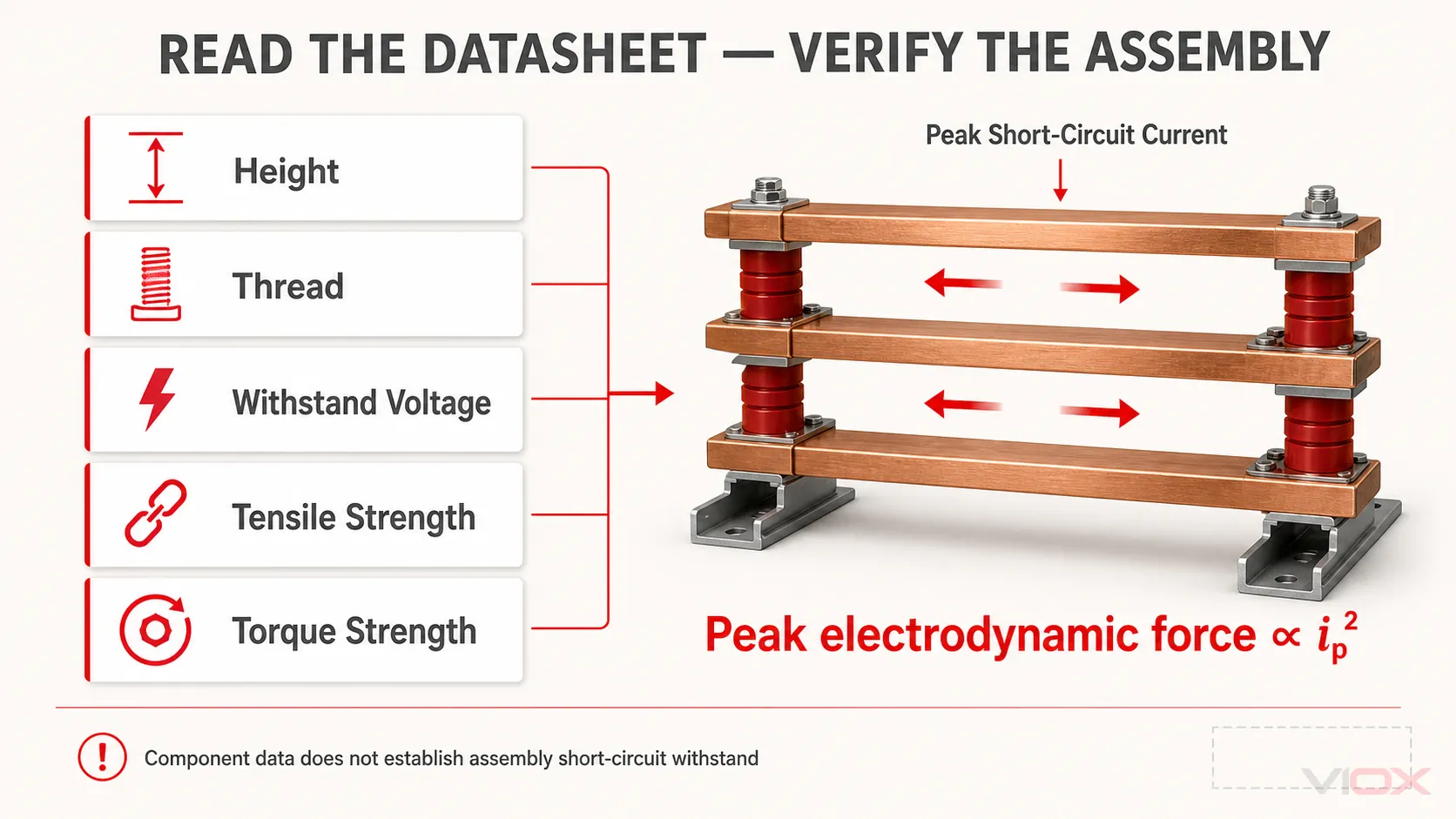
The test method, creepage profile, surrounding geometry, mechanical load, and assembly requirements still have to be checked. The table also shows why ordering only by color and approximate height is inadequate.
For smaller dimensional standoffs, the published VIOX JYZ Series uses a 14 mm body diameter with listed heights from 14 mm to 75 mm and M4, M5, or M6 thread options. The exact male/female insert arrangement must be confirmed when ordering.
How to Select a Busbar Support Insulator
Selection starts with the complete busbar system. Use this summary to identify the required inputs, then complete the calculation and documentation review in the busbar insulator selection guide.
| Selection input | What must be checked |
|---|---|
| Electrical system | Rated voltage, AC or DC duty, transient stress, earthing arrangement, and applicable assembly standard |
| Installed insulation distances | The shortest clearance and creepage paths after busbars, fasteners, barriers, enclosure parts, and adjacent phases are installed |
| Busbar geometry | Material, width, thickness, number of bars, orientation, bends, joints, and available mounting area |
| Mechanical duty | Busbar mass, vibration, peak short-circuit current, conductor spacing, support span, and frame stiffness |
| Mounting interface | Male/female configuration, thread, insert depth, hardware, access, and manufacturer-specified tightening method |
| Environment | Temperature, humidity, dust, salt, chemicals, condensation, ultraviolet exposure, altitude, and vibration |
| Evidence | Current drawing, material declaration, model-specific electrical and mechanical data, and relevant assembly verification |
There is no universal spacing between busbar insulators. Where short-circuit withstand is critical, use a validated assembly design, an engineering calculation based on the applicable method, or test evidence. A component tensile value cannot establish the complete assembly rating.
Overtightening can crack a thermoset body or damage the insert; undertightening can allow movement and fretting. The insert’s published torque-strength value is not necessarily the recommended installation torque.
Standards and Ratings: Component vs Assembly Scope
No single standard certifies every busbar insulator for every application. The relevant document depends on whether the designer is evaluating insulation coordination, the molded material, an individual post insulator, or the complete panel.
| Standard or reference | Scope relevant to this topic | Correct interpretation |
|---|---|---|
| IEC 60664-1:2020+AMD1:2025 CSV | Insulation coordination for equipment within its low-voltage scope | Supports decisions about clearance, creepage, pollution degree, and solid insulation; it is not a product catalog rating |
| IEC 61439 series | Low-voltage switchgear and controlgear assemblies | Applies to the complete assembly and its verification, including the installed busbar support system |
| IEC 60273:1990 | Characteristics of ceramic or glass post insulators for indoor or outdoor AC service above 1,000 V, and organic-material post insulators primarily for indoor AC service above 1,000 V | Relevant to defined post-insulator applications, not every low-voltage molded standoff; the standard treats DC use only as a provisional reference |
| UL 891 | Dead-front switchboards in North America | Relevant when a support is used within a switchboard evaluated to UL 891 |
| UL 508A | Industrial control panels in North America | Relevant to the panel and acceptable use of components within that panel |
| UL 94 | Flammability testing of plastic materials | Describes burning behavior of tested material specimens, not total insulator performance |
IEC 61439-1:2020 establishes general rules for low-voltage switchgear and controlgear assemblies, while conformity requires the applicable assembly part. It should not be presented as an individual busbar-insulator certification.
Similarly, a support used in a UL 891 switchboard or a UL 508A industrial control panel must fit the requirements and evaluation of that equipment. A material claim alone does not establish panel compliance.
Busbar Insulator vs Busbar Insulation
A busbar insulator is a separate structural component that holds a conductor and separates it from other conductive parts.
Busbar insulation is material applied directly to the conductor, such as:
- heat-shrink tubing
- insulating sleeve
- electrically qualified epoxy or powder insulation coating
- molded insulation
Insulating boots may cover exposed joints or terminations. Phase barriers are separate supplementary barriers placed between conductors; they are not insulation applied directly to the busbar.
These measures serve different functions. A coated busbar still requires adequate mechanical support and verified distances. A support insulator does not provide touch protection over the exposed length of a bare conductor.
Common Busbar Insulator Selection Mistakes
Choosing by Color
Color is not proof of resin formulation, CTI, dielectric strength, flammability classification, temperature behavior, or mechanical capability. Two red insulators can have different properties.
Selecting by Height Alone
Products with the same height can differ in body diameter, thread, insert depth, creepage profile, material, and mechanical strength. Height is one dimensional input, not a complete specification.
Treating Withstand Voltage as Operating Voltage
A dielectric withstand value applies under stated test conditions. It should not be copied directly into the system-voltage field or used as the sole evidence of insulation coordination.
Ignoring Short-Circuit Forces
Normal-operation stability does not prove fault stability. High prospective fault current can bend conductors, load supports laterally, and transfer force into mounting frames and fasteners.
Using a Generic Plastic Spacer
A general-purpose spacer may lack controlled tracking, heat, flame, insert, or mechanical performance. Use a support with appropriate product and material data for the application.
Assuming the Component Rating Equals the Assembly Rating
The completed panel includes the busbars, supports, hardware, frame, enclosure, spacing, joints, and protective devices. Its rating cannot be established by one component value.
Installation, Inspection, and Replacement
Follow the product drawing and manufacturer instructions during installation. Confirm that mounting surfaces are flat, the busbar is not forced into alignment, bolts engage correctly, and tightening does not twist or crack the insulating body.
Inspect busbar insulators after transport, overheating, a significant short-circuit event, or during planned maintenance. Check for cracks, deformation, loose inserts, carbon tracking, flashover or burn marks, conductive contamination, corrosion, busbar misalignment, and evidence of mechanical overload.
An insulator with cracking, tracking, a loose insert, flashover damage, or significant heat deformation should normally be replaced rather than returned to service without engineering evaluation. De-energize and isolate the equipment before inspection in accordance with the site’s electrical safety and lockout/tagout procedures.
For a symptom-based diagnosis, see common busbar insulator failures and how to prevent them.
FAQ
What is a busbar insulator?
A busbar insulator is a non-conductive component that supports a copper or aluminum busbar while keeping it electrically separated from grounded metalwork and adjacent conductors. It provides both insulation and mechanical support inside an electrical assembly.
What is a busbar support insulator used for?
It holds the busbar in its designed position, maintains separation from conductive structures, and transfers normal and fault-related mechanical loads into the panel’s support frame.
What are the main types of busbar insulators?
Common types include threaded standoff insulators, post insulators, molded support blocks, clamp or bracket supports, and custom molded supports. The correct form depends on conductor geometry, required distances, load direction, and mounting arrangement.
Is a standoff insulator the same as a busbar insulator?
A standoff insulator is one common type of busbar insulator. The broader term also includes post insulators, support blocks, holders, and other insulating support geometries.
Which busbar insulator material is best?
There is no universal best material. BMC/DMC and SMC are common for molded low-voltage supports, while epoxy, porcelain, and engineered composites suit other geometries or environments. Compare model-specific electrical, mechanical, thermal, moisture, tracking, and flame data.
How is spacing between busbar insulators determined?
Support spacing depends on busbar material and cross-section, orientation, conductor spacing, normal load, vibration, peak short-circuit force, mounting geometry, and the verified assembly design. There is no universal spacing value.
Does a higher withstand voltage mean the insulator is suitable for a higher operating voltage?
Not automatically. Withstand voltage is tied to a stated test condition. System suitability also depends on continuous voltage, impulse stress, creepage, clearance, pollution degree, surrounding geometry, and the applicable equipment standard.
Does UL 94 V-0 mean the busbar insulator is UL certified?
No. UL 94 V-0 is a flammability classification for a tested material specimen under defined conditions. It does not by itself establish the electrical, mechanical, or equipment-level certification of an insulator or panel.
When should a busbar insulator be replaced?
Replace or formally evaluate an insulator that shows cracks, carbon tracking, burn marks, flashover evidence, deformation, a loose insert, or mechanical damage. Inspect the complete support system after a significant fault.
Conclusion
A busbar insulator is both an electrical-insulation component and a structural part of the busbar system. Use the definitions and rating boundaries in this article to identify the component class, then complete the design with the detailed busbar insulator selection guide and model-specific product data.
Sources and Standards
- IEC 60664-1:2020+AMD1:2025 CSV, Insulation coordination for equipment within low-voltage supply systems
- IEC 61439-1:2020, Low-voltage switchgear and controlgear assemblies
- IEC 60273:1990, Characteristics of indoor and outdoor post insulators for systems above 1,000 V
- UL Solutions: UL 94 combustion and flammability testing for plastics
- UL Solutions: UL 891 General Coverage Program
- UL Solutions: UL 508A component requirements
- VIOX SM Series Busbar Insulator published specifications
- VIOX JYZ Series Busbar Insulator published dimensions