ブログ

ブログのカテゴリー

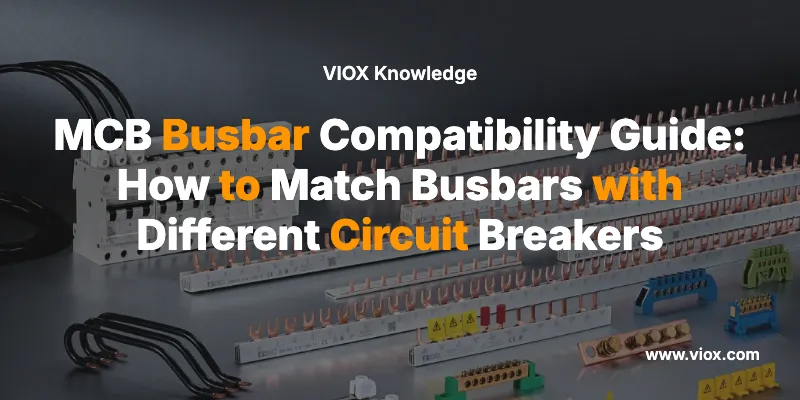
MCB Busbar Compatibility Guide: How to Match Busbars with Different Circuit Breakers

MCBバスバー互換性ガイド:異なる回路ブレーカーとバスバーを適合させる方法

Choosing the right MCB busbar is not just about finding a strip of copper that physically fits inside a panel. Busbar compatibility depends on terminal design, pole configuration, pitch, current rating, enclosure layout, and the circuit breaker family being used. That is why two busbars that look similar may perform very differently in real installations. If you are trying to match busbars with different circuit breakers, the practical goal is simple: ensure the busbar fits the breaker terminals correctly ensure the current path is mechanically stable ensure the assembly can carry the expected load safely avoid hot spots, loose contact, arcing, or installation rework This guide explains how to check […]

MCBバスバー互換性ガイド:異なる回路ブレーカーとバスバーを適合させる方法 続きを読む »
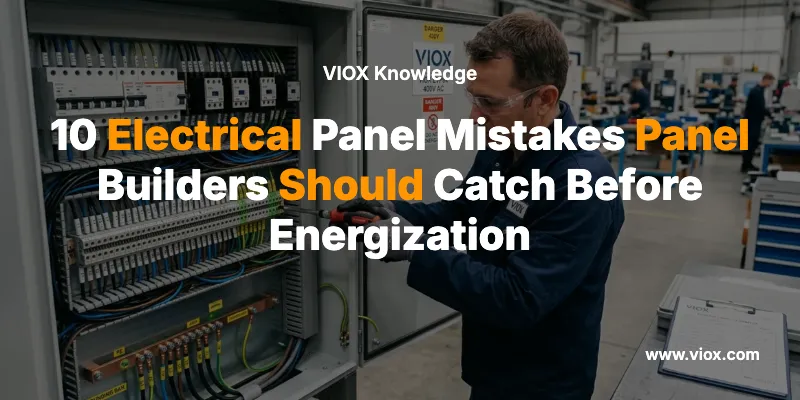
10 Electrical Panel Mistakes Panel Builders Should Catch Before Energization

電気パネルの構築者が通電前に見つけるべき10個の電気パネルのミス

An experienced panel builder conducting a critical pre-energization inspection on a low-voltage electrical panel to ensure compliance and safety. An electrical panel can look complete, clean, and professionally assembled while still containing errors serious enough to cause nuisance tripping, overheating, control failure, commissioning delays, or unsafe energization. That is why the final inspection before energization matters so much. For panel builders, this is the point where workmanship, documentation, component selection, and compliance discipline all meet. The goal of a pre-energization inspection is not simply to “take one last look.” It is to confirm that the panel as built matches the project intent, that installation and assembly quality are acceptable, and

電気パネルの構築者が通電前に見つけるべき10個の電気パネルのミス 続きを読む »

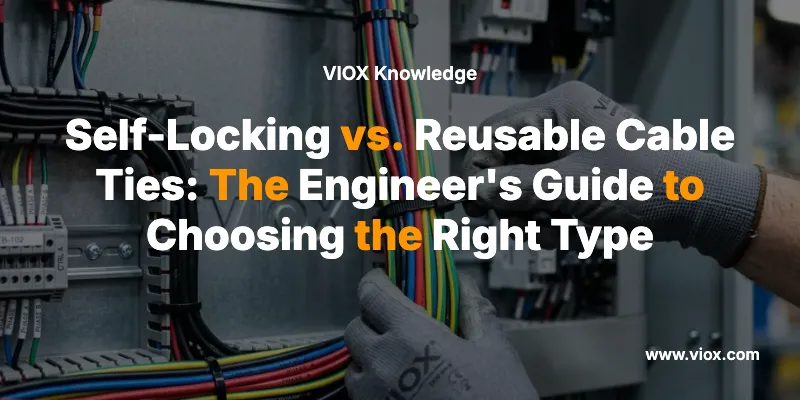
Self-Locking vs. Reusable Cable Ties: The Engineer's Guide to Choosing the Right Type

セルフロック式と再利用可能なケーブルタイ:適切なタイプを選択するためのエンジニアガイド

A professional engineer installing durable VIOX self-locking cable ties on colored electrical cables inside an industrial control panel. Which Cable Tie Type Delivers Better Performance for Industrial Applications? Self-locking cable ties provide superior tensile strength (up to 175 lbs) and permanent security for critical installations, while reusable cable ties offer adjustable, repeatable fastening with release mechanisms ideal for temporary or frequently modified assemblies—each excels in distinct engineering scenarios where their mechanical characteristics align with application requirements. The choice between self-locking and reusable cable ties represents a fundamental engineering decision that impacts installation reliability, maintenance efficiency, and long-term operational costs. While both fastening systems utilize similar nylon 6/6 construction and tooth-based

セルフロック式と再利用可能なケーブルタイ:適切なタイプを選択するためのエンジニアガイド 続きを読む »

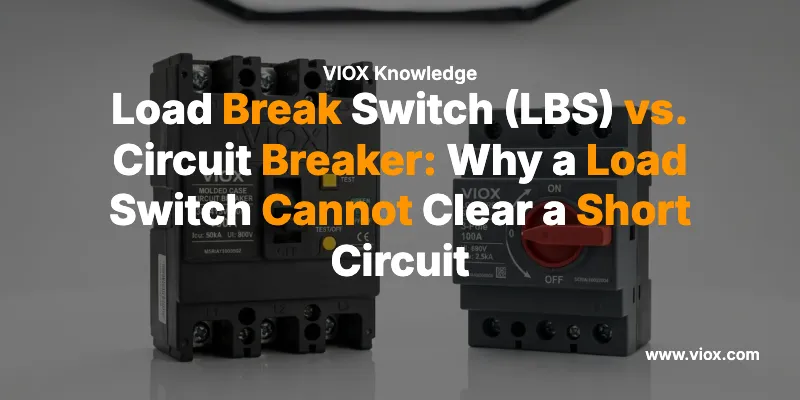
Load Break Switch (LBS) vs. Circuit Breaker: Why a Load Switch Cannot Clear a Short Circuit

負荷開閉器(LBS)と回路遮断器:負荷開閉器が短絡電流を遮断できない理由

VIOX medium-voltage load break switch installed in a metal-clad switchgear cabinet, representing a standard industrial power distribution configuration. What Is the Difference Between a Load Break Switch and a Circuit Breaker? A load break switch (LBS) is designed to make and break normal load currents, while a circuit breaker can additionally detect and interrupt fault currents such as short circuits. The critical distinction is that an LBS lacks the arc extinguishing capacity to safely clear short-circuit currents, making it a switching device rather than a protective device. Key Takeaways A load break switch can interrupt normal load currents and limited overload currents (typically 3–4× rated current), but it cannot break

負荷開閉器(LBS)と回路遮断器:負荷開閉器が短絡電流を遮断できない理由 続きを読む »

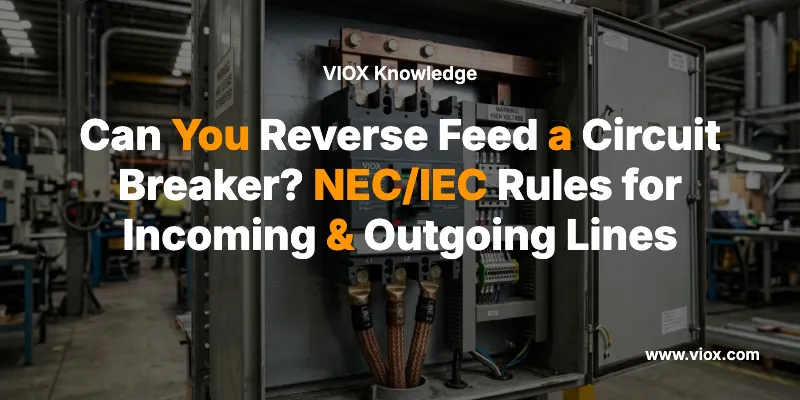
Can You Reverse Feed a Circuit Breaker? NEC/IEC Rules for Incoming & Outgoing Lines

回路遮断器に逆給電できますか?NEC/IEC規格における入力線と出力線

Is It Safe to Reverse Feed a Circuit Breaker? Yes, most standard circuit breakers can be reverse fed—but only if they are not marked with designated “Line” and “Load” terminals. Under NEC 705.30(D) and UL 489 testing protocols, breakers without directional markings have been evaluated for overcurrent tripping in both directions. Breakers with “Line”/”Load” labels, including most AFCI and GFCI types, must never be backfed unless specifically listed for that application. Fig 1. A reverse-fed VIOX molded case circuit breaker (MCCB) safely installed in an industrial electrical panel utilizing bottom-entry cable connections. Key Takeaways A circuit breaker without “Line” and “Load” markings is generally suitable for reverse feeding under both

回路遮断器に逆給電できますか?NEC/IEC規格における入力線と出力線 続きを読む »

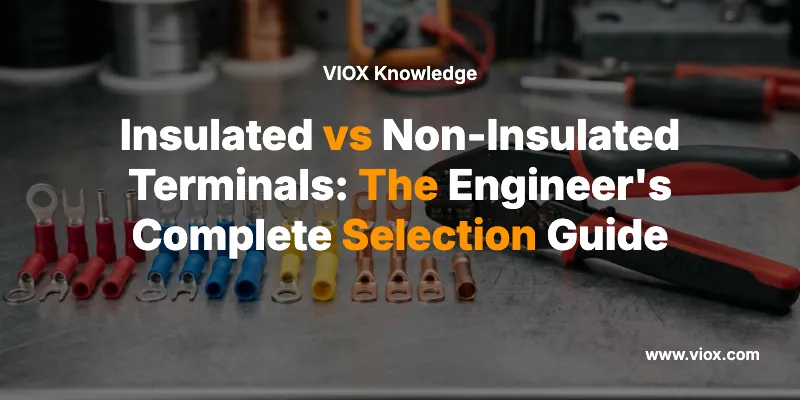
Insulated vs Non-Insulated Terminals: The Engineer's Complete Selection Guide

絶縁端子と非絶縁端子:エンジニアのための完全選択ガイド

A side-by-side comparison of insulated and non-insulated crimp terminals, featuring standard color-coded vinyl sleeves and bare copper variants on a professional workbench. What Is the Difference Between Insulated and Non-Insulated Terminals? Insulated terminals have a protective vinyl, nylon, or heat-shrink sleeve molded around the crimp barrel, providing electrical isolation, strain relief, and environmental protection. Non-insulated terminals are bare metal connectors—typically tinned copper or brass—without any sleeving, offering a compact and economical connection where secondary insulation or an enclosed environment already exists. Key Takeaways Insulated terminals protect against accidental contact, moisture ingress, and vibration-induced shorts; non-insulated terminals rely on the enclosure or secondary sleeving for protection. Standard color coding follows IEC

絶縁端子と非絶縁端子:エンジニアのための完全選択ガイド 続きを読む »

What Is a Float Switch? The Complete Engineer's Guide

フロートスイッチとは?完全エンジニアガイド

An industrial cable-suspended float switch installed in a concrete sump pit, providing reliable automatic pump control. What Exactly Is a Float Switch and How Does It Work? A float switch is a buoyancy-operated electromechanical device that detects liquid levels inside a tank or vessel and automatically opens or closes an electrical circuit in response. As the liquid rises or falls, a hollow float body moves a permanent magnet toward or away from an internal reed switch, triggering connected equipment—such as pumps, valves, or alarms—without requiring an external power supply for the sensing mechanism itself. Key Takeaways Float switches rely on Archimedes’ principle: a buoyant float translates liquid level changes into

フロートスイッチとは?完全エンジニアガイド 続きを読む »

Understanding kVA Rating for Transformers

変圧器のkVA定格について

VIOX 1000 kVA dry-type transformer in an industrial substation, highlighting high-voltage bushings and low-voltage terminals. What Does kVA Mean on a Transformer Rating? kVA (kilovolt-ampere) represents the apparent power capacity of a transformer, indicating the maximum voltage and current the unit can handle simultaneously without overheating. Unlike kW (kilowatts) which measures only real power, kVA accounts for both active power (kW) and reactive power (kVAR), making it independent of the load power factor. This rating ensures the transformer can supply any type of load—resistive, inductive, or capacitive—without manufacturer knowledge of the specific application. Key Takeaways kVA measures apparent power (voltage × current), while kW measures only real power that performs

変圧器のkVA定格について 続きを読む »

IEC 61439 Compliant Low Voltage Switchgear Design: A Complete Guide for Engineers

IEC 61439準拠の低圧スイッチギア設計:エンジニアのための完全ガイド

Figure 1: High-performance VIOX industrial low voltage switchgear assembly, demonstrating modern compartment design, reliable circuit protection, and clear busbar phase identification for superior substation safety. What Does IEC 61439 Require for Low Voltage Switchgear Design? IEC 61439 establishes comprehensive design rules for low voltage switchgear assemblies up to 1000V AC or 1500V DC, mandating verification of temperature rise limits, short-circuit withstand strength, dielectric properties, and protection against electric shock through testing, calculation, or design comparison with reference assemblies. The standard eliminates the distinction between Type-Tested Assemblies (TTA) and Partially Type-Tested Assemblies (PTTA), requiring all assemblies to meet the same safety and performance benchmarks regardless of verification method. Key Takeaways IEC

IEC 61439準拠の低圧スイッチギア設計:エンジニアのための完全ガイド 続きを読む »

How to Test an AFDD (Arc Fault Detection Device): A Step-by-Step Guide

AFDD(アーク故障検出デバイス)のテスト方法:ステップごとのガイド

Quick Answer: Testing Your AFDD in 30 Seconds Testing an Arc Fault Detection Device (AFDD) is straightforward: press the test button on the device face, and it should trip immediately, disconnecting power to the protected circuit. If the AFDD doesn’t trip when the test button is pressed, the device has failed and must be replaced immediately. This simple monthly test verifies the arc detection electronics are functioning correctly—a critical safety check that takes less than a minute but could prevent a devastating electrical fire. Key Takeaways Test button verification: Press the AFDD test button monthly; the device should trip instantly to confirm proper arc detection functionality Visual inspection matters: Check

AFDD(アーク故障検出デバイス)のテスト方法:ステップごとのガイド 続きを読む »

今すぐ見積もりを依頼する