

On this page
The Core Rule: Do Not Select Only by Motor kW
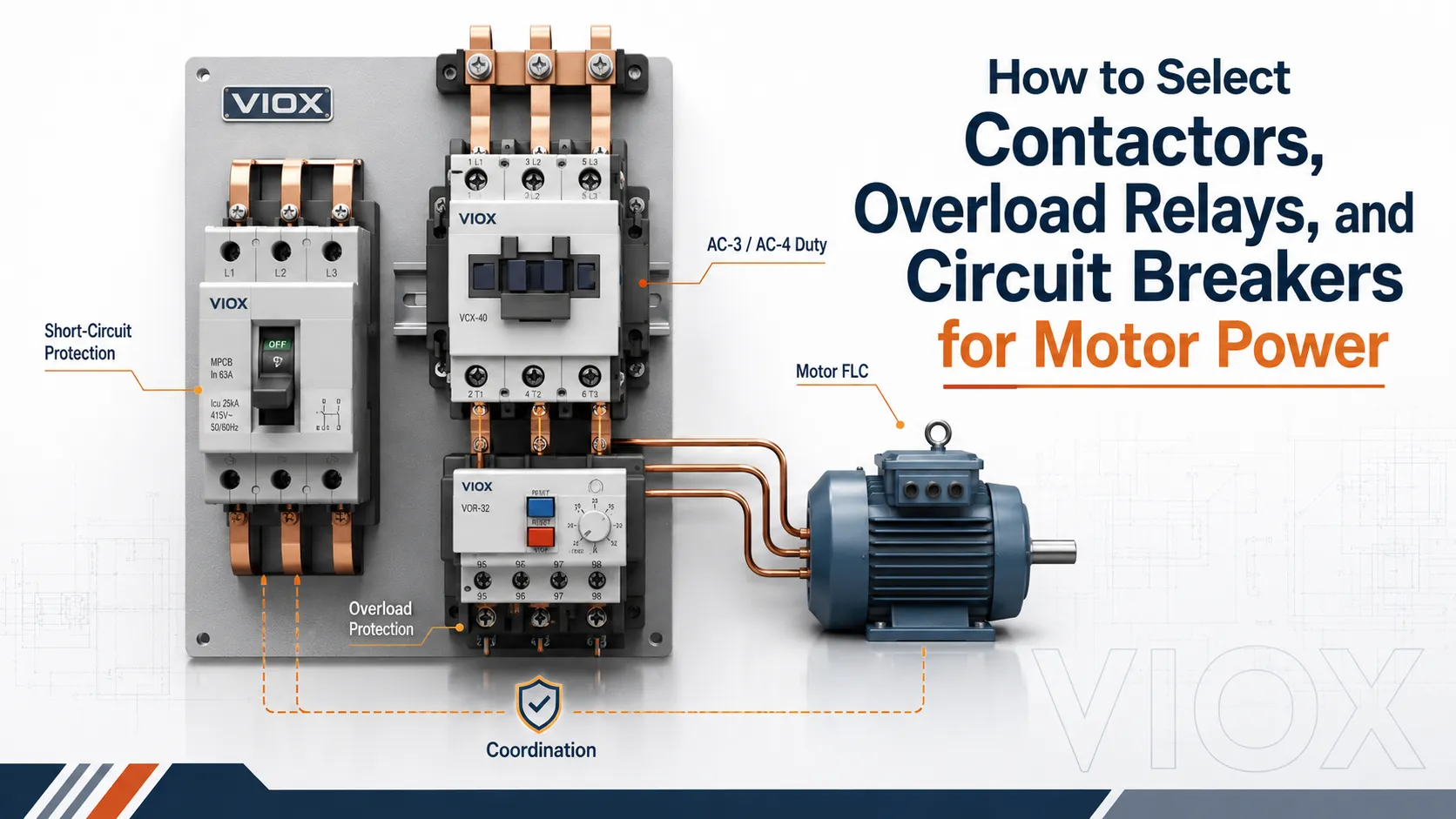
Motor power is only the starting point. To select a contactor, overload relay, and circuit breaker correctly, first convert the motor power into motor full-load current (FLC), then check the motor voltage, starting method, utilization category, duty cycle, short-circuit level, overload protection, and coordination between devices.
For most low-voltage motor panels:
- The contactor switches the motor on and off.
- The overload relay protects the motor against sustained overload.
- The MCB, MCCB, fuse, or MPCB provides short-circuit protection and feeder protection.
- A motor starter is the coordinated assembly of these devices.
The biggest mistake is selecting a contactor and breaker directly from kW with a simple multiplier. A 7.5 kW motor in a pump, a crusher, and a reversing hoist may need different switching duty, overload class, and short-circuit protection.
If you need the basic device comparison first, see Contactor vs Motor Starter. This guide focuses on practical selection.
Motor Control Components and Their Jobs
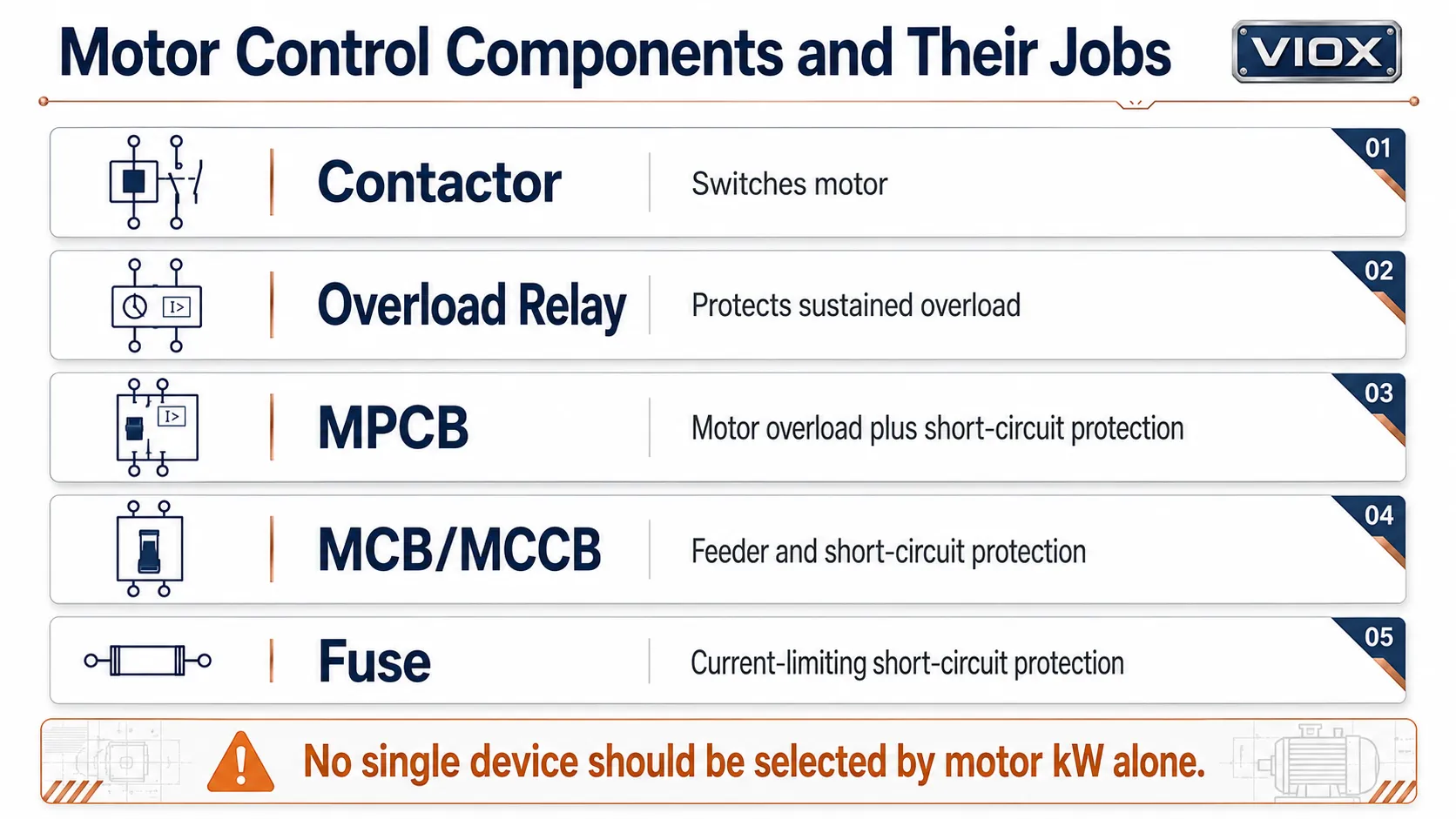
| Device | Main job | Selection basis | Common mistake |
|---|---|---|---|
| Contactor | Switches motor power on/off | AC-3 or AC-4 motor rating, voltage, duty cycle, coil voltage | Selecting by AC-1 resistive current rating |
| Thermal/electronic overload relay | Protects motor from sustained overload | Motor nameplate FLC, trip class, reset mode | Omitting overload protection because a breaker is installed |
| MPCB | Motor overload + short-circuit protection in one device | Motor current range, breaking capacity, coordination | Treating it like a general MCB |
| MCB/MCCB | Feeder and short-circuit protection | PSCC, cable size, trip curve/settings, coordination | Setting instantaneous trip too low for motor starting |
| Fuse | Short-circuit protection, often high current-limiting ability | Fuse class, breaking capacity, coordination | Using wrong fuse category for motor duty |
A contactor is not an overload protective device. A basic overload relay is not a short-circuit protective device. A general MCB is not automatically a motor protection device. Those boundaries matter.
Step 1: Convert Motor Power to Full-Load Current
For a three-phase motor, a first estimate of line current is:
I = P / (sqrt(3) x V x PF x eta)Where:
I= motor current in amperesP= motor input or output power in watts, depending on data availableV= line-to-line voltagePF= power factoreta= efficiency
If you only know the motor output power in kW, use the formula as an estimate, then verify against the motor nameplate. The final selection should use the nameplate full-load current, not only calculated current.
Example:
A 7.5 kW, 400 V three-phase motor with estimated power factor 0.85 and efficiency 0.90:
I = 7500 / (1.732 x 400 x 0.85 x 0.90)I ≈ 14.2 AThis estimate helps you begin. The actual nameplate current may differ. Motor design, efficiency class, frequency, service factor, ambient conditions, and manufacturer design all affect the real value.
For broader low-voltage formulas, see Electrical Formulas for Low-Voltage Panel Design and Maintenance.
Step 2: Select the Contactor by AC-3 or AC-4 Duty
For IEC-style motor control, contactors are not selected by a generic ampere rating alone. The utilization category matters.
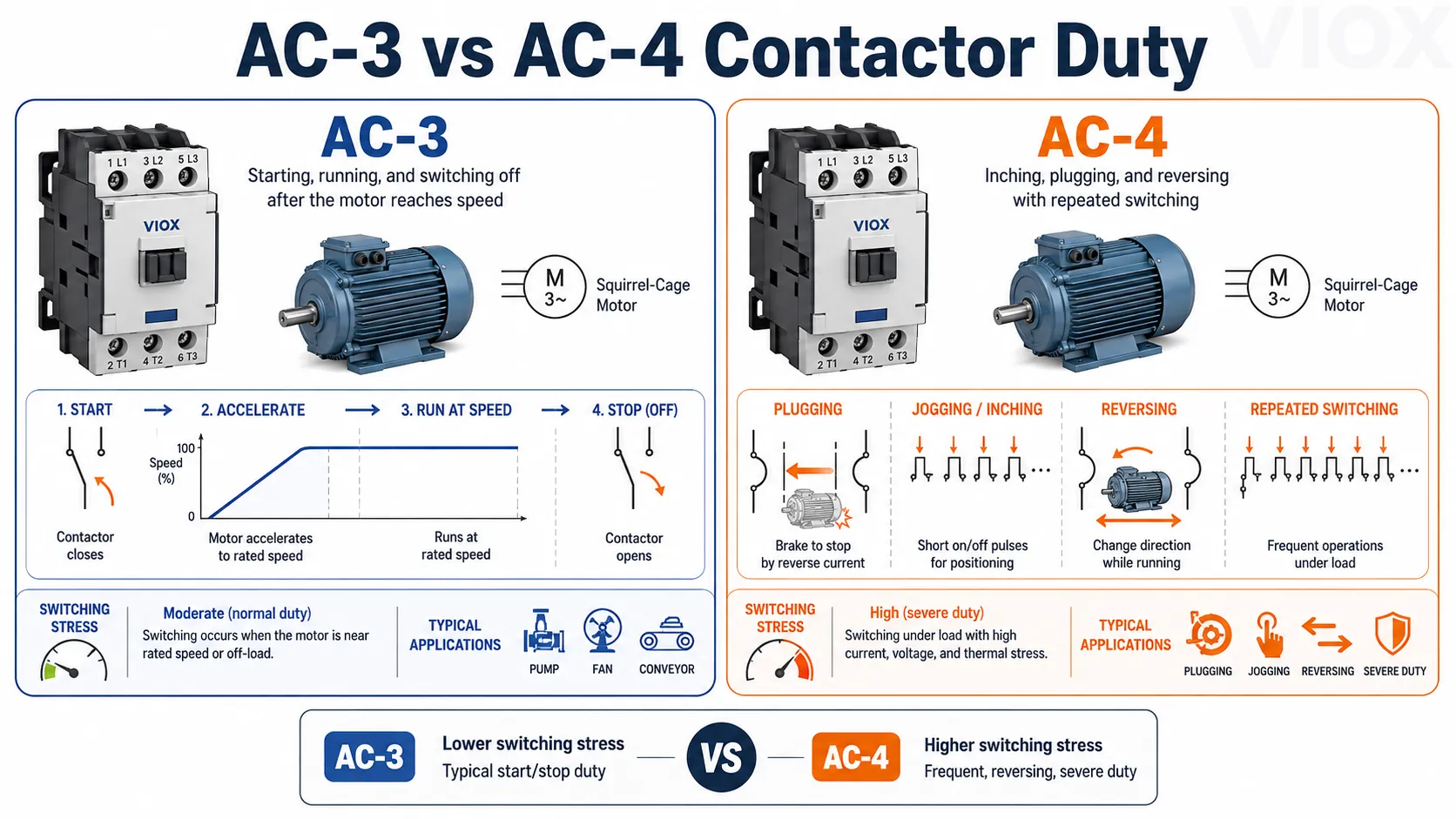
| Utilization category | Typical duty | What it means for selection |
|---|---|---|
| AC-1 | Non-inductive or slightly inductive loads | Resistive loads, not normal motor starting duty |
| AC-3 | Squirrel-cage motor starting and switching off after running speed is reached | Common duty for pumps, fans, compressors, conveyors |
| AC-4 | Starting, plugging, inching, reversing | Much more severe than AC-3; contactor may need to be larger |
| AC-15 | Control of AC electromagnetic loads | Auxiliary/control contacts, not main motor power contacts |
For standard direct-on-line motor switching, AC-3 is often the key contactor rating. For reversing, jogging, plugging, crane, hoist, or frequent inching duty, AC-4 or a more severe duty condition must be checked.
Do not select a motor contactor using only the AC-1 current printed on the device. AC-1 is for resistive or slightly inductive loads. A contactor with a high AC-1 rating may have a much lower motor rating under AC-3 or AC-4.
For VIOX product evaluation, see the AC Contactor product page.
Step 3: Check Contactor Voltage, Poles, and Coil Voltage
After choosing the motor duty rating, confirm:
- number of poles
- rated operational voltage
- motor current or kW rating at the actual voltage
- AC-3 or AC-4 rating
- making and breaking duty
- electrical endurance for the duty cycle
- mechanical endurance
- auxiliary contact needs
- coil voltage and control circuit type
Coil voltage is a frequent field mistake. The motor may be 400 VAC, but the control circuit may be 24 VDC, 110 VAC, or 230 VAC. The contactor coil must match the control circuit, not the motor power circuit.
Also check the application duty:
- standard pump or fan start/stop
- frequent cycling
- forward/reverse operation
- star-delta starter
- soft starter bypass
- VFD input or bypass contactor
- capacitor switching, if applicable
Each duty can change the proper contactor selection.
Step 4: Select the Overload Relay
Motors need overload protection because they can overheat under sustained overload, stalled rotor conditions, phase loss, or mechanical load problems.
An overload relay is usually selected by:
- motor nameplate full-load current
- overload relay adjustable current range
- trip class
- manual or automatic reset mode
- phase-loss sensitivity, if required
- compatibility with the contactor
- ambient compensation, if applicable
The overload setting should normally be based on the motor nameplate current and applicable local rules or manufacturer guidance.
Trip class matters
Trip class indicates how quickly the overload relay trips under specified overload conditions. Common classes include Class 10, Class 20, and Class 30 in many motor-control contexts.
| Trip class | Typical use |
|---|---|
| Class 10 | Standard motors with normal starting time |
| Class 20 | Loads with longer acceleration time |
| Class 30 | Heavy starting loads requiring longer acceleration |
Do not choose a higher trip class simply to stop nuisance tripping. If the motor cannot start without a high trip class, check starting method, load inertia, voltage drop, mechanical load, and motor suitability.
For a deeper guide, see Thermal Overload Relay Selection Guide and NEMA Class 20 vs IEC Class 10 Overload Relay Guide.
Step 5: Decide Between Overload Relay and MPCB
An MPCB, or motor protection circuit breaker, combines motor overload protection and short-circuit protection in one device, depending on the product design and ratings. It is often used in compact motor starter panels.
| Option | Best fit | Watch point |
|---|---|---|
| Contactor + overload relay + fuse/MCB/MCCB | Traditional motor starter, flexible coordination | Requires separate short-circuit protective device |
| MPCB + contactor | Compact motor feeders, machine panels, modular starters | MPCB must match motor current range and fault level |
| MCCB + contactor + overload relay | Larger motors, feeders with higher fault levels | MCCB settings must coordinate with starting current and overload relay |
| Fuse + contactor + overload relay | High fault-current limitation and strong coordination | Correct fuse class and replacement discipline required |
If you are choosing between overload relay and MPCB, see Thermal Overload Relay vs MPCB.
Step 6: Select the Short-Circuit Protective Device
Short-circuit protection is different from overload protection.
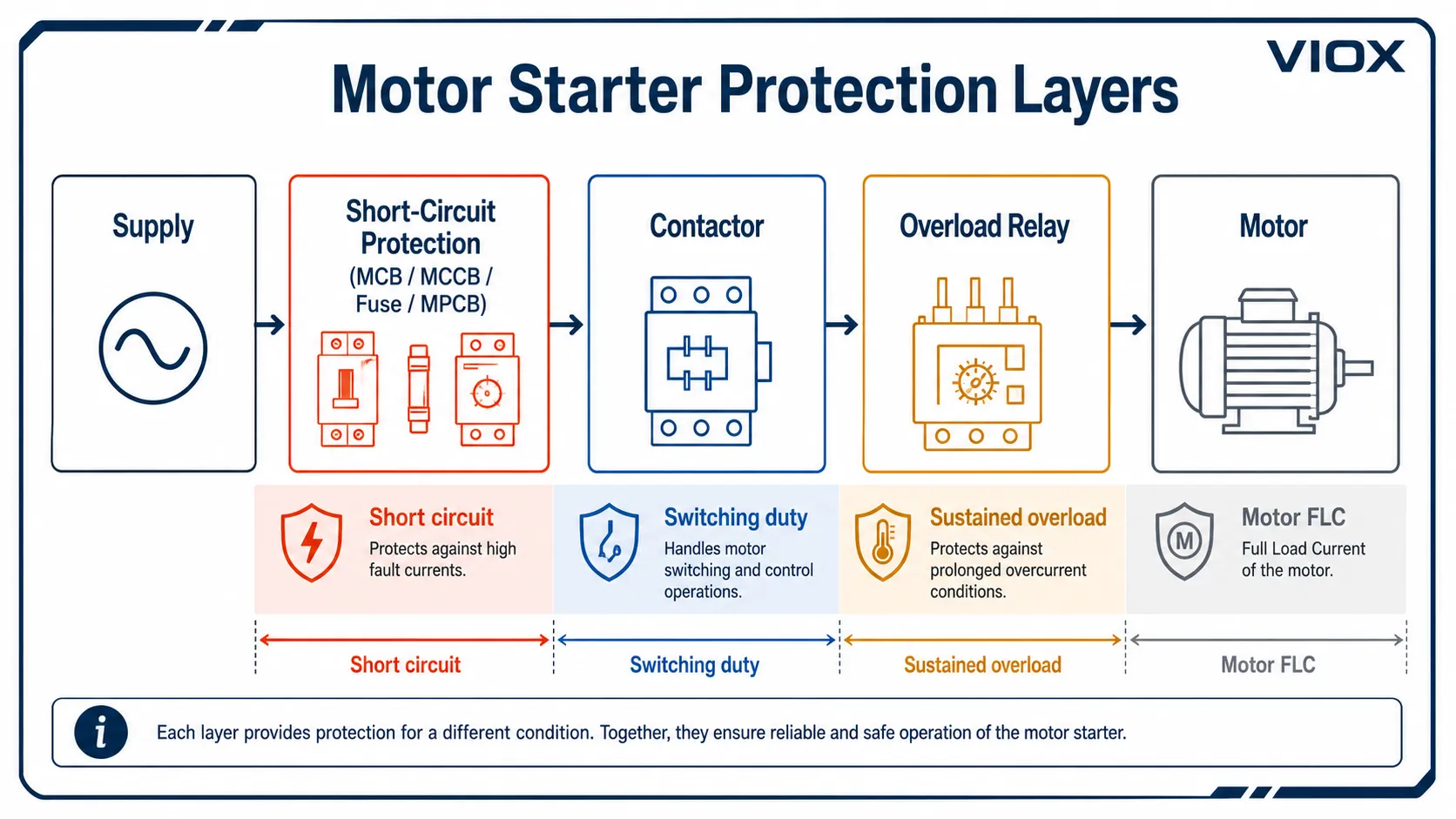
The short-circuit protective device may be:
- MCB
- MCCB
- MPCB
- fuse
- fused switch disconnector
It must be selected based on:
- supply voltage
- prospective short-circuit current at the installation point
- cable size and installation method
- motor starting current
- trip curve or trip settings
- coordination with contactor and overload relay
- applicable standard and local code
The key rule is:
Breaking capacity >= prospective short-circuit currentIf the available fault current at the panel is 10 kA, a breaker with only 6 kA breaking capacity is not suitable at that point.
For MCB/MCCB selection boundaries, see MCB Breaking Capacity: 6kA vs 10kA and Icu vs Ics vs Icw vs Icm Circuit Breaker Ratings.
Step 7: Do Not Set Instantaneous Trip Too Low
Motor starting current is commonly several times the full-load current. For direct-on-line starting, a rough field estimate is often:
Istart ≈ 5 to 8 x motor FLCThe exact starting current depends on motor design, supply voltage, load inertia, and starting method.
This is why setting instantaneous trip at a low fixed multiple of full-load current can be dangerous for motor circuits. It may cause immediate tripping during startup.
The correct approach is:
- Determine the motor starting current and starting time.
- Select a breaker or fuse that allows normal starting.
- Confirm it still clears short circuits safely.
- Coordinate it with the overload relay and contactor.
- Use manufacturer trip curves and coordination tables where available.
For small motor circuits, C-curve or D-curve MCBs may appear in some designs, but the final choice must be based on inrush current, cable protection, fault level, and local standard. Larger motors often require MCCBs, MPCBs, or fuses rather than ordinary final-circuit MCBs.
Step 8: Check Coordination Between Devices
Motor starter coordination means the short-circuit protective device, contactor, and overload relay work together safely under fault conditions.
Coordination questions include:
- Will the breaker or fuse clear a short circuit before dangerous damage occurs?
- Can the contactor withstand the let-through current and energy?
- Will the overload relay protect the motor without nuisance tripping?
- Does the selected combination match a tested manufacturer coordination table?
- Is the panel designed for the available fault current?
In IEC motor starter contexts, coordination is often discussed using coordination types. Do not claim a coordination type unless it is supported by manufacturer data for the exact device combination.
For broader motor starter architecture, see Types of Motor Starters Selection Guide.
Step 9: Selection Example for a 7.5 kW Motor
Assume:
- motor power: 7.5 kW
- voltage: 400 V three-phase
- estimated FLC: about 14-16 A, to be confirmed from nameplate
- application: standard pump
- starting method: direct-on-line
- duty: normal start/stop, not jogging
Contactor
Choose a contactor with an AC-3 motor rating suitable for the motor power/current at 400 V. Do not use the AC-1 rating as the selection basis.
Overload relay
Choose an overload relay whose adjustable range covers the actual motor nameplate current. Set according to the motor nameplate current and applicable rules. If the pump has normal starting time, a standard trip class may be suitable; verify against the real starting time.
Short-circuit protection
Choose an MCB, MCCB, MPCB, or fuse based on:
- available short-circuit current
- cable size
- starting current
- coordination with contactor and overload relay
- panel standard and local installation code
Do not choose the breaker simply because it has the same ampere value as the motor current. The breaker must allow motor starting and still protect the cable and circuit under fault conditions.
Coil voltage
If the control circuit is 24 VDC, choose a 24 VDC contactor coil even though the motor is 400 VAC. Coil voltage and motor voltage are separate selections.
Quick Selection Checklist
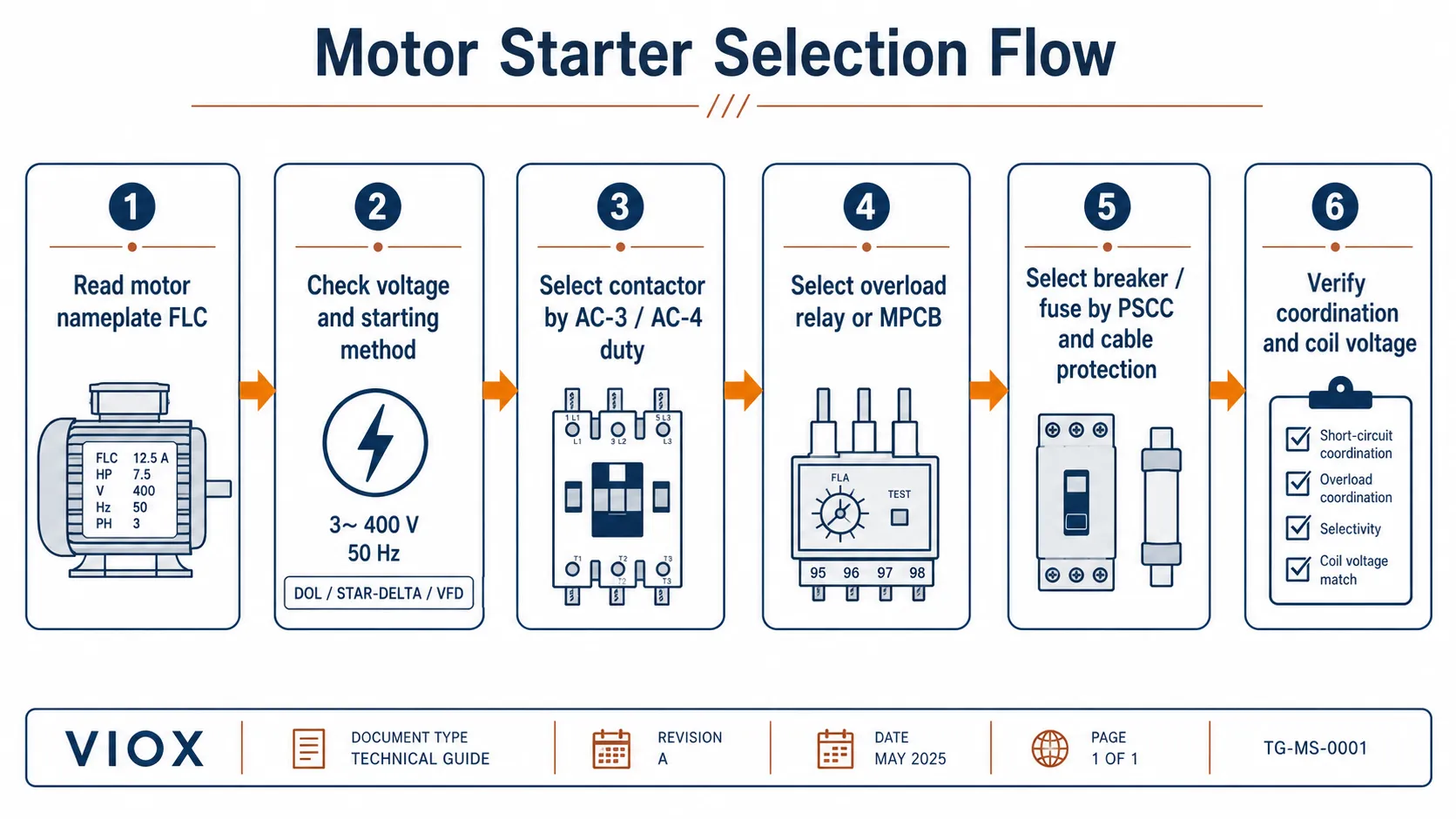
| Step | What to check | Why it matters |
|---|---|---|
| 1 | Motor nameplate full-load current | More accurate than kW estimate |
| 2 | Supply voltage and frequency | Affects current and product rating |
| 3 | Starting method | DOL, star-delta, soft starter, VFD |
| 4 | Contactor category | AC-3 for normal motor duty, AC-4 for severe duty |
| 5 | Overload relay range | Must cover motor FLC |
| 6 | Trip class | Must suit starting time and motor protection |
| 7 | Short-circuit device | Must match PSCC and cable protection |
| 8 | Coordination | Devices must work safely as a system |
| 9 | Coil voltage | Must match control circuit |
| 10 | Enclosure and environment | Heat, dust, vibration, and panel space affect reliability |
Common Selection Mistakes
Mistake 1: Selecting the contactor from AC-1 current
AC-1 is not the normal motor switching category. For most squirrel-cage motor applications, check AC-3. For reversing, inching, or plugging, check AC-4 or manufacturer guidance.
Mistake 2: Using motor kW without checking nameplate current
kW is useful for estimation. Nameplate current is the better basis for overload relay setting and final selection.
Mistake 3: Assuming the breaker protects the motor from all overloads
A breaker may protect against short circuit and feeder overload, but motor thermal overload protection often requires an overload relay, electronic overload, or MPCB.
Mistake 4: Setting short-circuit trip too low
Motor starting current may be several times full-load current. If the instantaneous setting or trip curve is too sensitive, the motor may trip during normal starting.
Mistake 5: Ignoring duty cycle
A pump starting a few times per day is different from a hoist, crane, reversing conveyor, or inching machine. Switching duty affects contactor selection.
Mistake 6: Ignoring fault level
A breaker with the right rated current may still be unsuitable if its breaking capacity is below the prospective short-circuit current.
Mistake 7: Mixing control voltage and power voltage
The motor may be 400 VAC, while the contactor coil may be 24 VDC or 230 VAC. Always check the control circuit.
FAQ
Can I select a contactor only by motor kW?
No. Motor kW gives a starting point, but final selection should use motor full-load current, voltage, utilization category such as AC-3 or AC-4, duty cycle, and manufacturer rating tables.
What is AC-3 contactor rating?
AC-3 is an IEC utilization category commonly used for squirrel-cage motor starting and switching off after the motor has reached running speed. It is the key rating for many standard motor contactor applications.
What is AC-4 contactor rating?
AC-4 covers more severe motor duty such as inching, plugging, and reversing. A contactor suitable for AC-3 may not be suitable for AC-4 at the same motor power.
Do I need an overload relay if I already have a circuit breaker?
Often yes. A general circuit breaker provides short-circuit and feeder protection, but motor overload protection usually requires an overload relay, electronic overload relay, or MPCB selected for the motor current.
What is the difference between an MPCB and overload relay?
An overload relay protects against sustained motor overload but usually needs separate short-circuit protection. An MPCB can provide motor overload and short-circuit protection in one device, if selected and rated correctly.
Can an MCB protect a motor?
An MCB may be used in some small motor circuits as part of the protection scheme, but it is not automatically a complete motor protection solution. Starting current, trip curve, cable protection, short-circuit capacity, and overload protection must all be checked.
How do I choose the breaker size for a motor?
Start with motor full-load current, cable size, starting current, and prospective short-circuit current. Then select a breaker, MPCB, MCCB, or fuse that allows normal starting, protects the cable, and has sufficient breaking capacity.
Why does my motor breaker trip during startup?
Common causes include starting current above the trip curve, low voltage, excessive load inertia, wrong breaker type, incorrect instantaneous setting, voltage drop, mechanical overload, or an unsuitable starting method.
Can I use a larger breaker to stop nuisance tripping?
Not without checking cable protection, motor protection, and fault clearing. Oversizing the breaker may hide the symptom while leaving the cable or motor under-protected.
What is the safest way to select a motor starter?
Use the motor nameplate current, application duty, starting method, short-circuit level, overload relay setting, contactor utilization category, and manufacturer coordination tables for the selected device combination.
Summary
Motor power is useful, but it is not enough. A reliable motor starter selection starts with full-load current, then checks contactor duty, overload protection, short-circuit protection, coordination, and control voltage.
For most low-voltage motor panels:
- select the contactor by AC-3 or AC-4 motor duty, not AC-1 current
- set overload protection from the motor nameplate current
- choose the short-circuit protective device from fault level, cable size, starting current, and coordination
- verify the complete starter combination, not just each device in isolation
For VIOX motor-control selection, review the AC Contactor, Thermal Overload Relay, and supporting guides on contactor vs motor starter, thermal overload relay selection, thermal overload relay vs MPCB, and contactor vs circuit breaker.